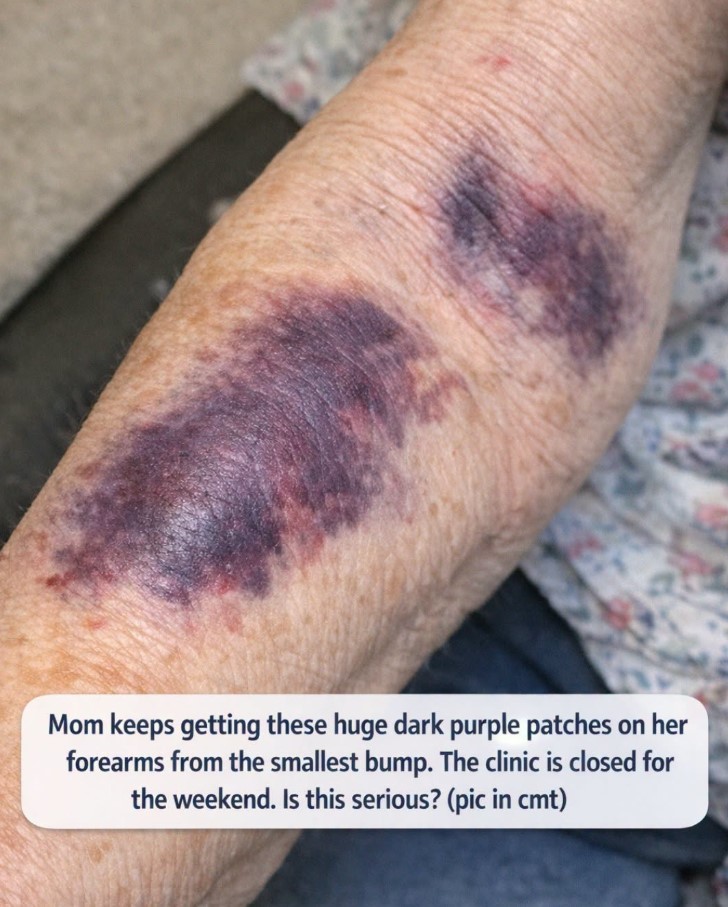
Seeing a large, dark purple bruise appear on your mother’s arm after what seems like the tiniest bump can be alarming. A light knock against a countertop, doorframe, chair, or shopping cart may leave behind a mark that looks far more serious than the injury itself.
The bruise might begin as a deep purple or reddish patch and gradually change color over the following days. It can become surprisingly large even when the original bump barely seemed noticeable.
For older adults, one possible explanation is senile purpura, also called actinic purpura. This common form of bruising is associated with aging skin and years of sun exposure. However, not every unexplained bruise should automatically be attributed to aging.
Certain medications, supplements, medical conditions, and problems affecting blood clotting can also make bruising easier.
So if the clinic is closed for the weekend, what should you do?
The first step is to look at the overall pattern—not just how dramatic the bruise appears.
What Does Senile Purpura Look Like?
Senile purpura typically appears as flat purple, reddish-purple, or maroon patches on areas such as the forearms and backs of the hands.
The marks can be surprisingly large. In some cases, they may measure several inches across, even though the injury that caused them was extremely minor.
A person might say, “I barely bumped my arm,” while the resulting bruise looks as though something much more serious happened.
That difference between the tiny injury and the dramatic appearance is one of the features commonly associated with age-related purpura.
The skin usually isn’t broken, and the area may not be particularly painful.
Over time, the color can change as the blood under the skin is gradually reabsorbed. A bruise may go from dark purple to reddish-brown and eventually take on greenish or yellowish tones before fading.
This process can take one to three weeks, particularly when the bruise is large.
Why Does It Happen More Often as We Age?
As people get older, the skin naturally becomes thinner.
The tissues underneath the skin also change, and there is less of the supportive collagen and elastic tissue that once helped protect the tiny blood vessels beneath the surface.
Think of the skin as a protective cushion.
When that cushion becomes thinner, even a relatively harmless bump can put enough pressure on small blood vessels to cause them to break.
Years of sun exposure can contribute as well. The outer forearms and hands are particularly exposed to sunlight, especially in people who spent many years gardening, driving, working outdoors, or doing other activities outside.
That is one reason these bruises often appear repeatedly on the same areas of the body.
Why Are the Forearms So Commonly Affected?
The forearms are exposed to countless small impacts during everyday activities.
You might bump your arm while reaching into a cupboard, carrying laundry, opening a door, moving furniture, getting something from the trunk of a car, or simply walking through a narrow space.
Most of these bumps are so insignificant that you don’t even remember them.
But when the skin and small blood vessels have become more fragile, the same ordinary contact can leave a noticeable bruise.
This is why a pattern of large, mostly painless purple patches appearing on the forearms after minor knocks can fit the typical appearance of senile purpura.
Still, the pattern needs to be considered alongside the person’s age, medications, other symptoms, and overall health.
Certain Medications Can Make Bruising Worse
Another important factor is medication.
Some medicines affect blood clotting or platelet function, which can make bruises larger or more frequent.
Examples include medications such as aspirin, clopidogrel, warfarin, apixaban, rivaroxaban, and dabigatran.
Long-term corticosteroid use can also contribute to thinner, more fragile skin.
Some supplements may increase the tendency to bruise in certain people as well, including fish oil, vitamin E, ginkgo, garlic supplements, and high-dose turmeric.
This does not necessarily mean that a medication or supplement is dangerous or should be stopped. It simply means that the full medication list is important when trying to understand why someone is bruising more easily.
Don’t Stop a Blood Thinner on Your Own
If your mother takes a prescription blood thinner and develops a large bruise, it can be tempting to think the medication should immediately be stopped.
That is something you should not do without medical guidance.
Blood thinners are often prescribed to reduce the risk of serious problems such as blood clots or strokes. Suddenly stopping one without instructions from a healthcare professional can carry its own risks.
Instead, make a note of the medication, the size and location of the bruise, when it appeared, and whether there was a known bump or injury.
Then discuss the bruising with her healthcare professional when the clinic is available.
When Does the Pattern Look More Reassuring?
A bruise is generally more reassuring when several features fit the typical pattern of age-related purpura.
For example, the marks may:
- Appear mainly on the forearms or backs of the hands
- Follow a minor bump or knock
- Be relatively flat
- Cause little pain
- Gradually change color and fade
- Occur while the person otherwise feels well
Older skin may also look thin or delicate, and previous healed bruises can sometimes leave pale or brownish marks behind.
The appearance can be dramatic without necessarily indicating a serious emergency.
However, appearance alone cannot determine the cause of bruising. New or unusual patterns should still be discussed with a healthcare professional.
When Should You Not Wait for the Clinic to Reopen?
This is the most important part of the situation.
Not every purple patch should simply be watched at home.
Seek prompt medical attention if bruising is occurring without any apparent injury, if numerous new bruises suddenly appear across the body, or if there are tiny red or purple pinpoint spots that do not fade when pressed.
Other warning signs include unusual bleeding from the gums, persistent nosebleeds, blood in the urine, black or tar-like stools, vomiting blood, fainting, severe weakness, confusion, chest pain, shortness of breath, or a severe headache.
A rapidly expanding and painful bruise is also a reason to seek medical attention sooner, particularly if the person takes a blood-thinning medication.
Significant swelling, reduced hand function, or a hand that becomes unusually cold or pale should also not be ignored.
What Can You Do Over the Weekend?
If the bruise followed a minor bump, looks like an ordinary bruise, and your mother otherwise feels well, simple care may be appropriate while waiting to speak with her clinician.
A cool pack wrapped in a thin towel can be applied for about 10 to 15 minutes at a time during the first day.
Do not put ice directly against the skin, particularly when the skin is thin and fragile.
If the area is uncomfortable, gently elevating the arm while resting may provide some relief.
It is also helpful to protect the area from additional bumps while it heals.
A soft, long-sleeved shirt can provide a small amount of protection, and moving sharp furniture edges or other obstacles around the home may reduce the chance of another injury.
What Should You Avoid?
It is best not to aggressively massage a fresh bruise.
Deep rubbing can irritate the injured blood vessels and potentially increase discomfort.
Very hot compresses should also be avoided immediately after the injury.
Be careful with adhesive tape as well. Older, fragile skin can tear when tape is removed.
Pain medications deserve some attention too. Aspirin and certain anti-inflammatory medicines, including ibuprofen and naproxen, can contribute to bruising in some people.
If pain relief is needed, follow the advice of the person’s healthcare professional and the medication’s instructions rather than changing medicines based on the bruise alone.
How Long Should the Bruise Take to Fade?
Age-related purpura can take time to disappear.
Many patches gradually fade over approximately one to three weeks.
The color may actually appear worse before it improves because blood can spread slightly beneath the skin during the first day or two.
A dark purple patch may eventually become brownish, greenish, or yellow before disappearing.
Sometimes a faint brown mark remains after the main bruise has cleared.
One useful idea is to take a photograph of the bruise and record the date. Taking another photograph a day or two later can make it easier to determine whether the patch is staying the same size, expanding, or gradually improving.
Can Future Bruising Be Reduced?
It may not be possible to prevent every bruise, but a few simple changes can reduce the number of minor injuries.
Soft, protective clothing can help shield fragile forearm skin.
At home, look for places where the arms repeatedly bump into furniture. A sharp table edge, narrow walkway, or laundry basket can become a source of repeated minor injuries.
Making small changes to the home environment can therefore make a surprisingly large difference.
Sun protection is also important for limiting additional sun damage. Using broad-spectrum sunscreen with an SPF of 30 or higher on exposed areas can help protect the skin when spending time outdoors.
Keeping the skin moisturized can also support the skin barrier, although moisturizer cannot completely prevent age-related bruising.
When Should You Mention It to Her Doctor?
Even if the bruises look consistent with senile purpura, it is worth mentioning them at a routine medical appointment if they are new, becoming more frequent, or getting noticeably larger.
A healthcare professional may review her medications and supplements and consider other factors that can influence bruising.
Depending on the situation, they may also decide that blood tests are appropriate to check things such as blood cell counts or clotting.
It is particularly important to mention bruising if it begins appearing in unusual areas such as the trunk, upper arms, thighs, or face without an obvious injury.
Other symptoms such as unusual fatigue, unexplained weight loss, or repeated infections should also be reported.
Not Every Purple Patch Is Senile Purpura
Although age-related purpura is one possibility, it is not the only explanation for purple marks on the skin.
A regular bruise from a more significant injury can look similar.
Other possibilities can include skin tears, certain blood or platelet disorders, clotting problems, liver-related conditions, medication effects, and some inflammatory conditions affecting blood vessels.
For example, cellulitis generally produces an area that is red, warm, swollen, and tender and may be accompanied by fever rather than presenting as a typical flat purple bruise.
This is why it is important not to diagnose the cause based solely on color or appearance.
So, Is It Serious?
If your mother is older, the patches are mainly on her forearms or hands, they appear after very minor bumps, she feels well otherwise, and there are no signs of unusual bleeding, this pattern can be consistent with senile purpura.
In that situation, it may not represent an emergency.
However, that does not mean every bruise should automatically be dismissed as part of aging.
If the bruises are appearing without injuries, spreading rapidly, occurring throughout the body, or accompanied by other concerning symptoms, medical attention should be sought sooner.
And if she takes a blood thinner, a rapidly expanding bruise deserves particular attention.
The goal is not to panic over every bruise, but also not to ignore a pattern that is clearly different from what is normal for her.
A Simple Weekend Check
If you’re waiting for the clinic to reopen, you can keep track of a few useful details.
Note the size of the bruise and whether it is growing.
Think about whether your mother remembers bumping the area.
Check her current medications and supplements.
Look for other unusual bruises or signs of bleeding.
Most importantly, pay attention to how she feels overall.
If she is feeling normal and the bruise behaves like a typical bruise—gradually changing color and becoming smaller—make a note to discuss it with her clinician.
If new warning signs appear, don’t simply wait for the clinic to reopen.
Conclusion :
Large purple bruises can look frightening, especially when they appear after an injury so minor that you can barely remember it happening.
In older adults, fragile skin and years of sun exposure can contribute to senile or actinic purpura, a common type of bruising that often affects the forearms and hands. These patches can be surprisingly large and colorful while causing relatively little discomfort.
Still, it is important to look at the complete picture.
Medications that affect clotting, long-term steroid use, certain supplements, and other medical conditions can contribute to easier bruising. New or unusual bruising deserves attention, particularly when it occurs without an obvious injury.
The reassuring news is that a typical age-related bruise often fades gradually over the course of one to three weeks.
The important thing is knowing when the pattern no longer looks typical.
If there is unexplained widespread bruising, unusual bleeding, rapidly expanding or painful patches, severe weakness, breathing problems, fainting, or other concerning symptoms, it is safer to seek medical attention rather than waiting.
And if the bruising keeps happening, even without emergency warning signs, bring it up at the next medical appointment.
A dramatic-looking bruise is not automatically a medical emergency—but a change in the usual pattern is something worth taking seriously.