
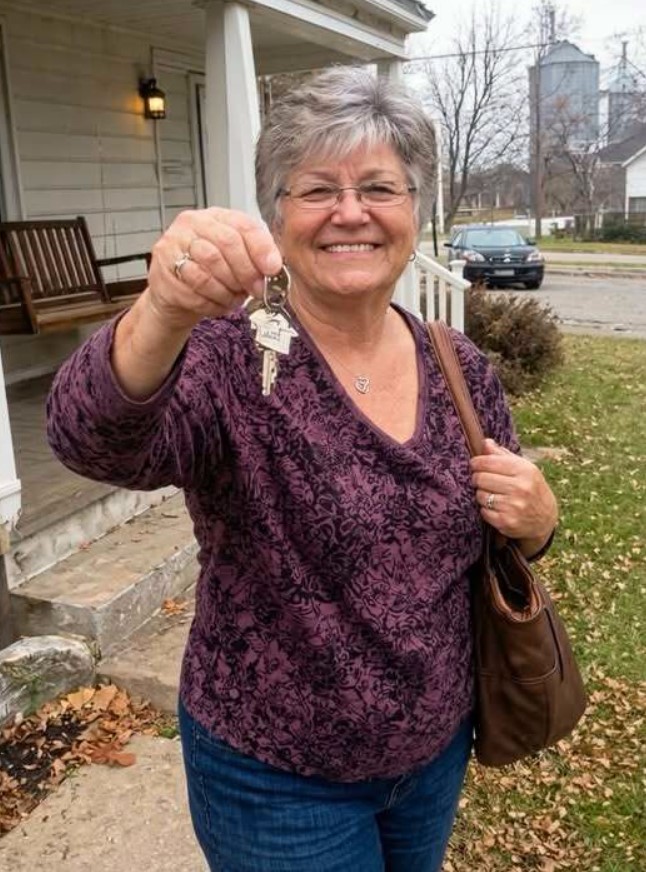
My daughter offered to let me stay in her basement for $800 a month from my Social Security check, plus four days of babysitting every week to “earn my keep.” I thanked her politely, then found myself a little two-room rental near the grain elevator for just $550.
At sixty-seven, I had learned that sometimes the most important decisions are the ones you make quietly, without arguing or asking anyone for permission.
I never imagined that choosing a small house of my own would uncover secrets my husband had kept from me, expose financial decisions my daughter regretted, and force our entire family to reconsider what love and responsibility really meant.
It all began on a Saturday afternoon at my daughter’s kitchen table.
The $800 Basement Room
Michelle’s husband, Todd, pushed a sheet of notebook paper toward me. In the middle of the page, he had written one number in thick black ink.
$800.
He had circled it twice.
“That covers your room, utilities, and part of the groceries,” Michelle explained. “And you’d watch the children four days a week. That way, you’re contributing something, Mom.”
Contributing something.
I sat quietly, looking at the number.
I was sixty-seven years old. I had raised Michelle on the modest income my husband, Dale, earned working as a hired farmhand. For twenty-two years, I had worked in the accounts department at the local lumberyard, balancing figures, checking invoices, and making sure every dollar was accounted for.
I knew how to calculate what I could afford.
My monthly Social Security payment was $1,640. Todd’s proposed rent would consume almost half of it before I paid for anything else.
In return, I would have a basement bedroom with one small window, a dehumidifier humming in the corner, and the responsibility of looking after two young children for most of the working week.
My husband had been gone for nearly two years. The farmhouse where we had lived together belonged to the family who employed him. They had generously allowed me to remain there after his death, but their son was returning to work the land with his wife and new baby.
I had until November first to move.
I understood their situation. They needed their house, and I couldn’t expect them to postpone their plans forever.
But I had hoped my daughter might offer me a little kindness during such a difficult transition.
Instead, Todd was calculating my value as though I were another household expense.
“Could I see the room again?” I asked.
He led me down thirteen stairs into the basement. The air smelled damp, and the walls felt cold despite the mild weather outside.
A dehumidifier stood near the bed, making a constant rattling sound. The little window sat high on the wall, allowing only a narrow strip of daylight into the room.
My four-year-old granddaughter, Sadie, followed us downstairs.
“Grandma, are you going to sleep underneath the house?” she asked.
I knelt beside her and smiled.
“Maybe, sweetheart. We’ll see.”
I wanted to say no immediately. I wanted to tell Michelle that I had spent my entire life caring for other people and that I deserved more than a basement room tied to rent payments and childcare duties.
But she was my only daughter.
I didn’t want a disagreement to become a family war, especially when I was already facing the uncertainty of leaving the only home I had known for decades.
So I thanked her and said I would think about it.
I folded Todd’s paper and placed it in my handbag.
That was when I made my decision.
A Little House of My Own
On my way home, I stopped at the feed store. For several weeks, a handwritten notice beside the cash register had caught my attention.
Small house available. Two rooms and bathroom. Ask Brandt.
I asked Mr. Brandt whether the property was still vacant.
He smiled and offered to show it to me.
The house stood on a quiet street behind the grain elevator. Its white siding needed a little attention, and the porch swing had seen better days, but there was a proper front door, a small kitchen, and a bedroom with a window that looked out toward the street.
There was even a little patch of ground where I could grow flowers.
Harvest season had left a fine layer of corn dust across the porch and windowsills. The place wasn’t fancy, but it felt peaceful.
Mr. Brandt scratched his head.
“It’s a simple house, Judy. Nothing special.”
I looked at the front entrance.
“It’s got its own door,” I said. “That’s enough for me.”
The rent was $550 a month, with electricity charged separately.
I could afford it.
I wrote a check for the deposit on the hood of my Buick. Mr. Brandt handed me two keys attached to a small metal ring.
One opened the front door. The other opened the back.
I stood there for a moment, holding them in my palm.
After decades of sharing a home with my husband and years of living in a house that belonged to someone else, I finally had keys to a place I had chosen entirely for myself.
It was a small thing, perhaps, but I felt a kind of freedom I hadn’t expected.
I moved my belongings in gradually, arranging my dishes in the cupboards and placing Dale’s photograph on the living room shelf. I bought inexpensive curtains and a secondhand lamp. The porch swing became my favorite place to sit in the evenings.
I didn’t need much.
I needed a safe home, a manageable rent, and the freedom to decide how I spent my days.
For nine days, I kept my decision from Michelle. I knew I should have told her immediately, but I was afraid of hurting her feelings.
Then Todd drove past the little house on his way to work and recognized my Buick.
That evening, Michelle called.
“So you’d rather give your money to a complete stranger than help your own family?”
I took a breath before answering.
“Michelle, I am helping myself find a place to live.”
“You could have stayed with us.”
“I could have, but the arrangement didn’t feel right to me.”
“You’d have had a roof over your head.”
“And I would have paid $800 every month while caring for the children four days a week.”
She fell silent for a moment.
Then I said something I had been thinking about since our conversation at her kitchen table.
“I’d rather be your mother than somebody paying rent to you.”
The line went quiet.
Then she hung up.
For the next ten days, I heard nothing from her.
No phone calls. No messages. Not even a photograph of the grandchildren.
Every evening, I sat on my porch swing and watched grain trucks line up near the elevator. I enjoyed the quiet, but I missed Sadie and her little brother, Ben, terribly.
Some nights, I wondered whether my decision had cost me more than I could afford emotionally.
Still, whenever I looked at the keys on my kitchen counter, I reminded myself why I had chosen the house.
I had not rejected my family.
I had simply refused to surrender my independence.
Then, on a Thursday evening, a pickup stopped outside.
A door slammed, and Michelle climbed out of the passenger seat. Her eyes were swollen, and she looked as though she had spent hours crying.
Todd followed her toward my porch, carrying a yellow legal pad.
The pages were covered with figures and handwritten notes.
I opened the screen door before they could knock.
Todd looked directly at me.
“Judy, I owe you an apology. I’m the one who came up with that $800 figure. Michelle didn’t.”
He entered the house, placed the legal pad on my kitchen table, and turned it toward me.
“There’s something here you need to read.”
The Numbers That Changed Everything
The first thing I noticed was that Todd’s handwriting looked unsteady.
The second was that Michelle stood behind him with both hands pressed against her stomach, just as she used to when she was a little girl and knew she had done something wrong.
I pulled out two chairs.
“Sit down, both of you.”
Neither moved.
“Please,” I added. “I’m sixty-seven years old. I shouldn’t have to ask grown people twice to sit at my kitchen table.”
Todd sat first. Michelle followed reluctantly.
At the top of the legal pad, Todd had written three headings: HOUSE, MONEY, and CHILDREN.
Beneath them were household expenses, bank balances, and a list of payments.
I recognized the $800 figure immediately.
Then I saw another entry: the estimated cost of hiring someone to care for the children.
Todd had calculated how much they would save by having me babysit instead of paying for outside childcare.
I looked up.
“Why is the cost of childcare written on a paper asking me to pay rent?”
He rubbed his forehead.
“I thought it was a fair arrangement.”
“And what did you think my time was worth?”
He had no answer.
Michelle began crying.
“I thought it would make everything easier,” she said. “The children would have you nearby, I could take more shifts at the clinic, and we’d all be together.”
“Easier for whom?” I asked.
She looked down at her hands.
I turned another page.
Near the bottom, one figure had been circled repeatedly.
$18,400.
Beside it were the words past due.
“What is this?”
Todd hesitated.
“It’s a business debt.”
He had been working at the plant while trying to establish a small repair business from a rented garage. Dale had once helped him purchase tools, and Todd had spent years talking about growing the business into something that could support his family.
I hadn’t known how badly things had deteriorated.
“How long have you owed this money?” I asked.
“Eleven months.”
“And you thought charging me rent would solve the problem?”
“Not exactly,” he admitted. “I thought it would help us keep everything from falling apart.”
I looked at the figures again.
Desperation might explain why he had made a poor decision, but it didn’t explain why he had treated my retirement income as something the family could simply claim.
Then I turned another page.
My husband’s name was written near the top.
Dale Mercer.
Below it was a date from the previous spring and an amount that made my heart skip.
$32,000.
I read it twice.
“Why is Dale’s name on this?”
Todd stared at the table.
“Before he died, your husband lent me money to help establish my repair business. I found the paperwork later.”
I gripped the edge of the table.
“Dale lent you thirty-two thousand dollars?”
Todd nodded.
“He told me to repay him. He said he didn’t want you worrying about it until I had the business running properly.”
My husband had always been generous. He had helped neighbors buy seed, paid for tractor repairs when a young farmhand couldn’t afford them, and given money to people who were struggling.
But thirty-two thousand dollars was a considerable amount.
I had never known about the loan.
“Where did Dale get that money?”
“From selling equipment and using savings he had kept before you married.”
I thought about my husband, who had always been careful with money but had also been stubborn enough to believe he could solve everyone else’s problems himself.
Todd turned the page again.
There was a bank record and a note written in Dale’s unmistakable handwriting. The message explained that the money was a loan, not a gift, and that I should be told about it if he died before Todd repaid it.
My eyes blurred.
I had spent nearly two years learning to live without seeing Dale’s handwriting. Now his words were sitting on my kitchen table, revealing a secret he had never shared with me.
“How much have you repaid?” I asked.
“Six thousand dollars.”
“So you still owe twenty-six thousand.”
He nodded.
“And instead of telling me the truth, you decided I should pay you to live in your basement?”
Todd lowered his head.
“I was ashamed.”
I almost felt sorry for him.
Then I noticed another page.
It contained a list of Dale’s belongings, along with a record of items Todd had taken from the farmhouse after my husband died.
One entry had been crossed out so aggressively that the paper was nearly torn.
A blue metal cashbox.
I remembered it immediately. Dale had kept old receipts, bank papers, and important documents inside that box. After his funeral, I had searched for it, but Todd had insisted he had never seen it.
Now I looked at him.
“Where is the cashbox?”
He swallowed.
“I gave it to Michelle. There was a letter inside addressed to her.”
“Why didn’t either of you tell me?”
Neither answered.
I stood.
“Get your coats. I want you both to leave.”
Michelle looked up, crying.
“Mom, please don’t shut me out.”
I looked at my only daughter, the child I had raised through fevers, scraped knees, school concerts, and all the ordinary difficulties of growing up.
“I haven’t shut you out, Michelle. I’m asking you to stop deciding what I can bear to know.”
They left quietly.
I locked the door behind them, returned to the kitchen table, and read every remaining page.
For the first time, I understood that the $800 proposal was only the beginning.
The Letter My Husband Left Behind
The next morning, Michelle arrived carrying the blue cashbox.
She set it on the kitchen table and remained standing.
“I should have brought this sooner,” she whispered.
“Yes,” I replied.
Inside the box were old tax returns, bank statements, receipts, and several envelopes held together by a worn rubber band.
One envelope had my name on it.
I opened it with trembling fingers.
Dale had written the letter several months before he died. He explained that he had lent Todd money and regretted not discussing it with me first. He had wanted to help our son-in-law succeed, but he acknowledged that his decision affected both of us.
He asked me not to allow the loan to destroy my relationship with Michelle.
I put the letter down and wiped my eyes.
Even in death, Dale was asking me to protect our family.
But another document lay behind the letter.
It was a bank statement from an account I had never seen before.
The balance was $47,860.
I checked the account details carefully.
The account was in my name.
I looked up at Michelle.
“Do you know about this?”
She nodded.
“When did you find out?”
“After Dad died.”
“How?”
She took an old phone from her purse. Its screen was cracked, and she held it carefully in both hands.
“Dad left me a recording. I should have told you about it.”
She pressed play.
After a brief burst of static, I heard Dale’s voice.
He sounded tired, but I recognized him immediately.
He explained that he had been saving money for years, setting aside earnings from side jobs, equipment sales, and other small sources of income. He had opened the account in my name because he wanted me to have choices if he died before me.
He wanted me to be able to find a home, pay for repairs, and handle emergencies without depending on anyone else.
Then he said something that made me sit upright.
The money he had lent Todd was separate from my savings. He specifically warned Michelle not to use my account to settle Todd’s debt.
The recording ended.
I sat in silence, listening to the quiet hum of my refrigerator.
My husband had spent years preparing for a future in which he would no longer be there to protect me. He had wanted to give me independence, yet he had kept the plan secret because he hoped to surprise me.
His intentions had been loving, but his silence had left me vulnerable to the very situation he had tried to prevent.
“Why didn’t you tell me?” I asked Michelle.
She wiped her cheeks.
“I was afraid you’d be angry with Dad. I thought you might never forgive him for keeping the money secret.”
“He did keep a secret from me.”
“I know.”
“And you kept one, too.”
She nodded.
I told her I would visit the bank alone.
She offered to accompany me, but I declined. I needed to understand my finances without anyone else speaking for me or deciding what I should do.
Michelle accepted my answer and left.
That Monday, I visited the bank and met with the branch manager. She confirmed that the account belonged solely to me and that Dale had arranged for me to receive the records after his death.
Then she showed me something else.
A transfer of $12,000 had been made from my account into Todd’s business account several months earlier.
The authorization carried my name.
But the signature was not mine.
I had signed thousands of invoices and payroll documents during my years at the lumberyard. I knew the shape of my own handwriting.
Someone had forged it.
The manager explained that the bank had already placed a hold on further transfers after Michelle contacted them with concerns about unauthorized activity.
I asked for copies of every document.
As I drove home, I began to understand why Todd had been so determined to have me move into his basement. He had known I might eventually search through Dale’s papers and discover the account.
The rent proposal had not simply been an attempt to cover household expenses.
It had also been a way to keep me close while he tried to manage a problem he didn’t want me to discover.
But there was another question.
Why had Michelle contacted the bank?
And what exactly had she known?
The Second Transfer
I called Michelle and asked her to come to my house.
When she arrived, I placed the bank documents on the table.
Her face went pale.
“You knew about the twelve thousand dollars,” I said.
She began crying.
“I knew Todd was trying to borrow money. I didn’t know he had forged your signature.”
“How did you know about the transfer?”
She looked away.
“Because I helped him get the money.”
I stood so quickly that my chair scraped the floor.
“You helped him take money from me?”
“I thought he was borrowing it,” she said. “His business was failing. The lender was threatening to take his tools, and I was afraid we would lose everything.”
She admitted that she had remembered Dale’s account and had persuaded herself that the money could be borrowed temporarily and repaid before I needed it.
She had convinced herself that she was saving her family.
“You were risking mine,” I told her.
She nodded through her tears.
Then she handed me a letter Todd had written to her shortly before he proposed the basement arrangement.
In it, he expressed concern that I might discover the account and visit the bank before he had time to explain the transfer. He also suggested that having me move into their basement would give them more time to manage the situation.
I read the letter twice.
There was no misunderstanding left to clear up.
I contacted the sheriff’s office and reported the suspected financial fraud. I knew that my decision would have consequences for Todd and Michelle, but I could not allow my love for them to become an excuse for dishonesty.
Later that afternoon, Todd came to see me.
He admitted that he had forged my signature on the $12,000 transfer.
He said he had been desperate and had intended to repay the money when his business recovered.
“Desperation doesn’t give you the right to sign another person’s name,” I told him.
He lowered his head.
“I know.”
I demanded a proper record of every amount taken and a repayment plan that my own attorney could review.
I also made it clear that he could no longer make decisions about my money or my home.
“I am not trying to destroy your life,” I told him. “But I won’t sacrifice mine to keep you comfortable.”
He left with the documents he needed to discuss the situation with his attorney.
For the first time in weeks, I felt that the truth had finally begun to emerge.
Then the sheriff called again.
The investigation had uncovered another transfer.
This one was for $8,500, and it had been sent to a personal account belonging to Michelle.
The authorization carried my forged signature, too.
I drove straight to my daughter’s house.
The Truth Michelle Had Hidden
Michelle opened the door before I could knock a second time.
Sadie was sitting on the living room rug, arranging plastic farm animals into rows. Ben was asleep on the sofa beneath a knitted blanket.
I held up the bank document.
“Eight thousand five hundred dollars.”
Michelle’s face changed immediately.
She knew what I was talking about.
“Did you take this money?” I asked.
She sat down slowly.
“Yes.”
The answer was quiet, but it was clear.
I asked her why.
She explained that the family had been struggling for months. Todd’s business had brought in less money than expected, her hours at the clinic had been reduced, and their mortgage payments had fallen behind. When the furnace broke, they had relied on credit cards and used most of their remaining savings to cover basic expenses.
She had been terrified of losing the house.
“Why didn’t you tell me?” I asked.
“Because I knew you’d ask questions. I didn’t want you to know how badly we’d messed things up.”
“So you forged my signature instead?”
She nodded, tears running down her face.
She admitted that she had transferred the money herself because she believed she could replace it before I discovered what she had done.
She had told herself that she was protecting her family.
But she had used money that Dale had deliberately saved to protect me.
I thought about the basement room, the rent, and the four days of childcare they expected me to provide. I had believed the proposal was simply unfair. Now I understood that it was connected to a much larger effort to keep their financial troubles hidden.
“Was the basement arrangement your idea?” I asked.
“Not at first,” she replied. “Todd wanted you to move in because the money would help us. But I agreed because I wanted you close. I wanted the children to have you around, and I thought it would help me work more hours.”
“And when I found my own house?”
She began crying harder.
“I felt abandoned.”
I stared at her.
“You felt abandoned because I chose to live in my own home?”
“I know how selfish that sounds,” she whispered. “I had spent so long thinking you would always help me that I forgot you were a person who might need help yourself.”
For a moment, I couldn’t speak.
I remembered all the times I had asked whether she was managing at work, whether the children were well, and whether she needed anything. She had always assured me that everything was fine.
I had believed her because I wanted to believe her.
“Michelle, when your father died, I thought learning to live without him would be the hardest thing I ever faced,” I said. “I was wrong. The hardest part has been learning how to be your mother when you no longer need me in the same way.”
She looked up at me.
“I do need you.”
“You need me to be your mother. That is different from needing me to pay your bills.”
She wiped her face.
“I know.”
I took a breath.
“I won’t lie to the sheriff for you. I won’t pretend I authorized those transfers, and I won’t give you money to make this disappear.”
She nodded.
“But I will listen when you tell me the truth. I will love you while you face the consequences. And I will not let you convince yourself that one terrible decision means you can never become a better person.”
She asked whether I could forgive her.
“Not today,” I answered honestly. “But I haven’t stopped loving you.”
Then I hugged her.
For a few moments, she clung to me as tightly as she had when she was little.
When we stepped apart, I told her that she and Todd needed to meet with their attorneys, cooperate with the investigation, and make a realistic plan to repay what they had taken.
They might have to sell their house if they could no longer afford it.
“The children need a safe home,” I explained. “They need parents who tell the truth. They don’t need a house that costs more than their parents can afford.”
For once, Michelle didn’t argue.
Learning to Live With the Consequences
The following weeks were difficult for everyone.
Todd’s repair business closed. He sold his equipment, paid what he could toward the debt, and returned to full-time work at the plant.
The investigation confirmed that the transfers had been made without my permission. Todd faced legal consequences for forging my signature, while Michelle’s cooperation and admission of responsibility helped her attorney negotiate a resolution that included restitution, financial counseling, and probation.
They were not excused from responsibility simply because they were family.
I hired an attorney of my own, and the bank recovered part of the money. The remaining amount became part of a formal repayment agreement. Todd and Michelle agreed to make monthly payments from their wages.
My attorney explained every document before I signed anything.
For the first time since Dale’s death, I felt that I was genuinely in control of my financial life.
The savings account had been built slowly over twelve years. Dale had intended it to give me choices, and despite the money that had been taken, I still had enough to keep my little house, maintain an emergency fund, and live without depending on my daughter.
It wasn’t a fortune.
But it was mine.
Michelle and Todd eventually sold their house before foreclosure proceedings could begin. They moved into a smaller rental closer to the plant and the clinic.
The children adjusted more easily than the adults.
Sadie missed her old bedroom, but she enjoyed having a small patch of grass where she could plant flowers. Ben was delighted that the new kitchen had a cupboard low enough for him to reach the cereal.
Michelle took extra shifts at the clinic, and Todd concentrated on rebuilding his savings.
They were tired, embarrassed, and often frightened. But they were finally facing their circumstances honestly.
I began visiting them once a week.
At first, Michelle treated every visit as though it were a test she might fail. She apologized repeatedly, asked whether I was comfortable, and offered me tea as though I were a guest she was afraid to offend.
One afternoon, I took her hand.
“You don’t have to earn every minute I spend with you.”
She looked surprised.
“I don’t?”
“No. But you do have to be honest with me.”
She nodded slowly.
“I can do that.”
“Then start there.”
Our relationship didn’t heal overnight. Trust returned in small pieces: an honest conversation, a promise kept, a bill discussed before it became a crisis.
Sometimes I still remembered the $800 written on Todd’s paper. Sometimes I remembered the damp basement and the way Michelle had said I would be contributing something.
Those memories continued to hurt.
But I was learning that forgiveness didn’t require me to forget, and loving someone didn’t mean giving them control over every part of my life.
The Drawing That Made Me Cry
In early December, the first snow arrived.
I was sweeping corn dust from my porch when I heard Sadie’s voice calling from the sidewalk.
“Grandma!”
She came running toward me in her red coat, her boots crunching through the thin snow. Michelle followed with a paper bag, while Todd carried Ben on his shoulders.
I opened the screen door.
“What are you all doing here?”
Sadie held up a folded sheet of paper.
“We made you something!”
Inside was a drawing of a little white house with a porch swing. Four stick figures stood in front of it, and a fifth figure stood on the porch.
The fifth figure was me.
Above the house, Sadie had written three words in uneven letters.
GRANDMA’S HOME.
I swallowed hard.
“It’s beautiful, sweetheart.”
She beamed.
“Mommy said we have to knock before we come inside now.”
I looked at Michelle.
She smiled a little.
“We thought it was a good rule to teach the children.”
“It is,” I said.
Todd cleared his throat and lifted the paper bag.
“We brought supper. Michelle made chicken and dumplings.”
I looked at the food, then at their faces.
There was no legal pad, no list of expenses, and no expectation that I would provide anything in return.
There was simply a family standing on my porch, waiting to be welcomed inside.
“Come on in,” I said.
My little kitchen was crowded with winter coats, children’s laughter, and the smell of warm food. Ben knocked over his cup, Sadie insisted on sitting beside me, and Todd apologized for tracking snow onto the floor.
Michelle laughed when I handed her a dish towel.
For a little while, we were simply a family having supper.
After the children finished eating, Michelle helped me wash the dishes. We stood together at the sink, one washing and the other drying.
“Mom?” she asked.
“Yes?”
“I’ve been thinking about Dad’s letter.”
I waited.
“He wanted you to have a home where you could make your own choices. I think he understood something I didn’t.”
“What was that?”
She turned off the tap.
“That being family doesn’t mean you belong to us. It means we have to respect that you belong to yourself.”
My eyes filled with tears.
“Your father would have liked that.”
She nodded.
“I wish I’d understood it sooner.”
“So do I.”
For a moment, we stood quietly beside the sink.
Then she picked up another plate.
“I don’t expect you to forget what I did,” she said.
“Good.”
She gave a sad little smile.
“But I hope someday you can trust me again.”
I looked at the daughter I had raised, the woman who had made terrible decisions, and the person who was finally trying to change.
“Trust isn’t something I can give you all at once,” I told her. “You’ll have to show me.”
“I will.”
I believed she meant it.
That was enough for that evening.
Two Years Without Dale
The following March marked two years since Dale’s death.
I went to the cemetery alone that morning, carrying a small bunch of daffodils from the grocery store. The ground was still cold, and the grass around his headstone had only just begun to turn green.
I placed the flowers beside his name and stood there for a long time.
I told him about the house, the porch swing, and the grain trucks that passed each morning. I told him that Michelle and Todd were working hard to make things right.
I told him I still missed him.
Finally, I admitted that I was angry with him for keeping the savings account a secret.
“You meant well, Dale,” I said softly. “But you should have trusted me with the truth. I could have handled it.”
The wind moved through the branches above me.
I touched the edge of his headstone.
“I hope you know I’m all right.”
When I returned home, a letter from my attorney was waiting in the mailbox. It contained a statement showing the latest payment from Todd and Michelle.
They had paid on time.
It was a modest amount compared with the total debt, but it was the fourth consecutive payment they had made without being reminded.
I placed the statement in my desk drawer beside Dale’s letters.
Then I made myself a cup of tea and sat on the porch swing.
A grain truck rumbled toward the elevator, and the driver lifted a hand in greeting. I waved back.
For months, I had thought independence meant having nobody to rely on. I had confused strength with never needing comfort and safety with keeping everyone at a distance.
I understood things differently now.
My little house didn’t protect me from loneliness, disappointment, or grief. It didn’t make my family perfect, and it couldn’t undo what had happened.
But it gave me a place where the decisions were mine.
From that place, I could love my daughter without surrendering my dignity. I could welcome my grandchildren without becoming their unpaid caretaker. I could forgive without pretending nothing had happened.
And I could remember my husband without allowing his good intentions to excuse his mistakes.
The Photograph in the Envelope
The following Sunday, Michelle arrived alone.
She brought a pot of soup and a small envelope.
“What’s that?” I asked.
“Something I wanted you to have.”
Inside was a photograph of Dale holding Sadie when she was a baby. He was sitting on the porch of the old farmhouse, his weathered hand resting protectively across her tiny back. He was smiling at whoever had taken the picture.
I turned it over.
On the back, Michelle had written a message.
I’m sorry I forgot that you were someone’s little girl before you became my mother.
I pressed the photograph against my chest.
For the first time in a long while, I cried without feeling angry.
Michelle sat beside me on the porch swing. Neither of us spoke for several minutes.
Then she leaned her head against my shoulder.
“I love you, Mom.”
I kissed the top of her head.
“I love you too.”
The grain trucks rolled past in the distance. Somewhere down the street, a dog barked, and the afternoon sun warmed the porch boards beneath our feet.
I still had questions, and I knew that trust would take time. But I no longer wondered whether choosing my own life had cost me my family.
It hadn’t.
It had forced us to learn what family was supposed to mean.
Not a bill. Not a debt. Not a basement room with a tiny window.
Family meant offering love without turning it into an obligation. It meant telling the truth even when the truth was difficult. It meant respecting another person’s choices, even when those choices were different from the ones we would have made for them.
I had chosen my little two-room house for $550 a month because it had its own door.
At the time, I thought that door was simply the entrance to a place where I could live comfortably on my Social Security payment.
I hadn’t realized how much it would teach me.
It wasn’t a door to loneliness. It was a door I could open when love arrived honestly, and close when someone asked me to disappear to make their own life easier.
And whenever I looked at the two keys resting beside my front door, I remembered that the home I had chosen for myself was not a rejection of my family.
It was a promise to myself that I would never again have to earn the right to be treated with respect.