Finding a huge green caterpillar chewing through your tomato plants can be enough to make any gardener panic. Tomato plants can go from looking lush and healthy to having leaves missing almost overnight when a hungry hornworm moves in.
But what if you discover something even stranger?
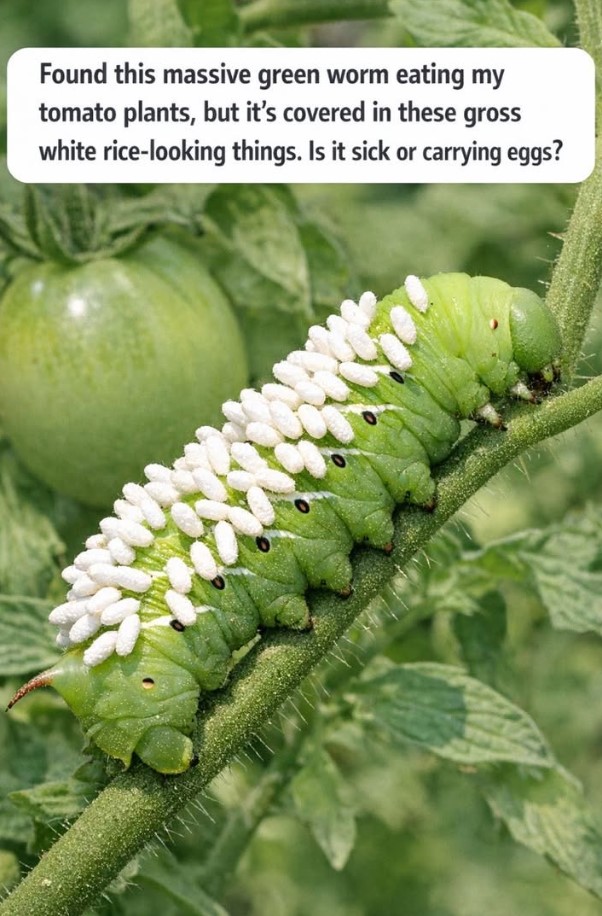
Imagine turning over a tomato leaf and finding a large green caterpillar covered with dozens of tiny white objects that look almost exactly like grains of uncooked rice. At first glance, you might assume the insect is carrying eggs, has some kind of disease, or is covered in insect eggs that are about to hatch.
Fortunately, that’s not what you’re seeing.
Those strange white structures are most likely braconid wasp cocoons, and their presence can actually be a sign that nature is already helping protect your garden. The caterpillar has been parasitized by a beneficial wasp, and the tiny wasps developing from those cocoons can help keep hornworm populations under control.
Understanding what you’re looking at can help you make a much better decision about whether to remove the caterpillar or leave it alone.
What Is the Huge Green Caterpillar on Your Tomato Plant?
The large green caterpillar commonly found eating tomato plants is often the tomato hornworm.
Tomato hornworms can become surprisingly large, reaching several inches in length. Their green bodies allow them to blend almost perfectly into tomato foliage, which is one reason gardeners sometimes don’t notice them until considerable damage has already occurred.
They are extremely hungry caterpillars. A single hornworm can consume a substantial amount of foliage, and several of them can quickly strip a tomato plant of leaves.
They usually have distinctive markings along their bodies and a horn-like projection at the rear. Despite the intimidating appearance, that horn isn’t a dangerous weapon and tomato hornworms aren’t considered a serious threat to people.
Their real threat is to your garden.
Why Are Tomato Hornworms So Difficult to Find?
One of the most frustrating things about hornworms is their camouflage.
Their green coloration blends naturally with tomato leaves and stems. During the day, they can remain almost motionless, making them surprisingly difficult to spot even when they’re right in front of you.
Sometimes the first clue isn’t the caterpillar itself but the damage it leaves behind.
You may notice:
- Large sections of leaves disappearing
- Bare stems where foliage used to be
- Chewed leaves
- Small dark droppings on leaves and soil
- A tomato plant suddenly looking much thinner
Checking your plants regularly is one of the best ways to catch an infestation before it becomes severe.
What Are the White Rice-Like Things?
This is the part that makes the discovery so fascinating.
The little white objects attached to the caterpillar are not eggs that the hornworm is carrying.
They are cocoons produced by braconid wasps, a group of tiny parasitic wasps that naturally attack caterpillars.
The wasp’s life cycle is remarkably different from what most people imagine when they see the caterpillar.
A female braconid wasp lays eggs in or on a suitable caterpillar. The developing larvae feed on the host, eventually emerging from the caterpillar and forming small white cocoons on its body.
Those cocoons are what look like tiny grains of rice.
Eventually, adult wasps emerge from the cocoons and continue their life cycle.
Is the Caterpillar Sick?
Not exactly.
The caterpillar may certainly be weakened and eventually die, but the white structures aren’t a disease or fungal infection.
They’re evidence of parasitism.
The wasp larvae have been developing using the hornworm as their host. By the time the white cocoons become obvious, the caterpillar has already been significantly affected.
It may become sluggish and stop behaving like a healthy, actively feeding hornworm.
While this might look unpleasant, it’s actually one of nature’s ways of controlling pest populations.
Are the White Things Eggs?
This is one of the biggest misconceptions surrounding a hornworm covered in white structures.
They’re not hornworm eggs.
The white structures are the protective cocoons associated with the developing braconid wasps.
That distinction is important because a gardener might otherwise remove the caterpillar immediately out of fear that hundreds of additional pests are about to hatch.
In reality, the opposite is happening.
The caterpillar has already become a host for a natural enemy, and the developing wasps can eventually help control other caterpillars.
Why Gardeners Should Be Happy to See a Parasitized Hornworm
It may sound strange to celebrate seeing a caterpillar eating your tomato plant, but a hornworm covered in wasp cocoons is a different situation from a healthy hornworm.
The presence of those cocoons means a natural biological-control process is already taking place.
Braconid wasps are valuable allies in gardens because they help regulate populations of caterpillars that can otherwise cause serious plant damage.
Instead of reaching immediately for a broad-spectrum insecticide, gardeners can sometimes allow these natural predators to do some of the work.
This is one of the most fascinating aspects of gardening: the solution to a pest problem can sometimes already be living in the garden.
Should You Remove a Hornworm Covered in Cocoons?
In general, leave a parasitized hornworm alone if you can tolerate the remaining plant damage.
Removing it means removing the host from which the beneficial wasps are developing.
Allowing it to remain gives the wasps an opportunity to complete their life cycle and emerge. Those adult wasps can then contribute to natural pest control in the surrounding garden.
If the caterpillar is causing serious damage to a valuable plant, you could consider carefully relocating it to another suitable area rather than destroying it outright.
However, healthy hornworms without the white cocoons are a different matter.
If you’re dealing with a large infestation, manually removing healthy hornworms can be an effective way to protect your tomato plants.
What Should You Do With Healthy Hornworms?
If you find a hornworm without signs of parasitism, inspect your tomato plants carefully for additional caterpillars.
Hand removal is one of the simplest control methods for larger caterpillars.
Wear gloves if you prefer not to touch them directly, then remove the caterpillar from the plant and relocate or dispose of it according to your preferred garden-management method.
The key is to check your plants frequently.
Finding one large hornworm often means you should inspect nearby plants because additional caterpillars may be hiding among the foliage.
How to Protect Your Tomato Plants Naturally
A healthy garden doesn’t necessarily need to be completely free of insects.
Instead, the goal can be to keep pest populations at manageable levels while protecting beneficial insects.
Inspect Plants Regularly
Walk through your garden every few days and examine tomato leaves, stems, and the soil beneath the plants.
Look for missing foliage, droppings, eggs, and caterpillars.
Check at Different Times of Day
Because hornworms can be difficult to see during daylight hours, checking plants in the evening can sometimes make them easier to find.
A flashlight can help reveal caterpillars that blend into the leaves.
Encourage Beneficial Insects
Avoid unnecessary broad-spectrum pesticides whenever possible.
A diverse garden with flowering plants can provide food and habitat for beneficial insects, including natural predators and parasitoids.
Remove Only the Pests You Need to Remove
If you find a healthy hornworm, removing it can protect your tomato plant.
If you find one covered in braconid wasp cocoons, consider leaving it alone.
This simple distinction can make a big difference.
What Other Creatures Help Control Hornworms?
Braconid wasps aren’t the only organisms that contribute to natural pest control.
Birds and other predators can feed on caterpillars, while various beneficial insects can attack eggs and younger larvae.
A garden that provides shelter, flowers, and a variety of plants can attract a wider range of helpful wildlife.
This creates a more balanced environment where pests are less likely to become completely overwhelming.
Can Tomato Hornworms Hurt People?
Although tomato hornworms look intimidating, they aren’t generally considered dangerous to humans.
Their rear horn may look threatening, but it isn’t designed to sting people.
Still, it’s sensible to use gloves when handling unfamiliar caterpillars. Not every caterpillar in the garden is harmless, and some species have irritating hairs or defensive spines.
If you’re unsure what you’ve found, avoid touching it directly until you’ve identified it.
Tomato Hornworm vs. Tobacco Hornworm
Another reason identification can sometimes be confusing is that tomato hornworms have a close relative called the tobacco hornworm.
The two can look quite similar and both may feed on plants in the same general family.
Small differences in body markings and the color and shape of their rear projections can help distinguish them.
For an ordinary gardener, however, the most important practical question is often simpler:
Is this a healthy hornworm, or is it covered with parasitic wasp cocoons?
That information can help determine whether removal is appropriate.
What If You See the White Cocoons on Another Caterpillar?
The same basic lesson applies: don’t automatically assume every unusual white structure on a caterpillar is an egg or disease.
Parasitoids are an important part of natural ecosystems.
If you see a caterpillar covered with small, organized cocoons, take a moment to identify what’s happening before destroying it.
You may be looking at one of the garden’s natural pest-control systems at work.
Why You Should Avoid Destroying the Cocoons
Those tiny white cocoons may look unpleasant, but they’re potentially much more valuable to your garden than they appear.
Once the wasps emerge, they can continue searching for suitable caterpillar hosts.
In other words, allowing the cocoons to develop can help support a natural population of beneficial parasitoids.
This is one reason experienced gardeners often become more selective about what they remove from their gardens.
Not every insect is an enemy.
A Simple Rule for Tomato Gardeners
When you see a large green caterpillar on your tomato plant, remember this simple rule:
Healthy hornworm = consider removing it.
Hornworm covered in white cocoons = consider leaving it alone.
That small distinction can help you protect your tomato plants while also encouraging natural biological control.
Final Thoughts
Finding a giant green caterpillar chewing through your tomato plant is certainly not a pleasant discovery. Hornworms can be serious garden pests, and their ability to blend into foliage makes them especially frustrating to deal with.
But if that caterpillar is covered in strange white, rice-like structures, don’t panic.
Those little white objects aren’t eggs waiting to hatch into more tomato-eating pests. They are associated with braconid wasps, beneficial parasitoids that use hornworms as hosts during part of their life cycle.
In fact, what looks like a disgusting garden problem may actually be evidence that your garden’s natural pest-control system is working.
So the next time you discover a hornworm covered in tiny white cocoons, take a closer look before reaching for the pesticide. That unusual-looking caterpillar may be helping introduce the next generation of tiny allies into your garden.
Nature can be messy, strange, and sometimes downright unpleasant—but it is also remarkably effective at finding its own balance.