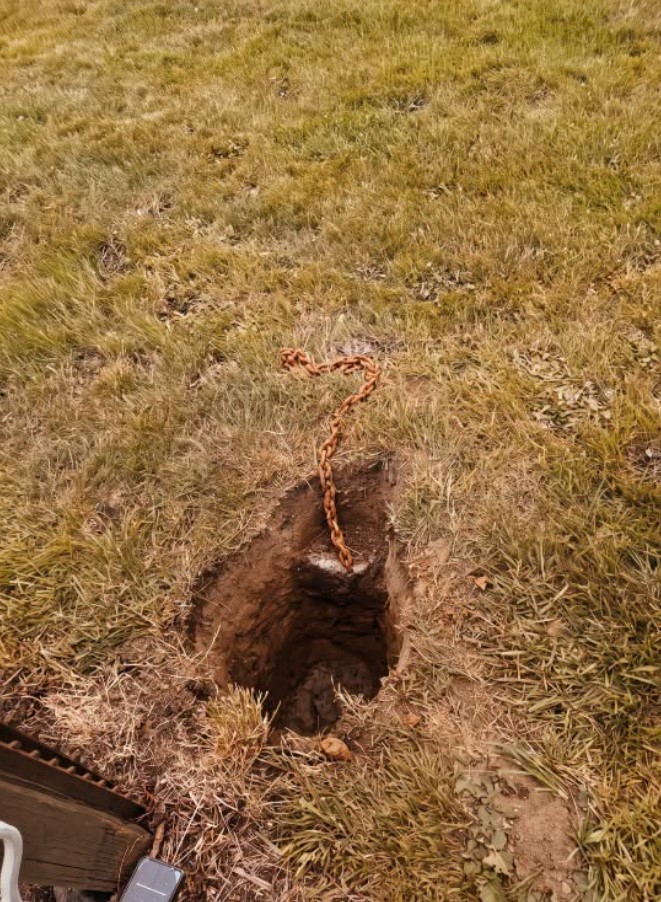
The first time I noticed the rusted chain sticking out of the ground beneath my mailbox, I honestly had no idea what I was looking at.
It was partially buried in the soil and so covered with rust that it looked like it had been there for decades. At first, I assumed it was simply a piece of old scrap metal left behind by a previous homeowner.
But there was something strange about it.
The chain wasn’t lying loose in the dirt.
It disappeared directly beneath the mailbox post.
I grabbed it and gave it a gentle pull.
Nothing happened.
I pulled harder.
Still nothing.
Whatever was underneath the ground had a much stronger grip than I expected.
That was when my curiosity really took over.
Why would someone bury a chain underneath a mailbox?
Was it part of an old fence?
Had someone once used it to secure something?
Could it have been connected to an old utility line?
Or was there some completely different explanation?
Eventually, after following the chain and uncovering more of the surrounding soil, the answer became clear.
It wasn’t treasure.
It wasn’t part of some mysterious underground system.
It was a clever piece of old-fashioned rural ingenuity.
The chain was part of an anchoring system designed to help keep the mailbox standing when faced with impacts, strong weather, or other forces.
And once I understood how it worked, the whole thing suddenly made sense.
The Strange Discovery Beneath the Mailbox
The discovery happened while I was working around the mailbox.
The ground around the post had become uneven, and I was clearing away some soil when the shovel struck something metallic.
At first, I thought I had hit a rock.
Then I heard the unmistakable sound of metal scraping against metal.
I moved some dirt aside and saw a small section of rusty chain.
It wasn’t new.
In fact, it looked incredibly old.
The links were dark orange and brown from years of exposure to moisture and soil. Some of the metal was rough and flaky, and parts of the chain had disappeared beneath the dirt.
Naturally, I wanted to know where it went.
I followed it toward the mailbox post.
That’s when I realized it wasn’t random debris.
Someone had deliberately installed it there.
The chain disappeared underground near the base of the mailbox.
That raised an even bigger question.
What was it supposed to do?
The Mystery Finally Makes Sense
After uncovering more of the area, the basic design became obvious.
The chain had been connected to the lower portion of the mailbox support.
The other end disappeared into the ground, where it was attached to a heavy anchor that had been secured with concrete.
In other words, someone had essentially given the mailbox an underground anchor.
The idea was surprisingly simple.
If the mailbox post was pushed, struck, or pulled, the buried anchor would resist the movement.
Instead of allowing the entire post to easily tip over, the underground weight provided additional stability.
It was an old-fashioned solution to a very ordinary problem.
And once I understood it, I started wondering how many other properties might have similar tricks hidden beneath the surface.
Why Would Anyone Need to Anchor a Mailbox?
For people who have always lived in cities or suburbs, the problem may not seem obvious.
A mailbox is just a mailbox.
It stands beside the road.
The mail carrier opens it.
You collect your mail.
That’s it.
But rural mailboxes can have a much harder life.
Many are positioned right alongside roads, sometimes several feet away from the nearest house.
That location makes them convenient for mail delivery.
Unfortunately, it can also make them vulnerable.
A mailbox standing alone beside a road can be exposed to:
- Accidental vehicle impacts
- Snowplows
- Heavy snow and ice
- Strong winds
- Falling branches
- Lawn and roadside maintenance equipment
- Vandalism
- Deliberate attempts to knock the mailbox down
Anyone who has lived along a rural road has probably seen damaged mailboxes.
Some are bent sideways.
Others are missing their doors.
Some are completely knocked off their posts.
And occasionally, an entire mailbox and its support system have to be replaced.
For a homeowner, repeatedly repairing the same mailbox can become frustrating and expensive.
That’s where creative reinforcement methods come in.
An Old-School Solution to a Common Problem
The buried chain wasn’t an elaborate invention.
There was no complicated machinery involved.
There wasn’t any modern technology.
It was simply a combination of basic materials used intelligently.
A sturdy chain.
A metal anchor.
Concrete.
A mailbox post.
And a little digging.
The anchor was placed underground and secured so that it would resist movement.
The chain connected that anchor to the mailbox structure.
If something tried to push the mailbox over, the force would be transferred through the chain into the buried anchor.
The ground and concrete would then provide resistance.
Essentially, the homeowner was giving the mailbox something solid to “hold on to.”
It was a practical answer to a practical problem.
Why the Chain Was Buried
At first, burying a perfectly good piece of chain might seem strange.
Why not simply attach it somewhere visible?
The answer is partly about appearance and partly about function.
An underground anchor doesn’t interfere with the normal use of the mailbox.
Nobody has to step around it.
Grass can grow over the area.
Snow can cover it.
Rain and weather don’t immediately expose the entire system.
And because the anchor is below ground, it can use the surrounding soil and concrete to resist movement.
Over time, however, moisture can reach the metal.
That’s why the chain I discovered had become so heavily rusted.
Decades underground can be hard on steel.
Rural Problem-Solving at Its Best
There’s something fascinating about solutions like this.
They weren’t necessarily designed by engineers sitting in an office.
They were often created by ordinary people who had encountered the same problem over and over again.
Imagine replacing your mailbox several times.
You install a new one.
A few months later, it’s damaged.
You repair it.
Then it happens again.
Eventually, you stop asking, “How do I replace this?”
Instead, you start asking, “How do I make sure this thing doesn’t move?”
That’s when people get creative.
Someone might use a heavier post.
Someone else might reinforce the base.
Another person might use concrete.
And someone else might come up with the idea of connecting the mailbox to a buried anchor.
The chain beneath my mailbox was essentially a physical reminder of that kind of thinking.
It Wasn’t a Trap
When you discover an unusual metal object buried near a roadside structure, it’s easy to imagine all sorts of possibilities.
Could it have been a trap?
Could it have been part of an old fence?
Could it have been used to secure livestock?
Could it have been something much more unusual?
In this case, the simplest explanation turned out to be the correct one.
It was there to stabilize the mailbox.
And that’s important because there is a difference between reinforcing a mailbox and deliberately turning it into a dangerous obstacle.
A properly installed mailbox should be secure and durable, but it should not be designed to cause serious injury to someone who accidentally hits it.
The purpose of an anchoring system like this should be stability and protection—not revenge against someone who damages the mailbox.
The Rust Actually Told Part of the Story
The condition of the chain was another clue.
It wasn’t simply rusty because someone had forgotten about it for a few years.
The corrosion suggested that it had spent a long time underground.
Some sections were barely visible.
Other parts were almost completely covered by soil.
That made me realize that the system probably hadn’t been touched for a very long time.
The property may have changed hands.
The mailbox may have been replaced.
The post may even have been repaired at some point.
But the old underground anchor remained.
Eventually, the chain became just another forgotten part of the property.
Until someone happened to hit it with a shovel.
I Tried Pulling It Free
Once I discovered what the chain was connected to, I naturally wanted to see how firmly it had been secured.
I grabbed the exposed section and pulled.
Nothing.
I changed my grip and pulled again.
Still nothing.
The chain didn’t even seem interested in moving.
That was when I realized just how much work had gone into the original installation.
The chain wasn’t simply buried.
It was attached to something substantial.
The anchor had been secured in concrete underground.
That meant removing it would probably require far more effort than it was worth.
And honestly, there was no reason to remove it.
The old system was doing exactly what it had been designed to do.
Why Old Rural Properties Can Hold So Many Surprises
One of the most interesting things about older properties is that they often contain traces of previous generations.
A current homeowner may know where the house was built and where the garage stands, but there can be countless small modifications hidden around the property.
Old fence posts can remain underground.
Previous owners may have installed drainage systems.
Old garden structures can disappear beneath vegetation.
Buried cables, pipes, anchors, foundations, and other hardware can survive long after their original purpose has been forgotten.
Sometimes these discoveries are completely ordinary.
Other times, they can tell you something about how the property was used decades ago.
The rusted chain beneath my mailbox was one of those small discoveries.
It wasn’t valuable.
It wasn’t mysterious once I understood it.
But it told a story.
Someone had once cared enough about that mailbox to make sure it stayed where it belonged.
A Mailbox Is More Vulnerable Than It Looks
A mailbox might appear sturdy when you look at it from the road.
But the actual strength of the system depends heavily on how the post is installed.
If the post is shallow, poorly supported, or weakened by rot, even a relatively modest impact can cause it to lean or collapse.
This is especially relevant for rural properties where mailboxes are often exposed to traffic and weather.
The farther a mailbox sits from the protection of a building or fence, the more exposed it can be.
A strong installation therefore matters.
The buried anchor I found was essentially an extra layer of protection.
It didn’t make the mailbox indestructible.
But it helped keep the structure firmly in place.
What Happened to the Old Anchor?
After uncovering enough of the chain to understand its purpose, I decided not to dig up the entire system.
There was really no reason to.
The old anchor was firmly embedded in concrete, and removing it would have meant disturbing the surrounding ground for no practical benefit.
Instead, I covered the exposed portion again.
The chain could remain where it had been for all those years.
It had already survived decades underground.
There was no need to disturb it simply because I had finally figured out what it was.
The Simple Lesson Behind the Discovery
What surprised me most wasn’t the chain itself.
It was the fact that something so ordinary had been completely invisible for so long.
Every time I walked past the mailbox, I saw the post.
I saw the box.
I saw the road.
But I never thought about what might be underneath.
Then one small piece of rusty metal appeared, and suddenly there was an entire story hidden beneath the surface.
Someone had experienced a problem.
Someone had looked for a solution.
Someone had installed the anchor.
And eventually, everyone forgot about it.
Except the ground remembered.
Could You Use a Similar Idea Today?
The general principle behind an underground anchor is still understandable today: structures exposed to movement can sometimes benefit from additional stabilization.
However, modern mailbox installations should follow appropriate local requirements and manufacturer or postal guidance.
A mailbox shouldn’t simply be made as heavy and immovable as possible.
There are safety considerations when a vehicle collides with roadside structures.
The goal should be a secure, properly installed mailbox—not a structure that creates an unnecessary hazard.
If an existing property contains an unusual buried object, it’s also wise to identify it before digging extensively.
Old properties can contain utilities and other buried infrastructure that should not be disturbed.
What looks like a simple piece of metal could sometimes be connected to something much more important.
The Chain Wasn’t Worth Anything—But It Was Still Interesting
When people hear about something unusual being discovered underground, they often imagine that the object might be valuable.
Gold.
Coins.
Old jewelry.
Something historically significant.
My discovery was much less exciting in terms of monetary value.
It was simply an old rusty chain.
But in another sense, it was more interesting than treasure.
It revealed a small piece of the property’s history.
It showed how a previous homeowner had solved a recurring problem with materials that were readily available.
And it reminded me that not every interesting discovery has to be valuable.
Sometimes the story is the valuable part.
Conclusion
Finding that rusted chain beneath my mailbox started as a strange little mystery.
At first, I had no idea why anyone would bury a chain in the ground.
It looked forgotten.
It looked useless.
It looked like a piece of scrap metal that had somehow been left behind.
But after following it to the mailbox post and uncovering the hidden anchor beneath the soil, everything became clear.
The chain was part of an old rural mailbox reinforcement system.
A metal anchor had been secured underground with concrete, and the chain connected that anchor to the mailbox structure. The purpose was simple: help keep the mailbox standing when faced with impacts, weather, or other forces that might otherwise knock it over.
There was no treasure buried beneath the mailbox.
There was no secret passage.
There was no complicated mechanism.
There was simply an old-fashioned solution to a common rural problem.
And honestly, I think that’s what makes the discovery so interesting.
Someone looked at a mailbox that kept getting damaged and decided to solve the problem with a shovel, some concrete, a piece of steel, and a little ingenuity.
Decades later, that solution was still sitting beneath the ground.
Forgotten, rusted, and almost invisible.
Until one day, a shovel hit metal and brought the story back to the surface.
Sometimes, the most fascinating things hiding around an old property aren’t valuable at all.
They’re simply reminders that someone was there before us—and that they found clever ways to solve the everyday problems we still encounter today.