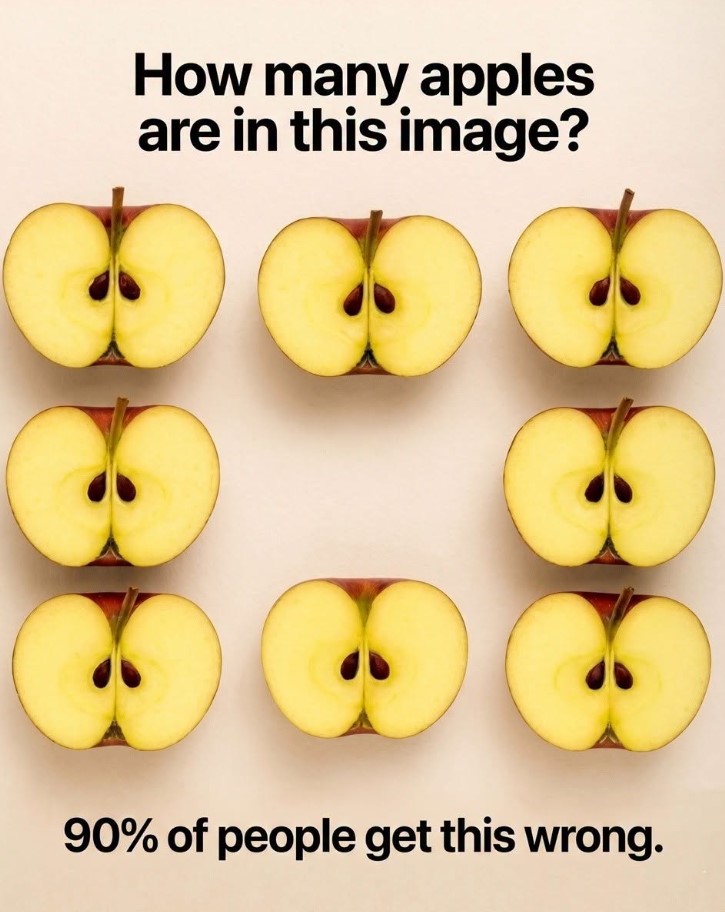
At first glance, this looks like one of the easiest picture puzzles you could come across. You see several apple halves arranged neatly in a square pattern, with an empty space in the middle. The question seems straightforward: How many apples are in the image?
But before you give your answer, take another look!
This little brain teaser has become an interesting challenge because people interpret the picture in different ways. Some count every visible piece, others combine the halves to calculate the number of whole apples, and a few come up with much more creative answers.
The surprising part is that several answers can make sense depending on how you understand the question.
So, take a moment to examine the picture, count what you see, and decide which answer you would defend. Are there four apples, eight apples, or perhaps something completely different?
Can You Count All the Apples?
The picture shows eight apple halves arranged around an empty square in the center.
Each half displays part of the apple’s core, including its seeds. The pieces appear to be arranged in a regular pattern, making the image look simple at first.
However, the challenge is deciding what exactly you are supposed to count.
Are you counting the visible pieces of fruit, or are you trying to determine how many complete apples were used to make them?
That small difference changes the answer.
Before reading the explanations below, try solving the puzzle yourself. You might even want to ask a friend or family member the same question and compare your answers.
Answer 1: Four Whole Apples
One of the most logical answers is 4 apples.
Why?
Because the picture contains eight halves, and two halves make one whole apple.
The calculation is simple:
8 apple halves ÷ 2 = 4 whole apples.
This answer assumes that the eight pieces came from four complete apples that were cut in half.
If the question is asking how many whole apples are represented by the pieces, four is the most reasonable mathematical answer.
Answer 2: Eight Pieces of Apple
Another possible answer is 8.
This time, instead of combining the halves, you simply count every visible piece in the picture.
There are eight separate apple halves, so the total is eight pieces.
Someone choosing this answer might argue that the question asks how many apples are in the image, not how many whole apples were used.
It is a different interpretation, but it is easy to understand why someone would choose it.
Answer 3: Zero Whole Apples
Here is where the puzzle becomes a little more philosophical!
A very strict interpretation could give the answer 0 whole apples.
After all, none of the visible pieces is a complete, uncut apple. Every piece has already been sliced in half.
If the question specifically asks how many whole apples are visible, someone could reasonably answer zero.
There is also another playful interpretation: the picture is a digital image made of pixels on a screen, not a collection of actual physical apples.
Of course, this is more of a joke than a practical way to solve the puzzle, but it shows how differently people can interpret a simple question.
Answer 4: One or Two Apples Were Used to Create the Picture
Look closely at the apple halves. They appear remarkably similar in shape, size, and detail.
This leads to another interesting possibility.
What if the picture was created by photographing only one apple, cutting it in half, and then copying the same image several times?
If that happened, perhaps only one whole apple was physically used.
Alternatively, two apples may have been used to produce the eight displayed halves.
There is no way to confirm this possibility simply by looking at the picture, but it is a fun reminder that photographs and digital images do not always show how many physical objects were involved in creating them.
Answer 5: Five Apples – What Happened to the Missing Middle?
Have you noticed the empty square in the center of the arrangement?
It almost looks as though something should be there.
This inspired another humorous answer: 5 apples.
The idea is that four whole apples are represented by the eight visible halves, while a fifth apple might have been placed in the middle before someone took it away.
Perhaps somebody became hungry and ate it!
Naturally, there is no evidence of a missing apple. This is simply a playful way to explain the empty space in the picture.
Still, it makes the puzzle more entertaining.
Answer 6: Sixteen Seeds
If you want to make the challenge even more interesting, forget about counting the apple halves and look at the seeds.
Each of the eight visible halves contains two dark seeds.
That gives us:
8 apple halves × 2 seeds = 16 seeds.
So, you could say there are 16 seeds in the picture.
Seeds can grow into new apple trees under the right conditions, which makes this a fun alternative interpretation.
Of course, sixteen seeds do not mean there are sixteen actual apples. They simply provide another detail to count.
Which Answer Is Actually Correct?
The answer depends on what you mean by the word “apples.”
If you are counting the visible pieces, the answer is eight.
If you are calculating how many whole apples those pieces represent, the answer is four.
If you are asking how many complete, uncut apples appear in the picture, the answer is zero.
For a traditional mathematical interpretation, four whole apples is the most sensible answer because two halves make one whole apple.
The important thing is to understand the difference between counting individual pieces and combining them into complete objects.
Why Do Simple Picture Puzzles Confuse So Many People?
Puzzles like this are interesting because they test more than basic counting.
They encourage us to think carefully about the wording of a question. Two people can look at exactly the same picture and reach different conclusions simply because they understand the question differently.
One person might focus on the visible pieces, another might think mathematically, and someone else might notice the seeds or the empty space in the middle.
There is also a tendency to answer quickly when a picture looks familiar. We see apples, recognize their halves, and immediately begin counting without considering what the question is really asking.
Taking a few extra seconds to examine the image can make a big difference.
Conclusion :
The apple-counting puzzle is a perfect example of how a simple image can create several different interpretations. At first, you might think the answer is obvious, but once you look closely, the challenge becomes much more interesting.
There are eight visible apple halves, which represent four whole apples if each pair belongs to one original apple. You can also count eight separate pieces, sixteen seeds, or even come up with playful explanations involving the empty space in the middle.
However, if you are looking for the most logical mathematical answer, four whole apples is the best choice.
The real fun of this puzzle is seeing how differently people approach the same question. Some focus on what they can see, while others think about the objects before they were cut.
So, what was your first answer? Did you immediately say four, or did you count all eight pieces? Share the puzzle with your friends and family and see whether they agree with your answer!