Picture a classic weekend breakfast.
A stack of warm pancakes sits in the middle of the table. Butter is slowly melting into the golden surface, coffee is steaming nearby, and someone reaches for the maple syrup.
You pick up the bottle.
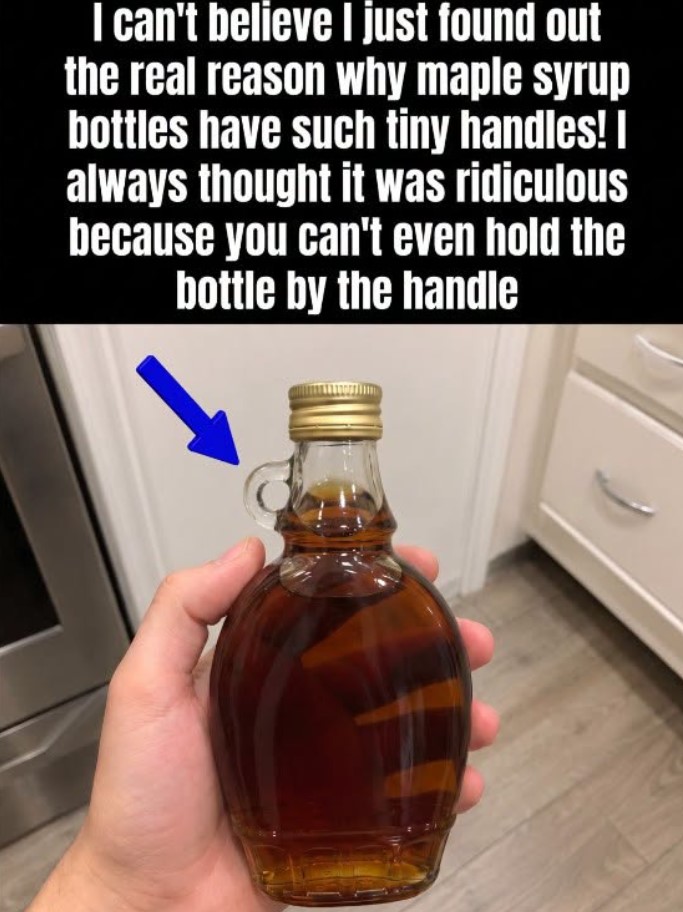
And there it is—that tiny little handle attached near the neck.
You’ve probably seen it hundreds of times.
Maybe you’ve even wondered about it.
But have you ever actually asked yourself what it’s for?
The handle is so small that you can’t comfortably carry the bottle by it. It isn’t particularly useful when pouring, either. In fact, depending on the bottle, it may be difficult to get even one finger through the little loop.
So why would a manufacturer go through the trouble of putting a handle on a bottle if the handle isn’t really a handle?
It turns out that this adorable little detail has a surprisingly interesting history.
The answer isn’t quite as simple as the popular story that it was merely copied from enormous old syrup jugs. Historians have found evidence of several earlier container designs with small handles, while the familiar oval glass maple-syrup flask was formally patented in the mid-20th century.
And over time, that tiny loop became something much more important than a practical grip.
It became part of what maple syrup looks like.
Today, you can see that little handle and immediately think of pancakes, waffles, Vermont, sugar shacks, snowy forests, and old-fashioned breakfasts.
So how did such a tiny piece of glass become one of the most recognizable details associated with maple syrup?
The First Question: Is the Handle Actually Useful?
Let’s begin with the obvious question.
Can you use it as a handle?
Technically, you might be able to hook a finger through it on some bottles.
Practically speaking, that’s not what it was designed for.
The tiny loop is positioned high on the neck of the bottle and is generally too small to provide the kind of comfortable grip you’d expect from a conventional jug handle.
That’s why the little loop has often been described as a decorative or nostalgic feature rather than a functional one.
In design terminology, an object that retains the appearance of an older functional feature even after that feature no longer serves its original purpose can be described as a skeuomorph.
It’s essentially a visual connection to an earlier design tradition.
And that idea helps explain why the tiny maple-syrup handle survived even after bottles became small enough that nobody needed a handle to carry them.
It Looks Older Than It Really Is
The little handle gives the bottle an old-fashioned appearance.
That’s probably one of the reasons it feels so natural sitting next to a stack of pancakes.
The bottle doesn’t look like an ordinary modern container.
Instead, its shape suggests something handcrafted, rustic, traditional, and perhaps even historic.
But there’s an important detail here.
The familiar maple-syrup flask that many people recognize today isn’t an ancient design that has remained unchanged for centuries.
The specific oval glass flask associated with maple syrup was patented by glass-container designer Brooks D. Fuerst in 1951. The patent application was filed in 1949, and the design was assigned to the Owens-Illinois Glass Company.
That means the familiar bottle is considerably more modern than its old-fashioned appearance might suggest.
And that’s what makes the story so interesting.
The 1951 Bottle That Helped Define the Look
Brooks D. Fuerst was an experienced designer of glass containers for food and liquids.
His 1951 design was officially given the rather unromantic description “jug or the like.”
It featured an oval flask-like body and a small handle near the neck.
The original version of the handle wasn’t quite the rounded little loop we’re accustomed to seeing today.
It had a more angular shape.
The bottle was also produced in several sizes.
The Cary Maple Sugar Company of St. Johnsbury, Vermont, was the first company known to use Fuerst’s 1951 flask for maple syrup, beginning around 1950. Early versions were sold in sizes including 2-ounce, 8-ounce, and 24-ounce containers.
So that tiny handle wasn’t simply something somebody randomly added to a bottle one afternoon.
It was part of a deliberate container design.
But the Story Goes Back Even Further
Here’s where the history gets even more fascinating.
The 1951 design wasn’t the first syrup-related container to feature a small handle.
An earlier design by Edwin W. Fuerst received a U.S. design patent in 1933.
That bottle was rounder than the later 1951 flask and also included a small handle near the neck.
The Cary company used this earlier design as well, and Quebec Maple Products also used the bottle for syrup products in Canada.
And even before that, there were other syrup containers featuring handles.
One example dates back to the early 1920s.
The Little Brown Jug Products Company used a ceramic container with a much more substantial handle. Its design was patented in 1922.
A later glass version introduced in the 1930s also featured a loop-style handle.
So the idea of giving a syrup container a handle definitely wasn’t invented in 1951.
Instead, the familiar modern bottle developed from a longer history of syrup and jug designs.
So Was the Tiny Handle Originally a Real Handle?
This is where the popular explanation becomes a little complicated.
You may have heard that the tiny loop is simply a leftover from the days when maple syrup was stored in huge ceramic jugs.
The theory sounds perfectly reasonable.
If you had a large container holding several pounds of liquid, you would obviously want a substantial handle.
Then, as containers became smaller, the handle supposedly shrank along with them.
Eventually, it became so tiny that it stopped being useful.
It’s a charming story.
But historical evidence suggests the reality isn’t quite that straightforward.
Maple syrup wasn’t always packaged in large handled ceramic containers in the way the popular story sometimes suggests. Historical researchers have pointed out that maple syrup was also commonly sold in tins and cans, and the modern glass flask design emerged through a series of different container styles.
So the tiny handle may not simply be a miniature survivor of one specific old jug.
Instead, it appears to have become part of a broader visual language associated with traditional syrup packaging.
The Handle Helped Make Syrup Look Traditional
Think about the psychology of packaging.
When you’re buying a food product, the container tells you something before you even read the label.
A sleek modern bottle might suggest efficiency.
A minimalist package might suggest sophistication.
A brightly colored plastic container might suggest something fun and family-friendly.
A glass flask with a tiny old-fashioned handle?
That suggests tradition.
It feels rustic.
It looks like something that could have been sitting on a farmhouse breakfast table decades ago.
That’s useful when you’re selling a product whose identity is closely tied to tradition.
Maple syrup has a particularly strong connection to history, forests, farms, winter, and seasonal production.
The bottle reinforces that image.
In other words, the handle may not need to help you carry the syrup.
It helps the bottle communicate what the syrup is.
The Bottle Became Part of the Brand
Over time, the little handle became so strongly associated with maple syrup that it practically became a visual symbol.
You don’t necessarily need to see the words “maple syrup.”
Show someone the familiar flask shape with the tiny loop and many people will immediately recognize the product.
That’s powerful packaging.
The same thing happens with other famous food containers.
A particular bottle silhouette can become inseparable from a brand or category.
The maple-syrup flask developed a similar identity.
The little handle became part of the visual shorthand.
It says:
Traditional maple syrup.
Even before you taste anything.
Why Maple Syrup Needed That Rustic Image
There’s another reason the design works so well.
Maple syrup has a very specific story behind it.
Unlike many sweet toppings, real maple syrup begins with sap collected from maple trees.
The sap is then concentrated by removing much of its water, producing the thick, sweet syrup people pour over pancakes and waffles.
That process naturally lends itself to a rustic image.
People associate maple syrup with:
- Maple forests
- Cold winters
- Sugar shacks
- Wooden buckets
- Steam rising from evaporators
- Family traditions
- Pancake breakfasts
- Rural New England and Canada
The tiny handle fits neatly into that visual world.
It’s almost like a miniature piece of nostalgia attached to the bottle.
Why the Bottle Is So Recognizable
The classic bottle isn’t only about the handle.
Its overall shape contributes to its identity.
The glass flask is typically narrow around the neck and wider through the body.
Some versions have decorative ridges or scalloped details toward the base.
Together, these features make the container immediately recognizable.
The handle is simply the finishing touch.
Remove it, and the bottle still looks like a maple-syrup container.
But add that little loop, and the design becomes unmistakable.
It’s one of those small details that can make an ordinary package feel iconic.
The Handle Has Changed Over Time
If you’ve seen older examples of these bottles, you may notice that the handle hasn’t always looked exactly like the one on bottles today.
The earliest versions of the Fuerst designs had more angular forms.
The rounded loop that many people recognize today developed later.
According to historical research, the handle evolved into its familiar rounded form by around the mid-1990s.
So even something as simple as a tiny glass loop has its own design history.
What looks like one timeless feature is actually the result of decades of evolution.
Why Didn’t Manufacturers Just Remove It?
This is perhaps the funniest question.
If the handle isn’t especially useful, why not get rid of it?
Because by the time a design becomes associated with a product, removing it can make the product feel strangely wrong.
Imagine seeing the classic maple-syrup flask without the little loop.
It might still hold syrup perfectly well.
It might even be cheaper or easier to manufacture.
But something would be missing.
The bottle would lose part of its personality.
That’s one of the hidden powers of familiar design.
Consumers become accustomed to visual details.
Eventually, those details become part of what the product is supposed to look like.
It’s a Tiny Piece of Nostalgia
There’s also an emotional reason the handle works.
Breakfast is full of nostalgia.
For many people, pancakes and waffles aren’t just food.
They’re associated with childhood mornings, family gatherings, weekend breakfasts, holidays, and lazy Sunday routines.
The maple-syrup bottle becomes part of that memory.
Maybe you remember watching someone pour syrup over a stack of pancakes.
Maybe you remember squeezing a plastic bottle while trying not to drown your waffles.
Maybe you remember the sound of a fork scraping against a plate while syrup slowly spread across it.
The bottle’s design becomes connected to those memories.
The tiny handle may seem insignificant, but it contributes to the overall feeling.
Why Glass Became So Important
The classic syrup flask is also strongly associated with glass.
Glass has an advantage beyond appearance: you can see the syrup.
That golden or amber liquid becomes part of the presentation.
The bottle itself becomes almost decorative.
You can see the color.
You can see how much remains.
And because the container is reusable as an object, it can sometimes become a keepsake after the syrup is gone.
The combination of transparent glass, traditional shape, and tiny handle makes the package feel more substantial than a generic plastic container.
The Tiny Handle Isn’t There for Your Finger
So if you’ve ever tried to use the little loop as a normal handle and wondered whether you were doing it wrong, don’t worry.
You’re not missing a secret technique.
The little loop isn’t designed to give you the same grip as the handle on a pitcher or jug.
It’s primarily a stylistic feature.
Its job is visual rather than mechanical.
That’s why trying to lift a full bottle by that tiny loop isn’t exactly the best idea.
The bottle itself is meant to be held around the body.
The little handle is there to complete the design.
A Small Detail With a Big Job
This is what makes the history so fascinating.
The handle may be physically tiny, but it does something important.
It tells a story.
It connects the modern product to older styles of syrup containers.
It gives the package a rustic appearance.
It distinguishes maple syrup from countless other sweet sauces.
And it helps consumers recognize the product immediately.
All of that from one tiny loop of glass.
That’s impressive packaging design.
The Handle Became a Symbol of Authenticity
There’s an interesting psychological effect at work here.
When a product has packaging that looks traditional, consumers may naturally associate that appearance with authenticity.
The bottle seems old-fashioned.
The shape feels familiar.
The little handle suggests history.
Together, these elements communicate an idea:
“This is the real thing.”
Of course, packaging alone cannot determine the quality or authenticity of the syrup inside.
But visual cues matter.
Manufacturers know that consumers don’t just buy products based on ingredients and price.
They also respond to appearance, familiarity, and emotional associations.
The maple-syrup flask takes advantage of all three.
It Isn’t Really a Mystery Anymore
Once you learn the story, the little handle doesn’t seem quite so strange.
It’s not an unfinished handle.
It’s not a manufacturing mistake.
It’s not a tiny grip designed for miniature hands.
And it’s not necessarily a direct leftover from one specific enormous maple-syrup jug.
Instead, it’s part of a long evolution of syrup-container design, shaped by earlier jug forms, glass-container design, marketing, nostalgia, and consumer expectations.
The exact motivation behind every early handle isn’t completely documented, so it’s best not to claim that there is one single explanation.
What we do know is that small-handled syrup containers existed well before the famous 1951 Fuerst flask, and the familiar design eventually became strongly associated with maple syrup.
The Cutest Detail on the Breakfast Table
And honestly, maybe that’s why the little handle is so charming.
It doesn’t need to be practical.
It doesn’t need to hold the bottle.
It doesn’t need to perform some complicated function.
It simply looks right.
Put it beside pancakes and waffles, and the scene immediately feels complete.
The bottle has personality.
It looks traditional.
It looks like something that belongs in a cozy kitchen on a cold morning.
And that’s exactly what good design can do.
What Happened When Plastic Took Over?
Glass wasn’t the only chapter in maple-syrup packaging history.
Plastic eventually became increasingly common.
Plastic containers offered advantages in shipping, durability, and manufacturing.
Modern maple-syrup jugs are often designed with much more practical handles that are large enough to grip comfortably.
Yet the classic glass flask never completely disappeared.
That’s significant.
If practicality were the only factor, the old glass bottle might have vanished entirely.
Instead, it remained valuable because it had become part of the visual identity of maple syrup.
Historical research notes that the classic flask became increasingly popular with smaller maple producers during the 1980s, while the familiar rounded handle shape emerged later.
Why We Still Love the Old-Fashioned Bottle
There is something satisfying about a package that looks connected to the past.
Modern life can be full of disposable, rapidly changing designs.
Food packaging changes.
Labels change.
Shapes change.
Colors change.
But some designs survive because people become attached to them.
The maple-syrup flask is one of those designs.
It doesn’t scream for attention.
It doesn’t need flashy graphics.
Its shape does most of the work.
And that tiny handle quietly tells you that this isn’t supposed to look like an ordinary bottle.
It’s supposed to feel like maple syrup.
A Tiny Lesson in Design
The maple-syrup handle also offers a useful lesson about how design works.
We often assume that every part of an object must have a practical purpose.
But that’s not true.
Some features exist to communicate an idea.
A decorative detail can tell us where a product comes from.
It can make something feel familiar.
It can trigger memories.
It can make a product easier to recognize.
The tiny handle does all of these things.
Its physical function may be minimal, but its visual function is significant.
Next Time You Pour Syrup, Look at the Bottle
The next time you’re sitting down with pancakes, don’t immediately reach for the syrup and start pouring.
Take a second to look at the bottle.
Notice the shape.
Look at the neck.
Look at the tiny loop.
Then remember that you’re looking at the result of decades of packaging history.
That little handle has survived changes in manufacturing, materials, consumer habits, and container design.
It has gone from an unusual feature on early syrup-related bottles to a familiar symbol of maple syrup itself.
And it has done all of that without ever needing to become a genuinely useful handle.
Conclusion :
So, why does your maple syrup bottle have that adorable little handle?
The short answer is that it isn’t really there to help you carry the bottle.
The familiar tiny loop is primarily a design feature—one that evokes older jug and syrup-container styles and helps give maple syrup its unmistakably traditional appearance.
The history is more complicated than the popular story that the handle simply shrank from a large, practical jug handle. Earlier syrup-container designs featuring small handles existed decades before the famous 1951 oval flask, and the modern form evolved through several stages of glass-bottle design. Brooks D. Fuerst’s 1951 patent became particularly important in establishing the flask shape that would become closely associated with maple syrup.
Over the decades, the tiny handle became more than decoration.
It became a visual signature.
You see the little glass loop, the familiar flask shape, and that golden liquid inside, and your brain immediately connects it with maple syrup.
Pancakes.
Waffles.
Weekend breakfasts.
Cold mornings.
Maple forests.
And old-fashioned comfort.
That’s why this tiny detail is so charming.
It doesn’t have to be useful to have a purpose.
Sometimes a design’s greatest job is to make us feel something.
And that little handle does exactly that.
So the next time someone asks why maple syrup bottles have those tiny handles, you can tell them the real story: they’re not miniature carrying grips waiting for your pinky finger.
They’re little pieces of design history.
And perhaps the cutest reminder that sometimes, the smallest details are the ones that make an object instantly recognizable.