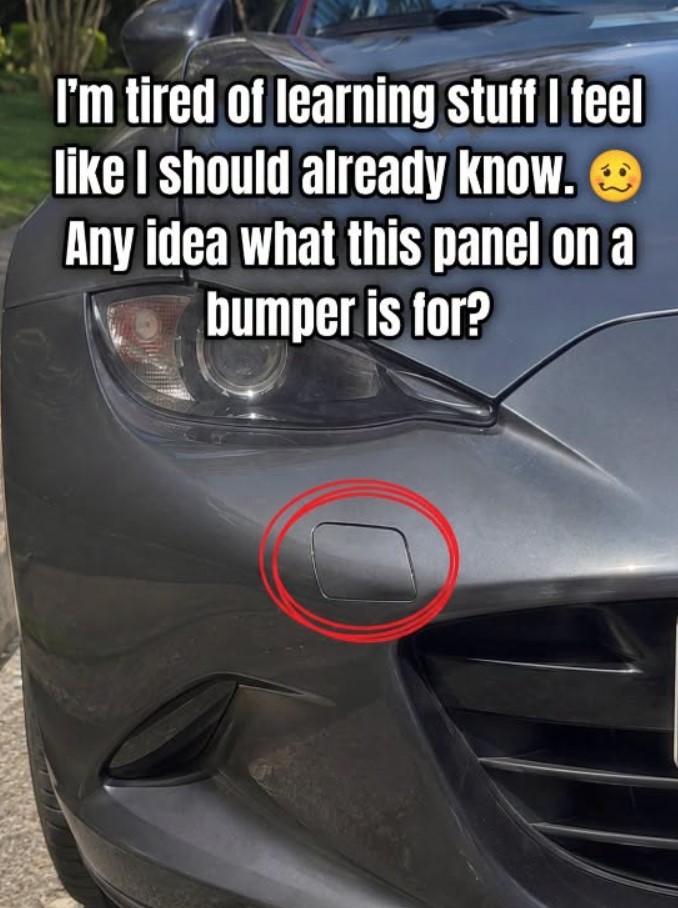
Have you ever looked closely at the front or rear bumper of a car and noticed a small, perfectly shaped panel that seems to serve no obvious purpose?
It may look like a decorative piece, an access cover, or simply another part of the bumper’s design. Because it blends so neatly into the surrounding plastic, many drivers never give it a second thought.
But that little panel can have a very important job.
On many vehicles, the small removable panel is actually a cover for the towing eye or tow hook attachment point. Behind it is a reinforced mounting location designed to accept a special towing eye when the vehicle needs to be recovered or moved in an emergency. Automakers commonly hide these attachment points behind small bumper covers so the exterior remains clean and attractive during normal driving.
Once you know what you’re looking at, that mysterious little panel suddenly makes much more sense.
What Is the Small Panel on the Bumper?
The small panel is generally known as a tow hook cover, towing-eye cover, or towing-point access cover.
Its purpose is simple: it hides the towing attachment point when the vehicle doesn’t need to be towed.
Behind the cover is usually a threaded socket or another designated attachment point. Depending on the vehicle, a removable towing eye may be stored in the trunk, cargo area, spare-tire compartment, or emergency-tool kit.
When needed, the cover can be removed and the towing eye installed into the mounting point.
Ford, for example, lists bumper components specifically described as caps that conceal the tow eye, demonstrating that these small panels are intentionally designed as access covers rather than decorative pieces.
Why Don’t Manufacturers Leave the Tow Hook Exposed?
A permanently exposed towing point would not necessarily be attractive or practical.
Most drivers spend nearly all of their time using their vehicle normally. They don’t need to see a metal towing eye sticking out of the bumper every time they look at the car.
Instead, manufacturers place the attachment point behind a removable panel.
This approach provides several advantages:
- It keeps the bumper looking clean and finished.
- It protects the attachment point from everyday dirt and weather.
- It prevents the towing hardware from sticking out unnecessarily.
- It allows the vehicle to have a dedicated recovery point available when required.
- It reduces the chance that the attachment point will be accidentally used for something it wasn’t designed to do.
The result is a small piece of exterior trim that looks insignificant but provides access to an important emergency feature.
Where Is the Towing Eye?
The exact location varies from one vehicle to another.
Some cars have a towing-eye access panel on the front bumper, while others have one on the rear bumper. Certain vehicles may have towing points at both ends.
The removable towing eye itself may be stored somewhere completely different.
Common locations include:
- The trunk
- The cargo compartment
- The spare-wheel well
- The emergency-tool compartment
- A dedicated storage tray
- A compartment beneath the luggage floor
Because designs differ considerably, it is not a good idea to assume that another vehicle’s procedure applies to yours.
The owner’s manual is the best place to start. Many manuals specifically identify the location of the towing eye and explain how to access the bumper mounting point.
How Does the Tow Hook Work?
The basic idea is surprisingly simple.
Many vehicles use a screw-in towing eye.
The towing eye is a metal piece with a threaded end on one side and a loop on the other. The threaded end screws into the reinforced mounting point behind the bumper cover.
Once installed correctly, the loop provides a designated point where appropriate recovery equipment can be attached.
The important thing is that the towing eye isn’t simply screwed into ordinary bumper plastic. The mounting point is designed as a structural attachment location.
Toyota owner documentation, for example, describes removing a bumper cover to access a towing hook and using the specified hook at that location.
Other manufacturers use similar systems, although the exact design, threading direction, storage location, and removal procedure can vary.
How to Find Your Car’s Tow Hook
If you are curious about your own vehicle, don’t start pulling random panels off the bumper.
Instead, check the owner’s manual first.
Look for sections with names such as:
- Towing
- Emergency towing
- Vehicle recovery
- Towing eye
- Tow hook
- Recovery points
- Emergency equipment
- Roadside emergencies
The manual should tell you whether your vehicle has a removable towing eye and where it is stored.
It should also identify the correct access panel.
This matters because a bumper can contain several small covers, sensors, clips, and other components. Not every panel is designed to be removed by the owner.
How to Access the Tow Hook
The exact procedure depends on the make and model, but the general process often follows a similar pattern.
Step 1: Locate the Towing Eye
First, find the towing eye supplied with the vehicle.
Check the trunk, cargo area, spare-tire compartment, or emergency-tool storage area.
Don’t assume every vehicle stores it in the same place.
Some vehicles may not include a removable towing eye at all because they use fixed recovery hooks or another towing arrangement.
Step 2: Identify the Correct Bumper Panel
Use your owner’s manual to determine which small panel provides access to the towing point.
It may be located on the front bumper, rear bumper, or another part of the vehicle’s fascia.
Don’t pry off a random panel simply because it looks removable.
Step 3: Remove the Cover Carefully
Many covers are designed to pop out using a suitable tool or a designated access point.
Some have small slots or edges where a tool can be inserted.
Others may use clips or tabs.
The removal process can be surprisingly delicate, especially when the panel is painted to match the vehicle.
If it doesn’t release according to the manufacturer’s instructions, stop rather than forcing it.
Breaking or scratching a bumper cover can turn a simple emergency procedure into an unnecessary repair.
Some owner manuals specifically describe using a suitable tool to remove the towing-eye cover.
Step 4: Install the Towing Eye
Once the cover has been removed, the threaded mounting point should be visible.
Insert the towing eye according to the vehicle manufacturer’s instructions.
It must be properly seated and securely tightened.
This step is extremely important. A towing eye that isn’t correctly installed can create a dangerous situation during vehicle recovery.
Different vehicles can even use different thread directions, so never assume that every towing eye screws in clockwise.
For example, Ford documentation for one model specifies a particular installation direction, demonstrating why the owner’s manual should always be followed.
Step 5: Use the Correct Recovery Method
Once the towing eye is installed, the next step depends on why the vehicle needs to be moved.
A towing eye is not a universal pulling point.
The vehicle’s weight, drivetrain, wheels, steering, brakes, terrain, and condition all matter when determining the correct recovery method.
For a disabled or damaged vehicle, professional roadside assistance or a qualified towing service is often the safest option.
What You Should Never Do With the Tow Hook
One of the biggest misconceptions about these attachment points is that they can be used for any kind of pulling.
That’s not necessarily true.
A tow eye is engineered for specific purposes and specific loads. Using it incorrectly can damage the vehicle or create a serious safety hazard.
For example, some manufacturers specifically warn against using towing eyes to pull a vehicle out of mud, sand, or other difficult situations. Other manuals restrict their use to particular emergency situations or loading the vehicle onto transport equipment.
So if your vehicle is deeply stuck, heavily damaged, or in a difficult position, don’t assume that attaching a rope or chain to the tow eye is automatically safe.
Follow the manufacturer’s instructions and use appropriate professional recovery equipment.
Is It the Same as a Trailer Hitch?
No.
This is another common misunderstanding.
A trailer hitch is designed to connect a trailer to a vehicle.
A towing eye or recovery point is generally intended for specific vehicle-recovery situations.
They perform very different functions.
A vehicle can have a trailer hitch and still have separate towing-eye attachment points hidden behind bumper covers.
The little panel on your bumper is therefore not necessarily an indication that the car is equipped for towing a trailer.
Why the Panel Can Be Easy to Miss
There is a good reason so many people overlook this feature.
The panel is intentionally designed to disappear into the bumper.
It may be:
- Painted the same color as the body
- Nearly flush with the bumper
- Very small
- Positioned low on the front or rear fascia
- Free of obvious labels
- Only visible when you know what you’re looking for
From a styling perspective, this is exactly what manufacturers want.
The vehicle should look normal during everyday driving, while still retaining access to an emergency recovery point.
That’s why a feature that can be extremely useful during a breakdown may remain completely unnoticed for years.
What If the Panel Is Missing?
If you discover that the small bumper panel is missing, don’t automatically assume that the towing point itself has been damaged.
The cover is often just an exterior trim component.
However, leaving the opening exposed can allow dirt, water, and debris to reach areas that were intended to remain covered.
A replacement cover may be available through the vehicle manufacturer or a parts supplier.
It’s also worth checking whether the attachment point behind the cover has suffered any damage.
If the vehicle has recently been involved in an accident, has been pulled incorrectly, or has visible damage around the bumper, have the relevant components inspected before relying on the towing point.
What If You Can’t Remove the Cover?
Don’t force it.
This may be the most important practical advice.
Some bumper covers are secured with clips, tabs, latches, or other mechanisms. A painted plastic cover can crack, bend, or become scratched surprisingly easily.
Your owner’s manual should explain the correct removal method.
For some vehicles, the cover is removed with a small tool. For others, a specific edge or location must be pressed first.
If you’re unsure, professional assistance is preferable to damaging the bumper.
Why You Should Check Your Owner’s Manual Now
Most people only think about towing equipment after something goes wrong.
That’s exactly when it becomes inconvenient to figure out where everything is.
Taking a few minutes to check the owner’s manual while the vehicle is safely parked can save time during an actual roadside emergency.
Find out:
- Whether your vehicle has a towing eye.
- Where the towing eye is stored.
- Where the towing-point cover is located.
- How the cover is removed.
- How the towing eye is installed.
- What type of towing or recovery is permitted.
- Whether there are restrictions on using the point.
This information can be particularly useful if you travel long distances or drive in areas where roadside assistance may take time to arrive.
The Small Panel Is More Important Than It Looks
At first glance, the little panel on the bumper might seem completely insignificant.
It’s easy to assume it’s simply part of the vehicle’s styling.
But on many vehicles, that small piece of plastic serves a very practical purpose. It conceals access to a dedicated towing or recovery point that may be needed when the vehicle is disabled.
Once you know what it is, you may start noticing the same feature on cars everywhere.
The design is clever: keep the towing hardware hidden during normal driving, but make it available when an emergency requires it.
Final Thoughts
The next time you walk around your car and notice a small rectangular or circular panel on the bumper, take a closer look.
There is a good chance it isn’t there by accident.
On many vehicles, that little cover hides a towing-eye attachment point, allowing a removable tow hook to be installed when the vehicle needs to be recovered or moved. Manufacturers use this design to keep the bumper clean and protected while still providing an important emergency feature.
But knowing what the panel is doesn’t mean it should be opened and used casually.
The safest approach is to check your specific owner’s manual, locate the towing eye, learn how the cover is removed, and understand the manufacturer’s restrictions before an emergency happens.
A few minutes of preparation can make a stressful roadside situation much easier.
So that mysterious little panel you’ve probably ignored for years may actually be one of the most useful hidden features on your vehicle.
Sometimes, the smallest details on a car have a much bigger purpose than they first appear to.