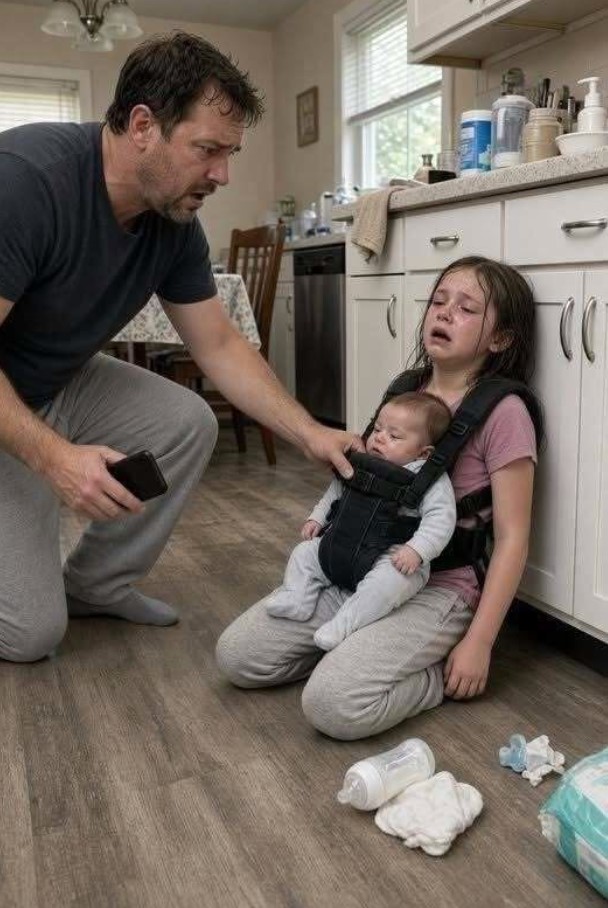
The phone was still in my hand when another notification appeared.
I stared at the screen.
For a moment, I didn’t move.
Tessa stood beside me, watching my face carefully. She was tired, frightened, and probably wondering whether she had done something wrong by telling me about the phone.
She hadn’t.
If anything, she had finally given me the one piece of information that could explain why our afternoon had gone so wrong.
I looked at the message again.
R: You said Grant wouldn’t find out. Leave the kids with Tessa and come now.
My first thought was that the message had to be some kind of misunderstanding.
Maybe there was an explanation.
Maybe “R” was someone I knew.
Maybe my wife had been dealing with something she was afraid to tell me about.
But none of those possibilities explained why she had left our nine-year-old daughter alone with an eight-month-old baby for hours.
And none explained why she had specifically been told to make sure I didn’t know.
I looked at Tessa.
“Did Mom say anything before she left?”
Tessa nodded slowly.
“She said I was old enough to help.”
My chest tightened.
“What exactly did she say?”
Tessa looked down at the floor.
“She said Miles was sleeping, and she’d be back really soon. She told me not to worry.”
“Did she tell you to call me?”
Tessa shook her head.
“She told me not to.”
I closed my eyes for a second.
That was the part I couldn’t get past.
A nine-year-old child shouldn’t have to decide whether she is allowed to call her father while caring for a baby.
She shouldn’t have to sit on a kitchen floor for hours because an adult promised to return in seventeen minutes.
And she certainly shouldn’t have to apologize when she finally asks for help.
I crouched beside her.
“Tessa, listen to me.”
She looked up.
“You didn’t do anything wrong.”
Her eyes immediately filled with tears.
“I tried to keep him happy.”
“I know.”
“I gave him his bottle.”
“I know.”
“I walked around with him because he wouldn’t stop crying.”
I swallowed hard.
“You did more than you should ever have been asked to do.”
She wiped her face with her sleeve.
“I didn’t want you to think I couldn’t handle it.”
That sentence broke something inside me.
I had spent the entire drive home thinking about what could have happened.
Now I realized what had already happened.
My daughter had been placed in a situation where she believed she had to prove she was responsible enough to protect her baby brother.
She was nine years old.
She was supposed to be a child.
I hugged her.
Then the second phone buzzed again.
This time, the screen showed a different message.
R: Is he home yet?
I stared at it.
Then another message appeared.
R: Don’t go back until you know what he’s doing.
My stomach dropped.
This wasn’t a single strange conversation.
There was a plan.
Someone had known my wife was leaving.
Someone knew the children would be alone.
Someone was monitoring whether I had returned home.
I immediately took screenshots of the messages and sent them to myself. I didn’t know yet what they meant, but I knew I needed a record of everything before anyone could delete it.
Then I checked the phone’s recent calls.
There were dozens.
Some were from the same number.
Others were from blocked or unfamiliar numbers.
I wasn’t interested in reading every message anymore.
I wanted to know one thing.
Who was “R”?
I opened the contact.
There was no full name.
Just one letter.
R.
I recognized the number.
Not because I had ever called it.
Because I had seen it before.
It belonged to someone who had been around our family several times during the past year.
Someone I had never considered a threat.
Someone my wife had always described as a friend.
I felt a cold sensation move through me.
I didn’t want to believe it.
So I checked the messages again.
There were conversations going back weeks.
At first they looked ordinary.
Short messages.
Questions about schedules.
Comments about errands.
Then the tone gradually changed.
There were conversations about when I was working late.
Questions about whether I would be home for dinner.
Messages about when the children were at school.
And then I saw something that made my hands go numb.
A message from several days earlier.
R: He still doesn’t suspect anything?
My wife’s response was short.
No.
Another message followed.
R: Good. Keep it that way.
I stared at those two words.
Keep it that way.
I had spent years believing that my home was the one place where I didn’t have to question the people closest to me.
Now I was standing in my bedroom, holding a hidden phone, wondering how long someone had been keeping secrets under my own roof.
I didn’t confront my wife immediately.
Not with the children in the house.
I had learned enough from my years working with dogs to understand one simple thing: when everyone is frightened, making a sudden move without knowing what comes next can make everything worse.
So I focused on the children first.
I gave Miles another bottle.
I helped Tessa change into comfortable clothes.
Then I made something simple for her to eat.
She barely touched it.
She kept looking at the front door.
“Is Mom coming back?”
I didn’t know what to tell her.
I didn’t want to lie.
But I also didn’t want to put adult fears into a nine-year-old’s mind before I understood them myself.
“Right now, we’re going to stay together,” I told her. “That’s what matters.”
She nodded.
Then, quietly, she asked:
“Are you mad at Mom?”
I looked at her.
“I’m upset about what happened today.”
“Because of me?”
“No.”
She shook her head.
“I mean… because I couldn’t take care of Miles.”
I immediately pulled her close.
“This was never your responsibility.”
She started crying against my shoulder.
And for the first time that afternoon, I let myself feel the anger.
Not at her.
Never at her.
At the adult who had decided that a nine-year-old could simply take over because it was convenient.
At whoever had encouraged it.
And at myself for not noticing how much had been happening around me.
A little after six o’clock, my wife’s car finally appeared at the end of the street.
Tessa saw it through the window.
“Mom.”
I stood up.
My heart was pounding.
I picked up the hidden phone and slipped it into my pocket.
I didn’t want Tessa standing in the middle of whatever conversation was about to happen.
“Go upstairs with your brother for a few minutes,” I told her.
She hesitated.
“Are you going to be okay?”
I almost smiled.
That was exactly the kind of question a nine-year-old shouldn’t have to ask her father.
“I’ll be okay.”
She nodded and went upstairs.
The front door opened.
My wife walked inside.
She looked completely normal.
Too normal.
She put her bag down.
Then she stopped when she saw me standing in the kitchen.
“Grant?”
I didn’t answer immediately.
She looked around.
“Where are the kids?”
“Upstairs.”
Her expression changed.
Just slightly.
But I saw it.
“What happened?”
I placed the phone on the kitchen counter.
Her face went pale.
For several seconds, neither of us spoke.
Then she whispered:
“Where did you get that?”
That was all I needed to hear.
Not What is that?
Not Why do you have my phone?
She knew exactly what it was.
And she knew I had found it.
“How long?” I asked.
She looked away.
“Grant…”
“How long have you had another phone?”
She didn’t answer.
“Who is R?”
She closed her eyes.
And then she started crying.
I had expected anger.
Denial.
Maybe even an accusation that I had invaded her privacy.
Instead, she sank into a chair.
“I didn’t know how to tell you.”
“Tell me what?”
She looked at me.
“That I was scared.”
Those words changed the entire conversation.
I sat across from her.
“Scared of me?”
She shook her head.
“No.”
“Then who?”
She looked toward the stairs.
“Not who. What.”
She explained that the person behind the messages had been pressuring her for months.
At first, the contact had seemed harmless.
Then the messages became more persistent.
They knew details about our family that they shouldn’t have known.
They knew where I worked.
They knew when I was away.
They knew the children’s schedules.
And eventually, the messages became threats.
My wife said she had been afraid that telling me would make the situation worse.
She believed that if she followed the instructions, the person would eventually leave us alone.
But that afternoon, the pressure had escalated.
The message telling her to leave the children with Tessa wasn’t accidental.
She had been told to come somewhere immediately.
And when she hesitated, the messages became more threatening.
I listened without interrupting.
Then I asked the question that had been bothering me from the moment I saw the phone.
“Why didn’t you call me?”
She began crying again.
“Because I was ashamed.”
“Of what?”
“Of letting it get this far.”
I looked at her.
“You didn’t just put yourself at risk.”
She nodded.
“I know.”
“You left Tessa responsible for a baby.”
“I know.”
“She was terrified.”
“I know.”
Her voice broke.
“I know.”
For a long moment, the kitchen was silent.
Then I heard footsteps on the stairs.
Tessa appeared at the bottom.
She looked at both of us.
“Are we okay?”
My wife immediately stood.
But I stopped her.
I walked over to Tessa and knelt down.
“We’re going to be okay.”
She looked at her mother.
Then at me.
“Really?”
I nodded.
“Really.”
That night, we didn’t pretend everything was fine.
We weren’t going to solve months of fear and secrecy in a single conversation.
But we finally had the truth out in the open.
I contacted the appropriate authorities and preserved the messages rather than deleting anything. We also arranged for the children to stay somewhere safe while the situation was investigated.
Most importantly, Tessa was finally relieved of the responsibility she had been carrying.
Before she went to bed, she came downstairs one last time.
She hugged me tightly.
Then she whispered:
“Dad?”
“Yeah?”
“I’m glad I called you.”
I hugged her even tighter.
“So am I.”
She pulled back.
“I thought you’d be mad.”
“I could never be mad at you for calling me.”
She nodded.
Then she asked the question that stayed with me long after she went upstairs.
“Will you come home next time I need you?”
I looked at her.
“Every time.”
And I meant it.
Because that phone hidden in the drawer had revealed much more than a secret conversation.
It had revealed how quickly a child can become invisible when adults are caught up in their own problems.
It had shown me that seventeen minutes can become three hours.
That a promise to “be right back” can leave a child carrying more responsibility than she should ever have to carry.
And it reminded me that sometimes children don’t tell us they’re frightened because they think they’re supposed to be strong.
Tessa hadn’t called because she wanted attention.
She called because she had reached the point where she couldn’t safely handle the situation anymore.
And that quiet sentence—
“Dad, I can’t hold the baby anymore.”
—wasn’t a failure.
It was a request for help.
The second phone eventually became part of a much larger investigation, but for me, the most important discovery happened before any of that.
It happened when I looked at my exhausted nine-year-old daughter sitting on the kitchen floor.
She had spent hours trying to protect her baby brother.
She had been scared.
She had been tired.
And she had still picked up the phone and called me.
That was the moment I realized something every parent needs to remember:
Children don’t need us to believe they’re capable of handling everything.
They need to know they are allowed to ask for help.
And if my daughter ever whispers my name like that again, I want her to know one thing without hesitation:
She never has to carry the weight of an adult problem alone.