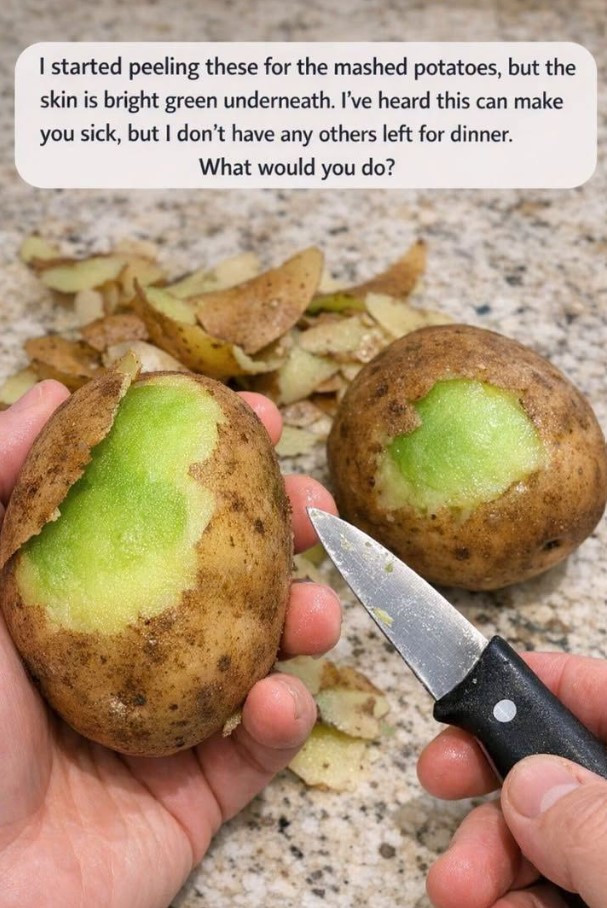
Imagine you’re already halfway through making dinner.
The meat is cooking, the butter is sitting on the counter, and you’re reaching for the potatoes because mashed potatoes are supposed to be the easy part of the meal.
Then you peel one.
Instead of finding the familiar white or creamy-yellow flesh underneath the skin, you notice a surprisingly bright green layer.
At first, you might assume it’s nothing serious. Potatoes can have odd spots, small blemishes, or areas of discoloration. But then you remember something you’ve heard before: green potatoes can sometimes contain compounds that can make people sick.
Now you’re standing in the kitchen with a pile of potatoes, no backup ingredients, and dinner depending on them.
So what should you actually do?
The answer isn’t quite as simple as “green means poisonous” or “just peel it and everything is fine.” The important thing is to understand why the potato turned green, how extensive the discoloration is, and whether the green extends into the flesh.
Why Do Potatoes Turn Green?
The green color itself isn’t a poison.
Potatoes contain chlorophyll, the same natural pigment responsible for the green color in many plants. When a potato is exposed to light, it can begin producing chlorophyll, causing the skin to develop a green appearance.
The concern is that the same conditions that encourage greening can also be associated with increased levels of naturally occurring glycoalkaloids, including solanine and chaconine.
These compounds are part of the potato’s natural defense system.
So the green color isn’t necessarily the dangerous substance itself. Rather, it can serve as a warning sign that the potato may contain elevated levels of these compounds.
That’s why a green potato deserves a closer inspection rather than being automatically treated as harmless.
The First Thing to Do: Look at How Much Green You See
Before deciding what to do with the potatoes, examine them carefully.
There’s a big difference between finding a small green patch near the skin and discovering that the potato is green throughout a substantial portion of its flesh.
If the discoloration is limited to a small area, you may be able to remove the affected section generously and inspect what remains.
The USDA notes that green potatoes don’t necessarily have to be thrown away when the affected tissue is limited. Removing the skin, sprouts, and green portions can reduce the affected material.
But if the potato is heavily green or green beneath the skin, the safer choice is to discard it.
I wouldn’t try to rescue a potato that remains noticeably green after peeling and trimming.
What About the Green Skin Underneath?
This is where the situation becomes more important.
Sometimes the outside of a potato doesn’t look particularly alarming. You peel it, however, and discover that the flesh directly beneath the skin has a green tint.
That means the discoloration isn’t simply sitting on the outer surface.
At that point, I’d stop and inspect the entire potato.
Cut away the affected area generously. If the remaining potato is completely normal in color and the green portion was confined to a relatively small area, some food-safety guidance considers the remaining portion usable after the affected tissue is removed.
But if the green extends deeply into the potato or appears over a large portion of it, there’s little reason to take the chance.
Dinner can be replaced.
Your health is harder to replace.
Why Solanine Gets So Much Attention
Solanine is one of the naturally occurring glycoalkaloids associated with green or sprouted potatoes.
In excessive amounts, these compounds can cause unpleasant symptoms affecting the digestive and nervous systems.
Possible symptoms include:
- Nausea
- Vomiting
- Abdominal discomfort
- Diarrhea
- Headache
- Dizziness
- Confusion
- Weakness
Symptoms can develop within several hours, although the timing can vary. More serious exposures can require medical attention.
The important point is that you shouldn’t panic simply because you see a little green.
At the same time, you shouldn’t deliberately eat heavily green potatoes just because you don’t have another side dish available.
Does Peeling Make a Green Potato Safe?
Peeling can significantly reduce the amount of glycoalkaloids when the affected compounds are concentrated near the skin.
That is why removing the skin and cutting away green areas is an accepted approach for potatoes with limited, superficial greening.
But peeling isn’t a magic solution.
If the potato remains green after you’ve removed the skin, that’s a different situation.
And if removing all of the green would leave you with only a small fraction of the potato, I’d throw it away rather than trying to salvage it.
A useful rule is simple:
Small, superficial green area: remove it generously and inspect.
Extensive or deep green discoloration: discard the potato.
Don’t Rely on Cooking to Fix the Problem
This is one of the most important points.
You might assume that boiling, baking, frying, or mashing the potatoes will make the problem disappear.
Unfortunately, cooking isn’t a reliable way to eliminate potato glycoalkaloids. Food-safety sources specifically caution that cooking does not destroy these compounds sufficiently to make heavily affected potatoes safe.
So don’t think:
“I’ll just boil them really well.”
That’s not the right strategy.
The better strategy is to remove the affected tissue before cooking—or discard the potato if the greening is extensive.
What If the Potato Tastes Bitter?
A bitter taste is another warning sign.
Potatoes with elevated glycoalkaloids can have a noticeably bitter taste, although taste should not be used as a test for safety.
In other words, you shouldn’t take a bite of a questionable potato just to determine whether it’s safe.
If you’ve already cooked a potato and it tastes unusually bitter, stop eating it rather than trying to convince yourself that the flavor is simply unusual.
A bitter or unpleasant potato combined with significant greening is a particularly good reason to throw it away.
What About Sprouted Potatoes?
Greening isn’t the only thing worth watching.
Sprouts are another indication that the potato has begun changing physiologically, and glycoalkaloids can be concentrated around the eyes and sprouts.
A firm potato with a small amount of sprouting may sometimes be salvaged by removing the sprouts and affected areas thoroughly.
But if the potato is heavily sprouted, shriveled, soft, rotten, or significantly green, it’s better to discard it.
In other words, don’t judge the potato based on one characteristic alone.
Look at the whole picture.
What I Would Do If These Were My Potatoes
If I were standing in the kitchen with potatoes that had just revealed a green layer under the skin, I wouldn’t immediately throw every potato into the trash.
I’d inspect them individually.
For a potato with a small, localized green area, I’d peel it thoroughly and cut away the green section and some surrounding flesh. I’d then inspect the remaining potato carefully.
If the potato looked completely normal afterward, I would be comfortable using the unaffected portion based on established food-safety guidance.
But if a potato were green over a large area, remained green after peeling, had extensive sprouts, was soft or shriveled, or otherwise looked questionable, I’d toss it.
Even if it meant changing dinner.
That’s especially true if you’re cooking for children, older adults, or anyone who may be more vulnerable to foodborne or toxin-related illness.
What If You Have No Other Potatoes?
This is where the dinner dilemma becomes real.
Maybe you’ve already started cooking the rest of the meal.
Maybe the grocery store is closed.
Maybe mashed potatoes were the centerpiece of the dinner.
It can be tempting to think:
“I don’t have anything else, so I’ll just use them.”
But you don’t actually need potatoes to make a satisfying dinner.
Depending on what you have available, you could substitute:
- Mashed sweet potatoes
- Mashed cauliflower
- Mashed parsnips
- Mashed turnips
- Rice
- Pasta
- Couscous
- A simple vegetable side
- Bread or rolls
You might not get the exact meal you planned, but that’s preferable to knowingly using potatoes that appear significantly affected.
Sometimes the easiest solution is simply changing the menu.
How to Store Potatoes So They Stay Healthy
Preventing greening starts with proper storage.
Light is one of the biggest factors involved in potato greening, so potatoes should be stored somewhere cool, dark, and well ventilated.
A dark pantry or suitable storage area is generally preferable to leaving potatoes exposed on a bright kitchen counter.
Avoid storing them in a place where sunlight or strong artificial light reaches them for long periods.
It’s also a good idea to inspect potatoes when you purchase them.
If you notice significant green areas already present in the store, choose another bag or individual potatoes when possible.
Why Potatoes Can Green Before You Even Buy Them
You might assume that green potatoes only happen because you’ve stored them incorrectly at home.
That’s not necessarily true.
Potatoes can be exposed to light at multiple stages—from growing in the field to being stored, transported, displayed at the grocery store, and eventually sitting in your kitchen.
Even transparent packaging can allow light to reach the potatoes.
So discovering a green potato doesn’t automatically mean you’ve done something wrong.
It can happen before the potatoes ever reach your kitchen.
What If Someone Already Ate the Green Potato?
Don’t panic.
Eating a small amount of a potato with minor greening does not automatically mean someone will become ill.
The risk depends on factors including the concentration of glycoalkaloids and the amount consumed.
However, if someone develops symptoms such as persistent vomiting, significant diarrhea, severe abdominal pain, confusion, marked weakness, or difficulty breathing after eating questionable potatoes, medical advice should be sought promptly.
For a suspected poisoning, contact your local poison-control service or emergency medical service for guidance appropriate to your location.
Don’t deliberately wait for severe symptoms before asking for help.
The Biggest Mistake to Avoid
The biggest mistake isn’t noticing that your potato is green.
It’s seeing significant greening and deciding to ignore it because you don’t have another option.
A green potato isn’t automatically dangerous, but substantial greening is a reason to pay attention.
If the affected portion is small and superficial, careful removal may be enough.
If the potato is extensively green or remains green beneath the skin, throwing it away is the more sensible choice.
And remember: don’t use cooking as a substitute for removing the affected parts.
Final Thoughts
Finding bright green underneath a potato’s skin can definitely make you pause in the middle of dinner preparation.
The good news is that you don’t need to panic every time you see a small green patch.
The green color itself comes from chlorophyll, which isn’t toxic. The concern is that greening can occur alongside increased levels of naturally occurring glycoalkaloids such as solanine.
That’s why the safest approach is to inspect the potato carefully.
If the green area is small and limited to the surface, remove the skin and generously cut away the affected portions. Then make sure the remaining potato looks completely normal.
But if the green discoloration is extensive, extends deeply into the flesh, or appears alongside significant sprouting, softness, shriveling, rot, or an unusually bitter taste, don’t try to rescue it.
Throw it away.
It may be disappointing to lose part of your dinner ingredients, especially when you’re already hungry and don’t have a backup plan. But there are plenty of ways to improvise a side dish.
The next time you’re shopping for potatoes, take a quick look before putting them in your cart. Once you bring them home, keep them in a cool, dark, well-ventilated place and check them again before cooking.
A few seconds of inspection can save you from an unnecessary food-safety gamble.
And when you’re standing in the kitchen wondering whether that bright green potato is worth the risk, remember the simplest rule of all:
If the greening is extensive or you’re unsure, it’s better to replace the potato than to gamble with your health.