Think you have a sharp eye for detail?
Then this snowy picture puzzle might be just the challenge you need.
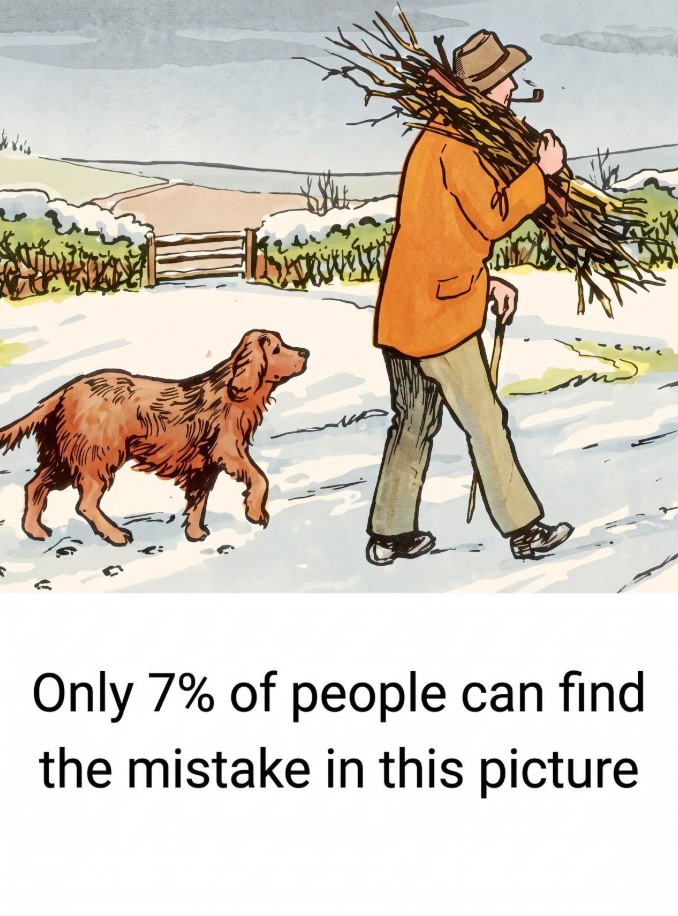
At first glance, the scene looks completely ordinary. A man is walking through a quiet snow-covered countryside with his dog. There is a fence in the distance, an open field stretching beyond it, and thick snow covering the ground.
Nothing seems unusual.
The man appears to be carrying a bundle of wood, perhaps returning home after gathering firewood. He has a cane in one hand and a cigar in his mouth, giving the picture an old-fashioned countryside atmosphere.
His dog is walking beside him.
The landscape is peaceful.
The snow appears untouched in many places.
But somewhere in this seemingly simple picture is a mistake.
And it is not necessarily the kind of mistake you notice immediately.
The clue is hiding down at ground level.
Can you find it before reading the answer?
Take a moment and study the picture carefully.
Don’t just look at the man.
Don’t just look at the dog.
Instead, pay attention to what both of them are leaving behind as they move through the snow.
A Little Nostalgia
Picture puzzles like this have been entertaining people for generations.
Long before social media feeds were filled with visual challenges, people could find similar puzzles in newspapers, magazines, children’s books, and puzzle collections.
They were simple in appearance but surprisingly effective at grabbing your attention.
You might look at an illustration for a few seconds and think everything was normal.
Then someone would point out one tiny detail.
Suddenly, you couldn’t understand how you had missed it.
That is part of what makes visual puzzles so enjoyable.
They encourage us to slow down.
Instead of quickly looking at the entire image, we have to examine individual details and ask whether everything actually makes sense.
This snowy scene uses exactly that idea.
It gives you a familiar winter landscape and hides the important clue somewhere you might normally ignore.
The Scene Looks Completely Normal
At first glance, there is nothing particularly strange about the picture.
The countryside is covered in snow.
A man is walking along a path.
His dog is following alongside him.
A fence runs through the background, separating different parts of the landscape.
The open countryside continues beyond the fence.
The man appears to be carrying a bundle of wood, suggesting that he may be heading home to use it for heating.
He also has a cane in one hand.
A cigar hangs from his mouth, adding to the old-fashioned character of the illustration.
The dog appears relaxed as it walks beside him.
Everything seems to fit together.
There is nothing obviously impossible about the scene.
But visual puzzles are designed to make you look at the bigger picture first.
The mistake is usually hidden in one of the smaller details.
And in this case, the snow itself holds the clue.
Don’t Focus Only on the Man
When people look at a picture like this, they naturally focus on the main character.
The man is the largest and most noticeable object in the scene.
You might examine his clothing, the wood he is carrying, his cane, or even the cigar.
You may also look toward the fence and the distant landscape.
But the important detail is much closer to the ground.
Try following the man’s path through the snow.
Where has he walked?
What marks should his feet have left behind?
Now compare that with the path taken by the dog.
This is where the puzzle begins to reveal itself.
Look at the Snow Around Their Feet
Snow makes visual puzzles especially interesting because it records movement.
When someone walks across fresh snow, their feet normally leave footprints.
The same principle applies to animals.
A dog walking through deep or soft snow should also leave marks behind.
Those tracks provide information about where the person or animal has been.
That’s why the footprints in this picture are so important.
The man and the dog are walking through the same snowy environment.
They are close to one another.
Yet the marks they leave behind do not appear to behave as you would naturally expect.
Something about the footprints doesn’t match the way the scene is supposed to work.
And once you notice that detail, the illusion becomes much easier to understand.
Can You Find the Mistake in 15 Seconds?
Before continuing, give yourself one more chance.
Look at the picture again.
Ignore the man’s face.
Ignore the fence.
Ignore the bundle of wood.
Ignore the background.
Focus only on the snow.
Now follow the path beneath the man and the dog.
Ask yourself:
Where are the footprints?
And more importantly:
Do the footprints make sense?
Many people look at the entire image without noticing the small marks on the ground.
That’s exactly what makes the puzzle effective.
Our brains are very good at recognizing familiar scenes.
When we see a person walking a dog through the snow, we automatically understand the situation without consciously checking every detail.
We see “man walking dog.”
We see “winter.”
We see “snow.”
And because the overall scene makes sense, our brains tend to overlook the small inconsistency.
Why Footprints Are Such a Good Puzzle Clue
Footprints might seem like an insignificant detail, but they can completely change the meaning of a snowy picture.
Snow acts almost like a record of everything that happens on its surface.
A person walking across it leaves a pattern.
A dog creates another pattern.
Someone dragging an object creates another.
If the snow is deep enough, these marks should remain visible unless something has disturbed or covered them.
That gives artists an opportunity to create hidden mistakes.
A picture can look realistic at first while containing an impossible relationship between the footprints and the characters.
That’s what makes this puzzle different from a simple “find the hidden object” challenge.
You aren’t necessarily searching for something that doesn’t belong.
You’re looking for something that doesn’t behave the way it should.
The Hint
Still having trouble?
Here’s the clue without making the answer too obvious:
Look closely at the footprints.
Don’t just count them.
Follow their direction.
Compare the marks made by the dog with the marks that should have been made by the man.
Ask yourself whether both sets of tracks match the positions of their feet.
Sometimes the easiest way to solve a visual puzzle is to stop asking, “What am I looking at?”
Instead, ask:
“What should happen here in real life?”
That change in perspective can reveal the mistake.
The Answer: Look at the Footprints
The hidden mistake is connected to the footprints in the snow.
The man and the dog are traveling through the same snowy landscape, but the tracks shown beneath them do not correspond naturally with their movement.
The footprints are the detail that breaks the realism of the scene.
At first, your eyes are drawn to the characters and the beautiful winter landscape.
But once you concentrate on the ground, the inconsistency becomes much easier to spot.
That’s the trick.
The puzzle doesn’t require complicated knowledge.
You simply have to notice that the snow should record their movements differently.
Why We Miss Small Details
There is a reason these puzzles can feel surprisingly difficult.
Our brains don’t examine every visual detail equally.
When we look at a familiar scene, we quickly identify the overall situation.
We recognize a person.
We recognize a dog.
We recognize snow.
We recognize a path.
Once the scene feels familiar, our brains tend to fill in the details automatically.
This is useful in everyday life because we don’t need to consciously analyze every object around us.
But it can work against us in a puzzle.
The artist knows that you’ll probably look at the scene as a whole.
That’s why the mistake is placed somewhere easy to overlook.
The Importance of Slowing Down
One of the best ways to solve visual puzzles is simply to slow down.
Instead of scanning the entire picture repeatedly, divide it into sections.
Start with the foreground.
Then examine the people.
Next, look at the objects around them.
Finally, check the background.
In this puzzle, the foreground is particularly important because that’s where the footprints appear.
You can also mentally ask questions about cause and effect.
If the man walked here, where should his footprints be?
If the dog walked there, what should its tracks look like?
If the snow is undisturbed, why are certain marks present or missing?
These questions can help reveal inconsistencies much faster.
Why Old-Fashioned Picture Puzzles Remain Popular
There is something satisfying about this type of puzzle.
It doesn’t require a phone app, complicated instructions, or special equipment.
All you need is a picture and a few minutes.
That’s probably one reason similar puzzles have appeared in magazines and newspapers for so many years.
They are accessible to almost everyone.
A child can try to solve one.
An adult can challenge a friend.
Families can look at the same picture and see who notices the mistake first.
And because the answer is usually based on observation rather than specialized knowledge, solving it can feel particularly rewarding.
A Simple Scene Can Hide a Clever Trick
The snowy countryside in this puzzle is deliberately ordinary.
That is what makes it effective.
If the scene were filled with strange objects, your attention would immediately be drawn toward them.
Instead, everything looks calm and familiar.
A man.
A dog.
Snow.
A fence.
A bundle of wood.
A quiet countryside path.
There appears to be nothing to investigate.
Until you look down.
That’s an important lesson for visual puzzles in general.
The most obvious part of a picture isn’t always where the answer is hiding.
Sometimes the smallest detail carries the entire puzzle.
Did You Spot It Quickly?
If you noticed the footprint problem within a few seconds, you probably paid close attention to the details rather than simply looking at the overall picture.
If you didn’t see it right away, don’t worry.
That’s exactly how these puzzles are designed.
The goal isn’t necessarily to prove that someone has better eyesight or a better memory.
It’s about changing the way you look at an image.
Once someone points out the clue, it suddenly seems obvious.
That is one of the most enjoyable parts of visual puzzles.
You can stare at a picture for a long time without seeing anything unusual.
Then, after discovering the answer, you wonder how you ever missed it.
The Real Challenge Is Observation
This snowy scene is a reminder that observation is different from simply looking.
Looking means seeing the picture.
Observation means questioning what you’re seeing.
The difference may seem small, but it matters.
When you observe carefully, you begin noticing relationships between objects.
You notice where something should be.
You notice where something shouldn’t be.
You notice whether an action has produced the expected result.
In this case, the snow provides the evidence.
The footprints tell the story.
And the inconsistency in those tracks is what gives away the mistake.
Conclusion :
Can You Spot the Mistake in This Snowy Scene?
The answer is hidden in one of the simplest parts of the picture: the footprints in the snow.
At first, the scene looks like an ordinary winter moment. A man walks along a snowy path with his dog while carrying a bundle of wood. A fence stretches across the countryside, and everything appears peaceful and perfectly natural.
But when you stop looking at the overall picture and concentrate on the ground, something doesn’t add up.
The tracks left by the man and the dog don’t correspond naturally with the way they are moving through the snow.
That small inconsistency is easy to overlook because our brains tend to focus on the main subjects of a picture rather than the tiny details surrounding them.
And that’s exactly what makes this puzzle so clever.
It reminds us that sometimes the answer isn’t hiding in the obvious places. A seemingly insignificant detail can completely change the way we understand an entire scene.
So the next time you come across a visual puzzle, don’t rush.
Look at the big picture first, but then slow down.
Check the ground.
Check the shadows.
Check the objects.
Check whether the actions in the picture actually make sense.
Because sometimes the smallest detail is the one that gives everything away.