His hand moved toward the keys again.
I watched his fingers coming across the edge of the bedside table, and for one terrifying second, my body reacted before my mind did.
I wanted to pull away.
I wanted to apologize.
I wanted to tell him he could have them if it would make him leave.
That was what years of living with him had taught me.
Give him what he wanted.
Avoid the argument.
Make yourself smaller.
But before his fingers reached the key ring, the doctor stepped between us.
He didn’t shout.
He didn’t threaten him.
He simply stood there, blocking his path.
“She said no,” the doctor said calmly. “Those keys stay with her.”
The room went completely quiet.
I stared at the doctor’s back.
It was such a simple sentence.
But I could hardly remember the last time someone had treated my “no” as a complete answer.
My husband gave a short laugh.
It wasn’t the friendly laugh he had used earlier when trying to convince the nurses that I was confused.
This laugh was colder.
“Fine,” he said. “Keep the keys. See how far that gets you.”
The nurse stepped toward him.
“You need to leave.”
He looked at her, then at the doctor, and finally at me.
For a moment, I saw the expression I knew better than any other.
His face became still.
His jaw tightened.
The softness disappeared.
That was the look he wore whenever something he believed he controlled suddenly stopped obeying him.
For years, I had learned to recognize his moods before they became dangerous.
I noticed the way his breathing changed.
The way his footsteps became heavier.
The way he placed objects down too hard.
The way silence itself could become a warning.
I had spent years studying him.
But that day, lying in that hospital bed, I realized something.
I had spent so much time figuring out what he needed that I had forgotten to ask myself what I needed.
And right now, I needed those keys.
Not because I planned to return to the house.
Not because a scratched piece of metal could magically make me safe.
I needed them because they belonged to me.
And for once, when he reached for something that belonged to me, another person stopped him.
He finally turned toward the hallway.
Before leaving, he looked back at me.
“You’ll call me.”
I said nothing.
The nurse waited until his footsteps disappeared down the corridor.
Then she closed the door.
Only after he was gone did my hands begin to tremble.
The keys were still lying on the table.
I tried to reach for them, but a sharp pain shot through my back.
The doctor immediately stopped me.
“Don’t twist.”
The nurse carefully picked up the key ring and placed it in my palm.
The metal felt strangely cold.
I closed my fingers around it.
And then I started crying.
Not loudly.
There was no dramatic breakdown.
I simply lay there with tears sliding toward my ears while I held those keys against the blanket.
The doctor gave me a moment.
Then he sat beside the bed.
“Do you want to continue documenting what happened?”
“Yes.”
The answer came faster than before.
So I told him everything.
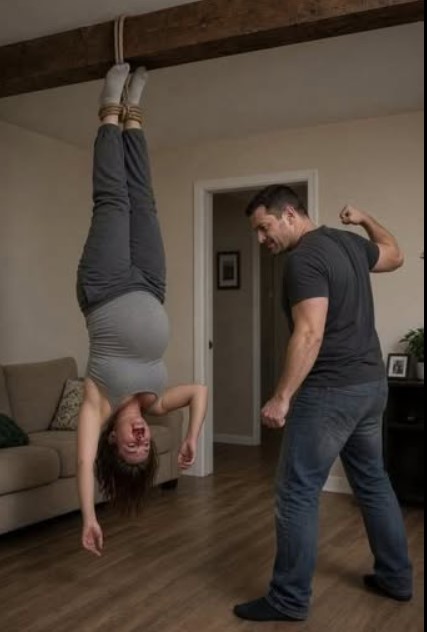
I told him about the ceiling beam.
I told him about being suspended upside down.
I told him how he had beaten my swollen stomach because he wanted a son.
I told him what he had said.
I told him how the pain became unbearable.
I told him about the blood.
I told him about losing consciousness.
I told him that when I woke up, I learned that the baby I had been carrying was gone.
The doctor didn’t interrupt unless he needed clarification.
He didn’t change my words.
He didn’t tell me to calm down.
He simply listened and documented what I said.
That difference meant more than I could explain.
At home, every disagreement eventually became a trial.
He decided what had happened.
He decided what I had meant.
If I said I was frightened, I was dramatic.
If I said something hurt me, I was exaggerating.
If I remembered something cruel, he told me I had misunderstood.
After enough years of that, I stopped trusting my own memory.
But the hospital chart didn’t depend on his approval.
The scans didn’t change because he sounded calm.
My injuries didn’t disappear because he called what happened an accident.
And the baby I had been carrying was gone.
That was the fact I couldn’t escape.
I had heard the doctor’s words when I first woke up.
The fetus was dead.
My spine had been damaged.
But understanding something and accepting it emotionally are two different things.
I turned toward the wall.
There would be no movement beneath my hand later.
No future appointment where someone would tell me the pregnancy was progressing normally.
No moment when I would hear a heartbeat again.
The future I had imagined had disappeared in a single violent act.
The nurse noticed the way I was holding the keys.
She didn’t tell me to be strong.
She didn’t tell me everything happened for a reason.
She simply adjusted the blanket around my shoulders.
“Would you like the room quieter for a while?”
“Yes.”
Another complete answer.
Another answer that nobody tried to argue with.
The doctor left after telling me that the medical team would continue treating my injuries.
Before he went, he explained that anything I wanted documented in my own words would remain clearly identified as my account.
Then the room became quiet.
A monitor continued its steady rhythm.
Footsteps passed outside.
Someone pushed a cart down the hallway.
The fluorescent lights remained painfully bright.
The world hadn’t stopped because mine had fallen apart.
People were still changing shifts.
Cups were still being carried down hallways.
Blankets were still slipping from patients’ shoulders.
The ordinary world continued.
Strangely, that helped.
Maybe one day I could continue too.
Later, the nurse came back and asked me what should happen if my husband returned.
A few hours earlier, I would have looked at her face searching for the safest answer.
This time, I understood something.
She wasn’t asking what he wanted.
She was asking what I wanted.
“Don’t let him in.”
She nodded.
“And don’t tell him where I’m going when I leave.”
She wrote that down.
The word “leave” sounded almost impossible.
At that moment, I couldn’t sit up without assistance.
I couldn’t imagine walking out of the hospital and starting another life.
But nobody demanded that I solve my entire future that day.
I only had to protect the next hour.
That mattered.
For years, my husband had used the size of leaving against me.
Where would I sleep?
How would I pay for things?
Who would help me?
Where would I go?
What would people say?
How would I explain everything?
Every unanswered question became another reason to stay.
But in the hospital, I began handling those questions differently.
I stopped trying to solve all of them at once.
Where would I sleep tonight?
Somewhere he didn’t choose.
Who would speak for me?
I would, whenever I could.
Who would decide whether he entered my room?
I would.
Who had the keys?
I did.
The answers were small.
But together, they became something bigger.
They became the beginning of control over my own life.
The next day, the pain was still there.
My injuries had not disappeared overnight.
The doctors explained that my spine would require follow-up care.
My body needed time to heal.
There were things I could not safely do alone.
I listened carefully.
For years, limitations had meant obedience.
Now the limitations were different.
They were medical.
They were about protecting my body rather than controlling my choices.
And for the first time, being told to rest did not feel like being ordered around.
It felt like care.
The hospital staff also helped me think through what would happen when I was discharged.
They didn’t force me to make decisions about the next five years.
They focused on the immediate future.
I would not leave with him.
He would not be given my destination.
He would not make decisions for me simply because he was my husband.
I kept expecting someone to ask if I was sure.
Sure enough to lose the house?
Sure enough to make him angry?
Sure enough to tell people what had really happened?
Nobody asked me that.
Instead, they asked practical questions.
Was there somewhere I could go where I felt safe?
Did I want him contacting me?
Was there anything he controlled that I would immediately need?
That final question made me look down at the keys.
The little plastic tag attached to them was scratched and worn.
They were ordinary keys.
They had opened the front door for years.
They had been with me when I went grocery shopping.
They had been in my pocket during appointments.
They had sat beside me while I searched for them in the dark.
I had never thought of them as important.
But now I understood something.
Control doesn’t always look dramatic.
Sometimes it looks like someone deciding who gets the keys.
Who keeps the documents.
Who talks to the doctor.
Who answers questions.
Who is allowed to leave.
Who can enter the home.
Who has to ask permission.
The violence that had brought me to the hospital was extreme.
But the road toward that moment had been built from smaller acts of control.
Things I had surrendered because surrender seemed easier than another argument.
I understood that only after he reached for those keys beside my hospital bed.
He couldn’t call that love.
He couldn’t call it concern.
I had already said no.
He reached anyway.
And this time, someone witnessed it.
The doctor had seen it.
The nurse had seen it.
But more importantly, I had seen it.
I hadn’t immediately made excuses for him.
I hadn’t wondered whether I was being unfair.
I hadn’t apologized.
Something inside me had changed.
The grief didn’t disappear.
If anything, it became sharper.
There were moments when I would wake from shallow sleep and, for a few seconds, forget what had happened.
My body seemed to remember the pregnancy even when my mind knew it was over.
For one brief moment, I would expect everything to still be normal.
Then the memory returned.
The baby was gone.
I hated those moments.
I hated how hope could appear before reality caught up.
I hated that my body could remember a future that no longer existed.
There was nothing beautiful about that grief.
It was simply grief.
I didn’t need to turn it into a lesson.
I didn’t need to pretend it had made me stronger.
I simply needed to survive it.
But I could decide what happened around that grief.
I could decide who came near me.
I could decide who spoke for me.
I could decide what went into my medical record.
And I could decide that the person responsible for my terror would not also become the person responsible for comforting me afterward.
That realization was painful.
But it was also freeing.
For years, every crisis ended with him becoming necessary again.
He would frighten me and then tell me I was safe with him.
He would create problems and then present himself as the only person capable of fixing them.
He would make home unbearable and then remind me that I had nowhere else to go.
The cycle depended on one belief:
That no matter what he did, eventually I would need him more than I feared him.
The hospital interrupted that cycle.
Not because the doctor solved my life.
Not because the nurse could erase what had happened.
They did something much smaller.
They stopped handing my decisions back to him.
When I said no, they treated no as meaningful.
When I asked for my account to be documented, the doctor wrote it down.
When I said I didn’t want him making decisions for me, they respected that.
When I wanted the keys, the keys stayed with me.
Their actions gave me enough space to hear my own voice again.
Days later, I was finally ready to leave the hospital under a discharge plan that did not involve getting into my husband’s vehicle or telling him where I was going.
The nurse brought my belongings to the bed.
There wasn’t much.
My clothes.
A few personal things.
The medical paperwork.
And the keys.
I held the key ring for a long moment.
I still didn’t know exactly what would happen to the house.
I didn’t know what the next conversation with my husband would look like.
I didn’t know how long my back would hurt.
I didn’t know what recovery would demand from me.
I didn’t know when the grief would become easier to carry.
There were still far more questions than answers.
But uncertainty no longer sounded like his voice telling me I had to return.
For the first time, uncertainty sounded like open space.
The nurse helped me prepare to leave.
When the door opened, I instinctively looked toward the hallway.
He wasn’t there.
My body still reacted as though he might appear.
My shoulders tightened.
My heartbeat quickened.
Then I looked at the people beside me.
The hallway was clear.
Nobody was blocking my way.
I moved slowly because my body required me to.
Not because someone had ordered me to.
That difference was almost invisible to anyone watching.
But I felt it.
Every careful step was mine.
Before leaving the room, I touched the pocket where I had placed the keys.
Once, those keys had simply meant access to a house.
A house where another person had made me feel as though I needed permission to exist.
Now they meant something much simpler.
They were mine.
I didn’t know which door they would open next.
Maybe a temporary room.
Maybe a new apartment.
Maybe, someday, a home that belonged entirely to me.
I didn’t know.
And for the first time, I didn’t need to know yet.
I only needed to know that I was leaving.
I was choosing where to go.
I was choosing who could speak to me.
I was choosing who could come near me.
And I was finally beginning to understand that saying no did not make me cruel, selfish, or disobedient.
It made me heard.
The doctor had drawn the line that day when he stood between my husband and those keys.
But the line didn’t stay on the hospital floor.
I carried it with me when I left.
And for the first time in years, I understood that the line was mine to keep.