The next morning, I returned to my house with one thought in my mind.
I was going to find out exactly what they had done.
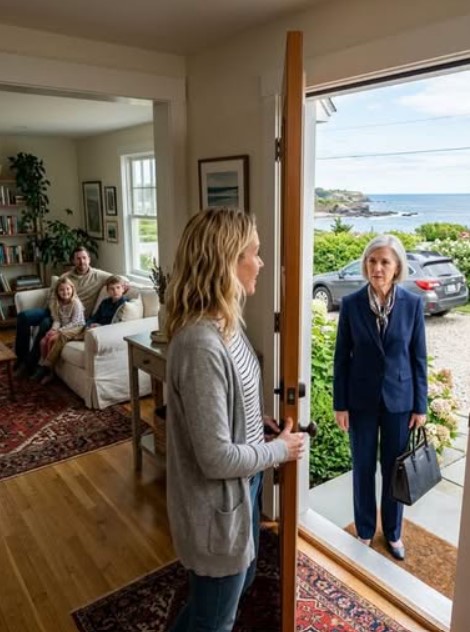
I parked across the street instead of in the driveway.
For a moment, I simply sat there.
The ocean was gray beneath the January sky, and the wind pushed dried leaves along the sidewalk.
This was the house I had worked for.
The house where Winston and I had spent our happiest summers.
The house where Peter had once built sandcastles as a little boy.
And now I was sitting outside it like a stranger.
I took my keys from my purse.
Then I tried the front door.
The key didn’t turn.
I tried again.
Nothing.
My heart began beating faster.
They had changed the locks.
I stood there staring at the brass lock that had not been there when I left Philadelphia.
That was when I understood that Tiffany hadn’t simply been rude.
She had planned this.
I walked around to the side gate.
Fortunately, the old latch was still the same.
I opened it quietly and moved toward the kitchen.
A window was slightly open.
Then I heard voices.
Tiffany.
And another woman.
I stopped.
“You said Peter already handled everything,” the woman was saying.
“He did,” Tiffany answered. “The paperwork is being processed.”
“What about Rosalind?”
There was a short silence.
Then Tiffany laughed.
“She won’t know what happened until it’s too late.”
I felt the blood drain from my face.
I moved closer.
“What if she refuses to cooperate?” the other woman asked.
“She won’t.”
“How can you be so sure?”
“Because Peter knows his mother. She hates conflict. She’ll complain for a day, maybe two, and then she’ll give up.”
I gripped the edge of the window.
They were talking about me as though I were a problem they had already solved.
Then Tiffany said something that made my stomach turn.
“The conservatorship papers are almost ready.”
I closed my eyes.
Conservatorship.
That was the word I needed to hear.
Not because I fully understood what they were planning, but because I knew enough to realize the danger.
They weren’t trying to borrow my house.
They were trying to take control of my life.
I waited until their conversation moved deeper into the kitchen.
Then I slipped through the side door.
The house was a mess.
Suitcases were stacked beside my dining table.
Someone had moved my photographs.
My sewing basket was sitting on the floor.
And on the counter was a pile of papers.
I picked them up.
The first page was a real estate valuation.
The second was a proposed listing agreement.
The third was a document containing my name.
I read it twice.
Then a third time.
My house was being prepared for sale.
But the final page was the one that made my hands shake.
It was a draft petition suggesting that I was no longer capable of managing my own affairs.
There were references to supposed forgetfulness.
Poor financial judgment.
Confusion.
Aging.
I knew immediately where they had gotten those examples.
The time I had forgotten my pharmacy pickup.
The afternoon I had misplaced my glasses.
The time I had accidentally left my phone charger in a hotel room.
Ordinary mistakes had been collected and rearranged into evidence.
Evidence that I was supposedly incapable of taking care of myself.
And Peter’s name was attached.
My own son.
I put the papers back exactly where I had found them.
Then I walked out.
I didn’t confront Tiffany.
Not yet.
I had learned something during the years after Winston died.
When people underestimate you, don’t correct them too quickly.
Let them continue believing you don’t understand what they’re doing.
I drove straight into town.
There was one person I trusted enough to call.
Her name was Mara Quinn.
Mara was a real estate attorney I had known for years.
I had altered her daughter’s prom dress once, years earlier, when the girl had accidentally ripped the entire side seam two days before the dance.
Mara had never forgotten it.
She answered immediately.
“Rosalind?”
“I need your help.”
My voice must have sounded different because she didn’t ask unnecessary questions.
“Come to my office.”
I arrived twenty minutes later.
I placed the documents on her desk.
She read them slowly.
Then she looked at me.
“Who prepared these?”
“I don’t know.”
“Does Peter have power of attorney over you?”
“No.”
“Have you ever signed anything transferring this property?”
“No.”
“Have you ever agreed to sell it?”
“Absolutely not.”
Mara leaned back.
“Then don’t speak to them again until we investigate this.”
I told her everything.
The surprise guests.
Tiffany’s cruel welcome.
The changed locks.
The papers.
The conversation I had overheard.
Mara immediately began making calls.
Within an hour, we discovered something even worse.
Someone had already attempted to record a deed transferring the property.
My property.
To Peter.
I stared at the document.
The signature looked like mine.
But it wasn’t.
I knew every curve of my own handwriting.
That wasn’t my signature.
Someone had copied it.
The notary information was also suspicious.
Mara looked at me.
“Rosalind, this is serious.”
“I know.”
“No. I mean potentially very serious.”
“What do we do?”
“First, we stop the property transfer.”
“And then?”
“We find out exactly why your son is doing this.”
I didn’t need to wait long.
Peter called that evening.
“Mom.”
His voice sounded tired.
“Where are you?”
“I’m at the house.”
“No, you’re not.”
“I was there.”
Silence.
“You found the papers,” he said.
It wasn’t a question.
“Yes.”
Peter exhaled.
“I was going to tell you.”
“When?”
“Soon.”
“Before or after you sold my house?”
“That’s not what this was.”
I closed my eyes.
“Then tell me what it was.”
He didn’t answer.
“Peter?”
Finally he said, “I needed money.”
The words were so quiet I almost didn’t hear them.
“How much?”
“A lot.”
“What happened?”
He told me about an investment.
A business venture that had failed.
Debts had accumulated.
Creditors were calling.
He had borrowed money from people he shouldn’t have.
And somewhere along the way, he had convinced himself that my house was the solution.
“You could have asked me,” I said.
“I knew you’d say no.”
“You didn’t even give me the chance.”
“I was embarrassed.”
“So you forged my signature?”
“I didn’t personally forge it.”
That answer hurt more than if he had simply admitted it.
“You let someone else do it.”
He said nothing.
“And the conservatorship?”
Peter’s voice became defensive.
“That was Tiffany’s idea.”
“But you signed it.”
Another silence.
I finally understood.
Tiffany may have designed the trap.
But Peter had walked into it willingly.
“You didn’t just want my house,” I said.
“What?”
“You wanted everyone to believe I wasn’t capable of keeping it.”
“Mom, that’s not—”
“I heard her.”
He stopped.
I could hear his breathing.
“I heard everything.”
Peter’s voice cracked.
“Mom, please.”
I had imagined this moment.
I had imagined screaming.
Calling him names.
Demanding an explanation.
Instead, I felt strangely calm.
“From now on, Peter, you don’t speak to me about the house.”
“Mom—”
“You speak to my attorney.”
I ended the call.
The following Monday, Mara and I went to court.
I was prepared to defend myself.
I was prepared to defend my home.
But I wasn’t prepared for Peter to walk into the courtroom looking like a completely different man.
He had lost weight.
His expensive coat hung loosely from his shoulders.
Tiffany was beside him.
She looked confident.
Until she saw the evidence.
Mara presented the forged deed.
Then the property records.
Then the financial documents showing Peter’s debts.
Then the messages between Peter and Tiffany discussing the property.
Finally, there was the conservatorship petition.
The judge examined everything carefully.
When he looked at Peter, his expression had changed.
“Mr. Hale, did you authorize these documents?”
Peter looked at the floor.
“Yes.”
“And did your mother authorize the transfer of her property?”
“No.”
The courtroom became completely silent.
I looked at my son.
He wouldn’t look at me.
The judge rejected the attempt to transfer control of my property and ordered an investigation into the forged documents.
The house was protected.
My name remained on the title.
And the conservatorship petition was dismissed.
When we walked outside, Peter finally approached me.
“Mom.”
I stopped.
He stood several feet away.
“I know I don’t deserve forgiveness.”
I said nothing.
“I was scared.”
“So was I.”
He swallowed.
“But I never thought I’d lose you.”
“You didn’t lose me because you needed money, Peter.”
He looked confused.
“You lost me when you decided I was something you could take from.”
His eyes filled with tears.
I could see the little boy he had once been.
The boy who used to run along the beach holding shells in both hands.
For a second, I wanted to hug him.
Then I remembered the changed lock.
The forged signature.
The petition calling me incapable.
I stepped back.
“I’m still your mother,” I said.
“But that doesn’t mean you get to hurt me without consequences.”
Peter nodded.
Tiffany never apologized.
She blamed Peter.
Then she blamed the debt.
Then she blamed me for being “too attached” to a house.
Eventually, she stopped calling.
And strangely, I was grateful.
I changed the locks again.
This time, every single one.
I installed a security system.
I updated my legal documents.
I moved my important papers to a safe deposit box.
And I made one promise to myself.
I would never again confuse being kind with being defenseless.
The house slowly became mine again.
I removed the furniture Tiffany’s family had brought.
I washed every towel.
I cleaned the kitchen.
I repaired the herb garden.
One afternoon, I found a plastic toy buried beneath the hydrangeas.
I smiled.
For the first time, I wasn’t angry.
The toy belonged to one of the children who had been staying there.
I could have thrown it away.
Instead, I placed it in a small box and left it by the front door for Tiffany’s family to collect.
Then I returned to the garden.
The January cold had finally started to fade.
A few tiny green shoots were appearing beneath the soil.
I thought about Winston.
I thought about the years I had spent building this place.
And I realized something.
The house had never really been about the walls.
It represented something much larger.
It represented the life I had rebuilt after losing my husband.
It represented every wedding dress I had stayed up late to finish.
Every uniform I had repaired.
Every dollar I had saved.
Every time I chose independence over fear.
Tiffany had seen a valuable property.
Peter had seen a solution to his debts.
But I had always seen something else.
Home.
That evening, I sat on the terrace with a cup of tea.
The ocean was calm.
The sun was disappearing behind the horizon.
I could hear gulls somewhere in the distance.
My phone buzzed.
A message from Peter.
I am sorry. I know sorry isn’t enough.
I read it.
Then I placed the phone facedown.
I didn’t know whether I would ever forgive him.
Maybe someday.
Maybe not.
But I knew one thing.
Forgiveness would never mean giving someone another opportunity to destroy what I had worked so hard to build.
I had spent twenty years sewing other people’s lives back together.
Now it was time to protect my own.
I looked at the house behind me.
My house.
The house I had rebuilt with my own hands.
The house where Winston’s memory still lived.
The house where I would sleep that night.
Alone, perhaps.
But not defeated.
I smiled.
For the first time since arriving in Newport, I finally felt rested.
Not because the betrayal hadn’t happened.
Not because my son hadn’t broken my heart.
But because I finally understood something I should have understood years ago:
Being a mother does not require you to surrender yourself.
Being seventy does not make you helpless.
And being kind does not mean you have to be easy to take advantage of.
The sea continued moving beyond the dunes.
The wind passed through the garden.
And inside my little seaside house, the lights were warm.
I turned the key in the lock.
This time, I knew exactly who the house belonged to.
Me.
And nobody was ever going to make me feel like an unwanted guest in my own life again.
The End.