What Stuart didn’t know was that the house he was already planning to sell was no longer mine.
And neither was the future he had designed for me.
The Sunday dinner came and went just as I had expected.
Stuart and Jennifer sat across from me, completely convinced they had finally won.
They talked about Cedar Grove.
They discussed the “advantages” of downsizing.
Jennifer even showed me photographs of the apartments.
I nodded.
I asked questions.
I pretended to be interested.
And all the while, I knew the closing date was approaching.
The following Thursday, the Victorian house that had belonged to my family for forty years would officially belong to someone else.
I didn’t feel victorious.
I felt sad.
This had been the house where I had raised Stuart.
It was where Robert and I had celebrated birthdays, Christmas mornings and countless ordinary Tuesday nights that had somehow become precious memories.
Selling it wasn’t revenge.
It was a decision about my future.
I just wished my son hadn’t forced me to make it.
The Last Morning
On the morning of the closing, I woke before sunrise.
For several minutes, I simply lay in bed listening to the quiet.
The house seemed different already.
Maybe it was because I knew I wouldn’t sleep there again.
I got dressed and walked slowly from room to room.
In Stuart’s old bedroom, I remembered him at eight years old, building a blanket fort across the floor.
In the hallway, I remembered measuring his height against the wall every birthday.
In the kitchen, I could almost hear Robert laughing as he tried to teach Stuart how to make pancakes.
So many memories.
So much life.
I placed my hand against the wall.
“Thank you,” I whispered.
Then I walked away.
I had one more thing to do.
Before leaving, I opened the drawer in Robert’s old desk and took out his leather journal.
I had read only a few pages.
One entry stayed with me.
Robert had written about Stuart years before.
He had recognized something I hadn’t wanted to see.
Stuart had learned to expect us to rescue him.
Every time he struggled financially, we helped.
Every time he made a mistake, I found an excuse.
Every time he demanded something, I told myself that was simply what mothers did.
Robert had worried that one day Stuart would stop seeing our help as love and start seeing it as something he was entitled to.
He had been right.
I closed the journal.
“I’m sorry I didn’t listen sooner,” I whispered.
Then I put it into my suitcase.
The House Was Gone
The closing took less than an hour.
The Hendersons were excited.
They talked about where they planned to put their furniture and how they wanted to preserve the stained glass windows.
I watched them smile as they signed the papers.
They weren’t buying a building.
They were buying a home.
That made leaving easier.
When the final document was signed, the lawyer slid the folder toward me.
“It’s official.”
I looked down at the papers.
Forty years of memories had become a transaction.
I took a deep breath.
“Thank you.”
Outside, Mrs. Henderson hugged me unexpectedly.
“I hope you don’t mind me saying this, but we feel incredibly lucky.”
I smiled.
“I think you’ll take good care of it.”
“We will.”
She handed me a small envelope.
Inside was a handwritten note thanking me for trusting them with the house.
There was also a gift certificate to a local garden center.
“For your next garden,” she had written.
I had to blink away tears.
My next garden.
I liked the sound of that.
My Final Message to Stuart
Before leaving, I placed an envelope on the mantel.
It had Stuart’s name on it.
I had thought about writing pages.
I could have listed every insult.
Every time he had asked for money.
Every time Jennifer had made some comment about my age.
Every time I had helped them while they acted as though they were doing me a favor.
But I didn’t.
My letter was short.
I told him that I had sold the house.
I told him I knew about Cedar Grove.
I told him I knew about their plans for the power of attorney.
And I told him I had chosen to leave.
Most importantly, I told him that I wasn’t asking permission.
I was making my own decision.
Then I wrote one final sentence:
I raised you to respect people, especially the people who love you. I hope one day you remember that.
I signed my name.
Mom.
Nothing more.
I left the letter on the mantel.
Then I walked out.
My Last Stop
Before starting the long drive south, I went to the cemetery.
Robert’s grave was beneath a large oak tree.
I brought yellow roses because they had always been his favorite.
I placed them beside his headstone and sat quietly.
“I’m leaving,” I whispered.
The words felt strange.
For five years, I had told Robert about everything.
My worries.
My loneliness.
Stuart.
The grandchildren.
Even small things like what I had cooked for dinner.
Now I was telling him that I was leaving the town we had called home for decades.
“I don’t know what happens next,” I said.
The breeze moved gently through the branches.
“But I know I can’t stay where I’m treated like a burden.”
I touched the locket around my neck.
“I wish you could see where I’m going.”
For the first time in a long time, I smiled.
“I think you’d be proud of me.”
Then I stood up.
I didn’t look back.
The Drive South
By the time I reached the highway, my hands had stopped shaking.
I expected to feel guilty.
Instead, I felt strangely light.
Every mile took me farther away from the house.
But it also took me closer to something I hadn’t had in years.
Freedom.
Rose was waiting for me in Florida.
She had been my college roommate decades ago, and although we’d stayed in touch, life had carried us in different directions.
Now she was opening her home to me.
“You’ll love it here,” she’d promised.
I wasn’t sure.
But I was willing to find out.
That night, I stopped at a small hotel halfway through the journey.
I sat on the edge of the bed and looked at my phone.
There were eleven missed calls.
All from Stuart.
Then came the messages.
Mom, where are you?
Another appeared.
Why isn’t the house answering?
Then:
Mom, call me immediately.
And finally:
What did you do?
I stared at the screen.
I didn’t answer.
A few minutes later, another message arrived.
That house was supposed to stay in the family.
I almost laughed.
Not because it was funny.
Because the message said everything.
Not once had he asked whether I was safe.
Not once had he asked whether I was okay.
He was worried about the house.
I turned the phone face down.
For the first time in my life, I didn’t feel responsible for fixing his feelings.
Stuart’s Sunday
I later learned exactly what happened.
On Sunday afternoon, Stuart and Jennifer arrived at the old address carrying another Cedar Grove brochure.
They expected me to open the door.
Instead, the Hendersons answered.
Stuart apparently stood there for several seconds without speaking.
Then he asked for me.
Mrs. Henderson told him they had just moved in.
That’s when he saw the letter.
He opened it.
He read it once.
Then again.
Jennifer reportedly started shouting.
She blamed Stuart.
Stuart blamed me.
They called Martha.
They called the lawyer.
They called the bank.
But there was nothing they could undo.
The house had been sold legally.
The money belonged to me.
And my attorney had already updated my estate documents.
Stuart’s plan had collapsed because he had never bothered to ask one simple question:
What did his mother actually want?
A New Life
Florida was nothing like home.
It was warmer.
Louder.
Brighter.
And completely unfamiliar.
But Rose welcomed me as if no time had passed.
Within a few weeks, I began making friends.
I joined a book club.
Then a community chorus.
Then I volunteered at a nearby elementary school.
That last one surprised me most.
I had spent thirty-five years teaching children to read.
I thought retirement meant that part of my life was finished.
Instead, I discovered that I still had something to give.
One afternoon, a little boy who had been struggling with reading finally finished an entire page without help.
He looked up at me with the biggest smile.
“I did it!”
I smiled back.
“Yes, you did.”
And suddenly I understood something.
I had spent years believing my value came from what I could do for other people.
I was wrong.
My value didn’t disappear because I got older.
It didn’t disappear because I retired.
And it certainly didn’t disappear because my son decided to call me useless.
Stuart Eventually Found Me
I had been in Florida for several months when Stuart finally showed up.
He stood in the lobby of my building, angry and embarrassed.
When he saw me, he immediately started talking.
“You sold the house without telling me.”
“I did.”
“You disappeared.”
“I left.”
“You could have at least discussed it with us.”
I looked at him quietly.
“We discussed it.”
“No, we didn’t.”
“Yes, we did.”
He frowned.
“When?”
“At Thanksgiving.”
His expression changed.
I continued.
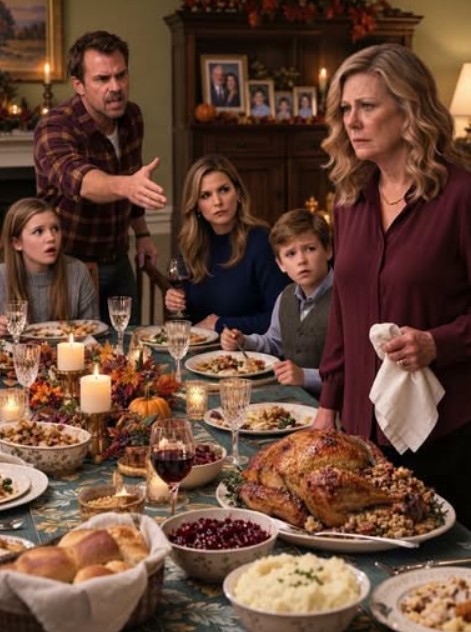
“You threw a turkey at me and called me a useless old woman.”
He looked away.
“I was angry.”
“You were cruel.”
“I’m sorry.”
I waited.
It was the first time he had said those words.
But an apology didn’t erase what happened.
He stepped closer.
“Mom, we were just trying to help.”
“By deciding where I would live without asking me?”
“We were worried.”
“You were worried about my house.”
His silence answered for him.
I looked at my son and tried to find the little boy who once brought me dandelions.
For a moment, I could still see him.
Then I remembered the turkey hitting my chest.
“I loved you enough to spend my whole life helping you,” I said quietly. “But I will not spend the rest of my life being treated like an asset.”
His eyes became wet.
“What do you want me to do?”
“Respect me.”
He nodded slowly.
“And if you can’t?”
“Then you won’t have a relationship with me.”
He looked shocked.
Perhaps he had never imagined that I could draw a boundary with him.
But I could.
And I did.
The Grandchildren
I made one thing clear.
My grandchildren were never going to pay for their parents’ mistakes.
Lily and Max were innocent.
They had watched their grandmother being humiliated at Thanksgiving, and I knew that moment had frightened them.
I called Lily regularly.
I talked to Max about school.
I sent birthday cards.
I never asked them to choose sides.
I never spoke badly about their parents.
Children shouldn’t have to carry adult conflicts.
One evening, Lily called me.
“Grandma?”
“Yes, sweetheart?”
“Are you happy in Florida?”
I looked out at the sunset.
“Yes.”
“Really?”
“Really.”
She smiled.
“Then I’m happy too.”
That meant more to me than she could ever know.
One Year Later
A year after Thanksgiving, I stood on my balcony watching the sun disappear over the horizon.
My life looked completely different.
I had my own small condo.
I had friends.
I volunteered twice a week at the elementary school.
I had joined a community chorus.
I had started gardening again.
And I had even allowed myself to consider companionship.
A retired history professor named Arthur had asked me to dinner several months earlier.
At first, I had refused.
Then he asked again.
Eventually, I agreed.
There was no rush.
No promises.
Just two people enjoying each other’s company.
That evening, my phone buzzed.
It was a message from Arthur.
Dinner at seven? I found a little Italian restaurant you might like.
I smiled.
Then I looked at myself in the mirror.
I barely recognized the woman staring back.
She stood straighter.
She smiled more easily.
She looked alive.
I touched Robert’s locket.
“You would be proud,” I whispered.
Then I put on my coat and walked outside.
What I Finally Understood
For a long time, I thought leaving meant losing.
I thought selling the house meant giving up the life Robert and I had built.
I thought moving away meant abandoning my family.
But I eventually understood something different.
The house was not my family.
The house was not my identity.
And being a mother didn’t mean surrendering every decision about my own life.
I had spent years giving Stuart chances.
I had helped him financially.
I had supported him emotionally.
I had protected him from consequences.
Perhaps I had loved him too much to see that I was hurting both of us.
He learned to expect me to rescue him.
And I learned to accept being taken for granted.
That Thanksgiving dinner finally broke the cycle.
The turkey was supposed to humiliate me.
Instead, it woke me up.
Three weeks later, I sold the house.
I left without a dramatic goodbye.
I didn’t scream.
I didn’t threaten him.
I didn’t beg him to understand.
I simply walked away.
And that was enough.
Stuart lost the house he had already claimed in his imagination.
Jennifer lost the renovation money she had already spent in her head.
But I didn’t feel like I had won.
I felt like I had finally stopped losing.
I stopped losing my dignity.
I stopped losing my independence.
I stopped losing sleep trying to make my adult son happy.
And most importantly, I stopped believing that getting older meant becoming less valuable.
At sixty-five, I wasn’t finished.
I was beginning again.
Sometimes the people closest to us are the ones who convince us that we are weaker than we really are.
But age is not weakness.
Retirement is not helplessness.
And being a mother does not mean becoming someone’s property.
My son called me useless.
Yet one year later, I had a new home, new friends, a new purpose, and a life I actually enjoyed.
I didn’t need to prove anything to Stuart.
I only needed to prove something to myself:
I still had the right to choose my own life.
And once I finally understood that, nobody could take it away from me again.