“Erica.”
Jason said my name so quietly that nobody at the table heard him at first.
Then the anchor spoke.
“Major Erica Sullivan, an active-duty Army officer, helped coordinate the rescue of nearly forty passengers during tonight’s dangerous Colorado blizzard…”
My father stopped moving.
Jason told me later that the room became completely silent.
The people who had been laughing only moments earlier were suddenly staring at the television.
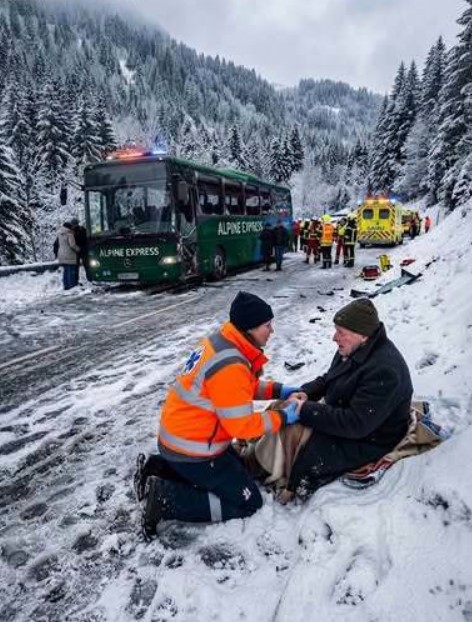
The footage showed the overturned bus.
It showed soldiers and state troopers carrying children through the snow.
Then the screen showed me climbing toward the damaged tanker.
My father’s face changed.
The pride he had been displaying for Jason only minutes earlier disappeared.
He looked confused.
Then stunned.
Then deeply uncomfortable.
And finally, according to Jason, he looked ashamed.
The reporter continued describing the rescue.
“Witnesses say Major Sullivan remained at the scene despite extremely dangerous conditions and personally helped remove the tanker driver from the wreckage.”
My father’s hand tightened around his wineglass.
Then it slipped.
The glass hit the floor and shattered.
Nobody moved.
His wife stared at him.
Jason stared at the television.
And one of the guests finally whispered, “That’s your daughter?”
My father didn’t answer.
He couldn’t.
For eighteen years, he had apparently found it easier to describe me as the daughter who was always busy, always somewhere else, always capable of taking care of herself.
Now the entire country was watching the woman he had told not to come home for Christmas.
My phone started vibrating again.
I looked down.
Dad.
I let it ring.
A few seconds later, he called again.
Then again.
Finally, I answered.
“Hello?”
There was silence.
Then I heard his voice.
“Erica.”
He sounded different.
Not angry.
Not annoyed.
Just…small.
“I saw you on television.”
“I know.”
“Are you okay?”
I looked around the break room.
My uniform was still covered in dried snow. My hands were bruised from the rescue, and my shoulder ached from pulling Walt out of the tanker.
“Yes,” I said. “I’m okay.”
“Were you out there the whole time?”
“Yes.”
“In that storm?”
“Yes, Dad.”
Another silence.
Then he asked something that surprised me.
“Why didn’t you tell me?”
I almost laughed.
Not because it was funny.
Because the question hurt.
“You told me not to come home.”
He stopped breathing for a second.
I could almost hear the sentence landing inside him.
“I didn’t mean—”
“You did.”
My voice remained calm.
“You told me Jason needed the attention. You told me my Army career would make things awkward. So I canceled my flight.”
“I know, but—”
“I volunteered for the overnight shift.”
He said nothing.
“I wasn’t sitting alone feeling sorry for myself,” I continued. “I was doing my job.”
My father swallowed.
“I’m proud of you.”
I closed my eyes.
Those words were exactly what I had wanted to hear for years.
And somehow, hearing them now hurt more than hearing nothing.
“Thank you,” I said quietly.
Then I looked toward the operations room.
“We still have reports to finish.”
“Erica—”
“I have to go.”
I ended the call.
I sat there staring at my phone.
Alvarez walked over and placed a cup of fresh coffee beside me.
“You okay?”
I nodded.
“No.”
She smiled faintly.
“That’s what I thought.”
I looked at her.
“Do you ever feel like people only notice what you do when someone else points a camera at it?”
She leaned against the table.
“All the time.”
That made me laugh for the first time that night.
A small laugh.
But it helped.
The Story Wouldn’t Go Away
I assumed the news coverage would disappear within a day.
It didn’t.
By the following morning, the rescue footage was everywhere.
People shared the video of the children being carried from the overturned bus.
The moment when I pulled Walt from the tanker was replayed repeatedly.
But the part that affected me most wasn’t the television coverage.
It was a handwritten card that arrived at the base several days later.
It came from the little boy who had refused to let go of my jacket.
His mother had sent it.
The front showed a drawing of a woman in a uniform standing beside a giant white mountain.
Above her was a crooked yellow sun.
Inside, in large uneven letters, he had written:
Thank you for saving me.
I stared at those words for a long time.
Then I placed the card inside my desk.
I had medals.
Awards.
Commendations.
Certificates.
But none of them meant as much to me as that piece of construction paper.
A week later, Walt came to visit.
He was using crutches, but he was smiling.
Behind him stood his daughter and four grandchildren.
And there was Rosie.
The little girl he had told me about inside the tanker.
She was wearing a red sweater and holding onto her mother’s hand.
Walt walked toward me.
“You remember me?”
I smiled.
“I remember you, Walt.”
He shook my hand.
Then he pulled me into a hug.
“You weren’t supposed to climb in there.”
“I know.”
“You could have been killed.”
“I know that too.”
He looked at me for a moment.
“Why did you do it?”
I glanced toward Rosie.
Then I looked back at him.
“Because you weren’t finished going home.”
His eyes filled with tears.
He looked away.
I understood.
Some rescues stay with you long after the emergency is over.
My Father Came to the Base
My father kept calling.
At first, I didn’t answer.
Then he started leaving messages.
“I’m sorry.”
“I should have asked about your life.”
“I didn’t understand.”
“I hope you can forgive me someday.”
I listened to every message.
But I didn’t respond.
Not yet.
I wasn’t trying to punish him.
I simply didn’t know what forgiveness was supposed to look like after eighteen years of being treated like the strong daughter who didn’t need anything.
Then, one afternoon, I received a call from the front gate.
“Major Sullivan?”
“Yes?”
“Your father is here.”
I froze.
“My father?”
“Yes, ma’am. He says he’s here to see you.”
I walked outside.
He was standing near the gate in a heavy coat.
He looked older than I remembered.
Not physically.
Emotionally.
Like the past few weeks had forced him to carry something he had spent years avoiding.
When he saw me, he smiled.
It was a nervous smile.
“I didn’t know if you’d come out.”
“I almost didn’t.”
He nodded.
“I understand.”
I stared at him.
“Why are you here?”
He looked around the base.
“I wanted to see where you spend your life.”
That sentence stayed with me.
For eighteen years, he had known where I lived.
He knew my phone number.
He knew my birthday.
He knew I was in the Army.
But he had never really known my life.
So I showed him.
I walked him through the base.
I introduced him to some of the soldiers.
Everyone called me “Major.”
My father noticed.
He noticed how people trusted me.
How younger soldiers came to me with questions.
How Alvarez spoke to me with respect but also the easy familiarity of someone who had been beside me through difficult years.
At one point my father stopped walking.
He looked at me.
“I had no idea.”
“You never asked.”
He looked down.
“I know.”
We continued walking.
Then he said something I wasn’t expecting.
“I’ve spent years telling myself you didn’t need me.”
I didn’t answer.
He continued.
“You were always strong. Always responsible. Always handling everything.”
He took a breath.
“I convinced myself that meant I was doing a good job as your father.”
I looked at him.
“Being strong doesn’t mean I didn’t need a father.”
His eyes filled with tears.
“I know that now.”
The Truth About Jason
That afternoon, Jason came to the base too.
He found me near the parking area.
“I owe you an apology.”
I crossed my arms.
“For Christmas?”
“For more than Christmas.”
He looked uncomfortable.
“I knew Dad treated me differently.”
I didn’t say anything.
“I knew he was proud of me. I knew he wanted people to see me as successful.”
He paused.
“But I also knew you were always getting pushed into the background.”
I felt something tighten inside me.
“Why didn’t you ever say anything?”
He looked at the ground.
“Because I liked being the favorite.”
That honesty surprised me.
He continued.
“I told myself it wasn’t my fault. Dad was making the decisions. But I benefited from them.”
He looked at me.
“And that wasn’t fair.”
I didn’t immediately forgive him.
But I appreciated the truth.
“Thank you for saying it.”
He nodded.
“I don’t expect you to forgive me right away.”
“Good.”
He smiled sadly.
“I deserve that.”
The Dinner
A month later, my father invited me to dinner.
Just me and him.
No Jason.
No neighbors.
No guests.
No audience.
When I arrived, he had cooked dinner himself.
That alone almost made me smile.
We sat at the kitchen table.
Not the large dining table where he had planned the Christmas celebration.
The kitchen felt smaller.
More honest.
My father put his fork down.
“I owe you an apology.”
I waited.
“I was wrong to ask you not to come home.”
I said nothing.
“I was wrong to make you feel like your success was something that threatened Jason.”
He looked directly at me.
“And I was especially wrong to assume that because you were strong, you didn’t need to be included.”
My eyes filled with tears.
He continued.
“I thought I was protecting Jason.”
“From what?”
He looked down.
“From feeling less important.”
I shook my head.
“And instead you made me feel less important.”
“I know.”
For once, he didn’t defend himself.
He didn’t say he had meant well.
He didn’t tell me I had misunderstood.
He simply accepted what he had done.
That mattered.
“I don’t expect you to forget,” he said.
“I won’t.”
He nodded.
“But I want the chance to do better.”
I looked at him for a long time.
“I can give you a chance.”
His shoulders relaxed.
“But trust takes time.”
“I understand.”
We sat there quietly.
Then he asked the question he should have asked years earlier.
“What is your life actually like?”
I laughed through my tears.
“You really want to know?”
“Yes.”
So I told him.
I told him about my soldiers.
The deployments.
The sleepless nights.
The people I had lost.
The people I had helped.
The responsibility.
The pride.
The fear.
The friendships that had become family.
And for the first time, my father listened.
He didn’t compare me to Jason.
He didn’t change the subject.
He didn’t look uncomfortable.
He simply listened.
And somehow, that ordinary act felt extraordinary.
One Year Later
The following Christmas was different.
I didn’t know what to expect when my father called.
“Are you coming home this year?”
I smiled.
“Do you want me there?”
There was a pause.
“Yes.”
Another pause.
“I want you there because you’re my daughter.”
That sentence meant more to me than he could ever know.
But I still had duty that year.
I couldn’t leave.
So my father came to Colorado instead.
He didn’t complain.
He didn’t ask me to change my schedule.
He simply said, “Then I’ll come to you.”
On Christmas Eve, he arrived at the base.
Jason came too.
But this time, there was no competition.
No one was trying to impress anyone.
We volunteered at a veterans’ center and served dinner to people who had nowhere else to go.
My father spent almost an hour talking to an elderly veteran who kept telling the same story.
He listened every time as if it were the first.
I watched him from across the room.
And I realized something.
People can change.
Not because the past disappears.
Not because one apology magically repairs everything.
But because sometimes a person finally decides to see the damage they caused.
Later that night, we walked outside.
Snow was falling gently.
My father handed me a small package.
Inside was an old photograph.
It was a picture of me when I first joined the Army.
I looked much younger.
Nervous.
Excited.
Trying to appear braver than I felt.
My father had written something on the back.
I should have told you this years ago. I am proud of you. Not because the country saw you on television. Not because strangers called you a hero. I am proud because you have always been the person who shows up when someone needs help.
I stared at the words.
Then I looked at him.
“Dad…”
He shook his head.
“You don’t have to say anything.”
For a moment, neither of us spoke.
Then I hugged him.
It wasn’t a perfect hug.
It didn’t erase eighteen years.
It didn’t erase every Christmas I had spent away from home or every time I had wondered why I wasn’t enough.
But it was real.
And sometimes real is better than perfect.
What That Christmas Taught Me
My father had told me not to come home because he was afraid my life would overshadow Jason.
He thought my Army career would make someone else feel small.
Instead, the night I stayed away became the night the entire country saw exactly who I had become.
But the television coverage wasn’t what changed my life.
The rescue wasn’t what repaired my family.
The attention wasn’t the important part.
What mattered was what happened afterward.
My father finally looked at my life instead of making assumptions about it.
Jason finally admitted that he had benefited from my silence.
And I finally understood something I should have known much earlier.
I didn’t need my father’s approval to prove that my life had value.
I had already built that life.
I had earned my place.
I had spent years showing up for people who needed me.
And when Christmas came and my father told me I wasn’t welcome at his table, I thought he was taking something from me.
He wasn’t.
Without realizing it, he gave me the opportunity to see how much of my identity I had been waiting for my family to recognize.
I spent that Christmas Eve in a blizzard.
I helped strangers get home.
I held a frightened child until he knew he was safe.
I climbed into a damaged tanker to bring a grandfather back to his family.
And somewhere between the snow, the emergency lights, and the sound of people calling for help, I realized something.
Home isn’t always the place where someone has saved you a seat.
Sometimes home is the place where you know your presence matters.
Sometimes it’s the people who stand beside you when no one is watching.
And sometimes, when the people who were supposed to see you first fail to see you at all, you discover that your life has already become something much bigger than their approval.
My father once worried that I would overshadow someone else.
He was right about one thing.
I was never meant to disappear so someone else could shine.
I was meant to stand where I was needed.
And that Christmas Eve, in the middle of a Colorado blizzard, I finally understood that I had never needed to be invited home to belong somewhere.
I had already found my place.