The Phone Call That Destroyed His Plan
Kelsey stopped laughing.
For the first time since she had walked into my house, she looked genuinely uncertain. She glanced at my father, then at the phone pressed against his ear, waiting for him to explain what was happening.
Richard said nothing.
He stood beside Daniel’s desk, gripping his phone so tightly that his knuckles had turned pale. The folder he had brought with him lay open on the kitchen table, its papers scattered as though he had expected to find a simple solution among them.
Instead, every new piece of information seemed to make his situation worse.
“Richard, what is going on?” Kelsey demanded.
He raised his hand to silence her.
Normally, she would have obeyed without hesitation. That morning, however, she seemed to understand that the confidence she had displayed only minutes earlier was disappearing.
I remained on the porch.
My clothes were wet, my knee hurt, and the pain in my abdomen came in waves that made it difficult to concentrate. I could hear the ambulance approaching, but my attention remained fixed on the doorway.
Margaret Sloan was still on the phone.
“Emily, can you hear me?”
“Yes.”
“Good. The ambulance is arriving. Let the medical team take care of you first. My office will handle your father.”
I swallowed hard.
“What did he do, Margaret? What was that phone call about?”
She paused briefly.
“We have confirmed that your name remains on the recorded deed. The house has not been transferred to your father. We are also investigating an attempt to obtain authority over Daniel’s estate without your valid consent.”
I closed my eyes.
For weeks, I had felt as though grief had stripped away every part of my life that made me feel secure. Daniel was gone, our baby would arrive soon, and now my own father had tried to force me out of the only home I had known with my husband.
Hearing that the house was still legally mine did not erase any of that pain.
But it gave me something solid to hold on to.
Richard could shout. He could threaten. He could arrive with a folder and announce that he had made a decision.
He could not simply declare himself the owner of my home.
Inside, his voice suddenly rose.
“That’s impossible. I was told the paperwork was sufficient!”
I looked toward Margaret’s phone.
She had heard him too.
“Emily, don’t engage with him,” she said. “Let the authorities document what happened.”
I nodded, although she could not see me.
For once, I would not allow my father’s anger to pull me into another argument.
Then the ambulance pulled into the driveway.
Two emergency medical technicians hurried toward me with their equipment. One knelt beside me while the other asked what had happened.
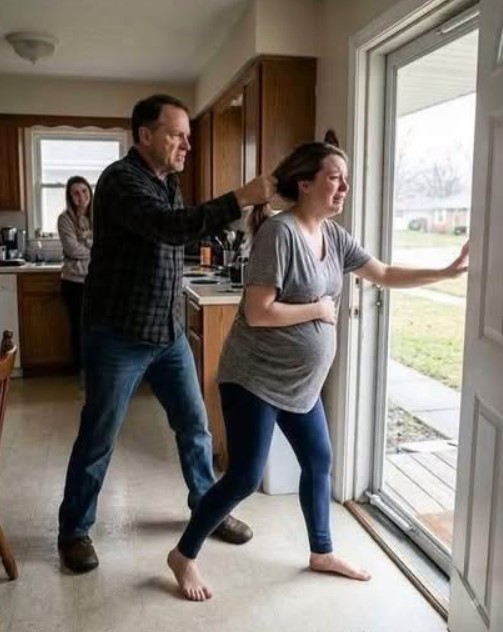
“My father pulled me by my hair and shoved me outside,” I explained, struggling to keep my voice steady. “I’m eight months pregnant, and my water broke.”
Their expressions changed immediately.
They asked whether I had fallen, whether I had struck my stomach, whether I was experiencing pain, and when the fluid had started coming down my legs.
I answered as best I could.
One of them checked my condition while the other prepared to help me onto the stretcher.
I was frightened, but their calm instructions gave me something to focus on.
As they helped me stand, I looked toward the open doorway.
Richard was watching.
For a brief moment, our eyes met.
I wanted him to see what he had done. I wanted him to understand that the woman he had dragged across the kitchen was his pregnant daughter, not an obstacle standing between him and a house.
But I said nothing.
I had spent years believing that if I could just find the right words, I could finally make my father understand how much he hurt me.
That morning, I realized that understanding was not something I could force him to give me.
The medical team helped me onto the stretcher.
Before they closed the ambulance doors, I heard Margaret speaking to someone else on her phone.
“Please preserve everything in the house exactly as it is. The police will need to take statements, and we need copies of any documents Richard brought with him.”
Then the doors shut.
As the ambulance pulled away, I pressed one hand against my stomach and whispered Daniel’s name.
I had no idea whether our baby would arrive that day. I had no idea what would happen to my father, what the documents would reveal, or whether I would ever feel comfortable walking through my front door again.
But I knew one thing.
I was not going to let Richard decide the rest of my life.
At the Hospital, Everything Became Real
The hospital staff moved quickly.
They assessed me and monitored the baby, asking questions about the incident and my pregnancy. I tried to explain everything clearly, but my thoughts kept breaking apart.
One moment, I was answering a question about the time my water broke. The next, I was remembering Daniel standing in the nursery, trying to assemble the crib.
He had complained that the instructions made no sense.
I had laughed at him.
He had looked at me and said, “When this little one arrives, you can tell them I built the whole thing without asking for help.”
I had promised to remember.
Now, lying in a hospital bed, I wondered how I was supposed to raise our child without him.
A nurse gently brought me back to the present.
“We’re taking care of you,” she assured me. “Let’s focus on you and the baby right now.”
I nodded.
The next hours passed in a blur of examinations, monitoring, and phone calls. The doctors explained what they were checking and what signs would determine the next steps.
I was scared, but I followed their instructions and tried to concentrate on each moment as it came.
Eventually, I was told that the baby needed to be delivered.
I remember gripping the side of the bed and thinking that Daniel should have been there. He should have been holding my hand, making one of his terrible jokes, and telling me that everything would be fine even if he was frightened himself.
Instead, I had to draw strength from the people around me and from the memory of the man who had loved me.
Hours later, I heard the sound I had been waiting for.
My baby cried.
The nurse placed my newborn where I could see the tiny face, and the world seemed to stop.
I cried so hard that I could barely speak.
“Hi, sweetheart,” I whispered.
The baby moved against me, small and warm.
For the first time since Daniel’s death, my grief was joined by something else.
Not happiness without sadness. Not a miracle that erased what had happened.
Hope.
I named my baby after a name Daniel and I had discussed together during one of our quiet evenings at home. As I held my child, I promised that I would tell the truth about the family we had been building.
Our child would know who Daniel was.
And our child would know that love did not mean allowing someone to hurt you.
The Second Phone Call
The following afternoon, Margaret called the hospital.
I was exhausted, and my baby was sleeping nearby. I almost let the call go to voicemail, but something told me I needed to hear what she had learned.
“Emily, how are you and the baby doing?”
“We’re being looked after,” I replied. “I’m tired, but we’re here.”
“I’m glad. I’ll keep this brief. The police have spoken with your father, and we have begun reviewing the documents he brought to your house.”
I sat up a little.
“What did you find?”
“First, the deed is clear. Your name was added legally, and the house remains in your ownership as recorded. Your father has no authority to remove you or sell the property simply because he says Daniel had debts.”
I let out a breath I had been holding.
“What about the company?”
“Daniel’s estate documents are more complicated, but the structure he established is important. His controlling shares and investment assets were placed under arrangements that require proper authorization. Richard cannot simply take control of them.”
I thought about my father’s expression when he heard the phone call.
“Is that why he looked so frightened?”
“Partly,” Margaret said. “We contacted the relevant financial institution to flag the disputed request and prevent unauthorized transactions while the matter is reviewed. The institution is examining the information submitted to it.”
She paused.
“There is also a question about the signature on one of the documents.”
My heart began to pound.
“Did he forge it?”
“I can’t responsibly tell you that before the examination is complete. What I can tell you is that the signature and the authority he claimed to have are being investigated.”
That answer was not as dramatic as the certainty I wanted.
But Margaret was not trying to entertain me. She was protecting my interests, and she would not promise an outcome before the facts were established.
“What happens now?” I asked.
“We preserve the evidence, cooperate with the authorities, and make sure your legal rights are protected. You focus on recovering and caring for your baby.”
I looked toward the little bassinet.
For the first time, I understood what Daniel had done when he arranged his affairs so carefully.
He had not been predicting his own death. At least, I had no reason to believe that.
He had simply understood that money, property, and family relationships could become complicated, especially during a crisis. He had made arrangements designed to protect the people he loved.
And when the crisis came, those arrangements mattered.
What My Father Had Never Understood About Daniel
Over the following days, Margaret helped me understand more about the estate.
Daniel had been involved in Hale-Mercer Logistics for years. My father liked to speak as though the business belonged to him alone, but the reality was more complicated.
Daniel had contributed to the company’s growth, helped secure contracts, and worked on decisions that affected its future. He had also acquired a significant ownership interest.
He rarely argued with Richard about recognition.
I used to think that meant he did not care.
Now I wondered whether Daniel simply understood that there were better ways to protect something than arguing about it at a family dinner.
His estate documents set out what would happen to his assets and how certain decisions would be managed after his death. The arrangements did not mean I could instantly take over every part of the company, but they did mean that Richard could not lawfully assume control merely because he wanted it.
Margaret also explained that the trust account had been established to provide financial protection for me and the baby.
The details mattered, and there were procedures to follow. Some assets would require review, some decisions would need formal approval, and the disputed paperwork would have to be investigated.
But the overall message was clear.
Daniel had not left me as helpless as my father assumed.
I thought back to the day Richard walked into my kitchen and announced that the house had to be sold.
He had not asked whether I had spoken to Daniel’s attorney.
He had not checked the deed.
He had not asked what arrangements Daniel had made.
He had simply assumed that my grief made me vulnerable and that my silence meant he could take charge.
His mistake was not merely that he underestimated the legal documents.
He underestimated me.
When Richard Tried to Explain Himself
My father did not visit the hospital.
At first, I assumed the police had told him to stay away, but Margaret later explained that the situation was being handled through the appropriate channels and that I could discuss contact arrangements with the authorities and my legal adviser.
Instead, he sent a message.
It was short.
We need to talk. You have misunderstood what I was trying to do.
I stared at the screen for a long time.
There was no apology for pulling my hair.
No mention of the fact that I had been eight months pregnant when he shoved me outside.
Nothing about the fear I had felt when my water broke on the porch.
He wanted to discuss his intentions.
I typed a response, then deleted it.
I tried again.
Finally, I sent one sentence.
You can explain yourself through Margaret. Do not come to my home or contact me in person unless the appropriate arrangements have been made.
My hand trembled after I pressed send.
For years, I had been afraid of what would happen if I refused my father directly. I had learned to soften my words, apologize even when I had done nothing wrong, and accept his version of events because challenging him always seemed to create more trouble.
Now I was doing something different.
I was not threatening him.
I was not insulting him.
I was setting a boundary.
His reply came minutes later.
After everything I’ve done for you, this is how you treat me?
I put the phone down.
The familiar guilt rose immediately. I began remembering the things he had done for me when I was younger, the school events he had attended, and the times he had helped when I needed him.
Those memories were real.
But so was what he had done to me.
One did not erase the other.
I could acknowledge that my father had once cared for me while also recognizing that his actions had become abusive and unacceptable. I did not have to pretend that the assault was a misunderstanding simply because he was my parent.
For the first time, I allowed myself to consider that loving someone did not require giving them unlimited access to my life.
The Documents That Changed Everything
Several weeks later, Margaret contacted me with an update.
The financial institution had continued reviewing the disputed request. The legal team had collected copies of the documents Richard brought to the house, along with the relevant estate records.
The review raised serious questions about the authority Richard had claimed.
He had presented himself as someone acting on my behalf, despite not having the necessary authorization. The circumstances surrounding the signature also required further investigation.
The matter was referred to the appropriate authorities, and Richard was asked to respond to the concerns.
I did not celebrate.
There was nothing satisfying about discovering that my own father might have attempted to use my name to gain control over property and financial assets after my husband died.
I had wanted a father who would help me through grief. I had wanted someone who would ask whether I had eaten, whether I needed help preparing for the baby, or whether I wanted company during the long evenings when the house felt too quiet.
Instead, I had been forced to protect myself from him.
Margaret reminded me that the investigation would take time. The legal consequences, if any, would depend on the evidence and the decisions of the appropriate authorities.
I understood.
I did not need a dramatic courtroom scene to know that the situation had changed.
Richard could no longer rely on his own declarations to take control of Daniel’s estate. His actions were being examined, the disputed transactions were under review, and the people responsible for protecting the assets had been alerted.
The plan he had walked into my home believing he could carry out had stopped.
And he had no one to blame for that but himself.
Kelsey Finally Called
About a month after the incident, I received a call from Kelsey.
For a moment, I considered ignoring it.
I had no desire to listen to her laugh again or hear her explain why she thought my father’s behavior was justified.
But curiosity got the better of me.
I answered.
“Emily,” she began, her voice unusually quiet.
“What do you want, Kelsey?”
She hesitated.
“I wanted to tell you that I didn’t know everything Richard was doing.”
I said nothing.
“He told me you were going to lose the house because of Daniel’s debts. He said you had agreed to let him handle the paperwork and that you were just being difficult because you were upset.”
I closed my eyes.
“Did you believe him?”
“Yes,” she admitted. “I did.”
“And when he dragged me outside?”
She did not answer immediately.
“I shouldn’t have laughed.”
“No,” I said. “You shouldn’t have.”
The silence between us was uncomfortable.
Then she began explaining that she had been shocked by the phone call, that Richard had become angry when she questioned him, and that she was now trying to understand what had happened.
I listened without interrupting.
Part of me wanted to tell her that she should have known better. Another part recognized that I did not need to persuade her to understand what I had experienced.
“You saw what he did,” I told her. “You were there. You don’t need another explanation from me.”
“I know.”
“I hope you make your own decisions from now on. But I need distance from both of you.”
She said she understood.
I ended the call.
I did not know whether her apology was entirely sincere or whether she was frightened by the consequences of Richard’s actions. Perhaps both things were true.
Either way, I did not owe her immediate forgiveness.
I had a newborn to care for, a home to protect, and a life to rebuild.
That was enough.
Returning to the House
The first time I returned home with my baby, I stopped outside the front door.
The porch looked exactly as it had before.
The same steps. The same railing. The same small crack near the edge of the concrete.
Yet I could no longer look at it without remembering the moment I had landed on my knee, felt the warmth running down my legs, and realized my father was still laughing inside.
Margaret had helped arrange the practical steps needed to make the house secure. The emergency key Richard had used was no longer a concern, and I made sure that access to the property was limited to people I trusted.
I also worked with the appropriate professionals to document what had happened and preserve the records connected to the dispute.
I did not want to live in fear of another surprise visit.
When I finally opened the door, the house was quiet.
Daniel’s shoes were still near the entryway. His favorite mug remained in the kitchen cupboard. The nursery was waiting for the baby, with the crib he had assembled standing beside the window.
I carried my child into the room and sat down in the chair we had chosen together.
For a long time, I simply watched the baby sleep.
Then I began to cry.
Not because Richard had won.
He hadn’t.
I cried because Daniel would never come home to see the nursery filled with our child’s things. He would never complain about the baby’s crying or insist that he could change a diaper faster than I could. He would never stand beside me in the kitchen and ask what we should make for dinner.
No legal document could bring him back.
No phone call could restore the future we had imagined.
But I could protect the home we had built, and I could give our child a safe place to grow.
That was what I intended to do.
The Final Meeting
Months later, after the immediate crisis had passed, a formal meeting was arranged through the legal representatives to address the remaining estate questions.
I did not meet Richard alone.
Margaret attended, and the discussion stayed focused on the disputed paperwork, the estate arrangements, and the steps required to protect the property and financial interests involved.
Richard looked older than I remembered.
He was no longer the man who had walked into my kitchen with a folder and announced that he was taking control. He appeared tired and angry, but beneath the anger I could see uncertainty.
He looked at me across the table.
“You could have handled this within the family,” he said.
I took a breath.
“You came into my home, grabbed me by the hair, and threw me outside while I was eight months pregnant. You tried to take control of my property without my permission. What part of that was supposed to be handled quietly?”
His jaw tightened.
“I was trying to protect the family.”
“From what?”
He had no immediate answer.
I continued.
“If you were worried about Daniel’s debts, you could have called Margaret. You could have asked me what was happening. You could have offered to help me with the baby. Instead, you decided that my grief gave you the right to make decisions for me.”
He looked away.
For once, I did not rush to fill the silence.
I did not soften the truth to make him comfortable.
I did not apologize for protecting myself.
The meeting continued, and the legal representatives addressed the remaining issues. I left with a clearer understanding of the next steps and a renewed determination to keep my affairs secure.
I never received the apology I had once imagined.
My father did not suddenly transform into a kind, understanding man. There was no single conversation that repaired years of behavior.
But I no longer needed that transformation to move forward.
I could accept that he might never give me the explanation I wanted and still build a good life for myself and my child.
That realization was its own kind of freedom.
What Daniel Had Really Left Me
People sometimes assume that an inheritance is measured by the amount of money or property someone receives.
Daniel had left behind assets that would help provide for our child, but his greatest gift had been the care he took to put things in order.
He had added my name to the deed.
He had established arrangements to protect certain financial assets.
He had worked with a qualified attorney to make his wishes clear.
He had made decisions that gave me a foundation when I was too overwhelmed by grief to think clearly about the future.
Those things mattered.
But there was something else I carried with me.
I remembered his words about not making myself smaller because someone else got louder.
For years, I had mistaken my father’s confidence for authority. I had believed that if he insisted something was true, I had to defend myself until he accepted my explanation.
Daniel had seen that pattern long before I understood it.
He had encouraged me to trust my judgment, ask questions, and stand up for myself.
Now, with a child depending on me, I had to put those lessons into practice.
I wanted my baby to grow up in a home where disagreement did not lead to intimidation, where love was not used as a weapon, and where nobody had to surrender their dignity to keep the peace.
I wanted our child to know that family relationships could be complicated without making cruelty acceptable.
And I wanted the home Daniel and I had built to remain a place of safety.
That was a responsibility I could carry.
The Life We Built Afterward
Life did not become easy overnight.
There were nights when the baby woke repeatedly and I wished Daniel were beside me. There were mornings when grief hit so suddenly that I had to sit down before I could continue with the day.
I learned to accept help from friends and relatives who respected my boundaries. I learned how to manage the practical details of raising a child while working through the legal and financial matters Daniel had left behind.
Some days were better than others.
I kept photographs of Daniel in the nursery and told the baby stories about him. I talked about the way he sang off-key while cooking, how he always checked the weather and still dressed incorrectly, and how he had spent an entire afternoon assembling the crib because he refused to admit the instructions were confusing.
Those small memories made him feel present in our lives.
Eventually, the house began to feel like home again rather than a place where something terrible had happened.
I changed the locks, rearranged a few things, and planted flowers near the front steps. The changes were small, but each one reminded me that I could decide what happened in my own home.
Richard remained at a distance.
Any necessary communication went through the appropriate channels, and I did not allow guilt to push me into an arrangement that made me feel unsafe.
Maybe our relationship would change someday. Maybe it would not.
I could not control that.
What I could control was how I raised my child, how I protected our home, and whom I allowed into our lives.
That became my focus.
Conclusion: He Thought My Grief Made Me Powerless
When my father walked into my house that gray Tuesday morning, he believed he had already won.
He thought Daniel’s death had left me too overwhelmed to protect myself. He assumed that because I was eight months pregnant, grieving, and unfamiliar with the details of the estate, I would accept whatever he told me.
He believed the folder in his hand was enough to make his decision final.
He was wrong.
One phone call brought Daniel’s attorney into the situation. That call helped alert the people responsible for protecting the estate, prompted a review of the disputed paperwork, and made it clear that my father’s claims would not simply be accepted without evidence.
The ambulance took me to the hospital, where my baby received the care we needed. The legal process continued afterward, and the questions surrounding my father’s actions were left to the appropriate authorities.
The outcome was not a magical victory in which every problem disappeared. I still had to grieve my husband, recover from a frightening experience, care for my newborn, and rebuild my sense of security.
But I kept my home, protected my rights, and learned that I did not have to surrender to the loudest person in the room.
My father had mistaken my silence for weakness. He had mistaken my grief for helplessness. And he had mistaken his place in my family for the right to control my life.
He learned that those things were not the same.
I never wanted my father’s downfall. I wanted his help, his kindness, and the reassurance that I was not facing the hardest period of my life alone.
But when he chose intimidation instead of compassion, I had to protect myself and my child.
That decision changed me.
I stopped waiting for him to approve of my choices. I stopped believing that keeping the peace was more important than telling the truth. And I stopped confusing forgiveness with giving someone another opportunity to hurt me.
Daniel could not be there to hold my hand, but the plans he made helped protect the future he wanted for us. His love remained part of the life I was building, not because paperwork could replace him, but because the care behind those decisions continued to matter.
Today, when I look at my child sleeping peacefully in the nursery, I think about the home Daniel and I created and the family we hoped to raise.
I think about the difficult morning that nearly broke me, and the phone call that reminded me I was not powerless.
Most of all, I remember that I had a choice.
I could allow fear to decide what happened next, or I could take the steps needed to protect the life my husband and I had built.
I chose to protect it.
And my father finally had to face the truth: my home was not his to take, my grief was not his opportunity, and being my father did not give him the right to control me.