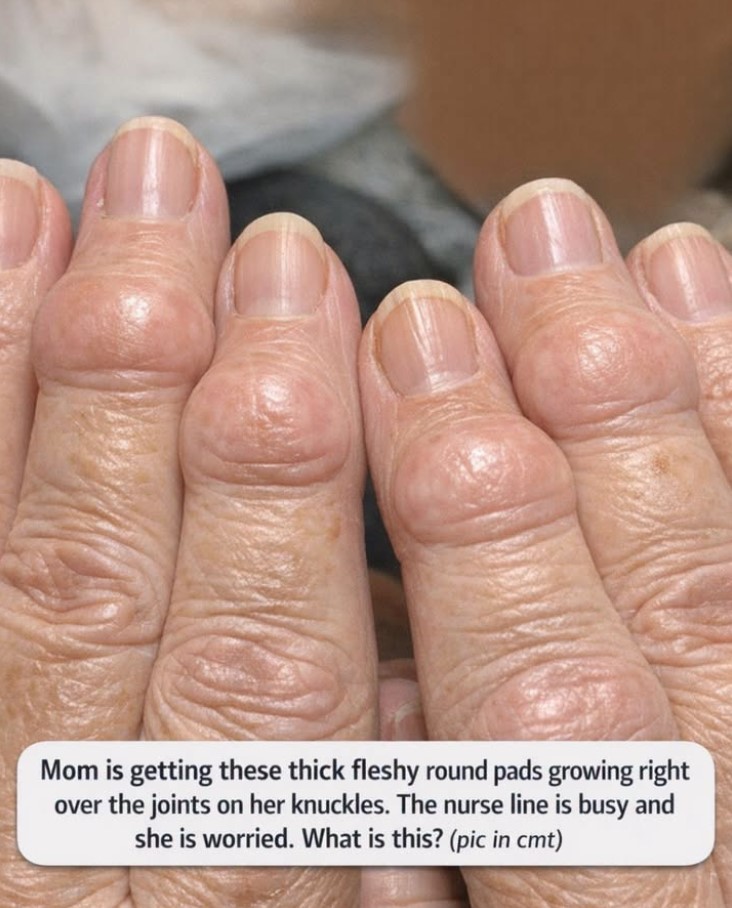
Finding a new lump or thickened area on a loved one’s hand can be worrying, especially when it appears directly over the knuckles. When a mother notices several round, fleshy pads developing over her finger joints, it is natural to wonder whether the changes are related to arthritis, an infection, or something more serious.
The uncertainty can become even more stressful when the doctor’s office is closed or the nurse advice line is busy. Every time she looks at her hands, she may wonder whether the bumps are getting bigger or whether she should be doing something to make them disappear.
One possible explanation is a condition known as knuckle pads. These are areas of thickened fibrous tissue that develop over the joints of the fingers. They are often harmless, but they can resemble other skin and joint conditions, making a proper examination important.
Understanding what knuckle pads look and feel like, what may contribute to their development, and which warning signs deserve attention can help your mom approach the situation more calmly while deciding on the appropriate next step.
What Are Knuckle Pads?
Knuckle pads are localized areas of thickened tissue that develop over the back of the finger joints. They are generally made up of fibrous tissue rather than fluid, and they may appear as rounded, raised areas that sit directly on top of a knuckle.
They commonly develop over the middle joints of the fingers, although they can also appear over the joints where the fingers connect to the hand.
The bumps may be skin-colored, slightly pink, or somewhat lighter than the surrounding skin. Their texture can feel firm, rubbery, or fleshy. Some are small and barely noticeable, while others become large enough to change the appearance of the knuckles.
In many cases, knuckle pads develop gradually and cause little or no pain. A person may notice them while washing their hands, applying lotion, or examining their fingers for another reason.
Although their appearance can be surprising, knuckle pads are often benign. They do not necessarily mean that the underlying finger joint is being damaged.
However, the appearance of a bump alone cannot establish the diagnosis. Other conditions can cause thickening, swelling, or lumps around the finger joints, and a healthcare professional can help determine which explanation fits your mom’s symptoms.
What Do Knuckle Pads Usually Look Like?
Knuckle pads often have a distinctive appearance. They may look like small cushions of thickened skin sitting directly over one or more finger joints.
The surface is commonly smooth rather than rough or scaly. The growths may be round or oval, and they can vary in size. Some people develop a single pad, while others notice several across different fingers.
The skin over the area may look much like the surrounding skin. In other cases, it may appear slightly pink or pale.
Knuckle pads are often relatively firm when touched. Unlike a fluid-filled cyst, they do not typically feel like a soft pocket of liquid. They may also seem attached to the tissue covering the joint rather than moving freely beneath the skin.
Pain is not usually a major feature. Some people experience mild sensitivity when the area is pressed or repeatedly bumped, but pronounced tenderness, warmth, or throbbing should prompt consideration of other causes.
The bumps can develop on one hand or both. Their presence on both hands does not automatically indicate a serious condition, just as having a bump on only one hand does not establish that it is harmless.
The most useful details are how the bumps developed, whether they are changing, how they feel, and whether other symptoms are present.
Why Do These Thick Pads Develop?
There is not always one clear reason why knuckle pads appear. In some people, they seem to develop without an obvious trigger. In others, repeated friction or pressure may play a role.
Certain activities place repeated stress on the skin and tissues around the fingers. Gardening, handling tools, knitting, crocheting, sewing, and other repetitive hand activities may involve frequent pressure or rubbing against the knuckles.
Over time, some people develop localized thickening in areas exposed to repeated irritation. However, not every person who performs these activities develops knuckle pads, and the presence of the bumps does not prove that a particular hobby caused them.
There may also be a genetic or familial tendency in some cases. Knuckle pads have been associated with other conditions involving fibrous tissue, including Dupuytren’s contracture, which causes thickening in the palm and may eventually pull one or more fingers toward the palm.
Related fibrous tissue conditions can also occur in the soles of the feet. These associations do not mean that everyone with knuckle pads will develop another condition, but they are useful details for a clinician to know.
Age, skin changes, previous irritation, and a person’s medical history may also help provide context.
For your mom, it is worth thinking about whether she regularly performs activities that put pressure on her knuckles and whether she has noticed similar thickened areas on her palms or feet. These details may help a clinician, although they cannot replace an examination.
Could the Bumps Be Arthritis?
Arthritis is one of the conditions people often worry about when their finger joints begin to look enlarged.
Osteoarthritis, in particular, can cause bony enlargements around the finger joints. These are commonly known as Heberden’s nodes when they affect the joints closest to the fingertips and Bouchard’s nodes when they affect the middle finger joints.
Arthritis-related nodes arise from changes involving the joint itself. They often feel very hard, sometimes almost like bone, and may occur alongside aching, stiffness, reduced movement, or changes in the shape of the fingers.
Knuckle pads, by contrast, involve thickening of the tissue over the joint. They may feel more like a firm layer or cushion sitting on top of the knuckle.
There can be overlap in appearance, however, and it is not always possible to distinguish the two by touch alone.
If your mom has difficulty bending her fingers, notices that her joints are becoming crooked, experiences persistent aching, or has significant morning stiffness, she should mention these symptoms during her medical assessment.
The distinction matters because treatment depends on the underlying cause. A skin-level thickening and an arthritic joint problem may require different approaches.
Could It Be a Cyst, Wart, or Callus?
Yes. Several other conditions can produce raised areas on the hands, and their appearance can sometimes be confusing.
Ganglion or mucous cysts: These are fluid-filled lumps that develop near joints or tendons. Their texture may be softer or more elastic than a solid fibrous pad, although cysts can sometimes feel firm. Their location and appearance vary.
Warts: Warts often have a rough or uneven surface. Some contain tiny dark dots and may interrupt the normal lines of the skin. A wart can appear on or around a finger joint, but it usually looks different from a smooth, broad pad of thickened tissue.
Calluses: Calluses develop when the skin responds to repeated pressure or friction. They tend to involve the surface of the skin and may appear thicker, flatter, or more yellowish than the surrounding area.
Other skin growths: Benign skin growths and, less commonly, more serious lesions can also cause persistent lumps. A new growth that changes quickly, bleeds, breaks open, or looks unusual deserves medical assessment.
Inflammatory joint conditions: Certain inflammatory diseases can cause swelling around the finger joints. These may be accompanied by pain, warmth, stiffness, or swelling in other joints.
Because these conditions can look similar, it is best not to assume that a bump is a wart, callus, cyst, or knuckle pad based only on its appearance.
When Is It Reasonable to Wait for a Routine Appointment?
If the bumps have appeared gradually over several weeks or months, are not particularly painful, and show no signs of inflammation, the situation may be suitable for a routine medical appointment.
This does not mean your mom should ignore the growths. New or unexplained lumps deserve evaluation, particularly if they continue to develop or if their appearance is changing.
While waiting for the clinic to respond, she can record when she first noticed the bumps, whether they are growing, and whether they affect one hand or both.
She can also take a clear photograph of each affected hand in good lighting. A photograph may help document changes over time and give the clinician a useful reference.
If she measures the bumps, she should do so gently and avoid repeatedly pressing on them. A measurement taken occasionally is more useful than checking the area every hour.
She should also pay attention to whether she can bend and straighten her fingers normally and whether she experiences discomfort during everyday tasks.
If the growths remain stable and there are no concerning symptoms, a primary care clinician or dermatologist may be an appropriate starting point. A rheumatology assessment may be useful if there are signs of an inflammatory joint condition.
The appropriate timing depends on the overall symptoms and the person’s medical history, so a healthcare professional’s advice should guide the decision.
Warning Signs That Should Not Be Ignored
Although knuckle pads are often benign, not every lump over a finger joint is a knuckle pad. Certain symptoms warrant more urgent attention.
Your mom should seek prompt medical evaluation if she notices any of the following:
- Rapid growth: A lump that enlarges noticeably over a few days should not simply be assumed to be a harmless fibrous pad.
- Redness or warmth: Skin that becomes red, hot, or increasingly swollen may indicate inflammation or infection.
- Significant pain: Severe or rapidly worsening pain is not typical of an uncomplicated knuckle pad.
- Fever or feeling unwell: Fever accompanied by a painful, swollen finger or hand can indicate an infection that needs urgent assessment.
- Drainage or an open wound: Pus, fluid, bleeding, or skin breakdown requires medical attention.
- Recent injury or puncture: A bite, splinter, puncture wound, or other injury near a joint can lead to complications.
- Difficulty moving the finger: New weakness, restricted movement, or an inability to bend or straighten a finger should be assessed promptly.
- Numbness or unusual sensations: New numbness, tingling, or loss of sensation should not be dismissed.
- Multiple swollen joints or prolonged morning stiffness: These symptoms may point toward an inflammatory condition that needs further investigation.
If a finger or hand becomes rapidly swollen and very painful, particularly with fever or spreading redness, she should seek urgent medical care rather than waiting for a routine callback.
If she develops sudden numbness, a pale or blue finger, or a cold finger associated with a change in circulation, emergency assessment may be necessary.
The key is to look at the whole picture rather than focusing only on the shape of the bumps.
What Will a Healthcare Professional Ask?
When your mom is finally able to speak with a nurse or clinician, having a few details ready can make the conversation more productive.
The clinician will likely ask when the growths first appeared and whether they developed slowly or suddenly. They may ask whether the bumps are becoming larger, whether they hurt, and whether the skin has changed color.
They may also want to know how many bumps are present, which fingers are affected, and whether the same pattern appears on both hands.
Her daily activities may be relevant. Regular gardening, knitting, handling tools, or other repetitive hand movements can provide useful context.
The clinician may ask about previous injuries, existing medical conditions, arthritis symptoms, and any family history of similar lumps or fibrous tissue problems.
It is also important to mention any medications and any recent changes in general health.
During the examination, the clinician will look at the location and shape of the bumps, feel the tissue gently, and assess the movement of the fingers. They may examine the palms and other areas of the hands for additional clues.
The aim is to determine whether the growths appear to involve the skin and tissue over the joints or whether the joints themselves are enlarged or inflamed.
How Are Knuckle Pads Diagnosed?
In many cases, a clinician can recognize possible knuckle pads from their appearance, texture, location, and history.
A physical examination may be sufficient when the growths have a typical appearance and there are no concerning symptoms.
If the diagnosis is uncertain, additional tests may be considered.
An X-ray can help identify changes in the underlying bones or joints, particularly when arthritis is suspected. It does not directly show every type of soft-tissue change, but it may help clarify what is happening around the joint.
An ultrasound examination may sometimes help distinguish a superficial thickening from a cyst or another soft-tissue lump.
In unusual cases, a specialist may consider additional testing, including a biopsy, if the appearance is atypical or the diagnosis remains uncertain.
Not everyone with knuckle pads needs imaging or a biopsy. The appropriate investigation depends on the examination and the clinician’s assessment.
The most important step is to establish what the growths actually are before attempting to treat them.
What Treatment Is Available for Knuckle Pads?
Treatment depends on whether the growths cause pain, interfere with movement, or are primarily a cosmetic concern.
If a clinician confirms that the bumps are knuckle pads and they do not cause significant problems, observation may be all that is needed.
This can feel disappointing to someone who wants the growths to disappear. However, a treatment is not always necessary simply because a benign condition changes the appearance of the skin.
If repeated friction or pressure appears to contribute to the problem, reducing that irritation may help prevent further aggravation.
For example, your mom might use protective gloves during gardening or household tasks, choose tools with comfortable grips, and take breaks during activities that repeatedly press against her knuckles.
If she frequently leans her knuckles against a hard surface while working, changing her hand position may also help.
Gentle skin care can keep the surrounding skin comfortable, especially if it is dry. However, ordinary moisturizers should not be expected to remove a deeper area of fibrous tissue.
Some people may be concerned about the appearance of the pads and ask whether medical procedures can remove them. Treatment options vary, and procedures may not provide a lasting cosmetic improvement. A specialist can discuss potential benefits, limitations, and risks if the growths are particularly troublesome.
The decision should be individualized rather than based on a home remedy or an online recommendation.
What Should She Avoid Doing at Home?
Until the cause of the bumps is known, your mom should avoid trying to remove them herself.
Cutting, shaving, filing, or squeezing a lump can injure the skin and introduce bacteria. The joints of the fingers move constantly, and a wound in this area may become irritated during ordinary activities.
She should also avoid using strong wart-removal acids unless a clinician has confirmed that the growth is a wart and advised her on appropriate treatment.
Products containing salicylic acid can damage healthy skin, particularly when applied incorrectly or used on an area that repeatedly bends and rubs against objects.
Household chemicals, concentrated vinegar, essential oils, and other unproven treatments should not be applied in an attempt to dissolve the growths. These substances may irritate or burn the skin without treating the underlying problem.
It is also best not to massage the bumps aggressively or repeatedly press them to see whether they have changed. Constant irritation can make the area sore and complicate the assessment.
If the bumps are painful, growing, or changing in appearance, the safest course is to have them examined rather than experiment with treatments at home.
Can Knuckle Pads Disappear on Their Own?
Knuckle pads often persist for a long time. Some remain relatively unchanged, while others gradually become more noticeable.
In certain cases, reducing repeated friction may help the area become less irritated. However, established fibrous thickening may not disappear simply because a person changes a habit or applies moisturizer.
It is therefore important to have realistic expectations.
A harmless growth can remain visible for months or years without necessarily indicating that something dangerous is happening. At the same time, persistence should not be used as proof that a lump is benign.
Changes in size, color, texture, pain, or movement are worth discussing with a clinician.
Your mom should avoid comparing her hands with photographs online and assuming that a similar-looking bump must have the same cause. Lighting, skin tone, the exact location of a growth, and other subtle differences can make visual comparisons unreliable.
An examination provides a much stronger basis for deciding what to do next.
How to Prepare While the Nurse Line Is Busy
Waiting for a callback can be frustrating, but there are practical steps your mom can take without irritating the bumps.
First, write down when she noticed the growths and whether they have changed. If she cannot remember the exact date, an approximate timeframe is still useful.
Second, take photographs of the affected knuckles in consistent lighting. Include both hands if both are affected, and take another photograph later if the appearance changes.
Third, note any symptoms. Are the bumps tender? Does the skin feel warmer than the surrounding area? Can she bend and straighten every finger? Does she have morning stiffness, swelling elsewhere, or pain during everyday activities?
Fourth, make a list of relevant activities and medical history. Mentioning repetitive hand use, a recent injury, or a history of joint problems may help the clinician decide what to investigate.
Finally, continue trying to contact the healthcare provider if the growths are new or unexplained. If the nurse line remains unavailable, a primary care office, urgent care service, or local medical advice service may be an alternative, depending on the symptoms and services available.
If warning signs appear, she should not wait simply because the telephone line is busy.
Questions Your Mom May Want to Ask the Clinician
Once she receives medical advice, a few direct questions may help her understand the situation.
She can ask whether the bumps look like knuckle pads or whether another condition is more likely. She may also ask whether the joints themselves appear affected and whether any testing is necessary.
If the clinician believes the growths are benign, it is reasonable to ask what changes should prompt another appointment.
If treatment is being considered, she can ask whether it is intended to relieve pain, improve movement, prevent further irritation, or change the appearance of the skin. Understanding the purpose of a treatment helps set realistic expectations.
She can also ask whether any activities should be modified and whether protective gloves or other simple adjustments might be helpful.
Most importantly, she should feel comfortable explaining what worries her. Even when a condition turns out to be harmless, having a clear explanation can reduce uncertainty and help her decide what to do if the growths change.
Conclusion: What Those Thick, Fleshy Pads Over the Knuckles Might Mean
When your mom notices thick, round, fleshy pads developing directly over her knuckles, it is understandable that she feels worried, especially when she cannot immediately reach a nurse for advice.
One possible explanation is knuckle pads, which are areas of firm, fibrous tissue that develop over the finger joints. They are often benign and may cause little discomfort beyond their unusual appearance. Repeated friction may contribute in some cases, and some people have a tendency to develop these kinds of fibrous tissue changes.
However, knuckle pads are not the only possible explanation. Arthritis-related enlargements, cysts, warts, calluses, inflammatory conditions, and other skin growths can sometimes look similar. That is why a new or unexplained lump should not be diagnosed from an article or photograph alone.
While waiting for professional advice, your mom can document the changes, take clear photographs, avoid repeatedly pressing on the bumps, and refrain from cutting them or applying harsh treatments. These simple steps can help protect the skin and provide useful information for the clinician.
If the bumps are growing rapidly, becoming red or hot, causing significant pain, draining fluid, or interfering with finger movement, she should seek prompt medical attention. Fever, spreading redness, or a rapidly worsening painful swelling may require urgent assessment.
If the growths have developed gradually and there are no warning signs, arranging a medical appointment is still worthwhile, but the situation may be less urgent.
The most reassuring approach is not to assume the worst, but not to dismiss the changes either. A healthcare professional can examine the bumps, consider the surrounding symptoms, and determine whether any testing or treatment is needed.
Until then, the best course is to keep the affected area protected, avoid unproven home remedies, and pay attention to changes that could alter the urgency of the situation. Your mom deserves a clear answer about what is happening to her hands, and getting the right assessment is the safest way to obtain one.
Medical note: This article is for general educational purposes only. It cannot diagnose your mom’s condition or replace advice from a qualified healthcare professional.