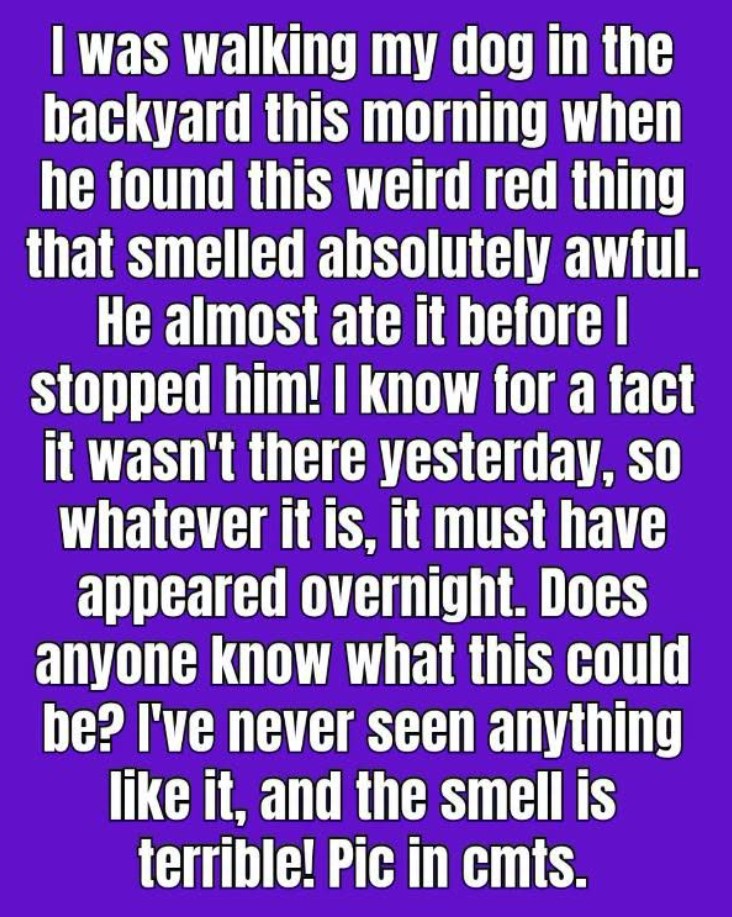
Imagine walking into your backyard one morning and discovering a strange, bright red growth poking out of the soil. It looks almost like something from a science-fiction movie, and the smell is even more surprising. Instead of the fresh scent of grass and flowers, you notice an unpleasant odor that reminds you of rotting meat or something left to decay for too long.
Naturally, you might wonder what has appeared in your garden overnight. Is it a dangerous mushroom? Is it harmful to your plants? Should you remove it immediately, or is it something that can be left alone?
In many cases, this unusual red growth is a type of fungus known as a stinkhorn mushroom. Stinkhorns are fascinating organisms that can appear suddenly in gardens, flower beds, lawns, and areas covered with wood-chip mulch. Although their appearance and smell can be unpleasant, they are a natural part of the environment.
These fungi are especially noticeable because of their unusual shapes, bright colors, and powerful odors. Some look like red or orange fingers emerging from the ground, while others resemble strange structures with several upright branches. Many also develop a slimy coating that attracts flies and other insects.
Despite their unpleasant reputation, stinkhorns play an important role in breaking down dead organic matter. Their appearance does not automatically mean that your garden is unhealthy or that something is wrong with your soil.
However, identifying an unfamiliar mushroom correctly is important, particularly if children or pets spend time outdoors.
Here is what you should know about the mysterious red growth in your backyard, why it smells so bad, whether it can harm your garden, and what you can do if you would rather not have it growing near your home.
What Is the Red, Smelly Thing Growing in Your Backyard?
The strange red growth may be a stinkhorn, a group of fungi belonging to the family Phallaceae.
Stinkhorns come in several shapes, sizes, and colors. Depending on the species, they may appear red, pink, orange, white, or brown. Some grow as simple upright stalks, while others develop complicated structures that resemble cages or lattices.
One reason these fungi attract attention is their ability to emerge surprisingly quickly. A gardener may notice nothing unusual one day and discover a fully developed mushroom the next morning.
Stinkhorns often begin as small, pale, egg-shaped structures partly buried in the soil or mulch. As the fungus develops, the outer covering splits, allowing the mature mushroom to emerge.
The visible mushroom is only the reproductive structure of the organism. Much of the fungus consists of a network of microscopic threads called mycelium, which grows through the surrounding soil and decomposing material.
When conditions are suitable, the fungus produces its visible fruiting body to help spread spores and continue its life cycle.
Red or orange stinkhorns are particularly striking because their bright colors contrast with the surrounding green grass, dark soil, and brown mulch.
Although the appearance described in the title strongly suggests a stinkhorn, color and smell alone cannot establish the exact species. If you want a reliable identification, take a clear photograph of the entire growth, including its base and surrounding area, and consult a local university extension service or knowledgeable mushroom identification expert.
Why Does the Red Mushroom Smell So Bad?
The unpleasant smell is one of the defining characteristics of stinkhorn fungi.
Unlike many familiar mushrooms, which may have a mild or earthy scent, mature stinkhorns can produce an odor resembling rotting meat, animal waste, or decaying organic matter.
The smell is not simply an accidental side effect. It plays an important role in the fungus’s reproduction.
Many mushroom species release spores into the air, allowing the wind to carry them to new locations. Stinkhorns use a different strategy.
Their mature fruiting bodies produce a sticky, often dark-colored spore mass known as the gleba. This material contains the spores and gives off the characteristic unpleasant odor.
Flies and other insects are attracted to the smell because it resembles a potential food source. When they land on the sticky surface, spores can attach to their bodies or be carried away as the insects feed.
The insects then move to other locations, helping distribute the spores.
This process allows stinkhorns to reproduce and spread without depending entirely on wind.
In other words, the very smell that makes homeowners want to remove these mushrooms is part of a natural system that helps the fungus survive.
Although the odor can be strong, it does not necessarily indicate that sewage, a dead animal, or another source of contamination is present in the garden. Sometimes, the fungus itself is responsible.
Why Is It Growing in My Backyard?
Stinkhorns usually appear when environmental conditions favor fungal growth. They are commonly associated with damp areas containing dead or decomposing plant material.
Several factors may explain why one suddenly appears in your yard.
1. Decomposing Wood and Garden Mulch
One of the most common places to find stinkhorns is in wood-chip mulch.
Mulch often contains pieces of bark, branches, leaves, and other organic materials that gradually decompose. These materials provide food for fungi that break them down.
If stinkhorn mycelium is already present in the mulch, suitable conditions can trigger the appearance of its fruiting bodies.
You may notice the mushrooms growing around shrubs, beneath trees, beside flower beds, or along garden paths where mulch has been spread.
Their presence in these locations is not necessarily a sign of poor gardening practices. It can simply mean that the fungus has found a suitable source of organic material.
2. Recent Rainfall or High Humidity
Moisture is another important factor.
After several days of rain, the soil and mulch may remain damp enough to support fungal activity. Warm temperatures combined with moisture can create favorable conditions for many fungi.
This is why unusual mushrooms sometimes seem to appear overnight following wet weather.
The underground fungal network may have been present for some time, even though nothing was visible above the surface.
Once conditions become suitable, the mushroom can emerge quickly.
3. Old Tree Roots and Decaying Stumps
Stinkhorns may also grow near old tree stumps, buried roots, fallen branches, or other decaying wood.
Even when a tree has been removed, its roots may remain underground for years. As the wood breaks down, it provides nutrients for organisms that help recycle organic matter.
If you notice red mushrooms repeatedly appearing around an old stump or a particular section of your garden, the decaying material beneath the surface may be contributing to their growth.
Removing the visible mushroom alone will not necessarily eliminate the underground fungal network.
4. Organic-Rich Soil
Gardens containing leaf litter, compost, bark, and other decomposing plant materials can provide suitable conditions for stinkhorns.
These organisms are generally decomposers rather than parasites attacking healthy garden plants.
Their job is to break down dead organic matter and return nutrients to the environment.
Consequently, the appearance of a stinkhorn does not automatically mean that your lawn, flowers, or vegetables are being damaged.
5. Seasonal Changes
Stinkhorns can appear during different seasons depending on the species and local climate.
In some areas, they are especially noticeable during humid periods or after autumn rainfall. In warmer regions, certain species may emerge at other times of the year.
If your garden experiences changing temperatures, regular rainfall, and plenty of organic mulch, the conditions may occasionally become ideal for these fungi.
Their sudden appearance is often part of a natural seasonal cycle rather than evidence of a new problem.
Is the Red Stinkhorn Mushroom Dangerous?
The answer requires a little care.
Stinkhorns as a group are generally not considered poisonous in the same way as certain deadly mushroom species. However, this does not mean that every unfamiliar red mushroom in your backyard is safe to touch or eat.
Several different fungi can have red or orange coloring, and some species may resemble one another. A photograph or a general description may not be enough to distinguish them reliably.
For this reason, never eat an unidentified wild mushroom, even if it resembles a stinkhorn.
It is also wise to prevent children and pets from chewing or swallowing unfamiliar fungi. If a child or animal eats a wild mushroom, seek prompt advice from an appropriate poison information service, medical professional, or veterinarian. Do not wait for symptoms to appear.
For ordinary garden maintenance, avoid rubbing your eyes or touching your face while handling mushrooms. Wash your hands after working around them, and use gloves or a suitable garden tool if you need to remove a specimen.
The unpleasant odor can be bothersome, but its presence alone does not mean the mushroom is producing dangerous fumes.
In most cases, a stinkhorn growing in a garden is primarily a nuisance because of its smell and unusual appearance rather than because it is damaging the landscape.
Does a Stinkhorn Harm Your Lawn or Plants?
Generally, stinkhorns are beneficial decomposers rather than plant diseases.
They obtain nutrients from dead and decaying organic materials, such as wood chips, fallen leaves, and old roots. By breaking down these materials, they contribute to the natural recycling of nutrients.
Unlike fungi that infect living plants, stinkhorns are not generally considered a threat to healthy grass, flowers, shrubs, or trees.
Their appearance can therefore be surprising without being a reason to worry about the overall health of your garden.
In some cases, their presence may indicate that your mulch or soil contains plenty of organic matter that is undergoing decomposition.
That said, the presence of one mushroom does not provide a complete picture of soil quality. You should not use stinkhorn growth alone as a measure of whether your garden needs fertilizer, additional watering, or other treatment.
If your plants are yellowing, wilting, or developing unusual spots, investigate those symptoms separately rather than assuming the stinkhorn is responsible.
The most common reasons homeowners remove these fungi are their strong odor, unattractive appearance, or concern that children and pets might try to eat them.
How Long Will the Red, Smelly Mushroom Last?
One reassuring feature of many stinkhorns is that their visible fruiting bodies are short-lived.
Depending on the species and weather conditions, a mushroom may deteriorate within hours or over several days.
As it ages, the stalk may collapse, the slimy spore mass may disappear, and the unpleasant smell may gradually fade.
The mushroom can therefore seem to appear suddenly and then vanish almost as quickly.
However, the underground mycelium may remain in the soil or mulch long after the visible mushroom has disappeared.
If conditions become favorable again, another fruiting body may emerge in the same general area.
This explains why removing a mushroom does not always prevent new ones from appearing later.
It also means that homeowners do not necessarily need to undertake extensive garden work simply because a stinkhorn has appeared once.
If the growth is isolated and the smell is temporary, allowing the mushroom to complete its short life cycle may be the simplest option.
How to Remove a Red Stinkhorn From Your Backyard
If the smell is unpleasant or you do not want the mushroom near a frequently used part of your garden, you can remove the visible growth.
You do not usually need to apply chemicals or treat the entire lawn.
Step 1: Protect Your Hands
Wear disposable or washable gardening gloves before handling an unfamiliar mushroom.
Avoid touching your eyes, mouth, or face while working, and keep children and pets away from the area.
If you are uncertain about the mushroom’s identity, avoid handling it directly and seek identification advice.
Step 2: Remove the Visible Mushroom
Use a small garden trowel or another suitable tool to lift the visible fruiting body from the soil.
If you can see an egg-like structure at the base, you may remove that as well. Be gentle to avoid unnecessarily disturbing nearby plants.
Remember that the mushroom is only the visible reproductive structure, so removing it does not guarantee that the underground fungus has been eliminated.
Step 3: Place the Material in a Bag
Place the removed mushroom in a bag and dispose of it according to local waste guidance.
Avoid crushing it unnecessarily, particularly if the surface contains a sticky spore mass.
Clean your garden tool afterward and wash your hands thoroughly.
Step 4: Inspect the Surrounding Area
Look for other mushrooms or egg-like structures nearby.
If several stinkhorns are emerging from the same mulch bed, they may be feeding on decomposing wood or other organic matter beneath the surface.
You can remove additional visible fruiting bodies if necessary, but digging up large areas of healthy garden soil is usually unnecessary.
Step 5: Manage the Odor and Keep the Area Tidy
If the mushroom is particularly smelly, removing the visible growth promptly may help reduce the odor.
You can also clear away fallen branches or excessive accumulations of decaying material where practical, especially if these are causing other garden maintenance problems.
However, remember that decomposing organic matter is a normal part of a healthy garden ecosystem. Removing every piece of leaf litter or organic mulch is not necessary simply because a stinkhorn has appeared.
Can You Prevent Stinkhorns From Coming Back?
Completely eliminating stinkhorns can be difficult because their underground fungal networks may extend through the soil or mulch.
Nevertheless, there are a few practical steps you can take to reduce the likelihood of seeing them repeatedly in a particular area.
Manage excessive moisture. Avoid unnecessary watering and address drainage problems where possible. Damp conditions can favor fungal growth, although stinkhorns may still appear after natural rainfall.
Inspect mulch beds regularly. If you notice the mushrooms while they are young, removing the visible fruiting bodies may reduce the smell and prevent them from remaining in place as they mature.
Maintain garden debris sensibly. Remove unwanted piles of rotting branches and other debris when appropriate. You do not need to remove all organic material, but keeping garden beds tidy may make unwanted growth easier to manage.
Consider the source of repeated growth. If mushrooms consistently appear around a decaying stump or a particular pile of wood chips, the decomposing material may be supporting the fungus. A garden professional can advise whether changing the affected material would be useful.
Avoid relying on fungicides. Fungicides are generally not an effective solution for eliminating stinkhorns because the underground fungal network may persist. Unnecessary chemical treatments can also affect other organisms in the garden.
The most practical strategy is usually to remove visible mushrooms when needed and accept that occasional regrowth may occur under suitable conditions.
Why Do Flies Gather Around the Red Mushroom?
If you notice flies landing on the red growth, there is a biological reason for their behavior.
Mature stinkhorns produce a foul-smelling, sticky spore mass that attracts insects searching for food.
When flies land on the surface, spores can adhere to their bodies or be carried away as they feed. The insects then move to other locations, helping the fungus reproduce.
Although a cluster of flies around a smelly mushroom may look unpleasant, it does not necessarily mean that your yard has a serious insect infestation.
The flies may simply be responding to the fungus’s natural reproductive strategy.
Once the mushroom disappears, the insects may lose interest in that particular spot.
If you are concerned about flies around your home, keep doors and windows screened and dispose of household waste properly. There is generally no need to spray the entire garden solely because flies are visiting a stinkhorn.
Should You Leave the Mushroom Alone?
In many situations, leaving a stinkhorn alone is a reasonable choice.
If the mushroom is growing in a distant corner of the yard, away from children, pets, and frequently used outdoor spaces, it may be easier to allow it to disappear naturally.
The fungus helps break down organic material, and its visible fruiting body usually does not remain for long.
Leaving it in place also avoids unnecessary disturbance to the surrounding soil.
On the other hand, removal may make sense if the mushroom is growing beside a patio, near an entrance, or in a garden area where the odor is particularly unpleasant.
You may also prefer to remove it if children or pets are likely to investigate it.
The important point is that you do not need to panic when you discover an unfamiliar mushroom. Identify it as carefully as possible, keep people and animals from eating it, and choose a sensible response based on its location and the circumstances.
Frequently Asked Questions
Why did a red mushroom appear overnight?
Stinkhorns can develop very quickly when moisture and temperature conditions are suitable. The underground fungal network may have been present for a long time before producing a visible mushroom.
Does the red color mean the mushroom is poisonous?
No. Color alone cannot establish whether a mushroom is poisonous. Some stinkhorns have red or orange stalks, but other fungi can look similar. Never eat a wild mushroom unless it has been reliably identified by a qualified expert.
Will the stinkhorn kill my grass?
Stinkhorns generally feed on dead organic matter rather than healthy grass. Their appearance does not usually indicate that your lawn is being damaged by the fungus.
Why does the mushroom smell like rotting meat?
The odor helps attract flies and other insects that carry the fungus’s spores to new locations. It is part of the mushroom’s reproductive strategy.
Will removing the mushroom stop it from growing again?
Not necessarily. The underground mycelium may remain in the soil or mulch and produce additional fruiting bodies when conditions are favorable.
Should I use bleach or a chemical treatment?
Bleach and other household chemicals are not recommended for treating garden soil. They may damage plants, disturb soil organisms, and fail to eliminate the underground fungus. Removing visible mushrooms is generally a more sensible approach.
Can stinkhorns grow in flower pots?
Yes, some fungi can grow in potting mixtures containing decomposing organic matter, particularly when the growing medium remains moist. If an unfamiliar mushroom appears in a pot, avoid eating it and remove it if necessary.
Are stinkhorns a sign of unhealthy soil?
Not necessarily. They often indicate that organic material is decomposing, which is a normal ecological process. Their presence alone cannot tell you whether your soil is healthy or unhealthy.
Conclusion :
Discovering a bright red, foul-smelling growth in your backyard can certainly be surprising, especially if it seems to have appeared overnight. However, in many cases, the strange organism is a stinkhorn mushroom, a fungus with an unusual appearance and an even more unusual way of reproducing.
Its unpleasant odor serves a natural purpose by attracting flies and other insects that help spread its spores. At the same time, the fungus contributes to the decomposition of dead wood, fallen leaves, mulch, and other organic materials in the garden.
Although the mushroom may look alarming, stinkhorns are generally not considered harmful to healthy lawns and plants. Their visible fruiting bodies are often short-lived, disappearing naturally after a brief period.
If the smell bothers you or the mushroom is growing somewhere children and pets might investigate it, you can remove the visible growth carefully using gloves and a garden tool. Just remember that the underground fungal network may remain, so new mushrooms can appear when conditions become favorable again.
Avoid using harsh chemicals or attempting to eliminate every trace of organic material from your garden. A more practical approach is to manage moisture where possible, keep the garden reasonably tidy, and remove unwanted fruiting bodies when necessary.
Most importantly, never assume that an unfamiliar mushroom is safe to eat based only on its color, smell, or general appearance. Keep children and pets from swallowing wild fungi, and seek professional identification if you are uncertain.
The next time you spot a strange red growth among your plants or mulch, you will have a better idea of what might be happening beneath the surface. What initially looks like a mysterious garden problem may simply be a natural fungus carrying out its role in the ecosystem.