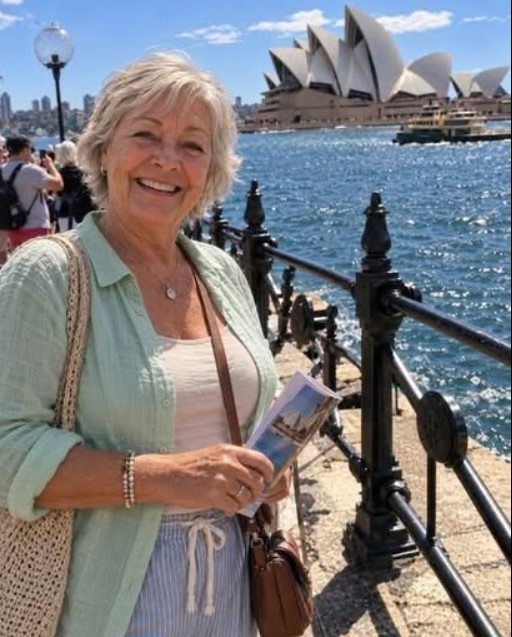
At sixty-nine, I made a decision that shocked my four children: I sold my house and set off to travel around the world. They accused me of being selfish, irresponsible, and careless about my family’s future. What they failed to understand was that I had spent nearly my entire life putting everyone else first.
I raised four children, worked hard, helped with my grandchildren, and gave money whenever one of my children found themselves in trouble. I never expected a reward for being a mother. Still, I sometimes wished someone would call simply to ask how I was doing.
After my husband, Theodore, died twelve years ago, I slowly began to understand how much of my identity had been wrapped up in caring for other people. My days were filled with obligations, but very little felt like it belonged to me.
Then, one morning, I looked at my calendar and realized something painful. I had spent sixty-nine years waiting for the perfect moment to live the life I had always imagined.
That moment had never arrived.
So I sold my house, packed my belongings, and booked a journey around the world.
My children were furious.
“You’re being selfish, Mom,” Brenda told me.
“What about the grandchildren?” Jocelyn demanded.
Mitchell could not believe I would spend my money on travel, while Douglas insisted that the house should have remained in the family.
I explained that it was my home and my decision, but they refused to understand. When I would not change my mind, Brenda and Mitchell blocked my number.
Their reaction hurt deeply, even though I tried not to show it. But I had made my choice. As long as I could walk, carry my suitcase, and explore unfamiliar places, I wanted to discover what life might still have waiting for me.
Australia was the fourth stop on my journey.
That was where I met Bartholomew, a seventy-one-year-old widower with a gentle manner and a wonderful sense of humor. We met through our shared interests in old movies, jazz music, gardening, and detective novels. Our conversations felt easy, and for the first time in years, I found myself laughing without thinking about what someone needed from me.
After several afternoons spent together, Bartholomew invited me to his house.
“I have a shelf full of old records you would enjoy,” he said. “Come over for coffee, and I’ll show you.”
I trusted him.
His home was warm and welcoming, with books, comfortable furniture, and family photographs arranged along the hallway. Nothing seemed unusual.
Bartholomew went into the kitchen to prepare coffee and encouraged me to make myself comfortable.
I walked into the living room.
Then I froze.
Above the fireplace hung an old photograph. My hands began to tremble as I stared at it.
I recognized the house in the picture. I knew the garden, the crooked wooden fence, and the apple tree leaning toward the kitchen window.
Most importantly, I recognized the woman standing in the middle of the photograph.
It was my sister, Margaret.
And standing beside her was a little boy I recognized as my late husband, Theodore.
The photograph had belonged to Theodore for decades. It had once been part of our home, and I had seen it countless times before it disappeared from our lives.
Yet here it was, hanging above the fireplace in a stranger’s house on the other side of the world.
When Bartholomew returned with two cups of coffee, he immediately noticed my expression.
“Are you all right?”
I could barely speak. I pointed toward the fireplace.
“Where did you get that photograph?”
He followed my gaze, and his expression changed.
“Why do you ask?”
“Because that is my childhood home. I lived there for thirty-eight years.”
I pointed toward the woman in the picture.
“And that is my sister. The boy beside her is my husband.”
Bartholomew slowly put down the cups.
“Theodore was your husband?”
I nodded, unable to understand what was happening.
He told me that the photograph had come from his father. His father had died eighteen years earlier, but he had always kept the picture and instructed Bartholomew never to throw it away.
“He told me that one day, someone might come looking for it,” Bartholomew explained.
My heart began pounding.
I had not been looking for the photograph. I had not even known where it was. But suddenly, I felt as though a mystery that had followed me for most of my life was finally about to reveal itself.
Bartholomew walked to an old cabinet and returned with a small metal box.
Inside were dozens of letters, some yellowed with age and others tied together with a faded blue ribbon. On the top envelope was a name I knew better than almost any other.
Theodore.
My husband’s name.
I reached for the letters, but Bartholomew gently stopped me.
“Before you read them, please promise me you’ll hear the whole story.”
I stared at him.
“What story?”
He looked at the letters and then back at me.
“Once you read these, you may never look at your past in the same way again.”
For twelve years, I had remembered Theodore as the quiet center of my life. He had been imperfect, sometimes stubborn and distant, but I had loved him deeply. Even after his death, I sometimes turned toward his side of the bed before remembering that he was gone.
Now, this stranger was telling me that Theodore had kept something from me.
“What are those letters?” I asked.
“They were written to my father,” Bartholomew replied.
“By whom?”
“Your husband.”
My mind struggled to accept his words. Why would Theodore have written to a man I had never heard him mention? And why had the letters been kept with a photograph of my sister?
Bartholomew explained that his father had known Theodore for years. He had inherited the photograph and letters, but he had never explained the entire story to his son.
I opened the first envelope.
The handwriting was unmistakably Theodore’s. I had seen it on shopping lists, birthday cards, and little notes he left around our home.
The letter was dated forty-seven years earlier.
As I read the final lines, my heart seemed to stop.
“If she ever finds out what happened that night, I hope she can forgive me.”
I read the sentence again.
The date was the same as the night Margaret disappeared.
For as long as I could remember, my family had believed that Margaret had run away. She had supposedly packed a small suitcase and left without saying goodbye. She never returned, and no one could tell me where she had gone.
My mother had blamed herself. My father had refused to discuss the matter. Theodore always told me that Margaret wanted a different life.
I had tried to accept that explanation, although a part of me had never stopped wondering what really happened.
Now I was holding a letter proving that Theodore knew more than he had ever admitted.
“What happened to my sister?” I asked.
Bartholomew handed me another envelope.
“This one may explain why your husband kept the secret.”
Inside was another letter. As I read it, the mystery became even more disturbing.
Theodore had spent years protecting someone who was still alive—or at least, someone he had once believed could be found.
The letter also mentioned my eldest daughter, Brenda.
I could hardly believe what I was reading. Brenda had recently called me selfish for selling my house and choosing to travel. Had she known something about Margaret? Had she been keeping a secret from me, too?
At the bottom of the page, I found a sentence that left me trembling.
“I never left willingly, Evelyn.”
It was Margaret’s handwriting.
My sister had written my name.
And suddenly, I understood that her disappearance might never have been the choice our family had always claimed it was.
That night, I barely slept. Bartholomew allowed me to stay in his spare bedroom, and he never pressured me to talk. He simply left a glass of water beside the bed and reminded me that I did not have to face everything alone.
By sunrise, I had decided that I needed answers.
“I’ve waited forty-seven years,” I told him. “I need to know what happened.”
Over breakfast, Bartholomew explained that his father had been involved in financial fraud. Theodore had worked with him for several years and eventually discovered what was happening.
According to Bartholomew, his father believed Margaret knew too much about the illegal activity.
“Was Margaret involved?” I asked.
“I don’t believe so,” he replied. “But my father thought she was a threat.”
I felt sick.
“Then what happened to her?”
Bartholomew admitted that he did not know every detail. However, he had learned that Margaret had spent time at a farmhouse outside the city, a place his father used to hide documents.
“Was she alive when she was there?” I asked.
“For a while, yes.”
His answer left me with more questions than before.
Bartholomew then brought out another box containing an old cassette tape, a photograph, and a handwritten address. I recognized the address immediately.
It belonged to the farmhouse Theodore had once told me was owned by a friend.
My husband had known about the place all along.
“Why didn’t he tell me?” I whispered.
Bartholomew explained that my father had threatened Theodore. He knew how deeply Theodore loved me and had warned him that revealing the truth about Margaret would destroy my life.
Even after my father died, Theodore remained silent. By then, he believed Margaret was dead, and he may have thought there was nothing left to gain by reopening the past.
For the first time in twelve years, I cried for my husband. I had spent so long wondering why he had kept secrets from me that I had never considered the fear and burden he might have carried.
Then I examined the photograph more closely.
On the back was a date, followed by three words:
“She is safe.”
The photograph had been taken after Margaret disappeared.
That meant someone had seen her after the night our family believed she had run away.
I turned the photograph over again and noticed an address written beneath the message. It belonged to a small coastal town several hours away.
My hands began to shake.
“She’s alive,” I said.
Bartholomew cautioned that we could not know for certain, but something inside me refused to let go of hope.
Theodore had once written that he had promised never to reveal Margaret’s location unless I was finally free.
Free.
For years, I had lived according to other people’s expectations. I had cared for my children, helped raise my grandchildren, and put my own wishes aside. Only after selling my house and leaving home had I begun making decisions for myself.
Perhaps Theodore had believed I needed to reach that point before I could face the truth.
That afternoon, Bartholomew drove me to the coastal town.
We stopped outside a small blue house. I sat in the car for a moment, staring at the front door and wondering whether I was about to discover the answer to a question that had haunted me for nearly half a century.
“What if she’s not there?” I asked.
Bartholomew looked at me gently.
“What if she is?”
I stepped out of the car and walked toward the door.
Then I knocked.
Once.
Twice.
At first, there was no response. I knocked again, and finally heard slow footsteps approaching from inside.
The door opened.
An elderly woman stood before me. Her hair was white, and her shoulders were slightly bent with age. But her eyes were familiar.
I knew those eyes.
For a moment, neither of us could speak.
Then she whispered my name.
“Evelyn?”
I covered my mouth.
“Margaret?”
Tears filled both our eyes. We stood there staring at one another, afraid that moving might somehow make the moment disappear.
Then Margaret opened her arms.
I stepped forward, and after forty-seven years, I finally held my sister again.
That evening, Margaret told me everything.
She had never run away willingly. She had discovered what our father was doing and had become frightened for her safety. Theodore had helped her escape, arranging for her to leave the state and find a place where she could live without being tracked down.
He visited her twice, then once more, before the danger became too great.
Our father eventually discovered what Theodore had done. Margaret explained that the threats had made it impossible for her to return home without putting both of us at risk.
She had built a new life under another name. She had married, lost her husband, and grown old far away from the family she had left behind.
But she had never forgotten me.
“Why didn’t you come back?” I asked through my tears.
Margaret took my hand.
“Because Theodore told me you would be safer if you believed I was gone.”
I could hardly speak.
All those years, I had believed my husband had simply refused to tell me the truth. Now I understood that he had been trying to protect me from a danger I had never fully understood.
“Why didn’t he tell me before he died?” I asked.
Margaret lowered her eyes.
“He was afraid you’d blame yourself. He wanted you to have a life without carrying the weight of what happened to me.”
Then she handed me a final letter Theodore had written to her shortly before his death.
In it, he explained that he was ill and did not have much time left. He wrote that if I ever stopped living entirely for everyone else, Margaret should find me and tell me the truth.
The final line broke my heart.
“Evelyn deserves the truth only when she is strong enough to choose her own life.”
I held the letter against my chest and cried.
For twelve years, I had thought Theodore’s greatest gift to me was the life we had built together. Now I realized that he had also tried, in his own imperfect way, to protect my chance of living freely.
When I eventually returned from the coastal town, I did not immediately call my children. For once, I did not feel obligated to explain every decision or apologize for taking time for myself.
Eventually, I called Brenda.
“Mom?” she answered cautiously.
“I found Margaret,” I told her.
There was a long silence.
Then Brenda whispered, “What?”
“I found my sister.”
She began to cry. After a moment, she told me that her grandmother had spoken about Aunt Margaret when she was younger. Brenda insisted she had never known where Margaret was or what had happened to her.
I believed her, but I also began to understand how easily secrets can be passed from one generation to another. In my family, people had sometimes confused silence with protection and sacrifice with love.
But love should never require someone to disappear. It should not mean that one person must give up everything while everyone else takes what they need.
I continued traveling. I visited new countries, stayed in small hotels, explored unfamiliar streets, and enjoyed the freedom of deciding what each day would bring. I also began visiting Margaret regularly. We had forty-seven years of lost time to make up for, and we did it slowly, through long conversations, shared memories, laughter, and tears.
My relationship with Bartholomew grew closer, too. We continued to write to each other and spent time together whenever our travels allowed. We never rushed to define what we meant to one another. At our age, we both understood that companionship did not need grand promises to be meaningful.
Eventually, my children began calling more often. Some apologized for how they had treated me, while others struggled to accept that I would no longer be available whenever they needed something.
I still loved them. I loved my grandchildren, too. But I no longer believed that being a good mother meant abandoning my own needs.
I had spent decades assuming that my life was supposed to become smaller as I grew older. I thought that after Theodore died, my most meaningful years were behind me.
I was wrong.
At sixty-nine, I discovered that I could still make new friends, uncover family secrets, reunite with someone I had believed lost forever, and build a future that belonged to me.
I had sold my house, but I had not thrown away my family’s history. Instead, I had found a missing part of it.
The photograph above Bartholomew’s fireplace had connected me to a truth that had remained hidden for forty-seven years. It had brought me back to my sister and helped me understand the quiet burden my husband had carried until his death.
Most importantly, it reminded me that a person’s story does not end simply because they have reached a certain age.
For years, I had waited for someday to travel, rest, discover new places, and finally live for myself. I had believed that someday would arrive when everyone else was satisfied and nothing more was expected of me.
But someday was never a date on the calendar.
It was a choice.
At sixty-nine, I finally chose myself. I did not lose my family by making that decision. Instead, I discovered which relationships could grow stronger when I stopped sacrificing everything to keep everyone else comfortable.
I had left home believing I was escaping my past. In the end, my journey helped me find the truth, recover a relationship I thought was gone forever, and understand the woman I had always been beneath the responsibilities.
The greatest mystery was not simply why Margaret had disappeared.
It was why I had spent so many years disappearing from my own life.
And this time, I promised myself, I would never make that mistake again.