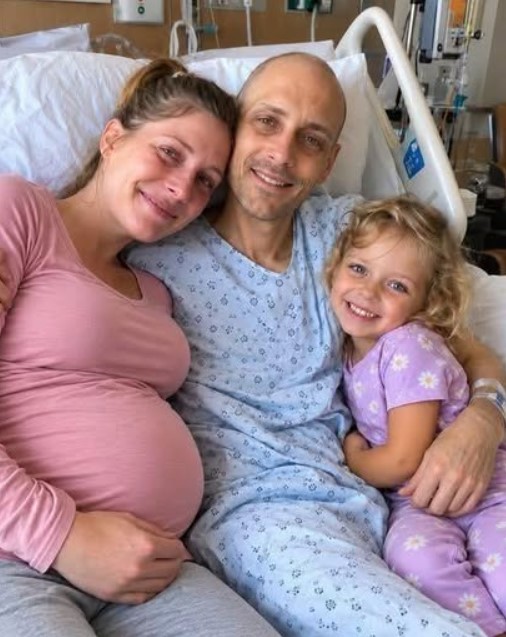
After my husband died, a nurse accidentally revealed that a woman had been visiting him secretly for several weeks before his death. A few days later, that same woman appeared at my door, handed me an envelope, and asked a question that changed everything I thought I knew about my husband.
“So you don’t know what he left you, do you?”
I was six months pregnant, raising our four-year-old daughter, and trying to understand how I was supposed to survive without the man I had loved since high school.
My husband, Jack, had been diagnosed with terminal cancer. The news had shattered our world, but we refused to give up without a fight. We spent every penny we could find on treatment. I sold my jewelry, emptied our savings, and even borrowed money against our house.
We tried everything the doctors recommended, holding on to hope even when the situation became increasingly difficult.
But sometimes, love and determination are not enough to change the outcome.
Jack died before he could meet our second child.
I remember sitting beside his hospital bed, holding his hand long after the doctors had told me there was nothing more they could do. I kept looking at his face, trying to memorize every detail, as though remembering him perfectly could somehow keep him with me.
He had been my best friend, my partner, and the person I imagined growing old beside. We had been together since high school, and I had never seriously imagined a future without him.
Yet suddenly, I was a widow with a young daughter, another baby on the way, and debts I could barely comprehend.
I didn’t know how to pay the bills. I didn’t know whether we could keep our home. Most frightening of all, I didn’t know how to explain to our little girl that her father would never come back.
Every day felt like a battle simply to get out of bed.
A few days after Jack’s death, I returned to the hospital to collect his belongings. The nurse had packed everything carefully into a bag and handed it to me with a sympathetic smile.
I thanked her and began checking the contents.
There were Jack’s wallet, his watch, a few personal items, and a sweater lying on top.
I stopped immediately.
The sweater was clearly a woman’s. It wasn’t mine, and I had never seen it before.
“Excuse me,” I said to the nurse. “I think there has been a mistake. This doesn’t belong to my husband, and it isn’t mine either.”
She looked at the sweater, then frowned.
“No, that definitely came from his room. It belonged to the woman who used to visit him. I assumed she was someone in your family.”
I felt my stomach tighten.
“What woman?”
The nurse seemed surprised by my reaction.
“She visited quite often during the last few weeks. I hadn’t seen her before that, but she came by regularly toward the end.”
I stared at her, waiting for her to explain that she had confused Jack with another patient.
But she didn’t.
Jack had grown up in an orphanage. As far as I knew, he had no relatives left. My own family would certainly have told me if someone had been visiting him.
Who was this woman?
And why had my husband never mentioned her?
I asked the nurse whether there was any way to identify the visitor. She explained that hospital privacy rules limited what she could tell me, but she helped me understand how I might make an inquiry through the appropriate channels.
Eventually, I was able to view footage from a hospital security camera.
There she was.
A thin woman with tired eyes, carrying a small handbag and wearing a dark coat. She walked into Jack’s room as though she knew him well.
I watched the footage several times, hoping something about her face would become familiar.
Nothing did.
I had never seen her before in my life.
For days, I could think of little else. I tried to convince myself that there must be a reasonable explanation. Perhaps she was an old friend. Perhaps Jack had known her from work. Perhaps she was connected to something from his childhood that he had never discussed.
But the questions kept returning.
Why had he hidden her visits from me?
Why had she started coming only when he became seriously ill?
And why had she left a sweater behind?
I knew that grief could make a person imagine the worst. I didn’t want to accuse the man I loved without understanding the truth.
Still, I needed answers.
Then, one evening, someone knocked on my front door.
When I opened it, my heart seemed to stop.
It was the woman from the hospital.
She looked exhausted, and her eyes were red as though she had been crying. For a moment, neither of us spoke.
Then she held out a sealed envelope.
“Jack asked me to give this to you after he died,” she said quietly. “He was very clear that I wasn’t to deliver it before then.”
My hands began to tremble.
“Who are you?”
She looked down at the envelope before answering.
“Someone who should have met you a long time ago.”
I glanced at the letter.
“What is this about? Why were you visiting my husband?”
She took a slow breath.
“So you don’t know what he left you, do you?”
I looked at her in confusion.
“Left me? Jack left me debts, a house I might lose, and two children who will grow up without their father. What else could there possibly be?”
Her eyes filled with tears.
“Please,” she whispered. “Read the letter first.”
I stepped aside and allowed her into the house.
My daughter was asleep in her bedroom, and the quiet made the moment feel even more unreal. I sat at the kitchen table while the stranger remained standing nearby.
I opened the envelope.
The handwriting was unmistakably Jack’s.
For a few seconds, I couldn’t read a single word. My eyes filled with tears, and I had to wipe them before trying again.
The letter began:
My love, if you are reading this, it means I wasn’t able to tell you everything while I was still with you.
I pressed my hand against my mouth.
There is something about my past that I should have shared with you years ago. I wanted to tell you, but I was afraid of opening a door I had spent my whole life trying to close.
I looked up at the woman.
She nodded gently, urging me to continue.
The woman standing beside you is connected to the part of my life I never understood. Please hear her out before you decide what to think of me.
I lowered the letter.
“What does this mean?”
The woman pulled out the chair opposite me and sat down.
“My name is Margaret,” she said. “And Jack was connected to my family long before he met you.”
She hesitated, struggling to find the right words.
“I am his biological mother.”
For several seconds, I couldn’t move.
Jack had always told me that he grew up without a family. He had never spoken about a mother who might still be alive. He had never mentioned anyone searching for him or anyone who might have known where he was.
“How is that possible?” I finally asked.
Margaret explained that she had given birth to Jack when she was very young. Her circumstances had been difficult, and she had been unable to care for him. He was placed in the care of others, and as the years passed, she lost track of what had happened to him.
She told me that she had spent many years regretting the decision and wondering whether her son had found a loving home.
Eventually, she began searching for him.
When she finally located him, Jack was already an adult. He had built a life of his own, and she was frightened that approaching him would cause more pain than comfort.
“So you found him, and you never told me?” I asked.
Margaret lowered her eyes.
“He knew who I was. He agreed to meet me privately. At first, we spoke only a little. Neither of us knew how to begin.”
She explained that their first conversations had been difficult. Jack had questions about his childhood, and she had no answers that could undo the years they had lost.
But when he became seriously ill, she learned how little time he had left.
“I went to see him because I couldn’t bear the thought of losing him twice,” she said.
I thought about the hospital visits, the sweater, and the way the nurse had spoken about the woman who seemed to know Jack so well.
“Why didn’t he tell me?”
Margaret looked at me with a sadness that made my anger falter.
“He was afraid you would think he had been living a double life. He also didn’t know how to explain his feelings about me. He was angry about his childhood, but he wanted answers before it was too late.”
I looked down at Jack’s letter again.
Part of me felt betrayed that he had kept this secret from me. Another part understood that the past can leave wounds people struggle to explain, even to those they love most.
But the letter wasn’t finished.
I continued reading.
I know we have spent almost everything trying to save my life. I know you are frightened about the future, and I hate that I am leaving you with so much responsibility.
My tears fell onto the paper.
There is something else you need to know. During my last weeks, Margaret helped me put some things in order. I have made arrangements for you and the children. Please don’t let fear convince you that you have to face everything alone.
I looked up sharply.
“What arrangements?”
Margaret opened her handbag and removed a second envelope, along with a folder of documents.
“Jack wanted you to have these,” she explained. “He was worried about the mortgage, the medical bills, and how you would manage when the baby arrived.”
Inside the folder were documents relating to a financial arrangement Jack had made before his condition worsened. There were also details about a life insurance policy and a savings account I hadn’t known he had maintained.
The amount would not make us wealthy, but it was enough to change our immediate situation. It could help cover the debts, give us time to decide what to do about the house, and provide a little security for the children.
I stared at the papers in disbelief.
“How did he manage this? We spent everything we had.”
Margaret explained that Jack had received help understanding his options. He had also been determined to make sure his children would have something to rely on after he was gone.
He hadn’t been hiding another family or secretly building a separate life.
He had been trying, as best he could, to protect the family he was leaving behind.
I began to cry harder.
For days, I had imagined that the mysterious woman represented another betrayal. I had feared that my husband had hidden an affair from me during the final weeks of his life.
Instead, I was discovering that he had been struggling to reconcile himself with the past while trying to prepare us for a future he would never see.
I looked at Margaret.
“Why didn’t you tell me who you were when you first visited him?”
“Because Jack asked me to give him time,” she replied. “He wanted to explain everything himself. When his condition deteriorated, he asked me to wait until after his death and bring you the letter.”
She paused.
“I know that doesn’t make the secrecy easy to forgive. I am sorry that you had to discover everything this way.”
I thought about how frightened Jack must have been. He had been facing his own death, worrying about his unborn child, and trying to make peace with a mother he had never known.
I wished he had trusted me enough to tell me.
But I also wished I could hold him one more time and tell him that we could have faced the truth together.
I folded the letter carefully and held it against my chest.
For a long time, neither Margaret nor I spoke.
Eventually, she asked whether she could meet my daughter.
I hesitated. I was still processing everything, and I wasn’t ready to let a stranger into our lives simply because she had shared a connection to Jack.
But I could see that Margaret wasn’t asking for forgiveness or demanding a place in our family. She seemed to understand that she had arrived carrying a complicated history, and that I needed time.
“I can’t promise anything right now,” I told her. “I need time to understand all of this.”
She nodded.
“Of course. You don’t owe me anything.”
Before she left, she gave me her contact details and promised to help me understand the documents Jack had left behind.
After the door closed, I returned to the kitchen and read his letter again.
I cried for the husband I had lost. I cried for the life we had planned and the moments he would never share with our children. I cried because I wished he had trusted me with his secret while he was still alive.
But beneath the grief, I felt something else.
Relief.
For the first time since Jack’s death, I could see a way forward.
The coming months were still difficult. I had to deal with paperwork, medical expenses, and the everyday demands of caring for a young child while preparing for the birth of another. There were days when the smallest tasks felt impossible.
But I was no longer facing the future with the same fear.
With the help of the financial arrangements Jack had made, I could begin addressing our debts. I could make informed decisions about our home instead of assuming we would lose everything. I could concentrate on my children rather than spending every waking hour wondering how we would survive.
Margaret and I stayed in contact, slowly getting to know one another. Our conversations were sometimes awkward. We both understood that sharing a connection to Jack did not automatically make us close.
She told me stories about his early childhood that I had never heard. I shared memories of the boy I had fallen in love with in high school, the man who made me laugh when I was upset, and the father who used to talk to my pregnant belly as though our baby could already understand him.
Through those conversations, I began to see Jack from a different perspective.
He had carried questions about his origins for much of his life. Finding Margaret had not erased the hurt of his childhood, but it had given him a chance to understand where he came from before he died.
I also began to understand that I could feel angry about his secrecy and still love him deeply.
Those feelings were not mutually exclusive.
When my second child was born, I held the baby close and thought about Jack. I imagined the way his face would have softened at the sight of our newborn, how he would have counted tiny fingers and toes, and how he would have tried to hide his tears.
It hurt knowing he would never be there.
But I also remembered his letter and the arrangements he had made. He had not been able to give our child a lifetime of memories, but he had tried to leave us some security and a path toward the future.
I placed the letter in a small box with Jack’s wedding ring and a photograph of us from our younger days. It became something I could return to when I missed him, not because it answered every question, but because it reminded me that our love had been real.
Over time, I stopped thinking of Margaret only as the mysterious woman from the hospital.
She was someone who had made mistakes, lived with regret, and finally found her way back to a son she had lost long ago. I did not have to excuse every decision she had made to understand her pain.
Nor did I have to become her closest friend overnight.
We took things slowly, allowing trust to grow naturally.
There were still difficult days. Grief did not disappear simply because the financial worries became more manageable. I missed Jack when I cooked his favorite meals, when our daughter asked questions about her father, and whenever I imagined the things he would have said about our growing family.
But I gradually learned that surviving did not mean forgetting.
It meant learning how to carry love and loss together.
Looking back, the woman at my door had frightened me because I believed she was bringing another betrayal into my life. Instead, she brought a truth Jack had never found the courage to share and a reminder that even the people closest to us can carry painful histories we do not fully understand.
I wish Jack had told me everything himself. I wish we had spent his final weeks talking openly about his childhood, his mother, and his fears for our future.
But I cannot change those last weeks, and I cannot ask him the questions I still have.
What I can do is build a life for our children that is filled with honesty, security, and love.
I can tell them stories about their father, make sure they know how deeply he loved them, and remind them that family is not defined only by the circumstances of our birth. It is also shaped by the people who show up, take responsibility, and care for us when life becomes difficult.
Jack left us far too soon. He never got to hold our second child, watch our daughter grow up, or see the years we had dreamed of sharing.
But he left me something more than paperwork and financial arrangements.
He left me the truth about a part of his life he had never fully understood himself. He left me the chance to see him as a whole person, with fears, regrets, and hopes that existed long before we met.
And he left me a reminder that even after the deepest loss, life can still offer unexpected help and new beginnings.
I will always wish I had more time with my husband. Nothing can replace him, and no discovery can make his death less painful.
But I no longer believe that my story ended when his did.
I am still a mother. I am still the woman Jack loved. And I am still capable of building a future for myself and our children, one difficult day at a time.
Sometimes, the truth arrives in the most unexpected way. Sometimes, it comes in the form of a stranger standing on your doorstep with a letter you never expected to read.
And sometimes, the person you thought had left you with nothing but grief has quietly tried to leave you enough hope to begin again.