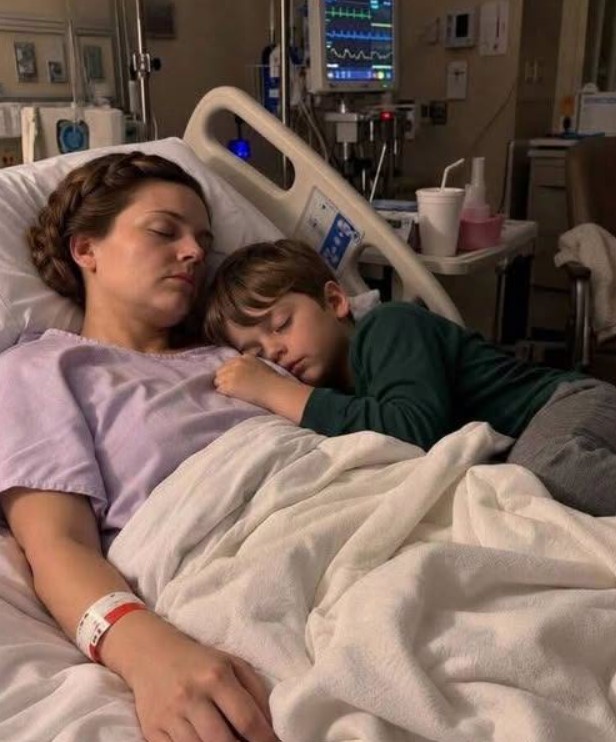
My wife had been in a coma for two months, and our seven-year-old son, Noah, refused to spend a single day away from her hospital room.
Every afternoon after school, he went straight to the hospital. He would pull a chair beside his mother’s bed, take her hand, and tell her everything that had happened during his day. He talked about his teachers, his friends, his homework, and the superhero comics he loved so much.
Sometimes, he read to her for hours. Other times, he simply sat quietly beside her, hoping she would open her eyes.
Almost every evening, he begged to stay overnight.
My mother and I were becoming increasingly worried. Noah was only seven years old. He needed proper sleep, time with his friends, and the freedom to enjoy his childhood without feeling responsible for his mother’s recovery.
But that Saturday evening, when I finally tried to convince him to come home, he looked at me with an expression I had never seen before.
“Dad, I can’t leave Mom on Saturdays.”
I frowned.
“Why not, buddy?”
He glanced at his mother’s motionless face and whispered, “Because that’s when she talks to me.”
I stared at him, unsure how to respond. I thought perhaps his imagination was helping him cope with a situation too painful for a child to understand.
Then he asked me a question that struck deeper than anything else he had said.
“Dad, why are you afraid to stay here with me?”
Suddenly, I realized that my son had been noticing things I had tried desperately to ignore.
My name is Jeremy, and two months earlier, I had been away on a business trip when my mother called me with news that changed our lives.
I remember standing outside a conference room, frustrated because a meeting had gone longer than expected. My phone rang, and I answered without thinking much about it.
“Jeremy, you need to come home.”
Something in my mother’s voice made my stomach tighten.
“Mom, what’s wrong?”
“It’s Emma. She’s in the hospital.”
I froze.
“What happened to my wife?”
My mother took a breath before answering.
“She’s in a coma, Jeremy. Noah is here with her, and he refuses to leave her side. Please come home as soon as you can.”
I didn’t ask another question. I grabbed my belongings, informed my colleagues that I had to leave, and headed straight for the airport.
Even now, I struggle with the guilt of not being there when Emma needed me. I know I couldn’t have predicted what happened, and I know my business trip did not cause her condition. But guilt doesn’t always listen to reason.
Sometimes, it simply stays with you.
When I arrived at the hospital, Emma was lying in a bed surrounded by medical equipment. Her eyes were closed, and she looked so peaceful that, for one painful moment, I almost expected her to wake up and ask why I had come home early.
But she didn’t move.
Noah was sitting beside her, holding her hand.
“Daddy, when will Mommy wake up?” he asked.
I knelt beside him and tried to find an answer that would make everything better.
“I don’t know, buddy. But the doctors are taking good care of her.”
It was the only honest answer I could give him.
From that day forward, our lives revolved around the hospital.
For two months, I watched the days pass without hearing my wife’s voice. Every morning brought another wave of uncertainty, and every evening ended with the same unanswered question: Would Emma ever open her eyes again?
Noah went to school because we insisted that he maintain some normality in his life. But as soon as his classes ended, my mother drove him to the hospital.
He completed his homework beside Emma’s bed. He read her superhero comics and described the adventures of his favorite characters. He told her about his classmates, his spelling tests, and the funny things that happened during recess.
He behaved as though his mother were simply resting and might wake up at any moment to join the conversation.
Sometimes, he fell asleep in the chair with his head close to her hand.
When the nurses gently suggested that he should go home, he would look at them with frightened eyes and ask if he could stay a little longer.
My mother and I worried about him constantly. We didn’t want him to feel that he had to protect his mother by remaining at her bedside every minute of the day.
But we had no idea just how much he believed that his presence mattered.
That Saturday evening, I decided we needed to have a serious conversation.
I pulled a chair beside him. He was reading a Marvel comic, completely absorbed in the story.
“Hey, buddy,” I said gently. “Can we talk for a minute?”
He looked up.
“Sure, Dad.”
“I know you’ve been taking wonderful care of Mom. You’ve been incredibly brave, and I’m proud of you.”
He glanced toward Emma.
“But even superheroes need to recharge. They need sleep so they can be strong enough to help people. How about we go home tonight? You can sleep in your own bed, and we’ll come back tomorrow.”
Noah slowly closed his comic.
Then he asked, “What day is it?”
“Saturday.”
His expression immediately changed.
“Then I can’t leave.”
I tried to understand what he meant.
“Why is Saturday different from the other days?”
“Because Mom won’t have anyone to talk to.”
I gave him a small, reassuring smile.
“You can talk to her again tomorrow, sweetheart.”
He shook his head.
“No, Dad. You don’t understand.”
He leaned closer, lowering his voice as if he were sharing something important.
“Mom talks to me on Saturdays.”
For a moment, I thought he was pretending. Perhaps he had mistaken a movement for a response or imagined hearing his mother’s voice because he missed her so much.
“Noah, sweetheart, I know you want Mom to wake up. We all do. But she isn’t able to speak right now.”
He looked at me seriously.
“Then stay and see.”
I hesitated.
Part of me wanted to explain again that patients in comas could sometimes move without being consciously aware of what was happening around them. I didn’t want to give him false hope.
But another part of me realized that I had never truly sat still long enough to understand what he was experiencing.
I was always busy. I answered work calls, spoke with the doctors, asked the nurses questions, or went downstairs to get coffee. I visited Emma every day, but I rarely allowed myself to simply sit beside her without looking for something else to do.
So I made a decision.
“Okay, buddy. I’ll stay tonight.”
Noah smiled and moved his chair closer to his mother’s bed.
For nearly an hour, he talked to Emma about school. He told her about a spelling test and complained that Grandma had burned the pancakes that morning.
From the corner of the room, my mother immediately protested.
“They weren’t burned!”
Noah grinned.
“They were black, Grandma!”
For a moment, I almost forgot why we were there. Noah’s sense of humor reminded me of Emma, who could always turn an ordinary moment into something funny.
Eventually, my mother went home, leaving the two of us alone with Emma.
I sat beside my son and watched my wife’s face. The room was quiet except for the steady sounds of the medical equipment.
Around seven o’clock, I stood up.
“I’m going to get some coffee,” I said.
Noah immediately looked at me.
“You promised you’d stay.”
“I’m only going down the hall for a few minutes.”
He frowned.
“There’s coffee down the hall. Why do you need to leave?”
I stopped.
His words were simple, but they exposed something I had spent two months avoiding.
I didn’t need coffee. I needed an excuse to leave a room where I felt helpless.
I looked at Noah, then at Emma.
“You’re right,” I said quietly. “I’ll stay.”
I sat back down.
About twenty minutes later, Noah moved closer to his mother’s bed. He gently slipped his hand beneath hers and looked toward me.
“Okay, Mom,” he whispered. “Dad’s here this time.”
Then he asked her a question.
“Mom, is Dad here with us?”
We waited.
At first, nothing happened.
Then I noticed Emma’s index finger move.
Just once.
I leaned forward.
“Emma?”
Her hand became still again.
Noah turned toward me, his face bright with a mixture of excitement and relief.
“See, Dad? She said yes.”
I stared at him.
“What do you mean?”
He explained that he had been asking his mother simple questions for several Saturdays. He had learned to interpret one finger movement as yes and two movements as no.
I was cautious. I knew that unconscious patients could make involuntary movements, and I didn’t want to confuse a reflex with meaningful communication.
Still, I decided to ask a few questions myself.
“Noah, move your hand away for a moment,” I said.
He did.
I leaned closer to Emma.
“Sweetheart, is Noah seven years old?”
After a pause, her finger moved once.
I felt my heart begin to pound.
I asked another question. Then another. Her responses were not always consistent, and I knew that we couldn’t draw medical conclusions from a few movements.
But I couldn’t dismiss what I had just witnessed, either.
I turned toward my son.
“How long has this been happening?”
“About four Saturdays,” he replied.
“Why didn’t you tell me?”
His smile faded.
“I tried. But people said that Mom sometimes moves when she’s sleeping.”
I swallowed hard.
“Buddy, you should have told me again.”
He lowered his eyes.
“You wouldn’t have believed me either.”
The words hurt because I knew there was truth in them.
I had been so focused on managing the situation that I hadn’t always listened to the person who spent the most time beside Emma.
I reached for Noah’s hand.
“We were worried about you, sweetheart. We didn’t want you to become exhausted.”
He nodded, but then he said something that made me look away.
“Dad, why are you always scared to stay with Mom?”
I tried to defend myself.
“I’m here every day, Noah.”
“I know. But you’re always leaving.”
He began counting on his fingers.
“You get coffee. You take work calls. You talk to Grandma. You ask the nurses questions. You go downstairs.”
I searched for an answer, but every explanation sounded weak.
Noah wasn’t saying I never visited my wife. He was telling me that I kept finding reasons not to remain with her when the room became quiet.
And he was right.
For two months, I had been terrified of sitting beside Emma with nothing to distract me from the possibility that she might never wake up.
I was afraid of losing her. I was afraid of the future without her. And I was afraid of what I would feel if I allowed myself to remember the last conversation we had before my trip.
The evening before I left, Emma had asked me to stay home.
“Jeremy, please don’t go this time,” she had said in our kitchen.
“It’s only three days,” I replied, picking up my suitcase.
“It’s never just three days. You’re always working.”
“The meeting is important, Emma.”
“And what about us?”
I was tired, impatient, and convinced that I could deal with our problems when I returned.
“We’ll talk when I get back,” I told her.
Then I walked out.
We never had that conversation.
Emma’s medical emergency was not caused by my decision to travel. I understood that. But the memory of leaving her upset had followed me ever since she became ill.
I wondered whether she would remember our argument when she woke up. I worried that she would be angry with me. And perhaps, without admitting it to myself, I was afraid to face the pain of knowing that our last conversation had ended badly.
Noah watched me quietly.
“Was Mom angry when you left?” he asked.
I took a slow breath.
“Yes, buddy. We were arguing.”
“Is that why you don’t stay?”
I couldn’t lie to him.
“Partly.”
He looked confused.
“But you love Mom.”
“More than anything.”
“Then why are you scared?”
I looked toward Emma and tried to find the words.
“Sometimes I get so busy trying to fix problems that I forget people need more than solutions. They need you to listen. They need you to stay with them.”
Noah considered that for a moment.
“Mom just wanted you there.”
I nodded, my eyes filling with tears.
“I know that now.”
He looked at Emma and seemed to think carefully about what he wanted to ask next.
“Let’s ask her something,” he said.
“What is it?”
“If she’s still mad at you.”
My heart began to pound.
“Noah, maybe we shouldn’t.”
But he turned toward his mother.
“Mom, are you mad at Dad?”
We waited.
Nothing happened.
He tried again, but her hand remained still.
I looked away, telling myself that perhaps she was tired or that the earlier movements had been involuntary.
Then Noah thought of another question.
“Mom, do you want Dad to stay?”
The room became completely silent.
I watched Emma’s hand, barely daring to breathe.
Several seconds passed.
Then her index finger moved once.
Yes.
I couldn’t speak.
Noah smiled at me.
“See, Dad? She wants you here.”
I gently took Emma’s hand.
For two months, I had imagined her waking up and remembering our argument. I had been so frightened of what she might say that I had forgotten something important.
I loved my wife. I wanted her to recover. And regardless of whether she could respond to me, she deserved to know that I was there.
I didn’t need to solve everything that night. I didn’t need to know when she would wake up or whether she remembered our last argument.
I needed to stay.
I turned toward Noah.
“Buddy, you don’t have to do this alone anymore.”
His forehead wrinkled.
“But Mom needs someone.”
“I know. And I’m here.”
“What if she wakes up?”
“I’ll be here.”
“What if she tries to talk?”
“I’ll listen.”
He hesitated before asking one final question.
“What if work calls?”
I smiled sadly.
“When I can, someone else will have to handle it. My family needs me, too.”
He studied my face, searching for a sign that I meant what I said.
Then he asked, “What about coffee?”
I laughed softly through my tears.
“Coffee can wait.”
I placed a hand on his shoulder.
“I’ve got Mom, Noah. You can rest.”
For weeks, my little boy had believed that staying beside Emma was his responsibility. He had carried the fear that if he left the room, his mother would be alone when she needed him.
I had been so worried about his exhaustion that I hadn’t understood how deeply that fear had taken hold of him.
He was only seven years old. He should have been worrying about school, comic books, and what he wanted for dinner—not whether his mother had someone to talk to.
That night, I told the nurse about the movements we had observed. I explained exactly what happened and asked the medical team to evaluate Emma’s responses.
I didn’t claim that she had fully regained consciousness. I knew that her condition required careful medical assessment, and I didn’t want to mistake a small movement for a definite sign of recovery.
Over the following days, the doctors monitored her closely.
Sometimes she moved. Sometimes she didn’t. They explained that responses in patients with impaired consciousness can be difficult to interpret, but they took our observations seriously.
For Noah, that mattered enormously.
He no longer felt that he had to convince everyone by himself.
That evening, when it was time to gather his school things and head home, he stiffened.
“I’m not leaving Mom,” he insisted.
I knelt in front of him.
“I’m staying tonight.”
“But it’s Saturday.”
“I know.”
“She needs someone.”
“And she has me.”
He searched my face.
“You promise?”
“I promise.”
“Right here?”
“Right here.”
At last, Noah leaned over and gently hugged his mother.
“Good night, Mom,” he whispered.
He started toward the door, then turned back one final time.
“Dad’s staying with you.”
I watched him leave with my mother, feeling a mixture of sadness and relief.
For the first time in weeks, Noah went home and slept in his own bed.
And I stayed beside my wife until morning.
There were no unnecessary phone calls. No wandering through the hallways. No searching for reasons to leave.
I held Emma’s hand and spoke to her in a voice I hoped she could hear.
“I’m sorry, sweetheart,” I whispered.
Her fingers remained still.
“I thought taking care of everything meant I was being a good husband. I thought working hard and solving problems was how I showed you I loved you.”
I swallowed, struggling to continue.
“But I forgot how important it was to simply be here. I should have listened to you before I left. I should have made more time for us.”
I didn’t know whether she could hear me. I didn’t know whether she remembered our argument or whether she would ever be able to answer.
But I spoke anyway.
I told her I loved her. I told her that Noah was being brave, that he missed her terribly, and that he needed his mother. I told her that I would be waiting whenever she was ready to come back to us.
Then I stayed until morning.
Over the following weeks, Emma began showing small signs of improvement.
There were occasional movements, brief responses to familiar voices, and moments when her eyes opened. Her progress was slow, and the doctors continued evaluating her condition.
We learned to appreciate every small change without assuming that it meant a full recovery was just around the corner.
Noah still visited his mother after school, but our lives gradually began to regain a little balance.
He went home for dinner. He played with his friends. He laughed more often, and sometimes he even complained when a playdate ended because it was time to visit the hospital.
Those ordinary complaints became precious to me.
They reminded me that my son was beginning to feel like a child again, rather than his mother’s full-time protector.
Saturdays remained special, but they were different now.
I stayed beside Emma, too.
Several weeks later, Noah was sitting near his mother’s bed, telling her about something that had happened at school. Halfway through his story, he turned toward me.
“Dad, you ask her today.”
I smiled.
“Are you sure?”
He nodded.
I moved closer to Emma and gently took her hand.
“Hey, sweetheart. It’s me.”
Her hand was warm against mine.
I thought carefully about what to ask, then decided to make the moment a little lighter.
“Emma, do you think Noah will ever learn how to spell ‘separate’?”
Noah immediately groaned.
“Dad! That’s not funny!”
I laughed quietly, then watched Emma’s hand.
Several seconds passed.
Then her index finger moved once.
Noah burst into laughter.
I laughed with him, and for the first time in months, the hospital room felt filled with joy instead of constant fear.
I looked at my son and thought about everything he had taught me.
At first, I had believed that Noah refused to leave because he couldn’t accept his mother’s condition. I thought he needed to learn that the hospital staff were caring for her and that he was allowed to go home and be a child.
I hadn’t understood the deeper reason behind his determination.
He stayed because he believed somebody had to be there for his mother.
And without realizing it, I had allowed my seven-year-old son to feel that somebody was him.
I had visited Emma every day. I had spoken to doctors, handled bills, managed schedules, and tried to keep the practical parts of our lives under control.
I thought I was doing everything a responsible husband should do.
But Noah had noticed what I had missed.
There is a difference between visiting someone you love and truly being present for them.
Being present means putting aside distractions when you can, listening without rushing, and allowing yourself to share a difficult moment even when you cannot make it better.
It means understanding that love isn’t always about finding a solution. Sometimes, it is simply about holding someone’s hand and refusing to walk away because the silence is painful.
My son learned that lesson long before I did.
It took a seven-year-old boy and one tiny movement of his mother’s finger to make me understand what I had been avoiding for months.
I couldn’t control Emma’s recovery. I couldn’t promise Noah that everything would return to the way it had been before. And I couldn’t go back and change the argument that had ended our last conversation before my business trip.
But I could choose what I did next.
I could stop hiding behind work. I could listen more carefully. I could help my son understand that he wasn’t responsible for saving his mother, and I could make sure he never had to carry that fear alone again.
Most importantly, I could stay beside the woman I loved.
And this time, I wasn’t going anywhere.