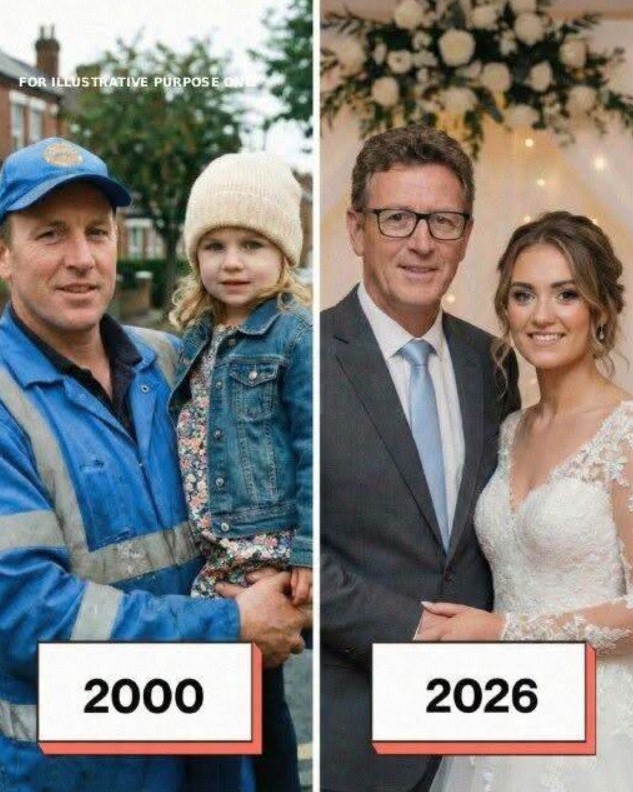
My name is Mia, and for as long as I can remember, my father has worked for the city as a garbage collector.
Some people prefer the terms sanitation worker, waste management technician, or public services employee. Whatever they call it, the work is the same. My father collects trash, cleans our streets, and helps keep our city running.
He has done that job since I was a little girl, and he has never been ashamed of it.
My mother died of cancer when I was only three years old. The illness came quickly, leaving my father with a little girl to raise and a future he had never imagined facing alone.
I don’t remember my mother’s voice or the sound of her laughter. My earliest memories of that time are mostly fragments. But I remember what my father told me one night as he sat beside my bed, holding my tiny hand.
“It’s just us now, princesa,” he whispered. “But we’re going to be okay.”
And somehow, he made sure we were.
We lived in a small two-bedroom apartment on the south side of town. The paint peeled from the walls, the radiator rattled through the winter, and the air conditioner struggled to keep us comfortable during the hottest months.
We weren’t rich, but we had a home. There was always food on the table, the electricity stayed on, and I had what I needed for school.
Only when I grew older did I understand what those ordinary things had cost him.
My father left for work at 4:30 every morning. I could hear the front door closing quietly as he tried not to wake me. While I was still sleeping, he was already outside in the cold, working beside a garbage truck and lifting bags that most people never thought twice about.
When he returned home, his clothes carried the smell of exhaust, sweat, and the streets he had spent the day cleaning. His hands were rough, his shoulders often hurt, and exhaustion sometimes left him too tired to speak much.
Yet he never missed a parent-teacher conference. He never forgot a birthday. He never made me feel that raising me alone was a burden.
When people asked about his work, he answered without hesitation.
“I work for the city’s sanitation department,” he would say proudly. “It’s honest work, and the city needs people willing to do it.”
That simple belief shaped the woman I became.
I studied hard, went to medical school, and eventually became a doctor. I didn’t choose medicine because I wanted people to admire me. I chose it because I had grown up watching my father spend his life caring for someone else.
He had taught me that love wasn’t measured by money, expensive possessions, or social standing. Love was getting up before sunrise because your child needed a better future. It was working through exhaustion and showing up anyway.
Then I met Jordan.
We first crossed paths during my second year of residency. He was visiting a friend at the hospital, and we ended up sharing an elevator. Our conversation began with something unimportant, but neither of us seemed eager to stop talking when the doors opened.
Jordan was thoughtful, patient, and a good listener. He remembered little things I mentioned and never made me feel that I needed to compete for his attention.
A few months into our relationship, we were sitting in a diner eating pancakes after a long day when he asked about my family.
“It’s just my dad and me,” I explained. “My mom died when I was little.”
“I’m sorry,” he said.
“He raised me alone. He works for the city, in sanitation.”
I watched him carefully, waiting for the familiar reaction: the polite smile, the awkward silence, the subtle judgment.
Instead, Jordan nodded.
“That’s hard work,” he replied. “Does he like it?”
“He says it’s honest.”
Jordan smiled. “Then that’s what matters.”
I fell a little more in love with him that night.
When Jordan eventually met my father, Dad prepared his signature dinner: spaghetti with meat sauce and garlic bread. It was the same meal he had cooked for every important occasion throughout my childhood.
He was nervous, though he tried to hide it.
Jordan treated him with warmth and respect. They talked about sports, work, and the ordinary things people discuss when they’re beginning to get to know one another. Before long, my father was laughing freely.
After Jordan left, Dad turned to me.
“He’s good to you,” he said.
“He is.”
“That’s all I care about.”
Six months later, Jordan proposed, and I accepted without hesitation.
I thought our biggest challenge would be balancing two demanding careers and planning a wedding. I didn’t realize that his family’s opinions about my background would become a problem we couldn’t ignore.
Jordan’s parents, Linda and Robert, owned several successful retail stores. They lived comfortably and moved in social circles where appearances seemed to matter almost as much as money.
The first time I met Linda, she asked what I did for a living.
“I’m a doctor,” I answered. “I’m finishing my residency.”
Her eyebrows rose.
“Oh. That’s impressive.”
Something about her tone made the compliment feel more like a surprise than genuine admiration.
Later, I overheard Jordan’s sister, Kayla, speaking to him in the kitchen.
“She comes from nothing. Are you sure about this?”
“I’m sure,” Jordan replied.
At another family dinner, his uncle Ron was even less subtle.
“A sanitation worker’s daughter? You could do better.”
Jordan immediately told him that his comment was unacceptable, but the damage had already been done.
Over time, the criticism became quieter and more carefully disguised.
“It’s not personal, Mia,” Linda once told me. “It’s just about how things look.”
I wanted to believe she would eventually get to know me and see beyond my father’s occupation. I hoped she would recognize that I had worked hard for everything I had accomplished.
But Linda seemed less interested in who I was than in what my background might say about her family.
Jordan defended me, yet I could see how much the constant tension affected him. I tried to reassure him that we could manage it together.
Unfortunately, the wedding gave his family a new reason to interfere.
Jordan and I had wanted a small ceremony with a few close friends and relatives. His parents insisted on something grander: an elegant venue, elaborate decorations, expensive flowers, and a guest list filled with business associates.
“People expect a certain standard,” Linda repeated whenever we questioned another expense or decision.
I didn’t care about the flowers or the chandeliers. I cared about marrying the man I loved and having my father beside me.
On the morning of the wedding, Dad arrived early. He stood near the entrance, adjusting his tie while taking in the grand ballroom. The polished floors, glittering chandeliers, and towering floral arrangements were a world away from our modest apartment.
Then he saw me in my wedding dress.
His entire face changed.
“You look beautiful, princesa,” he said, his voice thick with emotion.
I hugged him tightly.
“I’m so glad you’re here.”
“Wouldn’t miss this for the world.”
Jordan greeted him warmly, too, wrapping him in a hug. For a little while, everything felt exactly as it should.
Then I began noticing the looks.
A few of Jordan’s relatives glanced at my father and whispered to one another. One woman looked him up and down before turning toward her companion with a faint smile. Kayla approached him, spoke briefly, and then walked away without inviting him to join the family photographs.
I tried to tell myself I was being oversensitive. Weddings were stressful, and people were busy.
Then Linda approached me.
“Mia, darling, could I speak with you for a moment?”
She led me toward a quiet corner near the entrance.
“Your father is attracting attention,” she said.
I stared at her. “What does that mean?”
“Some of our guests are asking about him. They don’t understand why he’s dressed so simply for an event like this.”
I looked down at my father’s suit. It wasn’t designer clothing, but it was clean, neatly pressed, and chosen with care.
“He’s my father,” I said. “He’s supposed to be here.”
“Of course, but perhaps he could sit somewhere less visible. We have business associates here, and we want everything to look appropriate.”
For a moment, I couldn’t find the words to answer her.
“My father raised me by himself. He worked every day to give me a future. I’m a doctor because of what he sacrificed for me. And you think he should hide because he collects garbage?”
Linda’s expression hardened.
“Please don’t turn this into a scene. I’m trying to protect the atmosphere of the wedding.”
“No,” I replied. “You’re trying to protect your image.”
Before she could respond, I walked away.
I found Jordan near the head table and told him what had happened. His face changed immediately.
“She said that to you?”
“She wants Dad moved somewhere out of sight.”
Jordan shook his head in disbelief and went to confront his mother.
I stayed near my father, trying to keep my composure. Dad had noticed the tension, and I could tell he was worried.
“Everything all right, princesa?” he asked.
“Everything’s fine, Dad.”
He looked at me for a long moment.
“You don’t have to pretend with me.”
My eyes filled with tears, but before I could explain, Linda returned with Robert and Kayla.
This time, she wasn’t smiling.
“Carlos,” she said, using his name with a cold formality, “I think it would be best if you left the ballroom for a while.”
My father looked confused.
“Excuse me?”
“Some of the guests are uncomfortable, and we have certain expectations for this event. Perhaps you could wait outside until the formal reception is finished.”
I felt as though someone had struck me.
“He’s not leaving,” I said.
Linda turned toward me. “Mia, please. This is not the time.”
“You’re right. It’s not the time to humiliate my father at my own wedding.”
Robert stepped forward, his voice low but firm.
“We’ve spent a great deal of money on this event. We have every right to ensure that it reflects our family’s standards.”
Jordan returned just in time to hear the last sentence.
“What is going on?” he demanded.
His mother folded her arms.
“We are trying to resolve an unfortunate situation. Your bride’s father is making some of our guests uncomfortable.”
Jordan looked from his mother to my father.
“Because of his job?”
“Because of how this looks,” Linda replied.
Jordan’s expression turned hard.
“My future wife is a doctor. Her father raised her alone, sacrificed everything for her, and helped her become the person she is today. If you can’t respect him, then you have no business pretending to respect her.”
His mother stared at him.
“Don’t be dramatic, Jordan.”
“I’m not being dramatic. I’m telling you that this stops now.”
For a moment, I thought the argument was over. But Linda turned toward a nearby venue employee and quietly asked him to escort my father outside.
That was the moment something inside me broke.
My father had spent his entire life making sure I never felt small. He had worked in the rain, the freezing cold, and the summer heat without once asking for recognition. He had stood behind me at every important moment.
And now, at the wedding he had dreamed of attending, people were treating him as though he were something shameful.
I stepped forward, ready to tell everyone exactly what I thought of them.
But my father gently touched my arm.
“Wait, princesa.”
His voice was calm, almost gentle.
Then he turned toward the microphone beside the head table.
“May I have a moment, please?”
The room gradually quieted. Conversations faded, and guests began turning toward him.
Linda’s eyes widened.
“Carlos, this really isn’t necessary.”
My father didn’t argue. He simply took the microphone.
“I know some of you have been wondering who I am,” he began. “My name is Carlos. I’ve worked for the city’s sanitation department for more than thirty years.”
A few people shifted uncomfortably in their seats.
“I’m not a wealthy man. I don’t own a business, and I don’t wear expensive suits. Most mornings, I leave my home before the sun comes up. I pick up what people throw away, and I help keep the streets clean.”
He paused and looked around the ballroom.
“It’s not glamorous work. People don’t usually stop to thank you for it. Most of the time, they don’t even notice you’re there. But I have always believed that a job doesn’t make a person better or worse than anyone else. What matters is whether you do it honestly and whether you treat other people with respect.”
The room was silent.
“When my wife died, our daughter was three years old. I didn’t know how to be both a mother and a father. I didn’t know how I was going to pay the bills, raise a little girl, and help her build a future without the woman I loved.”
His voice trembled slightly, but he continued.
“I only knew that my daughter needed me. So I got up every morning and went to work. Some days, I was exhausted. Some days, my body hurt so badly that I could barely climb the stairs to our apartment. But every time I looked at Mia, I remembered why I had to keep going.”
I glanced at Jordan. His eyes were shining.
“My daughter studied harder than I ever could have imagined. She became a doctor. She works long hours caring for people who are frightened, sick, and vulnerable. I am proud of her in ways I cannot explain.”
Dad turned toward me.
“But I have never been proud of her because of her title. I am proud of her because she cares. Because she listens. Because she treats people with dignity, even when they have nothing to offer her.”
Then he looked toward Jordan.
“And today, she is marrying a man she loves. I came here to celebrate that love. I came here because I wanted to see my little girl begin a new chapter of her life.”
He took a slow breath.
“I heard what was said about me. I understand that some people believe my job makes me less worthy of standing in this room. I can’t change what I do for a living, and I wouldn’t want to. My work has allowed me to raise a daughter I love more than anything in this world.”
His gaze settled on Linda and Robert.
“But I want you to understand something. When you look at me and see a garbage collector, you are seeing only my occupation. You’re not seeing the father who stayed up through the night when his daughter had a fever. You’re not seeing the man who skipped buying new clothes so she could have the school supplies she needed. You’re not seeing the person who spent years trying to make sure she never felt alone.”
Linda looked down. Robert’s jaw tightened, but he said nothing.
Dad continued.
“And you’re not seeing the man who will always stand beside her, no matter how successful she becomes or how much money she earns.”
His voice softened.
“I didn’t come here expecting anyone to admire me. I didn’t come here expecting special treatment. All I wanted was to watch my daughter get married.”
He paused, letting his words settle over the room.
“If there’s one thing I hope everyone remembers tonight, it’s this: never be so impressed by someone’s money that you forget to notice their character. And never be so ashamed of honest work that you fail to recognize an honest person.”
He looked at me again.
“Princesa, I love you. I have always loved you. And I hope your marriage gives you the same kind of happiness you have brought into my life.”
For a moment, nobody moved.
Then one guest began clapping.
Another joined in. Soon, applause spread across the ballroom. Several people stood, and I saw tears on the faces of guests who had listened to every word.
I was crying openly.
My father lowered the microphone, apparently embarrassed by the attention. But I rushed toward him and wrapped my arms around him.
“You didn’t have to do that,” I whispered.
He held me close.
“I know. But sometimes people need to hear the truth.”
Jordan joined us, placing one arm around me and the other around Dad.
“I’m sorry,” he told my father. “You should never have been treated that way. Not today. Not ever.”
Dad patted his shoulder.
“Then make sure it doesn’t happen again.”
Jordan nodded. “I promise.”
Linda approached us a few moments later. Her expression was different now, although I couldn’t tell whether it came from genuine regret or embarrassment at having been challenged in front of so many people.
“Carlos,” she began, “I think there has been a misunderstanding.”
Dad regarded her calmly.
“No, Linda. I think everyone understood exactly what was being said.”
She fell silent.
Robert cleared his throat.
“We didn’t intend to hurt anyone.”
Dad nodded once.
“Intentions matter, but so do actions. You may not have meant to hurt Mia, but you hurt her when you treated her father as if he were something to hide.”
Linda looked at me.
“Mia, I’m sorry if you felt offended.”
I shook my head.
“I’m not asking you to admire my father’s job. I’m asking you to respect the man who raised me. And I need you to understand that I will never be ashamed of him.”
Jordan took my hand.
“Neither will I.”
For the first time that day, Linda had no answer.
The reception continued, but something had changed. Guests who had barely acknowledged my father earlier came over to shake his hand and tell him how much his speech had moved them. Some spoke about their own parents and the sacrifices they had made. Others simply thanked him for reminding them of something they had forgotten.
Dad accepted their kindness without seeking more attention.
He wasn’t interested in becoming the center of the evening. He had said what he needed to say, and that was enough.
Later, when the music began and guests moved onto the dance floor, I found him sitting quietly at our table.
“Come dance with me,” I said.
He looked surprised.
“Now? With all these people watching?”
I smiled through my tears.
“Especially with all these people watching.”
He stood and took my hand.
As we moved slowly across the dance floor, I rested my head against his shoulder. I thought about the little girl I had been, waiting for him to come home from work. I thought about all the birthdays, school mornings, difficult nights, and quiet sacrifices that had brought us to that moment.
“I wish Mom could see us,” I whispered.
Dad held me a little tighter.
“She would be so proud of you, princesa.”
“I couldn’t have done any of this without you.”
He shook his head.
“You did the work, sweetheart. I just made sure you had a chance.”
I began to cry again, and he gently kissed the top of my head.
For years, I had watched my father carry the weight of our little family without asking anyone for recognition. On my wedding day, I finally understood how much strength that had required.
His hands might have been rough from years of hard work, but those were the hands that had held mine when I was frightened. They had packed my school lunches, brushed the hair from my forehead when I was sick, and steadied me when I thought I couldn’t go on.
No expensive suit could have made him more dignified. No prestigious job could have made him more worthy of respect.
He was my father. He was the man who had raised me, protected me, and taught me what love looked like.
And I would never allow anyone to make me feel ashamed of him.
In the months after the wedding, Jordan and I had some difficult conversations with his family. We agreed that love could not mean accepting disrespect simply to keep the peace. Jordan made it clear that his relationship with his parents would depend on their willingness to treat me and my father with basic decency.
It wasn’t an easy process, and one speech didn’t magically erase years of prejudice. But it forced everyone to confront what had happened.
Eventually, Linda apologized to my father without excuses. She admitted that she had cared too much about appearances and had failed to consider the hurt her behavior would cause. Dad accepted her apology cautiously, making it clear that respect would have to be demonstrated through actions, not simply words.
Over time, our relationship became more civil. It wasn’t perfect, but the boundaries were finally understood.
Jordan and I built our marriage around the values I had learned in that small apartment: honesty, loyalty, compassion, and the courage to stand beside the people we love when doing so is uncomfortable.
My father continued working for the city. He still left home before sunrise, still wore his work clothes, and still took pride in keeping our streets clean.
He never asked me to repay him for the sacrifices he had made. He never demanded that anyone praise him. He simply kept living the way he always had.
Sometimes, when I visit him, he jokes that the only thing he wants from me is for me to eat more and stop worrying so much about work.
And every time I see his tired smile, I remember that wedding.
I remember the moment his own dignity was challenged in a room full of people who thought money and status made them important. I remember how he answered them without cruelty, without shouting, and without pretending to be someone he wasn’t.
He didn’t need to prove that he was wealthy or influential. He didn’t need to reveal a secret fortune or claim a prestigious title.
He simply told the truth about the life he had lived.
That day taught me something I will carry for the rest of my life: the worth of a person is never determined by the job they do, the clothes they wear, or the money in their bank account. It is revealed by the way they love, the sacrifices they make, and the respect they show others.
My father spent decades collecting what other people discarded. Yet he gave me something far more valuable than money or status: a childhood filled with love, a future built on sacrifice, and a belief that every honest person deserves dignity.
At my wedding, my in-laws tried to make him feel small because of his job.
Instead, he stood before the entire room and reminded everyone what real dignity looks like.
And as I watched him return to his seat, I knew one thing with absolute certainty.
I had never been more proud to be his daughter.