Have you ever come across a riddle that seems easy at first but becomes surprisingly difficult when you try to solve it? The “I Met a Man on the London Bridge” riddle is a perfect example. It uses a simple sentence, an ordinary encounter, and a clever play on words to hide the answer in plain sight.
Many people try to solve this puzzle by focusing on the man’s actions, wondering whether his hat, cane, or location provides a clue. However, the secret is much simpler than it appears. You don’t need to know anything about London Bridge or the man’s appearance. All you need to do is pay close attention to the words.
The Riddle: Can You Find the Answer?
Read the following riddle carefully before looking at the solution.
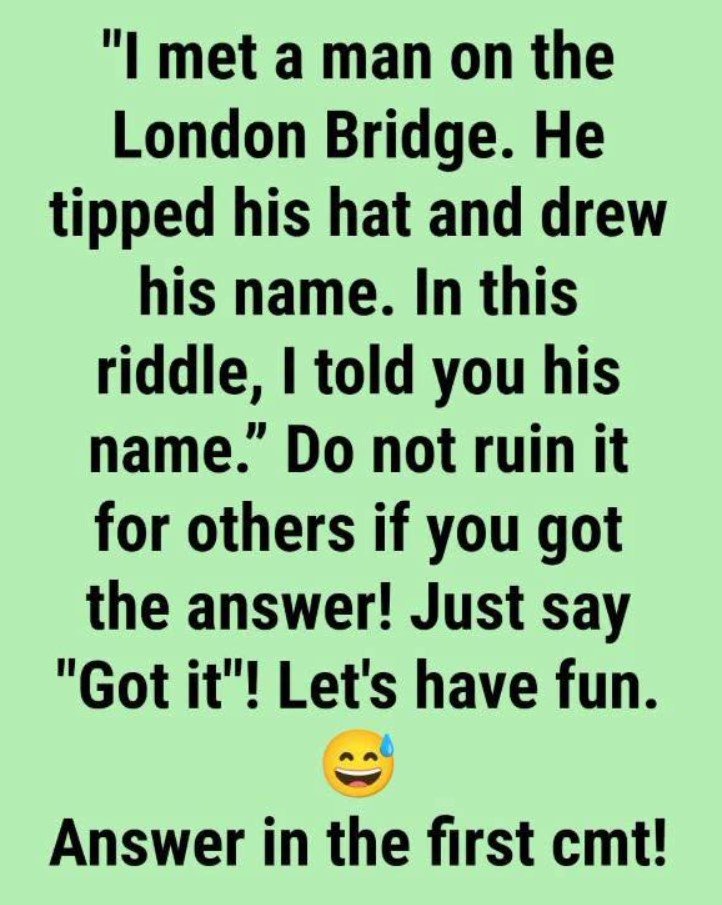
“I met a man on the London Bridge. He tipped his hat and drew his cane. In this riddle, I told you his name. What is the man’s name?”
Take a moment to think about it.
You might imagine a man walking across a famous bridge, greeting someone by tipping his hat, and carrying a cane. Perhaps you are looking for a hidden clue in the setting or trying to work out why the man is mentioned in the first place.
But the riddle isn’t really about the bridge, the hat, or the cane. Its answer is hidden in the way the sentence sounds when spoken aloud.
Can you figure it out before reading further?
The Answer to the London Bridge Riddle
The answer is Andrew.
At first, this might seem like a random name. After all, the riddle never directly introduces anyone named Andrew. It doesn’t describe the man, provide his age, or explain where he came from.
The trick lies in the words “and drew.”
When spoken aloud, the phrase “and drew” sounds very similar to the name “Andrew.” The sentence says that the man tipped his hat and drew his cane, placing the sounds of his name directly inside the riddle.
Instead of giving you the answer through a description or a series of clues, the puzzle hides it within an ordinary phrase.
That is what makes this riddle so effective. The information you need is already there, but your brain may interpret the words as separate actions rather than recognize the name they create.
Why Is This Riddle So Difficult to Solve?
One reason this puzzle confuses people is that our brains naturally try to understand sentences according to their usual meaning.
When we read that someone “tipped his hat,” we imagine a polite gesture. When we see the words “drew his cane,” we may picture someone drawing or pulling something. We tend to focus on the actions instead of listening to the sounds of the words.
The riddle takes advantage of that habit.
The phrase “and drew” normally connects two actions. However, when pronounced quickly, it can sound like “Andrew,” a familiar first name.
Once you recognize the connection, the answer becomes much easier to understand.
Another reason people struggle is that the puzzle appears to provide too little information. Readers may assume that the man’s name must be discovered through logic, observation, or a hidden detail about London Bridge.
In reality, the solution depends on wordplay rather than traditional deduction.
The lesson is simple: sometimes, solving a riddle requires you to change the way you look at the question. Instead of asking what the sentence describes, ask whether its words contain another meaning.
A Simple Trick for Solving Similar Riddles
If you enjoy brainteasers, there are several useful ways to approach puzzles like this one.
1. Read the riddle aloud.
Some word puzzles become easier when you hear them rather than read them silently. Similar sounds may reveal hidden names, phrases, or alternative meanings that are difficult to notice on the page.
2. Pay attention to unusual wording.
If a sentence seems strangely constructed, the wording may be deliberate. A phrase that sounds unnecessary or awkward might contain the most important clue.
3. Avoid overthinking the setting.
The mention of London Bridge creates a vivid picture, but the location isn’t essential to the answer. Riddles often include details that distract readers from the actual puzzle.
4. Look for words that sound like names.
Names can be hidden inside combinations of ordinary words. In this case, “and drew” provides the sound of “Andrew.” Recognizing that connection is the key to solving the puzzle.
5. Consider more than one interpretation.
A sentence can have an ordinary meaning and still contain a hidden message. Exploring different interpretations can help you discover the intended solution.
These techniques are useful for many word riddles, especially those that rely on pronunciation, double meanings, or familiar expressions.
Challenge Your Friends With This Riddle
Now that you know the answer, try sharing the puzzle with your friends or family members.
Read it aloud and ask them to identify the man’s name. Resist the temptation to give hints immediately. Some people may guess correctly within seconds, while others might spend several minutes searching for clues in the story.
If they get stuck, ask them to listen carefully to the phrase “and drew.”
You can also challenge them to explain why they think their answer is correct. This makes the puzzle more entertaining because the goal isn’t simply to guess a name; it’s to discover the wordplay that reveals it.
For an extra challenge, try these three short riddles.
Riddle 1: What has keys but cannot open locks?
Riddle 2: What gets wetter the more it dries?
Riddle 3: What has a face and two hands but no arms or legs?
Take a moment to solve them before checking the answers.
Answers:
- Riddle 1: A piano.
- Riddle 2: A towel.
- Riddle 3: A clock.
Like the London Bridge puzzle, these riddles encourage you to look beyond the most obvious interpretation of familiar words.
Conclusion
The “I Met a Man on the London Bridge” riddle is a great example of how a simple sentence can hide a clever answer in plain sight. At first, the story seems to describe an ordinary meeting between two people, with the man tipping his hat and drawing his cane. However, the real clue isn’t found in the man’s appearance, his actions, or the famous bridge. Instead, the solution depends on listening carefully to the words and recognizing the hidden name within the phrase “and drew.”
The answer, Andrew, shows how easily our minds can overlook something obvious when we focus too much on the literal meaning of a sentence. We naturally imagine the scene described in the riddle, trying to discover clues about the man’s identity. Yet sometimes, the best way to solve a puzzle is to stop imagining the situation and examine the language itself. When “and drew” is spoken aloud, it sounds like “Andrew,” revealing the clever wordplay that makes the riddle work.
This is what makes word riddles so enjoyable. They challenge our usual way of thinking, encourage us to pay attention to small details, and remind us that the simplest explanations can sometimes be the most surprising. You don’t need special knowledge or complicated calculations to solve this puzzle. You simply need patience, careful listening, and a willingness to consider a different interpretation of the words.
If you didn’t discover the answer immediately, don’t worry. Many people initially search for clues in the location or the man’s actions before noticing the hidden name. The fun comes from that moment of realization when everything suddenly makes sense. Once someone explains the answer, the riddle may seem easy, but recognizing the trick independently is what makes solving it satisfying.
You can share this riddle with friends, family members, or coworkers and see who discovers the answer first. Give everyone a chance to think before revealing the solution, and encourage them to explain how they reached their conclusion. You might be surprised by the different guesses people make and the creative ways they approach the same puzzle.
Ultimately, the London Bridge riddle offers a small but useful reminder: sometimes, the answer isn’t hidden in the story itself but in the way the story is told. The next time you encounter a tricky brainteaser, read the words carefully, listen to how they sound, and avoid dismissing details that seem ordinary. A familiar phrase may contain the clue you’ve been searching for all along.