Math puzzles have a special way of attracting our attention. Some look complicated and require several calculations, while others appear so simple that we feel confident we can solve them in just a few seconds. Yet even a short mathematical expression can lead to surprisingly different answers when people forget one important rule.
One such puzzle has been circulating online and challenging people to reconsider how they approach basic arithmetic. At first glance, the expression seems straightforward. It contains only addition, multiplication, subtraction, and division, along with a pair of parentheses. However, many people arrive at the wrong result because they try to solve everything in the order they see it.
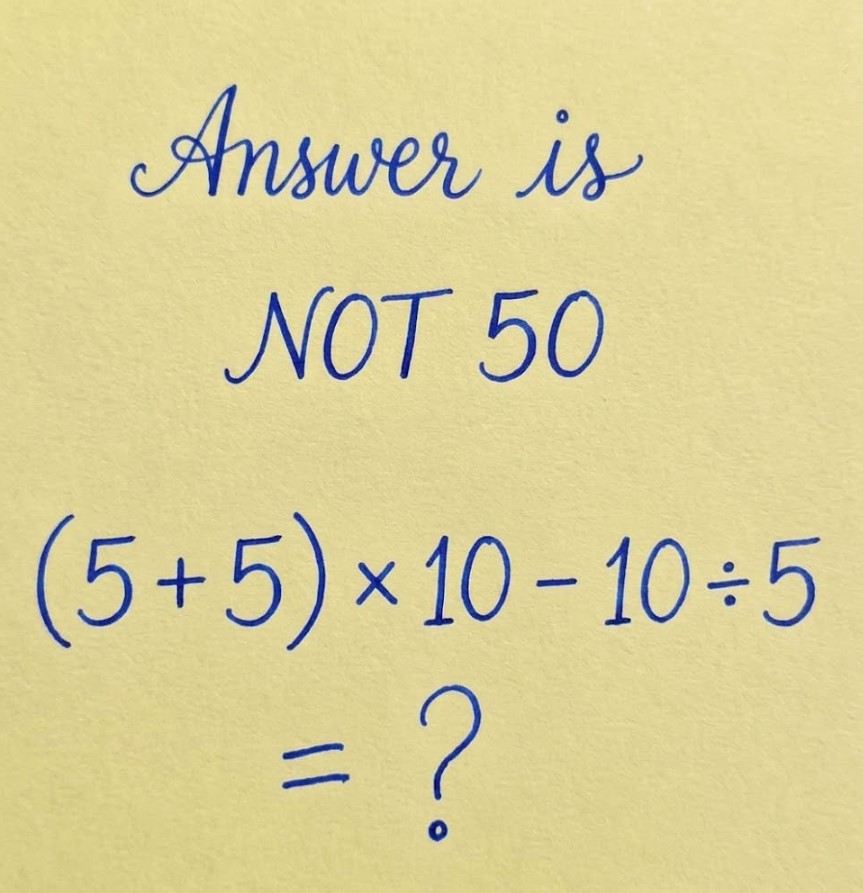
The puzzle is:
(5 + 5) × 10 − 10 ÷ 5 = ?
Some people quickly answer 50, while others suggest completely different numbers. But the correct mathematical answer is 98.
So, how do we reach that result? The secret is understanding the order of operations and applying it correctly. Let’s break the puzzle down step by step.
Why This Simple Math Puzzle Confuses So Many People
The main reason people get this puzzle wrong is that they don’t always follow the standard rules for solving mathematical expressions.
When we look at an equation, our eyes naturally move from left to right. It may seem logical to calculate the first operation, move to the next, and continue until the expression is finished.
However, mathematics does not always work that way.
Certain operations must be completed before others, regardless of where they appear in the expression. These rules ensure that everyone who solves the same equation using standard arithmetic reaches the same answer.
Without following these rules, two people could calculate the same expression in different ways and produce different results.
That is exactly what makes this puzzle interesting. It tests not only basic arithmetic skills but also whether we remember the correct order in which operations must be performed.
Step 1: Understand the Order of Operations
Before solving the expression, we need to understand a fundamental mathematical rule known as PEMDAS or BODMAS.
Both acronyms help students remember the proper sequence for completing calculations.
PEMDAS stands for:
- P – Parentheses: Complete calculations inside parentheses first.
- E – Exponents: Calculate powers and roots.
- MD – Multiplication and Division: Perform multiplication and division from left to right.
- AS – Addition and Subtraction: Perform addition and subtraction from left to right.
BODMAS follows the same principle but uses slightly different words:
- B – Brackets
- O – Orders
- D – Division
- M – Multiplication
- A – Addition
- S – Subtraction
An important detail is that multiplication and division have equal priority. Likewise, addition and subtraction have equal priority.
This means multiplication does not automatically come before division simply because the letter M appears before D in PEMDAS. Both operations are completed from left to right. The same rule applies to addition and subtraction.
Remembering this distinction is essential when solving expressions like the one in our puzzle.
Step 2: Start With the Parentheses
Here is the original expression again:
(5 + 5) × 10 − 10 ÷ 5
According to PEMDAS and BODMAS, the first thing we must do is calculate the expression inside the parentheses.
We have:
5 + 5 = 10
This is a simple addition problem. Once we calculate it, we can replace the entire expression inside the parentheses with the number 10.
Our equation now becomes:
10 × 10 − 10 ÷ 5
Notice that we haven’t finished the puzzle yet. We have only completed the first required operation.
Many people make mistakes at this point because they immediately move to subtraction or begin calculating everything from left to right. Instead, we must continue following the correct mathematical sequence.
Step 3: Complete Multiplication and Division
After solving the parentheses, we are left with:
10 × 10 − 10 ÷ 5
The next priority is multiplication and division.
As mentioned earlier, these two operations have equal importance. Therefore, we must perform them from left to right.
Looking at the expression, multiplication appears before division.
First, calculate:
10 × 10 = 100
The expression now looks like this:
100 − 10 ÷ 5
We still have a division operation to complete. Because division must be performed before subtraction, we cannot subtract 10 from 100 yet.
Next, calculate:
10 ÷ 5 = 2
After completing the multiplication and division, the expression becomes:
100 − 2
We are now left with only one operation.
Step 4: Perform the Final Subtraction
The last step is much easier because all the higher-priority operations have already been completed.
Our simplified expression is:
100 − 2
Subtracting two from one hundred gives us:
100 − 2 = 98
And there we have it!
<text strong> The correct answer to the puzzle is 98.</text>
Why Is 50 the Wrong Answer?
You might still be wondering why so many people choose 50.
One common mistake is misunderstanding the order of operations or treating the expression as though every calculation should be performed from left to right, without considering mathematical priority.
Another possibility is that people focus on only part of the equation. For example, they may correctly calculate the parentheses but then rush through the remaining operations without carefully checking which ones must come first.
Let’s look at the correct sequence again:
- Parentheses: 5 + 5 = 10.
- Multiplication: 10 × 10 = 100.
- Division: 10 ÷ 5 = 2.
- Subtraction: 100 − 2 = 98.
The important point is that subtraction must wait until both multiplication and division are finished.
If you ignore that rule, you can easily arrive at an incorrect result.
A Simple Way to Avoid These Math Puzzle Mistakes
You don’t need to be a mathematics expert to solve these puzzles correctly. A few simple habits can help you avoid common mistakes.
1. Never rush through the expression.
Even if the equation looks easy, take a moment to identify every operation before calculating. A few extra seconds can prevent an incorrect answer.
2. Look for parentheses first.
Whenever an expression contains parentheses or brackets, begin by solving what is inside them. This is one of the most important rules to remember.
3. Give multiplication and division equal priority.
Do not assume multiplication always comes before division. Complete whichever appears first when reading from left to right.
4. Treat addition and subtraction the same way.
These operations also have equal priority. Once you reach this stage, work from left to right.
5. Check your final calculation.
After reaching an answer, review each step. If you skipped an operation or completed subtraction too early, go back and correct it.
These habits are useful not only for online puzzles but also for schoolwork, everyday calculations, shopping, budgeting, and other situations involving numbers.
Try Another Quick Math Challenge
Now that you understand the rules, why not test yourself with another expression?
8 + 4 × 3 − 6 ÷ 2 = ?
Before choosing an answer, remember to follow the order of operations.
Start with multiplication and division, working from left to right. Then complete addition and subtraction, also from left to right.
The challenge is not about solving the problem as quickly as possible. It is about applying the correct rules and avoiding the temptation to calculate everything in the order it appears.
Taking your time is often the best way to get the right answer.
What This Puzzle Teaches Us About Basic Mathematics
A simple equation can remind us of an important lesson: knowing how to add, subtract, multiply, and divide is not always enough. We also need to understand when each operation should be performed.
The order of operations provides a universal method for interpreting mathematical expressions. Without it, calculations could become confusing and inconsistent.
That is why PEMDAS and BODMAS are taught in schools. They give students a reliable framework that can be used for simple arithmetic and more advanced mathematics.
Puzzles like this are also a useful way to exercise the mind. They encourage concentration, careful thinking, and attention to detail. Even people who rarely work with numbers can enjoy solving them because the challenge is based on a rule that everyone can learn.
The next time you see a viral math puzzle online, resist the urge to guess immediately. Read the expression carefully, identify the operations, and solve each part in the correct order.
You may discover that the answer is very different from what you first expected.
Conclusion: The Correct Answer Is 98, Not 50
The puzzle (5 + 5) × 10 − 10 ÷ 5 may look like an ordinary arithmetic exercise, but it demonstrates why understanding the order of operations is so important.
The solution becomes clear when we take it one step at a time. First, we calculate the parentheses and get 10. Next, we multiply 10 by 10 to get 100. Then we divide 10 by 5 to get 2. Finally, we subtract 2 from 100.
The result is 98.
The biggest lesson is that multiplication and division must be completed before addition and subtraction, with operations of equal priority handled from left to right. Once you understand this rule, many confusing-looking math puzzles become much easier to solve.
So, if you initially thought the answer was 50, don’t worry. These puzzles are designed to make people pause and reconsider their first instinct. What matters is understanding the reasoning behind the correct solution.
The final answer is 98.