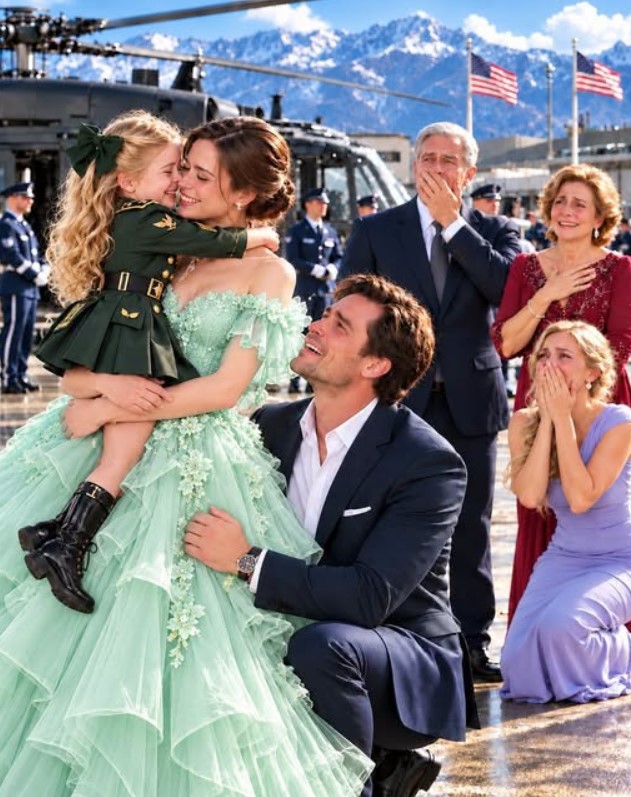
The Morning He Chose a Son
At 9:42 on a gray Tuesday morning in Alexandria, Virginia, I signed the final document ending my twelve-year marriage to Grant Whitmore.
I had imagined that moment countless times during the long year we spent separating our lives. I thought I might cry, feel angry, or perhaps experience an overwhelming sense of relief. Instead, I felt strangely calm.
The mediator gathered the signed papers into a neat folder. Grant barely looked at them. His attention was already on his phone.
At 9:47, I was officially Lauren Bennett again.
Five minutes later, my former husband said something I would never forget.
“You can take the girls, Lauren. I have a son coming now.”
For several seconds, I simply stared at him.
Our daughters, Hailey and June, were ten and eight. They understood that their parents were getting divorced, but they were still children who believed that their father would always love them.
The night before, June had spent nearly an hour making him a goodbye card. She had covered it with crooked blue stars because she was worried he might feel lonely without us.
And now Grant was talking about his daughters as though they were belongings he had decided to leave behind.
He glanced at me, apparently expecting an emotional reaction.
“That’s all you’re going to say?”
I slowly closed my folder.
“What would you like me to say?”
He shrugged and slipped his phone into his pocket.
“Madeline has her appointment this morning. My parents are meeting us there. Mom is practically beside herself. It looks like the family is finally getting a boy.”
Finally.
That one word explained more than Grant probably intended.
His mother, Patricia Whitmore, had never directly told me that she was disappointed to have granddaughters. Instead, she made comments about the family name, the importance of carrying on the Whitmore legacy, and how wonderful it would be to have a little boy in the family.
She always delivered these remarks with a pleasant smile, as though she were discussing the weather.
Grant stood and reached for his coat.
“You’re still taking the girls today, right?”
“Yes.”
“Good. Madeline needs things quiet for a while.”
I looked at the man I had once trusted with my entire future.
“Do you want to say goodbye to your daughters before we leave?”
He hesitated.
“I’ll call them.”
I nodded and said nothing more.
What Grant didn’t know was that our departure had already been arranged. Our bags had been transported to a military facility outside Washington, and the girls and I were scheduled to leave for Germany later that day.
I was an Army colonel, and a major new assignment was waiting for me overseas.
The move was not a surprise or a secret. It was clearly included in the custody agreement Grant had signed.
He simply hadn’t bothered to read the details.
That had become one of his habits. He signed documents without examining them, trusted that other people would handle the complicated parts, and assumed the world would arrange itself around his wishes.
On that Tuesday morning, he had no idea how much his careless decisions were about to cost him.
The Phone Call That Changed Everything
By noon, Hailey and June were sitting in the back of my SUV.
Each had a small backpack beside her. They were trying to behave normally, but I could see the sadness in their faces.
June finally broke the silence.
“Mom, Dad forgot to call.”
I tightened my hands around the steering wheel.
“He’s busy today, sweetheart.”
Hailey turned toward the window. At ten years old, she had already learned to recognize the difference between an explanation and a gentle lie.
We were less than an hour from the military airfield when my phone began ringing.
Grant.
I considered letting it go to voicemail, but something about the timing made me answer.
“Lauren.” His voice sounded breathless. “Something happened.”
I pulled onto the shoulder.
“What happened?”
“Madeline’s appointment. The doctor found a problem.”
For one frightening moment, I thought he meant the baby.
Then he continued.
“They ran additional tests because of her medical history. The pregnancy itself is healthy, but something came up when they reviewed my records.”
I frowned.
“What kind of problem?”
There was a long silence.
“Mom started asking questions about blood types. Madeline is O-negative, and I’m supposed to be AB-positive.”
I waited for him to explain.
“The doctor said blood types alone don’t prove anything about biological parentage. But Mom remembered something about my surgery when I was seventeen.”
Grant had suffered a serious football injury as a teenager. His family had always described the operation as relatively minor.
Apparently, it had been more complicated.
“What’s that got to do with anything?” I asked.
His voice dropped.
“They removed more than they told me.”
I felt a chill move through me.
“What are you saying, Grant?”
“The urologist pulled my old hospital records. Lauren, the report says I had a serious fertility problem. It says natural conception was extremely unlikely.”
He stopped speaking for a moment.
Then he added something that made my stomach tighten.
“The doctor says I may have been medically sterile before I ever met you.”
I stared through the windshield.
From the back seat, Hailey quietly asked whether everything was okay.
I raised one hand to reassure her, but Grant was still speaking.
“If that’s true, Lauren…”
He couldn’t finish the sentence.
He didn’t need to.
Suddenly, the pregnancy he had been celebrating was no longer the only question surrounding his family.
And there was something about my own medical history that Grant had never fully understood.
The Phone Call That Turned a Celebration Into a Family Nightmare
Three hours after Grant announced that he was finally having a son, his mother called me seventeen times.
On the eighteenth attempt, I answered.
I was standing beside the window of the military family transition center. Hailey and June were nearby, laughing over a game on June’s tablet. Our luggage was lined up beside the door, and our flight to Germany was scheduled to depart in less than four hours.
“Lauren,” Patricia whispered, “please tell me you haven’t left Virginia.”
“Why?”
She began crying.
“Something happened at Madeline’s appointment. The doctor found something in Grant’s medical history. Something that doesn’t make sense.”
I remained silent.
Behind her, I could hear Grant shouting.
“Mom! Hang up! Lauren has nothing to do with this!”
Then I heard another voice.
Madeline.
“You promised me she would never find out!”
The line suddenly went quiet.
I stared at my phone.
For the first time, I wondered whether Grant’s new beginning had been built on a secret that existed long before his affair.
The Whitmores had always cared deeply about their reputation.
Grant’s father, Richard, owned a successful property development company in Northern Virginia. Patricia organized charity events, attended expensive gatherings, and spoke endlessly about family values.
Grant had grown up believing that the Whitmore name could open almost any door.
My childhood had been very different.
My father was a mechanic, and my mother taught elementary school. We had never possessed great wealth or influential connections, but they had taught me that a person’s value was determined by their actions, not their surname.
I joined the Army at twenty-two and built my career through years of demanding assignments, difficult decisions, and personal sacrifices. Eventually, I earned the rank of colonel.
Grant had never been entirely comfortable with my success.
At social gatherings, he sometimes introduced me as someone who worked in military administration. When I received an important commendation, he complained that the ceremony conflicted with his golf tournament.
When I was promoted, Patricia asked whether I planned to keep playing soldier now that the girls were older.
I had stopped expecting their approval long before our divorce.
But I had never imagined that Grant would dismiss his own daughters simply because another woman claimed to be carrying a boy.
My phone rang again.
This time, the number was unfamiliar.
“Colonel Bennett?”
“Yes.”
“My name is Dr. Evelyn Hart. I’m calling from the maternal-fetal medicine clinic where Madeline Ross was examined this morning.”
I straightened.
“How did you get my number?”
“Mrs. Whitmore provided it. I cannot discuss another patient’s confidential medical information without proper authorization. However, your former husband has asked me to contact you about an older medical document bearing your name.”
“My name?”
“Yes. It dates back eleven years and concerns reproductive treatment.”
Eleven years.
The year Hailey was born.
I closed my eyes as memories returned.
Grant and I had struggled to conceive for almost two years. I had attended appointment after appointment, endured examinations, and listened to endless questions from Patricia about when I intended to give her a grandchild.
Eventually, Grant underwent testing.
The specialist requested a private consultation with him. Grant attended alone.
When he returned, he told me that everything was normal and that the problem was probably mine.
For months, I carried that guilt.
Then I became pregnant with Hailey.
Two years later, June arrived.
I had never questioned what Grant told me.
Until that day.
Dr. Hart continued carefully.
“There is a discrepancy between an older laboratory report and the medical history your former husband provided. The difference is significant enough that he has been advised to obtain further testing before making assumptions about biological parentage.”
I looked through the glass at my daughters.
Hailey was braiding June’s hair. Both girls had Grant’s dark eyes and familiar smile.
They had spent their entire lives believing their father loved them.
“Does this concern my daughters?” I asked.
“I cannot determine that without reviewing the appropriate records and obtaining the necessary consent. I recommend speaking with the physician who handled your original fertility treatment.”
After the call ended, I stood motionless.
Then I opened a secure folder on my phone containing documents I had collected during the divorce.
Financial records. Property agreements. Custody arrangements.
And an old medical file I had never fully understood.
The heading read:
WHITMORE, GRANT — REPRODUCTIVE EVALUATION — CONFIDENTIAL.
Halfway down the second page, I found a sentence that made my breath catch.
The report described an extremely low likelihood of biological conception without specialized intervention.
Below it was a handwritten note:
Follow-up recommended. Patient declined further discussion.
The document was dated six months before I became pregnant with Hailey.
My phone buzzed.
A message from Grant appeared.
Whatever my mother told you, stay out of it.
Another message followed.
And don’t you dare start questioning whether the girls are mine.
I read the words twice.
I hadn’t mentioned the girls.
Grant had.
That told me he was afraid of something I had not yet discovered.
The Envelope Patricia Brought to Me
At 2:16 that afternoon, Patricia arrived at the military facility carrying an old envelope.
She looked nothing like the elegant woman who had smiled across the divorce table that morning.
Her carefully arranged silver hair had become untidy. Her lipstick had faded, and her hands trembled as she struggled with her handbag.
“Please,” she said. “Can we speak somewhere private?”
I led her into an empty conference room.
“Where are the girls?” she asked.
“With a family support officer.”
She nodded.
I remained standing.
“Patricia, I have a flight to catch. Tell me why you’re here.”
She placed the envelope on the table.
“Grant believes Madeline is carrying his son.”
“He made that very clear.”
“He invited Richard and me to the appointment. He wanted us there when the doctor confirmed the pregnancy.”
Her voice became unsteady.
“But the physician reviewed his medical history and asked whether he had ever received fertility treatment.”
I folded my arms.
“And what did he say?”
“He said no.”
“Was that true?”
Patricia shook her head.
I felt a strange certainty settling over me.
“What happened eleven years ago?”
She opened the envelope.
Inside were three items: a photograph of Grant and Richard outside a private medical clinic, a handwritten letter, and a copy of a financial transfer.
The amount was $48,000.
The date was eleven years earlier.
“What is this?” I asked.
Patricia swallowed.
“Richard arranged something after Grant’s examination. Grant had been told that conceiving naturally would be extremely unlikely. He was devastated, and Richard said he knew someone who could help.”
“How?”
“He contacted a private fertility specialist and arranged payments.”
I stared at her.
“Did I know about this?”
Her eyes filled with tears.
“No.”
I sat down slowly.
During the years when Grant and I were trying to have children, I had undergone fertility treatment under the care of a physician recommended by Richard.
There had been medication, scheduled appointments, and a procedure I was told would improve our chances.
I remembered signing consent forms, but I also remembered being exhausted, frightened, and overwhelmed by medical terminology.
Had someone tried to make a decision about my treatment without telling me?
“Do you have proof of what actually happened?” I asked.
Patricia pushed a letter toward me.
It had been written by a physician named Dr. Samuel Mercer.
The paper was old, but the handwriting was still clear.
The letter explained that Richard had requested a donor-assisted arrangement without ensuring that I had received full information and given specific consent.
One sentence had been underlined:
Protecting the family name does not justify withholding information from the intended mother.
I read it several times.
“Did this procedure actually happen?”
Patricia shook her head.
“I don’t know. Dr. Mercer refused Richard’s request, but I cannot tell you what happened afterward.”
“Why are you telling me this now?”
Her expression changed.
“Because Madeline knows things about our family that she shouldn’t know.”
“What things?”
“She knew about Grant’s medical results. She knew about the payment. She even knew the name of the physician who refused Richard.”
I leaned forward.
“How?”
Patricia looked toward the door.
“Her mother worked at that clinic.”
“Her mother?”
“Eleanor Ross.”
The name sounded familiar.
Then I remembered a woman with auburn hair and a gentle voice. She had once held my hand during one of the most difficult appointments of my life.
Eleanor Ross had been there when I was told I might never become a mother.
And now her daughter was carrying the child Grant believed would secure the Whitmore family legacy.
Patricia then revealed something even more disturbing.
Madeline had threatened to expose information about the fertility clinic unless Richard transferred a controlling interest in the family company to Grant.
Apparently, she knew about the old medical records and wanted to use that knowledge to gain something from the Whitmores.
I immediately contacted my attorney, Rebecca Shaw.
Rebecca listened carefully and warned me not to jump to conclusions.
The documents raised serious questions, but they did not establish what had happened during my treatment or determine the biological parentage of my daughters.
She advised me to preserve every document, obtain original medical records through the proper channels, and avoid any informal testing or negotiations.
When she asked whether I was still leaving Virginia, I looked through the conference room window.
June was showing Hailey the card she had made for her father.
Blue stars. A crooked heart.
And three words written in purple marker:
I love Daddy.
“Yes,” I told Rebecca quietly. “I’m taking my daughters somewhere they can feel safe.”
The Secret Behind the Family Trust
Just before boarding our flight, I received an anonymous message.
Before you leave the country, ask Richard Whitmore why your daughters’ original birth records were placed in a sealed trust.
Another message arrived.
Ask him why he has been paying Eleanor Ross every month for eleven years.
I immediately forwarded everything to Rebecca.
Then I put my phone away and returned to the girls.
Hailey looked at me.
“Mom, are we still going?”
“Of course, sweetheart.”
“You look worried.”
“I’m handling some grown-up paperwork.”
“Is it about Dad?”
I brushed a strand of hair behind her ear.
“Your father and I have things to work out. But none of them are your responsibility.”
June came running over.
“Mom! They have chocolate muffins!”
I laughed.
“Then we’d better get one before they’re gone.”
That evening, we boarded the aircraft.
As we rose above Washington, June fell asleep against my shoulder. Hailey remained awake, staring out of the window.
After a while, she asked a question that broke my heart.
“Mom, did Dad really want a boy more than us?”
I took her hand.
“Your father made a very hurtful choice.”
“But why?”
“I can’t explain his decision for him.”
She looked down.
“Maybe if I played baseball instead of piano…”
“No, Hailey.”
My voice came out sharper than I intended, so I softened it.
“Listen carefully. You never have to become someone else to deserve love. Not for your father. Not for anyone.”
Her eyes filled with tears.
“Even if he doesn’t want us?”
I pulled her close.
“Especially then.”
I promised myself that whatever the Whitmores had hidden, I would never allow my daughters to believe their worth depended on their biological history or on whether they had been born boys or girls.
Three days later, we were settled into temporary military housing near Stuttgart, Germany.
The girls had already discovered a playground, made friends with another American family, and begun arguing over which bedroom had the better view.
That morning, Rebecca called.
“I found something.”
I gripped the kitchen counter.
“What?”
“The Whitmore Family Heritage Trust was created ten years ago. It was amended after June was born.”
Both girls were named beneficiaries.
The terms were unusual. Each was entitled to receive approximately four million dollars when she turned twenty-five, based on the latest valuation.
Their interests were protected by an independent trustee, meaning Grant could not simply revoke them.
There was something else.
Eleanor Ross had been receiving $5,000 every month from a company connected to Richard Whitmore.
The payments had continued for eleven years.
I asked Rebecca what Eleanor had been paid to do.
There was no clear description in the records.
Before we could discuss it further, Grant called.
“Where are the girls?” he demanded.
“In Germany. Exactly where the agreement says they would be.”
“You took them overseas?”
“Yes, Grant. You signed the documents.”
He became angry, but I reminded him that he had been represented by an attorney and had received the travel information.
Then his voice changed.
“Lauren, I need to ask you something. Are Hailey and June biologically mine?”
I tightened my grip on the phone.
“Why are you asking me?”
“Because Dad won’t answer my questions.”
“Then perhaps you should ask yourself why.”
He explained that the doctor had told him his old results showed almost no chance of natural conception.
I reminded him that a very low probability was not the same as absolute impossibility.
Then he mentioned Madeline.
“She says the baby is mine. She says she has proof.”
“Then ask your physician what that proof actually establishes.”
He went quiet.
Finally, he told me something that made me sit upright.
“Madeline said she didn’t choose me by accident. She said our families had unfinished business.”
Before I could ask what he meant, I heard Madeline’s voice in the background.
The call ended.
A few minutes later, Rebecca sent me a scanned letter written by Eleanor Ross eleven years earlier.
It was addressed to Richard.
The letter stated that Eleanor refused to participate in an attempt to conceal the identity of a person providing reproductive material.
One sentence was especially important:
Lauren Bennett deserves to know the truth.
At the bottom of the letter was a second signature.
Patricia Whitmore had signed as a witness.
The Woman Who Knew the Truth About My Daughters
When I confronted Patricia about the letter, she finally admitted that she had known Richard was trying to arrange treatment without explaining everything to me.
She claimed Richard had promised to stop.
I asked whether he had kept that promise.
She couldn’t answer.
“Did Grant know?” I asked.
“He knew his fertility results were poor. He didn’t know Richard had contacted Eleanor about a donor arrangement.”
“Then why did he allow me to believe I was the problem?”
Patricia lowered her head.
“Pride.”
One word explained years of unnecessary suffering.
Grant had watched me attend appointments, question my body, and blame myself for something I could not control.
He had remained silent because admitting the truth would have wounded his pride.
I told Patricia that my attorney would request every record we were legally entitled to obtain.
Before ending our conversation, she said she loved Hailey and June.
“Then show them,” I replied. “Don’t just say it when you’re frightened of losing them.”
The following morning, Rebecca arranged a consultation with Dr. Samuel Mercer, the retired physician whose letter had been found in Patricia’s envelope.
He remembered the Whitmore family immediately.
Richard had asked him to authorize a donor-assisted reproductive procedure without ensuring that I had received full information and given specific consent.
Dr. Mercer had refused.
He explained that he could not disclose another person’s protected medical information, but he could confirm that he had documented his concerns.
He also advised us to obtain the original treatment records from the facility that had actually treated me.
Before ending the call, he said something I would remember.
“Your former father-in-law believed he could determine the future of his family by controlling information. I told him that children are not instruments for preserving a surname.”
That evening, another message arrived from the unknown number.
Someone whose mother spent eleven years trying to make things right.
I asked who it was.
The reply came quickly.
My name is Caroline Ross. Madeline is my sister.
Caroline explained that her mother, Eleanor, had kept copies of correspondence because she believed Richard was pressuring the clinic to violate consent requirements.
Madeline had discovered the old files two years earlier.
She had known about Grant’s fertility history before she began dating him.
Caroline believed her sister was interested in the Whitmore family’s money and influence.
Then she told me something that made my heart race.
Madeline had supposedly said:
“Grant doesn’t have to be the baby’s father. He only has to believe he is until the papers are signed.”
The papers were related to the proposed company transfer.
I immediately asked Caroline to speak with Rebecca and preserve all messages and documents.
Before we ended the call, she mentioned one more thing.
Her mother had kept a separate envelope with my name on it.
It contained a message:
The truth about Hailey and June should only be opened by their mother.
The Envelope That Revealed the Truth
Caroline arranged for the envelope to be delivered through Rebecca’s office.
Four days later, it arrived.
I waited until Hailey and June were at school before opening it at the kitchen table.
Inside were five documents:
- A copy of my original consent form.
- A physician’s letter.
- A laboratory report.
- A handwritten note from Eleanor.
- An old photograph.
I examined the consent form first.
My signature was there, and I recognized it immediately.
The document authorized a fertility procedure using Grant’s reproductive material.
There was no authorization for a donor.
No additional consent.
No amendment allowing a different arrangement.
The physician’s letter explained that any significant change to the treatment plan would require new written consent.
Then I examined the laboratory report.
It showed that Grant’s sample had been processed and used in a procedure shortly before Hailey was conceived.
The report did not independently establish biological parentage, but it contradicted the assumption that a donor must have been used.
I then read Eleanor’s note.
She explained that Richard had wanted a donor arrangement because he feared his son could not father a child.
Eleanor had refused to cooperate without my consent.
Another physician had continued the treatment using the plan I had actually authorized.
Eleanor had kept copies because Richard had threatened to challenge the records and insisted that the family never learn about Grant’s diagnosis.
I lowered the letter.
For the first time in days, I could breathe.
There was no evidence that my daughters had been conceived through an unauthorized donor arrangement. In fact, the available documents suggested that my treatment had followed the plan I had approved.
But there were still unanswered questions.
Had every document been preserved? Were the records complete? Why had Richard been so determined to hide Grant’s medical history?
Then I looked at the photograph.
It showed a young Eleanor standing outside the clinic beside a woman in a cream-colored coat.
I recognized her immediately.
It was my mother, Margaret Bennett.
My mother had passed away three years earlier. I had never known that she had met Eleanor.
On the back of the photograph were six handwritten words:
Margaret knew. She protected Lauren.
I called Caroline.
She explained that her mother had once spoken about a schoolteacher who helped her find work after she lost her position at the clinic.
The woman’s name had been Margaret.
Tears filled my eyes.
My mother had quietly helped someone who was trying to protect my rights, yet she had never told me.
Perhaps she believed she was sparing me unnecessary worry. Perhaps she knew that the treatment had proceeded according to my consent and saw no reason to burden me with Richard’s attempted interference.
I would never know every detail.
But I understood something important.
Even when I believed I was standing alone, my mother had been standing behind me.
The Letter My Mother Left Behind
That afternoon, Rebecca called with another development.
Richard’s attorney had contacted her about the family trust.
According to the documents, Richard had created it after Grant attempted to use family assets as collateral for a failed business venture. He wanted to protect his grandchildren’s financial future from their father’s decisions.
The trust was not necessarily connected to the questions surrounding their parentage.
That distinction mattered.
For days, every discovery had seemed to point toward one enormous conspiracy. But the truth was more complicated. Some secrets were connected, while others were simply the consequences of people who had spent years refusing to communicate honestly.
Rebecca also told me that Grant had requested a formal paternity test for Madeline’s baby after birth.
He had also asked whether I would agree to testing for Hailey and June.
I refused.
Not because I feared the result, but because he did not get to abandon his daughters and then demand that they prove they belonged to him.
If a genuine medical or legal reason arose, we could consider what was appropriate for the girls. But I would not put them through unnecessary testing simply to satisfy their father’s pride.
After that conversation, I called my brother, Daniel.
When I showed him the photograph of our mother and Eleanor, he became quiet.
“Lauren, there’s something Mom left you.”
“What?”
“A letter.”
He explained that our mother had asked him to give it to me when I was finally ready to stop trying to earn the Whitmores’ love.
Two days later, the letter arrived.
My mother’s handwriting filled three pages.
She wrote about my childhood, watching me leave for basic training, the day I brought Hailey home, and June’s first steps.
Near the end, she wrote:
My beautiful Lauren, I know how hard you’ve worked to become the daughter, wife, officer, and mother everyone expected you to be.
But I hope one day you understand that you do not have to earn your place in the world.
When you were struggling to have children, I learned that someone was trying to make decisions about your treatment without your full knowledge. I helped the woman who stood up for your rights, and I made sure she knew she was not alone.
Never let anyone convince you that your daughters are less precious because of the circumstances of their conception, or because they are girls.
And never let a man who cannot recognize their worth convince you to question your own.
I pressed the pages against my chest and cried.
Not because I was frightened.
Not because I was angry.
But because, for the first time in years, I felt free.
Then my phone rang.
It was Grant.
“Lauren,” he said quietly. “I need to tell you something.”
“What happened?”
“Madeline had the baby.”
I checked the calendar. She wasn’t expected to give birth for several more weeks.
“Are they okay?”
“Yes. They’re receiving the care they need.”
I waited.
Grant took a shaky breath.
“The baby is a girl.”
I closed my eyes.
Then he continued.
“Madeline finally admitted something about the pregnancy. She knew about my medical history before we met. She knew about the old clinic and my father.”
I said nothing.
His voice broke.
“Lauren, the baby isn’t mine.”
The Day Grant Lost an Heir and Found the Family He Had Thrown Away
The day Grant discovered that the baby he had celebrated as his long-awaited son was neither a boy nor biologically his, he called me from a hospital parking lot.
“Lauren,” he whispered, “what have I done?”
I stood in my kitchen in Germany, watching rain slide down the window.
For a moment, I saw the man I had married. Not the arrogant businessman who had dismissed our daughters or the husband who had spent years making me feel that my career was an inconvenience.
I saw a frightened man who was finally facing the consequences of his decisions.
But sympathy was not forgiveness.
And forgiveness was not reconciliation.
“You hurt your daughters,” I told him.
“I know.”
“No, Grant. I don’t think you understand.”
He began to cry.
“I thought Madeline was giving me everything I wanted.”
“What was that?”
“A son. A fresh start. Someone who would carry on the family name.”
I looked at the photograph on my refrigerator. Hailey was wearing her new school uniform, and June was grinning beside her.
Two little girls who had handled a painful change with more grace than the adults around them.
“You already had a family,” I said.
Grant remained silent.
“You had two daughters who loved you. You had a wife who supported you for twelve years. You had a home. You didn’t lose those things because Madeline lied to you. You lost them because you stopped valuing what you already had.”
He asked whether he could speak to the girls.
“Not today,” I replied.
“Please, Lauren.”
“They need consistency, not another emotional conversation followed by promises you might not keep.”
He insisted that he would do anything.
“Then start by getting help. Work with your attorney and a family counselor. Show them you can be reliable. Respect their boundaries.”
“Do they hate me?”
I looked down.
“No. They still love you. But they’re learning that loving someone doesn’t mean accepting every way that person treats them.”
He cried harder.
Finally, he whispered, “I’m sorry.”
I closed my eyes.
“I hear you.”
That was all I could honestly offer.
After the call, I went to collect the girls from school.
June ran toward me, waving a drawing.
“Mom! Look!”
It showed three figures standing beneath a bright yellow sun: one tall woman and two little girls. There was a house, some flowers, and a dog.
I laughed.
“We don’t have a dog.”
“Not yet,” June announced.
Hailey smiled.
“We voted.”
“Oh, you voted?”
“Unanimously.”
For the first time since the divorce, I understood something important.
We weren’t waiting for our old life to return.
We were building a new one.
The Truth About Madeline, Richard, and the Medical Records
Over the following months, the Whitmore family went through changes no one had expected.
Madeline acknowledged that she had misrepresented important facts about her relationship with Grant and the pregnancy. She had learned about his fertility history through documents belonging to her mother and had approached him partly because of the Whitmore family’s wealth.
The proposed company transfer never happened.
The question of the baby’s biological father was handled privately through appropriate medical and legal channels.
Caroline helped her sister arrange independent counseling and practical support for the baby.
Despite everything that had happened, I hoped Madeline’s little daughter would grow up surrounded by people who valued her for who she was.
She had done nothing wrong.
She deserved love just as much as Hailey and June.
Richard eventually agreed to provide records relating to the old clinic correspondence.
An independent review found evidence that he had tried to pressure medical staff into arranging treatment without proper consent. However, the available records did not establish that an unauthorized procedure had actually occurred.
My own treatment records were consistent with the plan I had approved.
A fertility specialist also explained that Grant’s old results indicated a very low probability of natural conception, not absolute impossibility. Later testing showed that his fertility had changed over time.
There was no simple answer to every question about what had happened eleven years earlier.
But I had learned something important.
A medical report was not a measure of fatherhood. Biological uncertainty was never an excuse for abandoning a child.
Hailey and June did not need to prove their worth through laboratory results.
They needed adults who showed up.
Richard’s financial trust remained in place, protecting the girls’ future interests.
Unexpectedly, Patricia began changing as well.
She stopped talking about the importance of having sons. Instead, she started asking Hailey about her piano lessons and mailing June books about astronomy.
She eventually sent me a letter.
It was a genuine apology, not a vague explanation or an attempt to excuse her behavior.
She admitted that she had spent too many years believing that protecting the family’s image was the same as protecting the family.
She had treated my daughters as though their worth depended on a surname and an imagined future.
She acknowledged that they deserved better, and that I did too.
I read the letter twice before placing it in a drawer.
I wasn’t ready to forget what had happened.
But I was willing to recognize that people could change if their actions eventually matched their words.
Grant Slowly Learns What Being a Father Really Means
Grant’s transformation took longer.
At first, he tried to repair everything with expensive gifts.
He sent Hailey a tablet, bought June a dollhouse, and even sent flowers to me.
I returned the flowers.
The girls kept their gifts only after we discussed them.
Eventually, Grant began attending counseling.
He also started writing letters to his daughters. Instead of asking them to forgive him, he wrote about ordinary things.
He told Hailey about a bird that had built a nest outside his office. He described a recipe he was trying to learn and recalled the day she first rode her bicycle.
He reminded June about the time she lost her first tooth and how excited she had been.
Most importantly, he stopped making promises he couldn’t guarantee.
Slowly, with professional guidance and within the agreed custody arrangements, the girls agreed to brief video calls.
The first conversation was difficult.
Hailey barely spoke, while June held her stuffed rabbit against her chest.
Grant looked at them for a long moment.
“I owe you both an apology,” he said.
Hailey frowned.
“For what?”
“For making you feel that you weren’t enough.”
June’s eyes filled.
“Because we’re girls?”
Grant closed his eyes.
“Yes. I said things that made you think that, and I was wrong.”
Hailey crossed her arms.
“Mom says we don’t have to forgive you right away.”
Grant nodded.
“She’s right.”
June looked directly at him.
“Are you going to disappear again?”
His voice trembled.
“I’m going to work very hard not to. And if I say I’ll call, I’ll call.”
Hailey studied him before quietly answering.
“Okay.”
It wasn’t forgiveness.
It wasn’t reconciliation.
But it was a beginning.
And sometimes, a beginning is all people can honestly offer.
The Day My Daughters Saw Their Mother Become a Colonel
Six months after our divorce, I stood in a grand auditorium in Stuttgart wearing my Army dress uniform.
Rows of service members filled the room. Senior officers sat near the stage, and American and German flags stood beneath the lights.
It was the ceremony marking my assumption of a major new leadership assignment.
I had worked toward that moment for years.
There had been deployments, long nights, difficult decisions, and countless sacrifices.
But when I looked into the audience, I wasn’t searching for a husband.
I was searching for two little girls.
Hailey sat in the front row wearing a beautiful cream-colored dress with a soft mint ribbon. June wore a matching mint-green dress and held a small bouquet of white flowers.
My brother Daniel had also flown from Virginia to surprise us.
When my name was announced, the room filled with applause.
I walked toward the stage, where the presiding general shook my hand.
“Colonel Bennett, congratulations.”
“Thank you, sir.”
He smiled.
“Your daughters must be very proud.”
I looked toward the front row.
June was waving both hands, while Hailey was smiling so widely that I could see her from the stage.
“Yes, sir,” I answered. “I believe they are.”
After the ceremony, the girls rushed toward me.
June nearly knocked the flowers out of my hands.
“Mom! You looked like a movie star!”
I laughed.
“A movie star?”
“A military movie star!”
Hailey wrapped her arms around my waist.
“I’m proud of you, Mom.”
I held her close.
For years, I had believed that success meant keeping everything together: my marriage, my career, my family, and my reputation.
I had thought that if I worked hard enough, loved deeply enough, and sacrificed quietly enough, I could prevent anything from falling apart.
But standing there with my daughters, I finally understood something.
Sometimes the greatest victory isn’t saving the life you planned. It is finding the courage to build the life you deserve.
That evening, Daniel took us to dinner at a small restaurant overlooking the city.
After the girls ordered their pasta and I chose salmon, Daniel raised his glass.
“To Lauren.”
I shook my head.
“Don’t start.”
He grinned.
“To my little sister, who somehow became the strongest person I know.”
My daughters clapped.
Then Daniel reached into his jacket and handed me a small velvet box.
Inside was my mother’s silver locket.
I opened it carefully. On one side was a photograph of my parents. On the other was a tiny inscription.
You were always enough.
Tears blurred my vision.
Hailey leaned closer.
“What does it say?”
I showed her.
She read the words aloud, then looked at me.
“Grandma was right.”
I smiled through my tears.
“Yes,” I whispered. “She was.”
A New Life for Team Bennett
A year later, our lives looked completely different.
The girls had become comfortable with the everyday rhythms of Germany.
Hailey performed in a school piano recital, and June joined a junior science club.
After months of discussions and careful planning, we finally adopted a golden retriever named Sunny.
June insisted that the name was perfect.
“Because our house is happy now,” she explained.
Grant continued working to rebuild his relationship with the girls. He visited according to the agreed schedule and attended important events whenever circumstances allowed.
He had stopped measuring fatherhood by the idea of having a son.
One afternoon, June asked him whether he still wished she had been a boy.
He answered without hesitation.
“No, sweetheart. I wish I had been a better father to the daughter I was lucky enough to have.”
June thought about his answer.
Then she hugged him.
It was the first time she had done so in nearly a year.
I watched from a distance.
I wasn’t jealous or angry. I was relieved that my daughters might eventually have a healthier relationship with their father.
But I also understood that Grant’s growth did not mean I had to return to him.
I could wish him well without inviting him back into my life.
That distinction had taken me a long time to learn.
One bright spring morning, I received another letter from Richard Whitmore.
Inside was a formal document showing that the family trust had been amended. The girls’ protected interests remained intact, but the revised provisions expanded their future educational opportunities and provided funding for charitable projects when they became adults.
Richard had also written a personal note.
He admitted that he had spent his life trying to build a legacy through money and control. He had believed that a son would preserve everything he had created.
But he now recognized that the people who had shown the most integrity in the family were the women he had underestimated.
He wrote that his granddaughters deserved more than wealth. They deserved the freedom to become whoever they wanted to be.
He couldn’t undo his mistakes, he said, but he could stop repeating them.
I read the letter slowly.
His change did not erase what he had done. Still, perhaps it meant the next generation would not inherit all of his mistakes.
That afternoon, Hailey found me sitting on the patio.
“Mom?”
“Yes?”
“Do you think people can really change?”
I considered her question.
“Some people do.”
“How do you know?”
“Because they act differently, even when no one is watching.”
She thought about that.
“Like Dad?”
“Maybe. Time will tell.”
Then she asked whether I thought I would ever get married again.
I laughed softly.
“That’s a big question.”
“Well, whoever it is has to like Sunny,” she said.
“Absolutely.”
“And June.”
“Definitely.”
“And me.”
I kissed her forehead.
“Especially you.”
She smiled before becoming serious again.
“Mom, I don’t think you need a husband to be happy.”
I looked at her.
She shrugged.
“You’re already happy.”
I felt tears rise unexpectedly.
“Yes,” I told her. “I am.”
The Final Lesson I Learned Beside the Mountain Lake
That summer, the girls and I traveled to the Austrian Alps.
We spent three days hiking, taking photographs, and eating far too much chocolate.
On our final evening, we stood beside a beautiful mountain lake as the setting sun painted the water gold.
Sunny raced through the grass, and June chased him.
Hailey stood beside me, holding my hand.
“Mom, remember when we first moved here?”
“Of course.”
“I thought our family was over.”
I squeezed her hand.
“So did I, for a little while.”
She looked toward June.
“But it wasn’t.”
“No,” I replied.
She smiled.
“It just changed.”
I looked at my daughters, the mountains, and the sunlight reflected on the water. I thought about the imperfect but beautiful life we had built from the pieces of the one that had fallen apart.
And I finally understood something I wished I had known on that gray Tuesday morning in Alexandria.
When Grant told me to take our daughters because he had a son coming, he believed he was choosing a better future.
He thought having a boy would make him important. He thought the Whitmore name mattered more than the people carrying it. He believed I would leave broken.
But he was wrong.
I left with the two most precious people in my world.
I left with my dignity, my career, my independence, and a future that belonged to me.
The medical records had revealed attempts to control decisions that were never Richard’s to make. Madeline’s deception had exposed the emptiness of Grant’s obsession with a male heir. And the letters from my mother had reminded me that love never needs to be earned through perfection.
Yet the greatest surprise came much later.
It happened one quiet Sunday afternoon when Hailey and June were playing in our garden.
I was standing in the kitchen when I overheard June talking to a new friend.
“Do you have a dad?” the little girl asked.
June nodded.
“Yes. He lives in America.”
“Do you miss him?”
“Sometimes.”
The girl pointed toward the house.
“Then who takes care of you?”
June looked through the open door and saw me preparing lunch.
She smiled.
“My mom. She’s an Army colonel.”
The little girl looked impressed.
“Is she important?”
June considered the question carefully.
Then she answered:
“She’s important because she’s our mom. The colonel part is just extra.”
I turned away before the girls could see my tears.
For twelve years, I had tried to prove that I was enough.
Enough as a wife.
Enough as an officer.
Enough as a mother.
Enough as a woman who had given birth to daughters instead of the son her husband’s family wanted.
But my children had understood the truth all along.
I had never needed to prove anything.
That evening, after dinner, the girls curled up beside me on the couch.
Sunny slept at our feet. Hailey rested her head on my shoulder, and June held my hand.
Outside, the first stars began appearing in the sky.
“Mom?” June whispered.
“Yes, sweetheart?”
“Are we going to be okay forever?”
I smiled.
“I can’t promise that life will always be easy.”
She looked worried, so I continued.
“But I can promise that whatever happens, we’ll face it together.”
Hailey reached for her sister’s hand.
“Team Bennett,” she announced.
June grinned.
“Team Bennett!”
I wrapped my arms around both of them.
And for the first time in longer than I could remember, I wasn’t afraid of tomorrow.
Five minutes after our divorce, Grant told me to take our daughters because he believed a son would give him everything he had ever wanted.
He didn’t understand that he was handing me everything I would ever need.
My daughters were never the disappointment.
They were the blessing.
My divorce was never the end.
It was the beginning.
And the family I thought I had lost was sitting right beside me, holding my hands and reminding me that the greatest legacy anyone can leave is not a name, a fortune, or an empire.
It is the love that remains when everything else changes.