
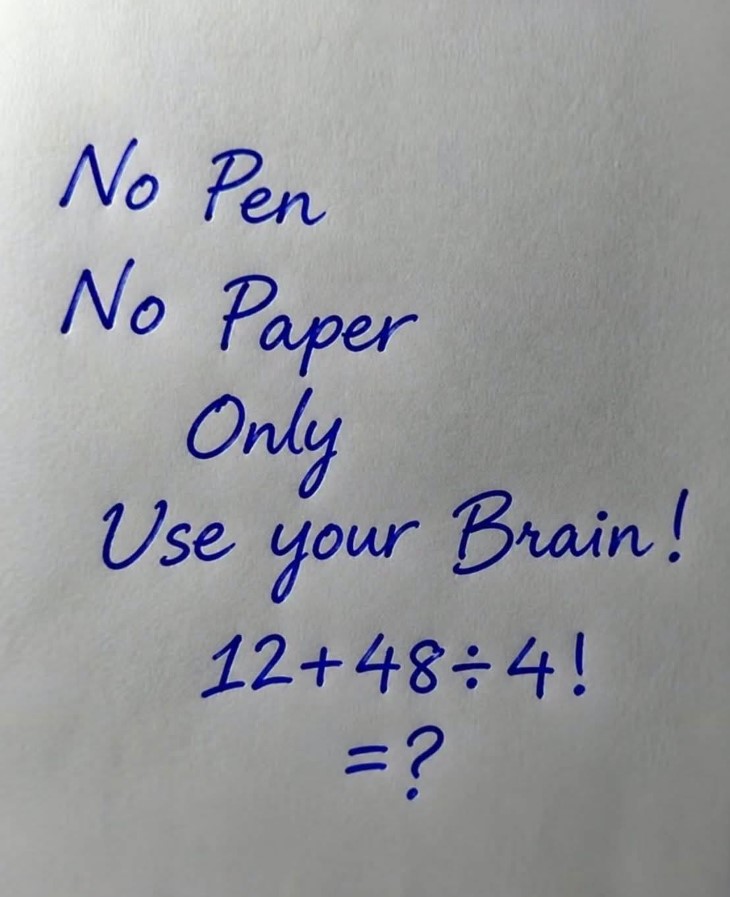
Are you good at solving math problems in your head? Here’s a little challenge that might make you stop and think twice before giving your answer.
At first glance, this mathematical puzzle looks incredibly simple. It contains only a few numbers and basic mathematical symbols, so you might assume that finding the correct answer will take just a few seconds.
However, there is one small detail that makes this problem much trickier than it appears.
The challenge comes with a simple instruction: “No Pen, No Paper, Only Use Your Brain!” That means you have to solve the equation mentally, without writing anything down or reaching for a calculator.
Take a close look at the expression:
12 + 48 ÷ 4! = ?
What answer did you get?
Some people quickly calculate 48 divided by 4, obtain 12, and then add it to the first 12. That gives them 24.
But is 24 really the correct answer?
Not quite. There is an important mathematical symbol hiding in plain sight, and understanding what it means changes the entire calculation.
Before reading the explanation, give yourself a moment to solve the puzzle. You may discover that the smallest detail is the one that makes all the difference.
Why This Math Puzzle Is More Difficult Than It Looks
The first thing that makes this equation confusing is the exclamation mark after the number 4.
Most people are familiar with ordinary mathematical operations such as addition, subtraction, multiplication, and division. When they see an expression containing these symbols, they usually know what to do.
However, the exclamation mark is not an ordinary punctuation mark in this equation.
In mathematics, it represents an operation called a factorial.
This is the hidden trick that makes the puzzle different from a regular division-and-addition exercise.
If you overlook that symbol and treat the expression as though it says 12 + 48 ÷ 4, you will arrive at the wrong result.
To solve the problem correctly, you need to understand factorials and remember the standard order of mathematical operations.
The Secret Behind the Exclamation Mark: What Does 4! Mean?
In mathematics, a factorial is written using an exclamation mark after a whole number.
For example:
- 3! means 3 × 2 × 1.
- 4! means 4 × 3 × 2 × 1.
- 5! means 5 × 4 × 3 × 2 × 1.
In other words, the factorial of a positive whole number is calculated by multiplying that number by every positive whole number below it, continuing down to 1.
Let’s calculate the factorial in our puzzle.
4! = 4 × 3 × 2 × 1
Now work through the multiplication:
4 × 3 = 12
12 × 2 = 24
24 × 1 = 24
Therefore:
4! = 24
This is the important detail that many people miss when they first look at the equation.
The number 4 followed by an exclamation mark does not simply mean the number 4. It represents the value 24.
Once you understand this, the original problem becomes much easier to solve.
Understanding the Order of Operations
There is another important mathematical rule you need to remember: the order of operations.
When an equation contains several different mathematical operations, you cannot simply solve them from left to right without considering their priority.
The commonly used rule is called PEMDAS:
- P – Parentheses: Solve expressions inside parentheses first.
- E – Exponents: Calculate powers and related operations.
- M – Multiplication: Perform multiplication.
- D – Division: Perform division.
- A – Addition: Perform addition.
- S – Subtraction: Perform subtraction.
Another common version is BODMAS, which stands for Brackets, Orders, Division, Multiplication, Addition, and Subtraction.
An important detail is that multiplication and division have equal priority, as do addition and subtraction. When operations have the same priority, work from left to right.
For this particular puzzle, the factorial must be evaluated before the division and addition.
After that, division must be completed before addition.
Let’s put these rules into practice.
Step-by-Step: How to Solve the Equation
Here is the original expression again:
12 + 48 ÷ 4! = ?
Step 1: Calculate the Factorial
Start with the factorial symbol.
As explained earlier:
4! = 4 × 3 × 2 × 1
Therefore:
4! = 24
Now replace the factorial in the original equation with its actual value.
The expression becomes:
12 + 48 ÷ 24
Step 2: Perform the Division
According to the order of operations, division must be completed before addition.
So, calculate:
48 ÷ 24 = 2
The equation is now:
12 + 2
Step 3: Complete the Addition
The only operation remaining is addition.
12 + 2 = 14
And there you have it!
The correct answer is:
14
Why Do So Many People Get 24 Instead?
If you answered 24, don’t feel bad. It’s an understandable mistake, especially when you’re trying to solve the problem quickly.
The most common error is overlooking the factorial symbol.
People see the equation and immediately think about dividing 48 by 4. They calculate:
48 ÷ 4 = 12
Then they add the first 12:
12 + 12 = 24
The arithmetic itself is correct, but the interpretation of the original equation is not.
The problem is that 4! is not equal to 4. It is equal to 24.
This one small difference completely changes the calculation.
Another reason people make mistakes is that they rush through mathematical expressions without checking which operations should be performed first.
A few extra seconds spent examining the symbols can prevent an incorrect answer.
What Makes Factorial Problems Interesting?
Factorials are more than just a trick used in internet puzzles. They are an important mathematical concept with applications in several areas of mathematics and science.
One common use is calculating the number of possible arrangements of objects.
For example, imagine you have four different books and want to know how many ways you can arrange them on a shelf.
There are four choices for the first position, three remaining choices for the second, two for the third, and one for the final position.
That gives us:
4 × 3 × 2 × 1 = 24 possible arrangements.
This is exactly why 4! equals 24.
Factorials are also used in probability, combinations, statistics, and other mathematical fields.
So even though the exclamation mark looks like a small detail in this puzzle, it represents a useful mathematical operation with many real applications.
Try Another Mental Math Challenge
Now that you have solved this equation, why not test yourself with another simple-looking problem?
Try this one without using a calculator:
6 + 3 × 4 = ?
Think carefully before answering.
Should you add first, or should you multiply?
Remember the order of operations. Multiplication comes before addition.
First:
3 × 4 = 12
Then:
6 + 12 = 18
The correct answer is 18.
This second challenge demonstrates why understanding mathematical rules is just as important as knowing how to calculate.
Conclusion :
The puzzle titled “No Pen, No Paper, Only Use Your Brain!” is a great reminder that even a short mathematical expression can contain a surprising twist. At first glance, the equation 12 + 48 ÷ 4! looks like an ordinary arithmetic problem that should take only a few seconds to solve. However, the small exclamation mark after the number 4 changes everything.
The correct answer is 14, because 4! represents the factorial of 4, which means multiplying 4 by 3, then by 2, and finally by 1. This gives us 24. Once that value is substituted into the original equation, we divide 48 by 24 to get 2, and then add the remaining 12 to arrive at 14.
What makes this challenge particularly interesting is how easily the hidden detail can be overlooked. Many people are so focused on the familiar operations of addition and division that they forget to consider what the exclamation mark actually means. It is a simple mistake, but it demonstrates why taking a moment to understand every symbol is essential when solving mathematical problems.
The puzzle also highlights the importance of following the correct order of operations. Even when the numbers seem easy, performing calculations in the wrong order can lead to an incorrect result. Understanding the rules makes it possible to solve problems more accurately, whether you’re working on a school exercise, a mental math challenge, or a more complicated equation.
So, did you get 14 on your first attempt, or did you initially think the answer was 24? Either way, now you know the secret behind the puzzle. Share it with your friends and family, challenge them to solve it without a pen or paper, and see who remembers what the little exclamation mark really means!