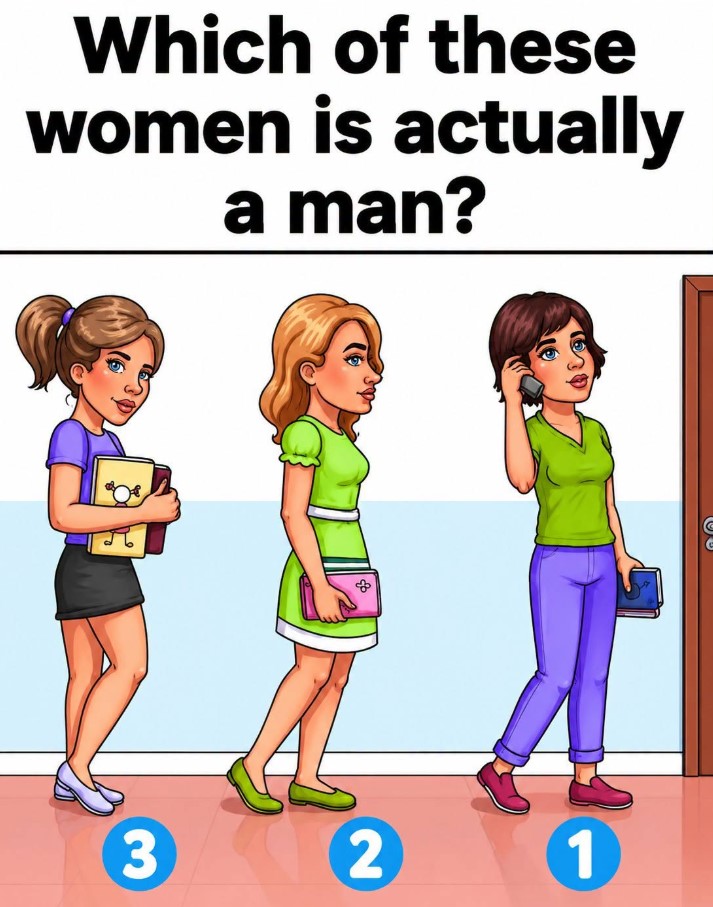
At first glance, this picture looks like a simple visual puzzle. Three people are standing in a line inside a hallway, each dressed differently and holding books or other small objects. Above them is a question that immediately makes you curious: Which of these women is actually a man?
The challenge may seem easy because all three figures have different hairstyles, outfits, and appearances. However, the puzzle is not asking you to judge their clothing or guess based on their hairstyles. Instead, it encourages you to examine the small details that might be easy to overlook.
Sometimes, a visual riddle hides its main clue in a place we rarely think to examine. A tiny difference in posture, facial features, or body details can attract our attention once we know where to look.
Before revealing the intended answer, take a moment to study all three figures. Look carefully at their faces and necks, and see whether you can spot the detail that makes one person stand out.
Take a Closer Look at the Three People
The picture shows three people standing in a hallway against a light blue wall. A dark brown door with a silver handle can be seen on the right side.
Each person is identified by a number inside a blue circle. Although they are standing close together, their appearances and clothing are quite different.
Let’s examine each figure before looking at the main clue.
Person Number 1: The One Near the Door
The first person is standing closest to the door. They have short, dark brown hair and are wearing a bright green V-neck shirt with casual blue trousers.
Their trousers appear to be rolled up slightly at the bottom, and they are wearing pinkish-red shoes.
One hand is holding a phone against their ear, while the other holds a small blue book or notebook. Their head is turned slightly, as though they are looking back while having a conversation.
At first glance, nothing particularly unusual stands out. The outfit is casual, and the person’s overall appearance does not immediately attract attention.
Person Number 3: The One at the Other End
The third person is standing at the opposite end of the line.
They have longer brown hair tied neatly into a ponytail. They are wearing a short-sleeved purple top, a short black skirt, and purple shoes.
They are also holding two books, one yellow and one dark red, while looking over their shoulder.
Like the first figure, this person appears quite ordinary at first glance. There is no obvious detail that immediately gives away the answer to the puzzle.
Person Number 2: The Person in the Middle
Now look at the person standing between the other two.
They have long blonde hair pulled back from their face and are wearing a light green dress with a white stripe near the bottom.
They are holding a pink notebook and standing upright, facing forward.
Their clothing and hairstyle are different from those of the other figures, but neither detail is the main focus of the puzzle.
Instead, pay attention to the front of the neck, just below the chin.
There is a small raised area that appears more noticeable than the corresponding area on the other two figures.
This is the detail the puzzle wants you to notice.
The Hidden Clue: What Is an Adam’s Apple?
The small raised area on the front of the throat is commonly known as an Adam’s apple.
Its medical name is the laryngeal prominence. It is formed by the thyroid cartilage, which surrounds and protects part of the larynx, also known as the voice box.
During puberty, hormonal changes can affect the growth of the larynx. In many males, the thyroid cartilage becomes more prominent, making the Adam’s apple easier to see.
This is why a noticeable Adam’s apple is often associated with male anatomy.
However, it is important to understand that everyone has a larynx and thyroid cartilage. The size and visibility of the Adam’s apple vary naturally from person to person. Some women have a noticeable one, while some men have a relatively small or barely visible one.
Therefore, this physical feature can be a clue in a picture puzzle, but it cannot reliably establish someone’s sex or gender in real life.
The Correct Answer to the Puzzle
If you followed the clue used in the original puzzle, the intended answer is number 2, the person standing in the middle.
The reason is the noticeable raised area on the front of the neck, which the puzzle identifies as an Adam’s apple.
The other two figures do not appear to have the same prominent feature in the illustration.
That small detail is what the puzzle uses to direct your attention toward the middle figure.
Did you notice it before reading the explanation, or did you initially focus on the hairstyles and clothing?
Why Are Small Details So Easy to Miss?
One interesting aspect of visual puzzles is that people often concentrate on the most obvious parts of an image.
When we look at three people standing in a row, our attention naturally moves toward their faces, clothing, hairstyles, and posture. We may recognize the overall scene without carefully examining every individual detail.
This quick way of processing images is useful in everyday life, but it can make visual challenges more difficult.
There are several reasons why someone might overlook the clue:
We focus on familiar details. Clothing and hairstyles are easy to recognize, so they often attract our attention before smaller physical features.
We make assumptions too quickly. Once we decide what we are looking at, we may stop searching for other possibilities.
We overlook small differences. A subtle detail on the neck may be less noticeable than a bright outfit or a different hairstyle.
We do not compare the figures carefully. Looking at each person separately may not reveal the difference as easily as comparing the same area across all three figures.
The best way to approach these challenges is to slow down, examine the whole image, and avoid settling on an answer too quickly.
A Fun Way to Challenge Your Friends
Once you know the intended answer, you can share the picture with friends or family members and let them solve it for themselves.
Ask them to examine all three figures without giving away the clue. Some may immediately look at the necks, while others might spend their time comparing the clothing and hairstyles.
You can make the challenge more interesting by giving everyone a short time limit. Afterward, compare their answers and ask what detail helped them reach their conclusions.
Remember not to reveal the explanation too soon. The enjoyment of a visual puzzle often comes from discovering the hidden clue independently.
Conclusion :
This visual puzzle reminds us that sometimes the smallest details attract the most attention once we know where to look. Three people standing in a hallway may seem like an ordinary scene, but the question above them encourages us to examine the picture more carefully and search for something that might not be immediately obvious.
The intended answer is number 2, the person in the middle. The clue is the noticeable raised area on the front of the neck, which the puzzle identifies as an Adam’s apple. Although this feature is commonly associated with male anatomy, it is worth remembering that its size and visibility vary from person to person and cannot determine someone’s gender by appearance alone.
What makes this challenge interesting is not simply finding the answer. It is the way the puzzle directs our attention toward a small feature that many people might overlook during their first glance. Instead of focusing only on hairstyles, clothes, or accessories, we are encouraged to examine the entire picture and compare details carefully.
Whether you spotted the clue immediately or needed a little help, the puzzle offers a fun reminder to slow down and pay attention. Our first impression does not always reveal everything, and a second look can sometimes make all the difference.
So, did you choose person number 2 before reading the explanation? Share the picture with someone else and see whether they notice the same detail. You might be surprised by how many different answers people give before discovering the clue!