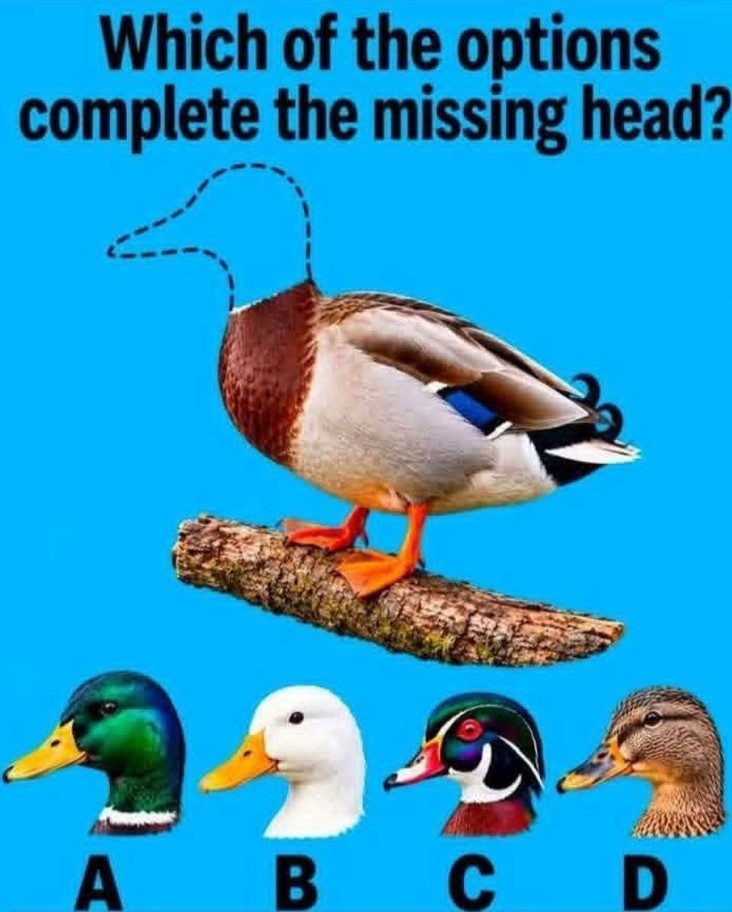
Picture yourself looking at a beautiful duck sitting peacefully on a small wooden log. Its body is clearly visible, with a lovely mixture of brown, gray, and white feathers, a bright green patch on its wing, and distinctive orange feet.
But there is one very unusual problem: the duck has no head!
Instead of its head, there is only a dotted outline showing where it should be. Fortunately, four possible replacements are provided, labeled A, B, C, and D.
Your challenge is to examine the picture carefully and decide which head belongs to the duck’s body.
It sounds like a simple matching game, but don’t be fooled. Each option has different colors, markings, and details. Choosing the correct one requires more than simply picking the head that looks the prettiest.
Can You Find the Missing Duck Head?
Before looking at the four options, take a moment to study the duck’s body.
Notice the combination of brown, gray, and white feathers. There is also a noticeable green patch on its wing, while its feet are bright orange.
These details are important because the correct head should complete the bird naturally.
Think about the overall appearance of the duck. Would its head have bright colors? Would it be mostly white? Or would it have darker, more natural-looking feathers?
The goal is to find the option that best matches the bird shown in the main picture.
Examine the Four Possible Answers
There are four different duck heads to choose from. Each one has its own distinctive appearance, making the challenge a little more interesting.
Option A: The Glossy Green Head
The first option features a beautiful, glossy green head. It has a bright yellow beak and a noticeable white collar around the lower part of its neck.
Its colors are bold and immediately attract attention. The green and white combination gives it a distinctive appearance.
But does this head belong to the duck with the brown, gray, and white body?
Option B: The Completely White Head
The second option looks very different from the first.
It has an entirely white head and a bright orange beak. The orange coloring is similar to the duck’s feet, which might make this option seem like a reasonable match at first.
However, you need to consider the complete appearance of the bird rather than focusing on just one matching color.
Would a completely white head look natural with the body in the picture?
Option C: The Colorful Patterned Head
The third option is probably the most unusual of the four.
Its face features a combination of white, black, and orange stripes, along with a distinctive red eye.
It has a much more complicated pattern than the other choices. Although it is certainly eye-catching, you need to decide whether these markings fit the overall appearance of the duck.
Look carefully before making your choice.
Option D: The Mottled Brown Head
The final option has a more natural, understated appearance.
Its head is covered in mottled brown feathers with small black markings. The beak also contains several colors, including orange, black, and yellow.
At first glance, this option might seem compatible with the duck’s brown and gray body.
But is it the correct replacement, or is another option a better match?
How to Solve the Missing Head Puzzle
The best way to approach this challenge is to compare the four options with the visible features of the duck.
Don’t focus only on the color of the feathers. Pay attention to the beak, the neck markings, and the overall appearance of each candidate.
Try imagining each head attached to the body. Which combination looks most natural?
It can also help to eliminate the options that seem less compatible before choosing your final answer.
For example, Option C has very distinctive facial markings, while Option B has an entirely white head. Options A and D offer two different combinations that you may want to examine more closely.
Take your time. The answer is already in front of you, but noticing the right details is the real challenge.
The Correct Answer: Option A
If you selected Option A, congratulations! You found the correct missing head.
The answer is the glossy green head with the white collar and bright yellow beak.
This is the head that completes the duck shown in the puzzle.
The green coloring and distinctive white neck marking make it the intended match among the four choices. The other options have different patterns and appearances that do not correspond to the correct duck.
If you chose another option, don’t worry. The purpose of this challenge is to test your observation skills and encourage you to look more carefully at visual details.
Why Are These Picture Puzzles So Interesting?
Missing-piece puzzles are enjoyable because they encourage us to examine familiar objects in a different way.
When we look at a complete animal, we usually recognize it immediately without thinking about every individual feature. However, when one important part is missing, we must pay closer attention.
We start comparing colors, shapes, patterns, and proportions. Even small details that might normally go unnoticed suddenly become important.
These challenges can also be a fun way to spend time with friends and family. Everyone can choose an answer, explain their reasoning, and compare their choices before the correct solution is revealed.
The best part is that you don’t need any special knowledge or equipment. All you need is a picture, a little patience, and a willingness to look closely.
Conclusion
The missing duck head puzzle may look simple, but it is a fun test of observation and attention to detail. With four different options available, each featuring its own colors and markings, finding the correct match requires you to look beyond the first impression.
The correct answer is Option A, the glossy green head with the white collar and yellow beak.
Whether you identified it immediately or needed a little extra time, the important thing is to enjoy the challenge. Sometimes, the smallest details make the biggest difference when solving a visual puzzle.
Why not share this challenge with your friends and family? Ask them to choose between A, B, C, and D before revealing the answer. You might be surprised by how differently everyone approaches the same picture!
So, did you choose Option A on your first attempt?