
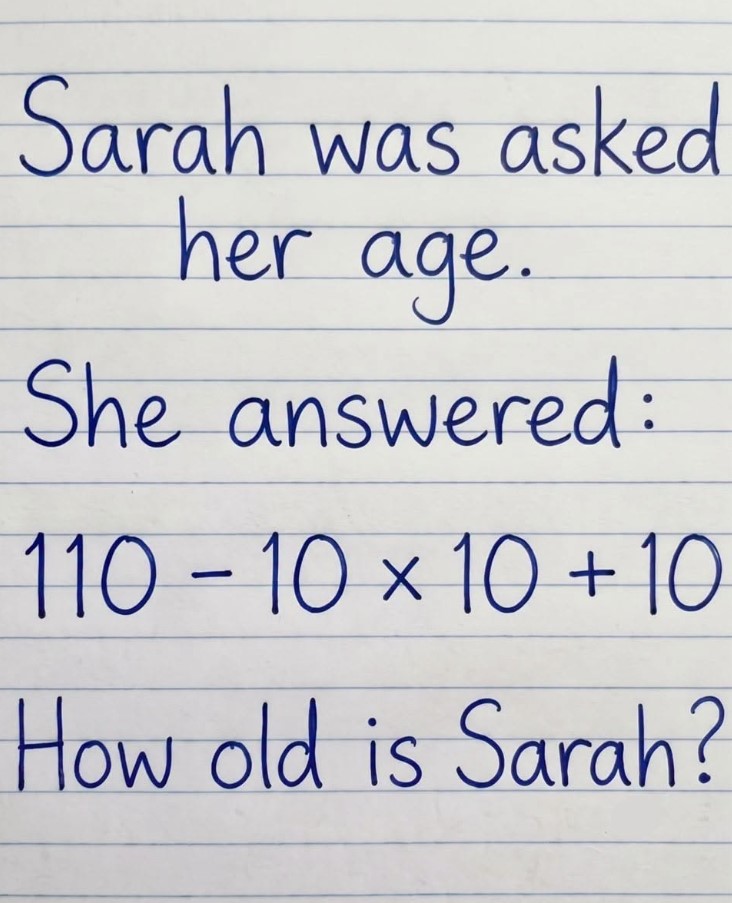
At first glance, this little math puzzle looks incredibly easy. It contains only a few numbers and basic arithmetic operations, so you might think finding the answer will take just a few seconds.
But don’t be too quick! Many people rush through the calculation and end up with the wrong result. The trick is not the numbers themselves. It is knowing which mathematical operation must be performed first.
Here is the challenge:
Sarah was asked her age. She answered:
110 − 10 × 10 + 10
How old is Sarah?
Take a moment to solve it yourself before reading the explanation. You might be surprised by how easily a simple mistake can change the entire answer.
Why Is This Math Puzzle Tricky?
The expression contains three basic operations: subtraction, multiplication, and addition.
Many people naturally start calculating from the left side because that is how we usually read numbers and sentences. However, mathematics follows a specific set of rules called the order of operations.
These rules tell us which calculation should be completed first when an expression contains more than one type of operation.
Without following these rules, two people could solve the same expression in different ways and arrive at different answers. The order of operations ensures that everyone follows the same mathematical procedure.
The Important Rule: Multiplication Comes Before Addition and Subtraction
Before solving Sarah’s age puzzle, remember this simple mathematical rule:
- Multiplication and division are performed before addition and subtraction.
- When addition and subtraction appear together, calculate from left to right.
- When multiplication and division appear together, also calculate from left to right.
This means you should never automatically solve every operation in the order you see it.
In Sarah’s puzzle, multiplication must be completed before subtraction and addition.
Step-by-Step Solution: How Old Is Sarah?
Let’s solve the expression carefully.
The original calculation is:
110 − 10 × 10 + 10
Step 1: Perform the multiplication first.
Look at the multiplication part:
10 × 10 = 100
Now replace the multiplication in the original expression with 100.
The calculation becomes:
110 − 100 + 10
Step 2: Calculate from left to right.
We now have subtraction and addition. Since both operations have the same priority, we must work from left to right.
Start with:
110 − 100 = 10
The expression now becomes:
10 + 10
Step 3: Complete the final addition.
10 + 10 = 20
We have reached the final answer!
Sarah is 20 years old.
Why Do So Many People Get the Answer Wrong?
The biggest reason people make mistakes with this puzzle is that they begin calculating immediately without checking the order of operations.
For example, someone might look at the expression and start with the first two numbers:
110 − 10 = 100
Then they multiply:
100 × 10 = 1,000
Finally, they add 10:
1,000 + 10 = 1,010
This answer is incorrect because the multiplication was performed at the wrong stage. The expression does not allow us to simply work through every operation from left to right.
Another common mistake is to change the order of the final addition and subtraction. Even though addition and subtraction have equal priority, their order still matters. You must follow the expression from left to right.
Understanding this small detail makes a big difference.
A Simple Way to Remember the Order of Operations
If you enjoy solving math puzzles, remembering the order of operations will help you avoid many common mistakes.
One popular way to remember the rule is PEMDAS:
- P – Parentheses: Solve calculations inside parentheses first.
- E – Exponents: Calculate powers and roots.
- M – Multiplication: Perform multiplication.
- D – Division: Perform division.
- A – Addition: Perform addition.
- S – Subtraction: Perform subtraction.
There is one important detail: multiplication and division share the same priority, as do addition and subtraction. They are completed from left to right rather than treating multiplication as always coming before division or addition as always coming before subtraction.
Once you understand this, even expressions that look confusing become much easier to solve.
Try Another Quick Math Challenge
Now that you know Sarah’s age, why not test your skills with another short calculation?
Try solving this expression without using a calculator:
50 − 5 × 5 + 5
Remember the same rules. Complete the multiplication first, then work from left to right with the remaining operations.
The correct answer is 30.
If you got it right, you have understood the most important trick behind Sarah’s puzzle!
Conclusion :
Sarah’s age puzzle is a perfect example of how a calculation that looks simple can confuse people when they forget the basic rules of mathematics.
The expression 110 − 10 × 10 + 10 may tempt you to start calculating immediately from the left, but the correct approach is to complete multiplication first. After that, subtraction and addition are performed from left to right.
Once we follow the correct steps, the answer becomes clear: Sarah is 20 years old.
The interesting thing about this challenge is that it does not require advanced mathematical knowledge. It simply tests your attention, patience, and understanding of a rule that many people learned in school but sometimes forget.
So, before answering the next math puzzle you encounter, take a few seconds to examine the operations carefully. Sometimes, the difference between a correct answer and a completely wrong one is simply knowing what to calculate first.
Did you get Sarah’s age right on your first attempt, or did the puzzle catch you off guard? Share it with friends and family and see who can solve it without making a mistake!