Are you good at visual puzzles that challenge your ability to think in three dimensions? Sometimes, a problem that looks incredibly simple can become surprisingly difficult when you have to imagine how objects will look after they are cut apart.
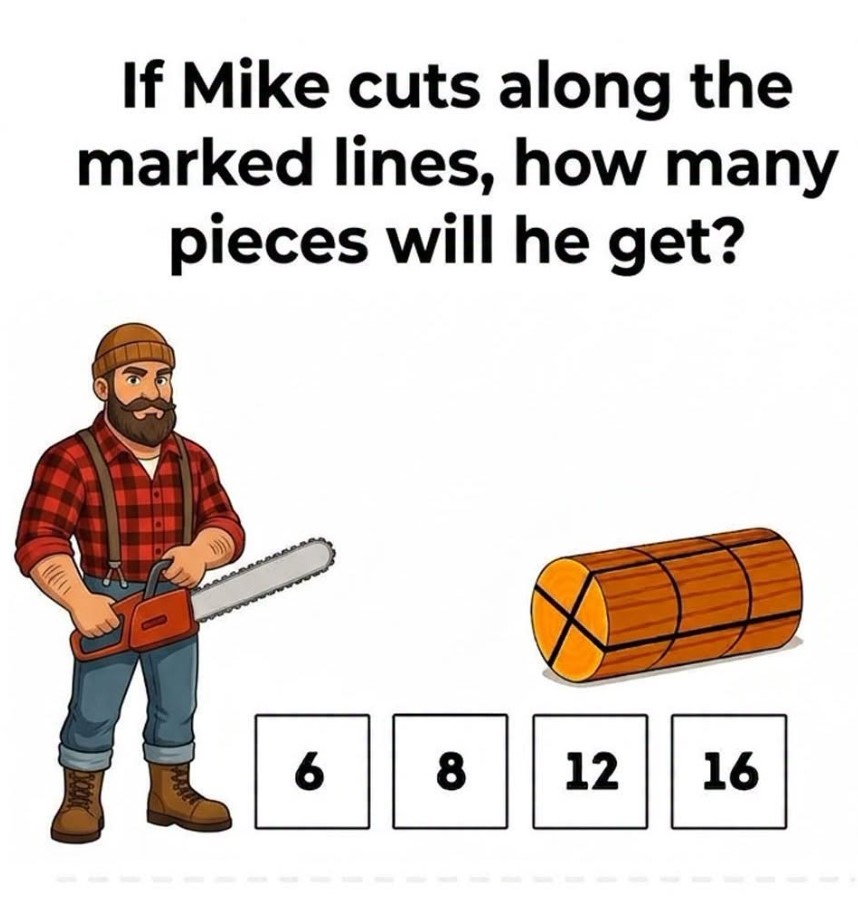
Today’s challenge features a hardworking lumberjack named Mike, who is preparing to cut a large log of wood with his chainsaw.
At first glance, the task seems easy. There are several black lines marked on the log, and Mike plans to follow every one of them. But how many individual pieces will he actually get when he finishes?
The answer isn’t as obvious as it might seem. You need to pay attention to two different types of cuts and understand how they work together.
The Challenge: How Many Pieces Will Mike Get?
Take a close look at the picture.
Mike is standing beside a large cylindrical log with several marked lines running across and around it.
Some lines cross the circular front face of the log, dividing it into sections. Other lines run along the length of the cylinder, creating additional divisions.
Mike intends to make a cut along every marked line.
Your task is to determine how many separate pieces of wood will remain after all the cuts are completed.
Here are the four possible answers:
- A. 6 pieces
- B. 8 pieces
- C. 12 pieces
- D. 16 pieces
Before looking at the solution, take a moment to study the arrangement.
Don’t simply count the black lines and assume that each one creates only one additional piece. The important part is understanding how the cuts divide the entire log.
Why Is This Puzzle Tricky?
The biggest challenge is that the log is a three-dimensional object.
If you look only at its circular front face, you might focus on the sections created by the lines crossing the center.
However, the cuts running along the length of the log also matter.
These two types of cuts work together to divide the original cylinder into smaller sections.
This is where many people make a mistake. They count the divisions on the front face but forget that the longitudinal cuts continue through the length of the log.
To solve the puzzle correctly, you need to consider the cross-section and the cuts along the cylinder separately.
Step 1: Examine the Circular Cross-Section
Start by looking at the front face of the log.
Imagine that you are looking directly at the circular end rather than viewing the entire cylinder from the side.
The marked lines crossing this face divide the circular cross-section into several sections.
Each section represents part of the original log that may become a separate piece after the cuts are completed.
Instead of trying to imagine the entire cutting process at once, focus on understanding this circular arrangement first.
Step 2: Look at the Cuts Along the Length
Now pay attention to the other marked lines.
These cuts run along the cylinder, dividing the log lengthwise.
They create additional separations between the sections formed by the cross-sectional cuts.
This is an important detail because a single section of the circular face can be divided into smaller pieces by the lengthwise cuts.
The final number therefore depends on how both sets of cuts interact.
Step 3: Combine the Two Types of Cuts
Once you understand the cross-sectional divisions and the lengthwise cuts, you can visualize the final arrangement.
Imagine each cut passing completely through the wood along its marked path.
The original log is gradually separated into smaller sections until every marked line has been followed.
The key is to count the resulting pieces rather than simply counting the number of lines.
The Correct Answer: 12 Pieces!
If you selected C. 12, congratulations! That is the answer given in the original puzzle.
The log is divided by the marked cuts into 12 individual pieces.
If you chose 6, 8, or 16, don’t worry. This is exactly the kind of puzzle that can be confusing when you try to visualize a three-dimensional object from a two-dimensional picture.
The important thing is to remember that the cuts across the circular face and those running along the length of the cylinder must both be considered.
Why Are Three-Dimensional Cutting Puzzles So Difficult?
These challenges require us to imagine what happens inside an object that we can only see from the outside.
Our eyes naturally focus on the visible lines and surfaces. However, when an object is cut, the resulting pieces depend on how the cuts extend through its entire structure.
This is why spatial reasoning is so important.
It helps us understand how objects fit together, how shapes change when they are divided, and how different sections relate to one another.
Puzzles like Mike’s cutting challenge provide an enjoyable way to practice these skills.
Tips for Solving Similar Visual Puzzles
If you enjoy these challenges, here are a few techniques that can help you solve them more confidently:
Look at the object from different angles. A front view may reveal details that are difficult to understand from the side.
Separate the problem into smaller steps. Identify each type of cut before trying to calculate the final number of pieces.
Visualize the cuts passing through the object. Don’t assume that a line only affects the surface where it appears.
Count the final sections, not the lines. One cut does not always create just one additional piece, especially when several cuts intersect.
Take your time. These puzzles are designed to test careful thinking rather than speed.
Final Thoughts
Mike’s cutting puzzle is a great reminder that simple-looking challenges can require a surprising amount of imagination.
At first, counting the marked lines on a wooden log might seem like an easy task. But once you consider the circular cross-section and the cuts running along the cylinder, the problem becomes much more interesting.
The correct answer given by the original puzzle is 12 pieces.
Whether you solved it immediately or needed to examine the picture several times, the challenge is a fun way to test your spatial reasoning and attention to detail.
Did you choose 12, or did another answer seem more convincing? Share your result and challenge your friends and family to see whether they can solve Mike’s puzzle without looking at the answer!