Have you ever come across a simple math problem that looks easy to solve but somehow manages to confuse thousands of people?
Some puzzles become popular because they involve complicated calculations. Others attract attention because they hide a clever detail that most people overlook.
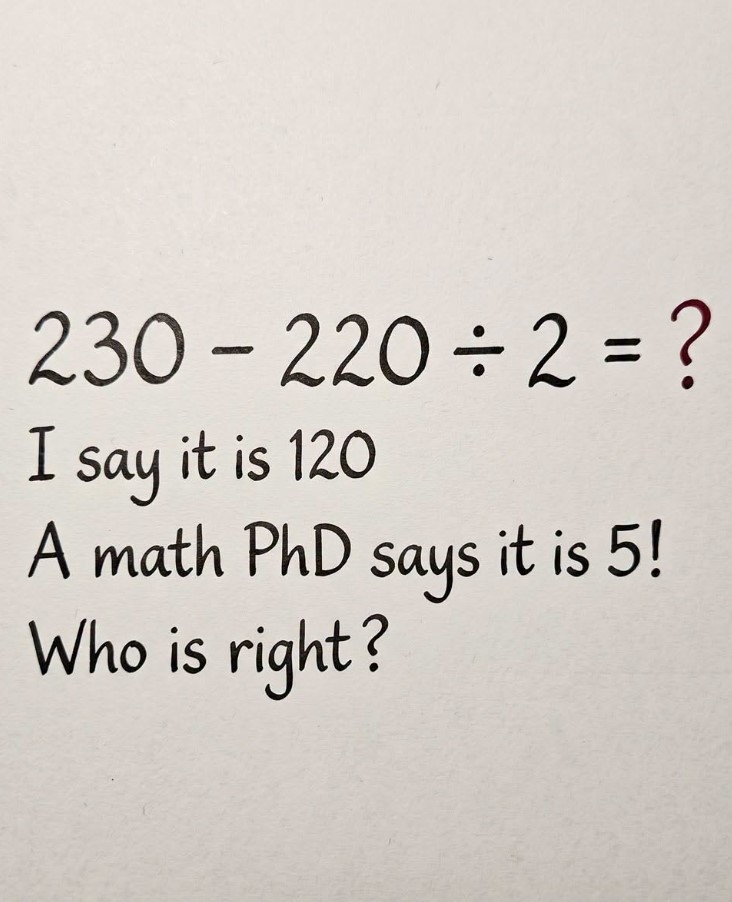
Today’s challenge is a perfect example. It involves a short arithmetic equation and two people who seem to disagree about the correct answer. One person gives the result as 120, while a Math PhD confidently answers with something that looks completely different: 5!
How can both answers possibly be correct?
At first, you might think someone has made a mathematical mistake. But the secret is much more interesting than that. It involves a special mathematical symbol that can completely change the way we read an answer.
The Math Puzzle: Can You Solve It?
Take a close look at this equation:
230 − 220 ÷ 2 = ?
Before reading the explanation, try solving it yourself.
Some people might subtract 220 from 230 first and then divide the result by 2. Others may remember the standard order of mathematical operations and perform the division before the subtraction.
The difference between these approaches leads to two very different results.
So, what is the correct answer?
According to the original puzzle, one person says the answer is 120, while the Math PhD responds with 5!
Let’s examine the calculation carefully.
Step 1: Remember the Order of Operations
When solving mathematical expressions, we cannot simply perform every operation from left to right.
There are established rules that tell us which calculations must come first.
One commonly used system is PEMDAS:
- P: Parentheses
- E: Exponents
- M: Multiplication
- D: Division
- A: Addition
- S: Subtraction
Another commonly used version is BODMAS, which stands for Brackets, Orders, Division, Multiplication, Addition, and Subtraction.
Both systems remind us that multiplication and division must be handled before addition and subtraction. When operations have the same priority, we work from left to right.
In our puzzle, there are no parentheses or exponents. We only have division and subtraction.
That means we must divide first.
Step 2: Perform the Division
Let’s return to the original equation:
230 − 220 ÷ 2
The division comes before the subtraction.
So we calculate:
220 ÷ 2 = 110
Now we replace the division with its result:
230 − 110
The difficult part is already behind us. We only need to complete one subtraction.
Step 3: Complete the Subtraction
Now calculate:
230 − 110 = 120
Therefore, the numerical answer to the original equation is:
120
The person who answered 120 was absolutely correct.
But what about the Math PhD?
Why did the expert write 5 instead of 120?
This is where the clever trick appears.
The Secret Is Hidden in One Small Symbol
Look carefully at the Math PhD’s answer:
5!
At first glance, the exclamation mark might look like ordinary punctuation used to express excitement or confidence.
However, in mathematics, this symbol has a special meaning.
It is called the factorial symbol.
A factorial tells us to multiply a whole number by every positive whole number below it, continuing all the way down to 1.
For example, 4 factorial is written as:
4! = 4 × 3 × 2 × 1
The answer is:
4! = 24
So when someone writes 5!, they are not simply writing the number 5 followed by an exclamation mark.
They are using a mathematical operation.
What Does 5! Actually Mean?
Let’s calculate it step by step.
5! = 5 × 4 × 3 × 2 × 1
Start with the first multiplication:
5 × 4 = 20
Continue:
20 × 3 = 60
Then:
60 × 2 = 120
Finally:
120 × 1 = 120
The result is:
5! = 120
And suddenly, everything makes sense!
The Math PhD didn’t give a different numerical result. The expert simply expressed the number 120 using factorial notation.
Why Are Both Answers Correct?
Now let’s compare the two responses.
The first person wrote:
120
The Math PhD wrote:
5!
Although they look completely different, both expressions have exactly the same numerical value.
In other words:
5! = 120
The first answer gives the result directly, while the second uses a mathematical symbol to represent that same result.
There is no disagreement between the two answers once we understand what the exclamation mark means.
A Few More Factorial Examples
If factorial notation is new to you, here are a few simple examples to help you understand it.
- 1! = 1
- 2! = 2 × 1 = 2
- 3! = 3 × 2 × 1 = 6
- 4! = 4 × 3 × 2 × 1 = 24
- 5! = 5 × 4 × 3 × 2 × 1 = 120
- 6! = 6 × 5 × 4 × 3 × 2 × 1 = 720
As you can see, factorial values increase very quickly.
For example, 5 factorial is 120, but 6 factorial is already 720.
This is why factorial notation is useful in mathematics, especially when working with large numbers and counting possible arrangements.
Where Is Factorial Notation Used in Real Mathematics?
Factorials are not just a clever way to confuse people in online puzzles.
They are an important part of several mathematical topics.
One common application is permutations, which involve arranging objects in different possible orders.
Imagine you have five different books and want to place them on a shelf. How many different arrangements are possible?
The answer is:
5! = 120
That means there are 120 possible ways to arrange the five books.
Factorials also appear in combinations, probability, statistics, and other areas of mathematics.
So that little exclamation mark has a much bigger role than most people realize!
Final Thoughts
The Math PhD’s Secret Trick is a wonderful example of how a small mathematical symbol can completely change the meaning of an answer.
At first, the two responses seem to contradict each other. One person says 120, while the other confidently writes 5!
But once we understand factorial notation, the mystery disappears.
The original equation gives us 120 when we follow the correct order of operations. Meanwhile, 5! also equals 120 because it represents the multiplication of all positive whole numbers from 5 down to 1.
So both answers are correct!
The lesson is simple: never judge a mathematical expression by its appearance alone. Sometimes, the smallest symbol carries the most important information.
Did you know what the exclamation mark meant before reading the explanation, or did you initially think the Math PhD had made a mistake?
Share this puzzle with your friends and family and see whether they can discover the secret without any help!