Visual puzzles are a fun way to challenge your attention, sharpen your observation skills, and test how carefully you notice details. Some puzzles look incredibly easy at first, but once you start counting, you may realize that finding the correct answer takes more concentration than expected.
Today’s challenge is a simple-looking egg-counting puzzle. Your task is to look carefully at the picture and count every egg you can see. Don’t rush, because it is easy to overlook a few eggs when they are grouped closely together.
The Egg Counting Challenge: Can You Get It Right?
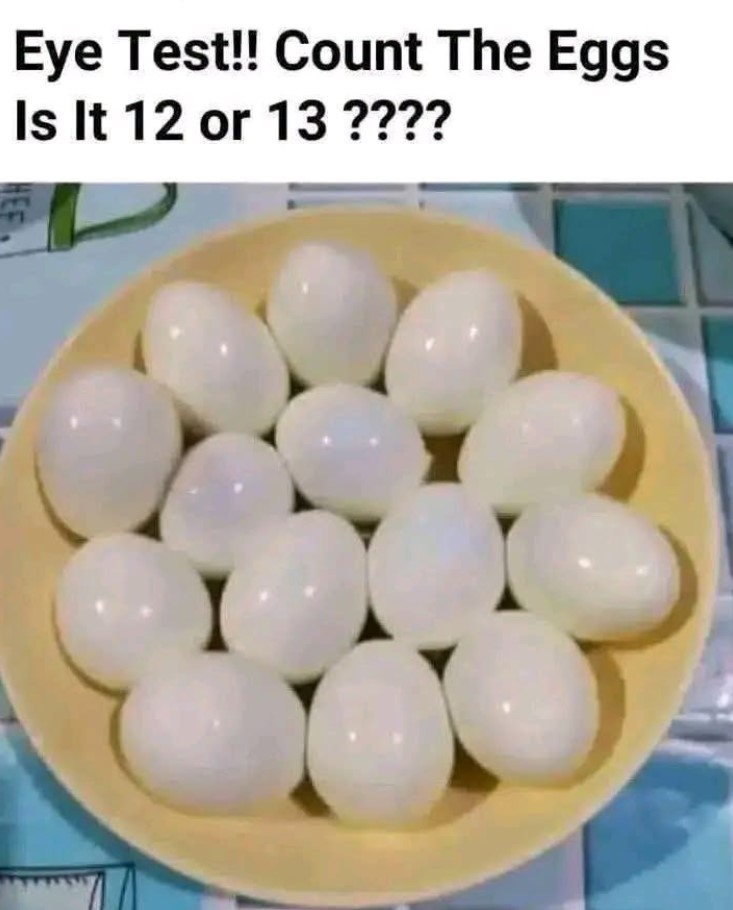
The picture shows a plate filled with peeled, hard-boiled eggs sitting on a countertop. The eggs are packed together, and their overlapping shapes can make it difficult to distinguish one from another at first glance.
Before looking for explanations or reading anyone else’s answers, take a moment to count them yourself. Try counting from the top to the bottom, moving from one side of the plate to the other. This simple technique can help prevent counting the same egg twice or missing one hidden between others.
Why This Puzzle Is Trickier Than It Looks
Counting objects in a crowded picture is not always as easy as it seems. When several objects have similar colors, shapes, and sizes, our brains tend to group them together instead of recognizing each one separately.
In this image, the eggs are close together, and some are partially hidden behind others. The reflections and shadows also make certain shapes harder to identify clearly. That is why two people looking at exactly the same picture may come up with different numbers.
Some people count only the eggs they can clearly see, while others try to imagine whether additional eggs could be hidden underneath the visible pile.
Answer 1: The Logical Count – 14 Eggs
The most straightforward answer is 14 eggs. This is the count based on the individual egg shapes that are clearly visible in the picture, without trying to guess what might be hidden underneath.
Here is how to break down the count:
- Top row: 3 eggs
- Left side: 2 eggs
- Right side: 2 eggs
- Center cluster: 4 eggs
- Bottom row: 3 eggs
Adding everything together gives:
3 + 2 + 2 + 4 + 3 = 14 eggs.
If you count only the eggs that are visibly identifiable, this is the most reasonable answer to the puzzle.
Answer 2: The 3D Perspective – Could There Be 16 to 18 Eggs?
Some people believe that counting only the visible eggs may not tell the whole story. Because eggs are rounded and slippery, they cannot always be stacked neatly without other eggs supporting them.
Looking at the raised central portion of the pile, it is possible to imagine that a few eggs are hidden underneath the visible ones. If there is another layer supporting the center, the total number could be higher than the number we can see.
Under this theory, the pile might contain between 16 and 18 eggs.
However, this is only a guess based on how someone imagines the eggs are arranged. The picture does not clearly prove that any additional eggs are hidden beneath the visible layer.
Answer 3: The Optical Illusion Theory – Only 7 or 8 Eggs?
Another interpretation comes from people who think the picture may be playing tricks on their eyes.
The lighting, reflections, and blurry edges can make certain shapes appear confusing. Some people may question whether every visible shape represents a separate egg or whether reflections and visual distortions are making the pile look larger than it really is.
From this perspective, the number could be reduced to approximately 7 or 8 eggs.
This interpretation is more of a playful theory than a reliable count. There is no clear evidence in the image that the eggs are duplicated, reflected, or digitally manipulated.
Answer 4: The Internet’s Wildest Theories
As with many viral puzzles, not everyone is willing to settle for a simple answer. Some people take the challenge much further, coming up with funny and completely unreasonable explanations.
Here are a few of the most entertaining possibilities:
The One-Egg Theory: What if the entire picture somehow represents one egg moving around the plate, captured in a strange way? It sounds ridiculous, but that is exactly the kind of answer that makes internet puzzles entertaining.
The Mirror Theory: Someone might argue that the plate is reflecting the eggs, meaning the visible number should be doubled. Under this theory, 14 becomes 28.
The Infinite Egg Theory: Since we cannot see beneath the plate, perhaps there are hundreds of eggs hidden underneath the visible ones. The pile could supposedly continue forever.
The Cake Theory: And finally, someone could claim that none of the eggs are real because the entire plate is actually an incredibly realistic cake.
These theories are obviously meant for fun, not serious counting, but they show how creative people can become when a simple picture turns into an online debate.
So, What’s the Final Answer?
If you count the clearly visible eggs without making assumptions about hidden layers, the answer is 14 eggs.
If you believe some eggs must be hidden underneath to support the pile, you might guess 16, 17, or 18. If you follow the optical illusion theories, you could even arrive at 7 or 8. But the most logical answer based on the visible shapes is 14.
Conclusion
This egg-counting challenge proves that sometimes the simplest pictures can be surprisingly difficult to solve. At first glance, a plate full of eggs seems like an easy task. Most people would probably assume they could count everything in just a few seconds. But once the eggs begin overlapping and blending into one another, it becomes much easier to lose track, count the same egg twice, or overlook one hiding between the others.
The most reasonable answer is 14 eggs based on the visible shapes, although the puzzle leaves room for different interpretations. That is what makes these visual challenges so entertaining. People look at the same picture, yet their brains may organize the shapes differently, leading them to completely different answers. Some rely on a quick glance, while others take their time, carefully examining every corner of the image before making their final decision.
The trick to solving puzzles like this is not necessarily having extraordinary intelligence or perfect eyesight. It is learning to slow down, focus, and pay attention to the small details that are easy to miss. A little patience can make a big difference, especially when several objects are grouped together and your eyes are tempted to see them as one large shape.
Whether you counted 14 eggs, came up with a different number, or had to count everything twice, the important thing is that you took the time to challenge your mind. These little brain teasers are a great way to break up your daily routine, have fun with friends and family, and discover how differently people can approach the same problem.
So, did you get the right answer on your first try, or did the overlapping eggs fool you? Share your count with others and see who gets it right without taking a second look. You might be surprised by how much debate a simple plate of eggs can create!