
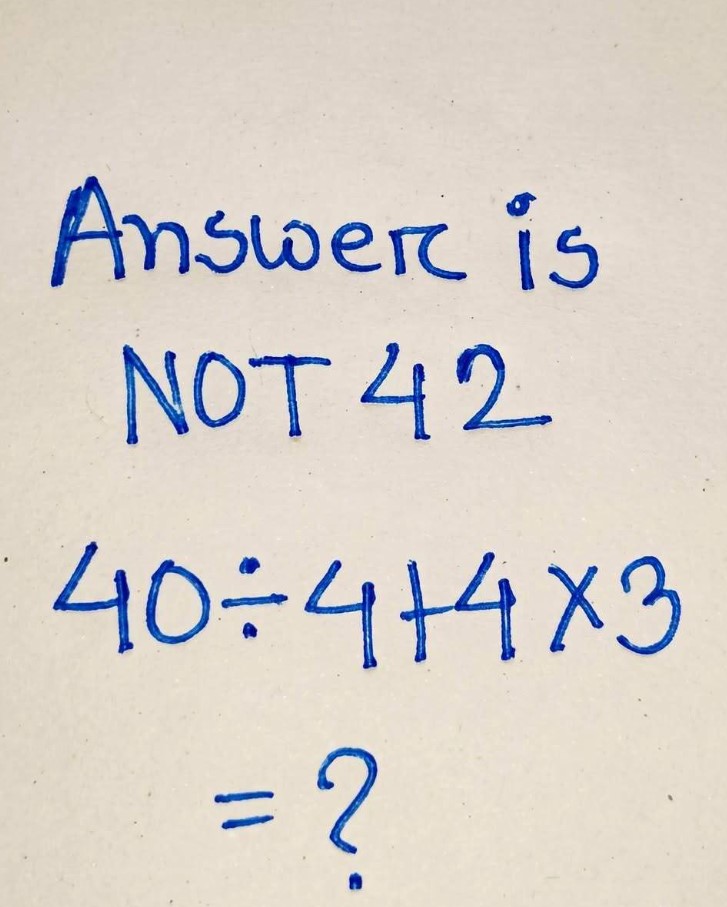
Are you good at solving math puzzles? Do you trust your first answer, or do you prefer to double-check your calculations before making a decision? Today’s challenge may look like a simple arithmetic problem, but there is a little trick that can easily lead you to the wrong result.
At first glance, the equation seems straightforward. You only need to perform a division, an addition, and a multiplication. Nothing too complicated, right? However, many people make the same mistake when trying to solve it because they forget one important mathematical rule.
The puzzle even gives you a warning: “Answer is NOT 42.”
That statement might seem strange, especially when 42 appears to be a perfectly reasonable answer. But there is a reason behind it.
Are you ready to test your mathematical skills? Take a moment, look at the equation, and try to solve it before reading the explanation.
The Math Challenge: Can You Find the Correct Answer?
Here is the equation you need to solve:
40 ÷ 4 + 4 × 3 = ?
Your mission is to find the correct number that replaces the question mark.
You might be tempted to start calculating immediately from left to right. After all, that is how we usually read numbers and mathematical expressions. But this is exactly where the challenge begins.
Before choosing your answer, remember the warning written above the equation: the answer is not 42.
Can you figure out why?
Take a few seconds to work it out yourself. If you already have an answer, keep it in mind and continue reading to see whether your calculation follows the correct mathematical rules.
Why Do So Many People Answer 42?
The number 42 is a common answer because many people approach the equation by performing the operations in the wrong order.
Here is how someone might arrive at that result:
First, divide 40 by 4:
40 ÷ 4 = 10
Next, add 4:
10 + 4 = 14
Finally, multiply the result by 3:
14 × 3 = 42
Everything may seem logical when you follow these steps. The individual calculations are correct, and the final multiplication does produce 42.
However, the problem is not with the calculations themselves. It is with the order in which the operations were performed.
In mathematics, multiplication and division have priority over addition and subtraction. This means you cannot simply complete every operation from left to right without considering the rules.
That small detail changes the entire answer.
The Secret Behind the Puzzle: Order of Operations
To solve mathematical expressions correctly, we use a standard system known as the order of operations.
These rules establish which calculations must be performed first and which ones should come afterward. They are important because they ensure that everyone follows the same mathematical process and arrives at the same answer.
The general order is:
- Parentheses: Complete any calculations inside parentheses first.
- Exponents: Calculate powers and roots.
- Multiplication and Division: Perform these operations from left to right.
- Addition and Subtraction: Complete these operations from left to right.
You may remember this system through the acronym PEMDAS or BODMAS, depending on where you learned mathematics.
The most important detail for this particular puzzle is that multiplication and division have equal priority. You must perform them in the order they appear, moving from left to right.
The same principle applies to addition and subtraction.
Once you understand this rule, the puzzle becomes much easier.
Step-by-Step Solution: Let’s Solve It Together
Now let’s return to the original equation:
40 ÷ 4 + 4 × 3 = ?
We will solve it carefully using the correct order of operations.
Step 1: Look for parentheses and exponents
There are no parentheses or exponents in this equation, so we can move directly to multiplication and division.
Step 2: Perform the division
The first division is:
40 ÷ 4 = 10
Our expression now becomes:
10 + 4 × 3
Step 3: Perform the multiplication
According to the order of operations, multiplication must be completed before addition.
Therefore:
4 × 3 = 12
The equation is now:
10 + 12
Step 4: Complete the addition
We are left with one simple calculation:
10 + 12 = 22
And there we have it!The correct answer is 22.
The number 42 may look convincing at first, but following the proper order of operations reveals the real solution.
Why Is Understanding Mathematical Rules So Important?
This puzzle is more than just a quick calculation. It demonstrates why understanding mathematical rules is often more important than simply being able to perform arithmetic quickly.
Imagine two people solving the same equation. Both know how to divide, multiply, and add. Both can perform the calculations correctly. However, if they use different orders of operations, they may arrive at different results.
That is why mathematical conventions exist.
The order of operations removes confusion and provides a consistent method for solving expressions. Whether you are working on a school assignment, calculating expenses, helping children with homework, or solving a difficult problem, these rules help you avoid unnecessary mistakes.
It also teaches an important lesson: getting the individual calculations right is not enough. You must understand how the different parts of a problem fit together.
Common Mistakes to Avoid When Solving Math Puzzles
Even people who are comfortable with mathematics can make mistakes when they rush through a problem.
Here are some common errors to watch out for:
1. Solving everything from left to right
This is probably the biggest mistake in today’s challenge. Although multiplication and division are performed from left to right, addition and subtraction must wait until those operations are finished.
2. Thinking multiplication always comes before division
Multiplication does not automatically take priority over division. Both operations have the same level of importance, so you solve whichever appears first when moving from left to right.
3. Ignoring the order of operations
Some people focus so much on calculating quickly that they forget to apply the mathematical rules. Taking a moment to identify the operations before starting can prevent this problem.
4. Trusting the first answer without checking
A result may look correct simply because the calculations seem reasonable. However, checking your steps can reveal mistakes that you might otherwise overlook.
5. Getting distracted by the warning
The statement saying that the answer is not 42 is an interesting clue, but you should not simply choose another number because the puzzle tells you to. The goal is to find the correct answer through mathematical reasoning.
Conclusion
This tricky math puzzle is a perfect reminder that even a simple-looking equation can lead to confusion when we forget the basic rules of mathematics. At first, the number 42 seems like a perfectly reasonable answer. The division gives us 10, adding 4 produces 14, and multiplying by 3 gives us 42. Every individual calculation appears correct, which is exactly why so many people fall for this mistake.
However, mathematics is not only about knowing how to add, subtract, multiply, and divide. It is also about understanding when each operation should be performed. The order of operations exists for a reason: it ensures that mathematical expressions are solved consistently and that everyone following the same rules arrives at the same result.
As we discovered, multiplication and division must be completed before addition and subtraction. Applying this rule changes the calculation completely. First, 40 divided by 4 gives us 10. Then, 4 multiplied by 3 gives us 12. Finally, adding those two results gives us 22, which is the correct answer.
The interesting part of this challenge is that it shows how easily our minds can be influenced by the way a problem is presented. When we see a familiar-looking equation, we sometimes rush into calculating without taking a moment to examine its structure. We trust our first instinct instead of checking whether we are following the correct method.
That is why slowing down can make such a big difference. A few extra seconds spent reviewing the order of operations can help you avoid mistakes and improve your confidence when dealing with more complicated calculations.
So, how did you do? Did you initially get 42, or did you recognize the trick and find 22 straight away? Don’t be discouraged if your first answer was incorrect. The purpose of these puzzles is not simply to prove who is right or wrong, but to encourage logical thinking and remind us of useful mathematical concepts.
Share this challenge with your friends, family, or classmates and see what answers they come up with. You might be surprised by how many people confidently choose 42 before discovering the hidden mistake.
Remember: in mathematics, the correct method matters just as much as the final answer!