Welcome back, puzzle lovers! Are you ready to challenge your mathematical thinking with a brain teaser that looks simple but can easily lead to the wrong answer?
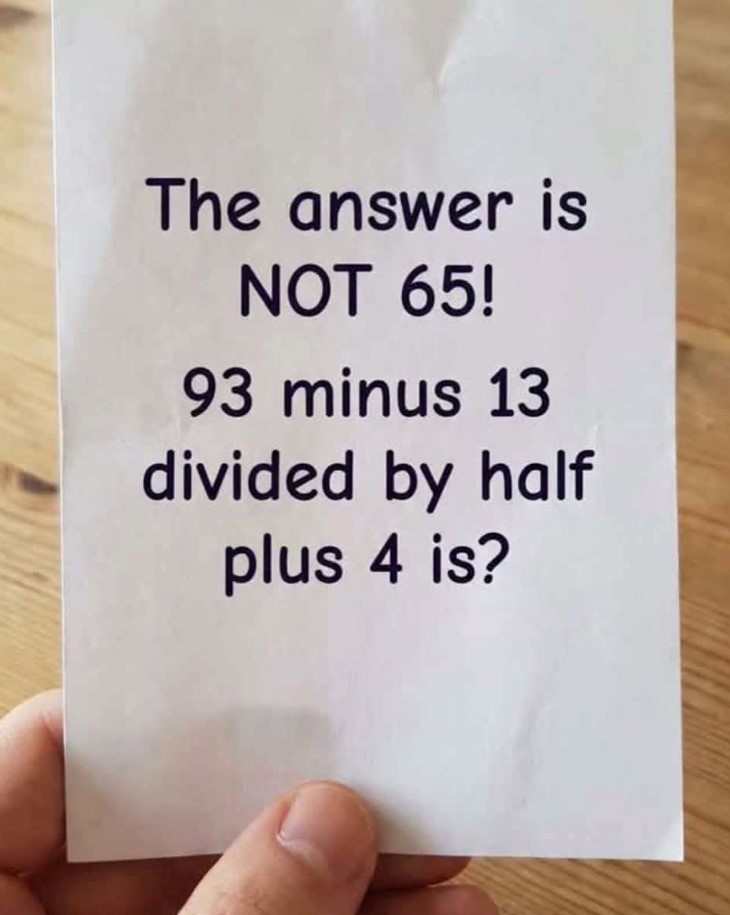
Today’s math challenge has a little warning written right at the top: “The answer is NOT 65!”
That warning might make you even more curious. After all, if the calculation seems straightforward, why would so many people arrive at the same incorrect result?
The trick is hidden in the wording of the problem, particularly in the expression “divided by half.” Understanding what those words actually mean is the key to solving the puzzle correctly.
Before looking at the explanation, take a moment to solve it yourself. Read the entire expression carefully, remember the basic rules of mathematics, and see whether you can beat the trick.
The Math Challenge
Here is the complete puzzle:
93 − 13 divided by half + 4 = ?
At first glance, you might be tempted to start with 93 minus 13 and continue working from left to right.
However, mathematics does not always work that way. When an expression contains several different operations, you must follow the correct order of operations.
There is also another important detail: dividing by half is not the same as dividing by two.
Take a few seconds to think about that difference before continuing.
Why Does This Math Puzzle Fool So Many People?
The main reason this puzzle causes confusion is that people often read the expression too quickly.
When someone sees “93 minus 13 divided by half plus 4,” they may immediately calculate 93 minus 13. That gives 80, but it means they have performed the subtraction before completing the division.
Another common misunderstanding comes from the phrase “divided by half.”
Some people interpret it as dividing by 2, when it actually means dividing by one-half.
These two operations produce completely different results.
To solve the puzzle correctly, we need to understand both the order of operations and the meaning of fractions.
Understanding the Order of Operations
In mathematics, the order of operations tells us which calculations should be completed first when an expression contains multiple operations.
One popular way to remember these rules is PEMDAS:
- P – Parentheses: Complete calculations inside parentheses first.
- E – Exponents: Calculate powers and roots.
- MD – Multiplication and Division: Perform these operations from left to right.
- AS – Addition and Subtraction: Perform these operations from left to right.
For our puzzle, there are no parentheses or exponents. We only have division, subtraction, and addition.
That means we must complete the division first.
We should not simply calculate everything from left to right without considering the mathematical rules.
The Important Trick: What Does Dividing by Half Mean?
This is the part of the puzzle that makes the biggest difference.
Dividing by half means dividing a number by 1/2, or 0.5.
It does not mean dividing that number by 2.
In fact, dividing by one-half is equivalent to multiplying by 2.
For example:
- 10 ÷ 2 = 5
- 10 ÷ 0.5 = 20
- 20 ÷ 0.5 = 40
As you can see, dividing by half makes the original number twice as large.
This is because dividing by a fraction is the same as multiplying by its reciprocal.
So, when we reach 13 divided by half in our puzzle, we must calculate:
13 ÷ 1/2 = 13 × 2 = 26
Now that we understand this important detail, we can solve the complete expression.
Step-by-Step Solution
Let’s work through the calculation carefully.
Step 1: Write down the original expression.
93 − 13 ÷ 1/2 + 4
Step 2: Complete the division first.
According to the order of operations, division must be performed before addition and subtraction.
13 ÷ 1/2 = 26
Our expression now becomes:
93 − 26 + 4
Step 3: Perform the subtraction.
Now we have only subtraction and addition remaining. These operations have equal priority, so we work from left to right.
93 − 26 = 67
Step 4: Complete the addition.
67 + 4 = 71
The correct answer is 71!
The warning at the beginning of the puzzle was right: the answer is not 65.
Why Are 44 and 65 Common Wrong Answers?
Different mistakes can lead people to incorrect results.
One possible mistake is to subtract 13 from 93 first, then divide the result by 2 and add 4:
93 − 13 = 80
80 ÷ 2 = 40
40 + 4 = 44
The problem is that this approach ignores the order of operations and misunderstands the phrase “divided by half.”
Another incorrect approach is to treat the division by half as though it were division by 2 while still following the order of operations:
13 ÷ 2 = 6.5
93 − 6.5 + 4 = 90.5
This also produces the wrong answer because dividing by half means dividing by 0.5, not by 2.
The correct interpretation gives us 26 for the division, which leads to the final answer of 71.
How to Avoid Similar Math Mistakes
If you enjoy solving mathematical brain teasers, a few simple habits can help you avoid common errors.
1. Read the Entire Problem First
Never rush into the first calculation you notice. Read the complete expression so you understand which operations are involved.
2. Pay Attention to Mathematical Language
Words such as “half,” “twice,” “divided by,” and “multiplied by” can change the meaning of a calculation. Make sure you understand exactly what each phrase means.
3. Remember PEMDAS
Always follow the correct order of operations. Multiplication and division come before addition and subtraction, with operations of equal priority completed from left to right.
4. Work Through Each Step
Breaking a complicated-looking expression into smaller calculations makes it easier to avoid mistakes.
5. Check Your Final Answer
Once you have finished, review your calculations. A quick check can help you identify whether you accidentally skipped an operation or misunderstood a fraction.
Conclusion :
This math puzzle is a great example of how a simple-looking calculation can become surprisingly confusing when the wording is designed to catch your attention. The expression contains familiar numbers and basic operations, but the phrase “divided by half” changes the entire calculation.
The most important lesson is that dividing by one-half is the same as multiplying by two. Once you understand that concept and remember to follow the correct order of operations, the puzzle becomes much easier to solve.
The correct answer is 71, not 65, 44, or 90.5. By completing the division first and then working through the remaining subtraction and addition from left to right, we arrive at the right result.
So, did you manage to solve the challenge before reading the explanation? Did the tricky wording catch you off guard, or did you immediately recognize that dividing by half means multiplying by two?
Share your answer and challenge your friends and family to try the same calculation. You might be surprised by how many different answers people come up with when they rush through it!
And remember, the secret to solving these brain teasers isn’t necessarily being faster at mathematics. It’s about slowing down, reading carefully, understanding the rules, and paying attention to the little details that make all the difference.