Sometimes, the simplest math problems can turn out to be surprisingly tricky. A question that looks easy enough for an elementary school student can quickly confuse people who rush through it without paying attention to the rules.
Today’s challenge is a perfect example. At first glance, the equation seems straightforward, and you might feel confident that you already know the answer. But before writing down your result, take a moment to think carefully about the order in which you perform the calculations.
This puzzle is designed to test your basic mathematical knowledge, concentration, and ability to avoid common calculation mistakes. It doesn’t require advanced mathematics or complicated formulas. All you need is a clear understanding of the order of operations.
So, are you ready to put your math skills to the test? Look at the equation, solve it carefully, and see whether you can get the correct answer without making a mistake!
The Math Challenge: Can You Solve It?
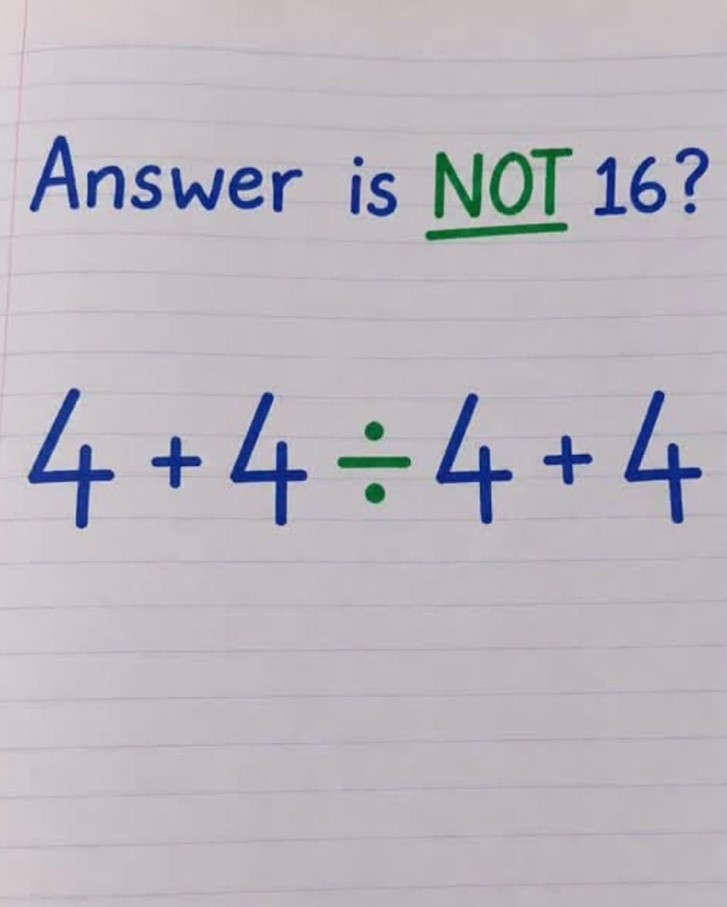
Take a close look at the equation shown in the puzzle:
4 + 4 ÷ 4 + 4 = ?
The instruction accompanying the question gives an interesting warning: the answer is NOT 16.
That small detail makes the challenge even more interesting. Many people instinctively try to calculate the expression without thinking about which operation should come first.
Before reading any further, try solving it yourself.
You can use a piece of paper if you prefer, but there is no need for a calculator. The entire challenge can be solved with a few simple calculations.
What answer did you get: 6, 9, 16, or something else?
Why Is This Simple Math Puzzle So Tricky?
The difficulty comes from the way our brains naturally approach simple calculations.
When we see an expression containing several numbers and mathematical symbols, we may be tempted to solve everything from left to right. While that approach works for some expressions, it isn’t always correct when different mathematical operations appear together.
In this particular puzzle, addition and division are mixed in the same equation.
The division symbol is easy to overlook, especially when the expression looks so familiar. Someone who doesn’t follow the correct mathematical rules may arrive at an incorrect result.
There are also several reasons why this challenge can catch people off guard:
The equation looks familiar: Because the numbers are small, many people assume the problem is easier than it really is.
The operations are mixed: Addition and division must be handled according to specific mathematical rules.
People rush to answer: When a problem looks simple, it’s tempting to calculate quickly instead of checking each step.
The warning creates doubt: Seeing the instruction that the answer is not 16 encourages you to reconsider your calculation.
Common Mistakes People Make
Before looking at the correct solution, let’s examine some of the mistakes that can happen when solving this equation.
One common mistake is treating every operation as if it has the same priority. Someone might add the numbers together without paying attention to the division symbol.
Another mistake is introducing parentheses that aren’t actually part of the original expression. For example, changing the equation into a different calculation can produce a completely different result.
Let’s look at the original equation again:
4 + 4 ÷ 4 + 4
Some people might incorrectly group the numbers as:
(4 + 4) ÷ (4 + 4)
That calculation gives 1, but it isn’t what the original equation asks you to solve.
Others might calculate:
(4 + 4) ÷ 4 + 4
This produces 6, but again, the parentheses have changed the original expression.
The important lesson is simple: never add brackets or change the structure of a mathematical expression unless they are actually included in the question.
Understanding the Order of Operations
To solve this puzzle correctly, you need to understand a basic mathematical principle called the order of operations.
Two common ways of remembering these rules are PEMDAS and BODMAS.
PEMDAS stands for:
- P – Parentheses
- E – Exponents
- M – Multiplication
- D – Division
- A – Addition
- S – Subtraction
BODMAS stands for:
- B – Brackets
- O – Orders (powers and roots)
- D – Division
- M – Multiplication
- A – Addition
- S – Subtraction
These acronyms remind us which mathematical operations need to be considered first.
One important detail is that multiplication and division have equal priority. The same is true for addition and subtraction. When operations have equal priority, they are generally performed from left to right.
For this puzzle, however, we only need to remember one essential rule:
Division must be completed before addition.
Once the division has been calculated, the remaining additions can be performed from left to right.
Step-by-Step Solution
Now let’s solve the original equation carefully.
The expression is:
4 + 4 ÷ 4 + 4
Step 1: Identify the Division
According to the order of operations, division must be completed before addition.
Look at the middle part of the equation:
4 ÷ 4
Four divided by four equals one.
So we can replace that part of the expression with 1.
The equation now becomes:
4 + 1 + 4
Step 2: Calculate the Addition From Left to Right
Now that the division is finished, only addition remains.
Start with the first two numbers:
4 + 1 = 5
The expression is now:
5 + 4
Step 3: Complete the Calculation
Add the remaining numbers:
5 + 4 = 9
And there we have it!
9
The correct answer is 9!
Why Isn’t the Answer 16?
You might be wondering why some people immediately think the answer is 16.
The reason is that they may treat the division as though it were another addition, calculating:
4 + 4 + 4 + 4 = 16
But this completely ignores the division symbol in the original equation.
Mathematics requires us to respect the order of operations. We cannot simply replace one operation with another or calculate everything in whichever order seems convenient.
The same principle applies to much more complicated expressions involving multiplication, division, subtraction, and parentheses.
Understanding these basic rules helps prevent mistakes and makes even challenging calculations easier to approach.
How to Improve Your Math and Concentration Skills
Puzzles like this are a fun way to revisit basic mathematical concepts and practice paying attention to details.
Here are a few simple habits that can help you become more confident when solving similar challenges:
1. Read the entire equation first: Don’t begin calculating as soon as you see the first numbers. Look at all the mathematical symbols before deciding what to do.
2. Remember PEMDAS or BODMAS: These familiar rules help you determine which operations should be completed first.
3. Write down each step: Even when an equation looks easy, writing the calculations separately can prevent careless mistakes.
4. Avoid rushing: Taking a few extra seconds to check your work is often enough to catch an error.
5. Practice different puzzles: Try solving expressions that combine addition, subtraction, multiplication, division, and parentheses.
6. Check your final answer: Once you’ve completed the calculation, go back to the original expression and make sure you followed the correct order.
Remember, the goal isn’t simply to get the answer quickly. It’s to understand why that answer is correct.
Conclusion
This simple math puzzle shows that even the most familiar numbers can create an interesting challenge when different mathematical operations appear together. At first, the expression 4 + 4 ÷ 4 + 4 may look like an easy calculation, but getting the correct answer requires more than simply adding the numbers from left to right.
The secret is understanding the order of operations. By completing the division first, we discover that 4 ÷ 4 equals 1. The remaining expression becomes 4 + 1 + 4, which gives us the correct answer of 9.
Although the calculation is simple, it reminds us how important it is to slow down, read carefully, and follow the basic rules of mathematics. Sometimes, the biggest mistakes happen not because a problem is difficult, but because we assume it is too easy to require our attention.
Whether you answered correctly on your first attempt or needed to review the explanation, this challenge is a fun reminder that a little concentration can make a big difference.
Now it’s time to challenge your friends and family! Share the equation with them, ask them to solve it without using a calculator, and see who remembers the order of operations.
Did you get 9 on your first try, or did you initially choose another answer? Share your result and see who in your family can solve this simple math puzzle correctly!