At first glance, this logic puzzle looks like a simple counting exercise. Someone tears several pages out of a book, and all you need to do is count how many pages are missing.
But don’t answer too quickly!
This challenge is more complicated than it appears because it tests whether you understand how pages are arranged inside a book. Many people immediately count the six page numbers mentioned in the question and assume that six pages have been removed.
However, there is an important detail that changes the answer.
A book is not made up of individual numbered pages placed separately. Each physical sheet of paper has two sides, and each side carries a different page number. Once you understand this, the puzzle becomes much easier to solve.
So, can you figure out how many sheets of paper the boy actually tore out?
Take a moment to read the question carefully before looking at the explanation.
The Logic Challenge: How Many Pages Were Torn Out?
Here is the riddle:
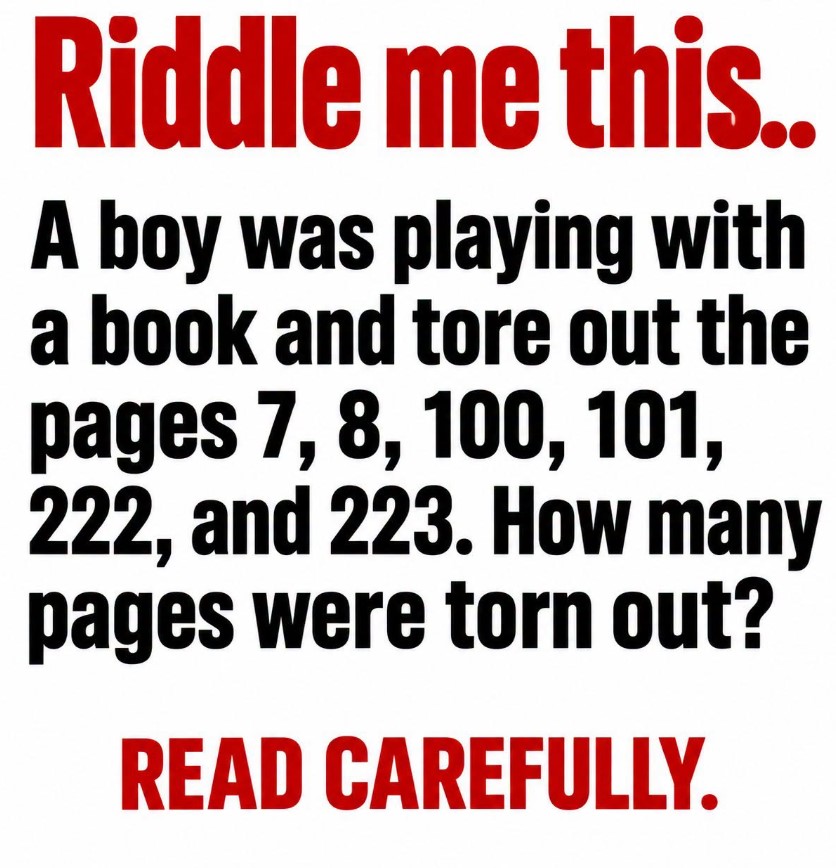
A boy was playing with a book and tore out the pages numbered 7, 8, 100, 101, 222, and 223.
How many pages were actually torn out?
Think carefully before answering.
At first, the solution seems obvious. The question mentions six different page numbers:
- Page 7
- Page 8
- Page 100
- Page 101
- Page 222
- Page 223
If you simply count the numbers, you get six.
But is that the correct answer?
Remember that a physical sheet of paper has two sides. One side has a page number, while the opposite side has another number.
This means that two consecutive page numbers can belong to the same physical sheet.
That small detail is the key to solving the entire challenge.
Why Is This Puzzle So Tricky?
The difficulty comes from the difference between a numbered page and a physical sheet of paper.
In everyday conversation, people often use the words “page” and “sheet” as though they mean exactly the same thing. However, they are not identical.
A page refers to one numbered side of a sheet of paper. A sheet is the actual piece of paper, which normally contains two numbered pages.
For example, imagine opening a regular book.
You might see page 7 on one side of a sheet and page 8 on the opposite side. If someone removes that entire sheet, both page numbers disappear together.
This is why counting the numbers in the riddle does not give you the number of physical sheets removed.
The puzzle is designed to make you focus on the six numbers instead of thinking about how those pages are arranged inside a book.
The Common Mistake Most People Make
The most common mistake is answering six immediately.
After reading the list, people often count each number as a separate piece of paper. They don’t stop to consider that some of the numbered pages are printed on opposite sides of the same sheet.
This is understandable because we normally think of pages as separate units when reading.
However, when a sheet is physically torn from a book, both sides are removed at the same time.
Another mistake is assuming that every pair of consecutive page numbers must automatically belong to the same sheet without checking the actual page arrangement.
To solve the puzzle correctly, you need to identify which numbers are printed on opposite sides of each physical sheet.
Let’s examine the numbers one by one.
The Answer: How Many Sheets Were Torn Out?
The correct answer according to the original puzzle is:
5 sheets of paper.
The boy removed five physical sheets, even though six page numbers are mentioned.
Here is how the calculation works.
Step-by-Step Explanation
In a standard book, the numbered pages are arranged so that odd-numbered pages are generally on the right-hand side and even-numbered pages are on the left-hand side.
Each physical sheet contains two consecutive page numbers.
Let’s look at the six numbers from the riddle.
Step 1: Pages 7 and 8
Pages 7 and 8 are printed on opposite sides of the same physical sheet.
Therefore, removing both pages means removing just one sheet of paper.
Step 2: Pages 100 and 101
These two numbers do not belong to the same sheet.
Page 99 is on the opposite side of page 100, while page 101 shares its sheet with page 102.
So the boy removes two separate sheets:
- One sheet containing pages 99 and 100.
- Another sheet containing pages 101 and 102.
Step 3: Pages 222 and 223
These two numbers also belong to different physical sheets.
Page 222 shares its sheet with page 221, while page 223 shares its sheet with page 224.
Therefore, these two page numbers represent two additional sheets.
Step 4: Count the Physical Sheets
Now put everything together:
- Pages 7 and 8 = 1 sheet.
- Pages 100 and 101 = 2 sheets.
- Pages 222 and 223 = 2 sheets.
The total is:
1 + 2 + 2 = 5 sheets.
The final answer is 5.
Understanding the Difference Between Pages and Sheets
To make this puzzle even easier to understand, imagine holding a notebook with several sheets of paper.
Each sheet has a front side and a back side. If the front side is numbered 1, the reverse side is numbered 2.
The next sheet contains pages 3 and 4, followed by another sheet containing pages 5 and 6.
The arrangement continues in the same way throughout the book.
Here is a simple example:
| Physical sheet | Numbered pages |
|---|---|
| Sheet 1 | Pages 1 and 2 |
| Sheet 2 | Pages 3 and 4 |
| Sheet 3 | Pages 5 and 6 |
| Sheet 4 | Pages 7 and 8 |
| Sheet 5 | Pages 9 and 10 |
Notice that removing one physical sheet means removing two numbered pages.
This is exactly the principle needed to solve the riddle.
The important thing is not simply how many page numbers appear in the question. You need to determine how many different physical sheets those numbers represent.
Why Do Logic Puzzles Like This Fool So Many People?
Logic puzzles are interesting because they often challenge the way we interpret familiar information.
When we see a list of numbers, we naturally want to count them. When someone asks how many pages were removed, we may assume that every number represents a separate page of paper.
But a closer examination reveals that the question requires a different approach.
This type of challenge encourages us to slow down and consider the details before reaching a conclusion.
It also shows why understanding the wording of a question is just as important as performing the calculation.
You might know how books are organized, but if you rush through the problem, you could still overlook the difference between a page and a sheet.
Simple Tips to Improve Your Logical Thinking
If you enjoy brain teasers and logic challenges, a few simple habits can help you become better at solving them.
1. Read the Question Carefully
Never assume that a question is asking exactly what it appears to ask at first glance. Pay attention to the words used and consider whether they have different meanings.
2. Avoid Rushing to Count
When a puzzle contains several numbers, don’t immediately add them together. First, determine what each number represents.
3. Think About Real-Life Situations
Sometimes, imagining the situation in your head makes the answer easier to understand. In this case, picturing an actual book and its physical sheets helps reveal the solution.
4. Look for Hidden Assumptions
Many logic puzzles become difficult because we automatically make assumptions without checking whether they are correct.
Ask yourself whether every number represents a separate object or whether some of them belong together.
5. Explain Your Reasoning
After finding an answer, try explaining how you reached it. If you can describe every step clearly, you are more likely to understand why your solution is correct.
Final Thoughts
This book-page puzzle is a great reminder that simple questions can sometimes require more careful thinking than we expect.
At first, the answer seems to be six because the riddle mentions six different page numbers. But once you understand that a physical sheet contains two numbered sides, the problem becomes much clearer.
The key is recognizing that pages 7 and 8 belong to the same sheet, while pages 100 and 101 belong to two different sheets. The same applies to pages 222 and 223.
When everything is counted correctly, the boy has removed five physical sheets of paper.
If you answered five, congratulations! You understood the difference between numbered pages and actual sheets.
If you answered six, don’t worry. The puzzle is designed to encourage exactly that first reaction before revealing the important detail.
The next time you encounter a logic question, remember not to rush. Sometimes, the smallest detail in the wording can completely change the answer.
Now share this challenge with your friends and family. Ask them how many sheets were torn out and see whether they can solve it without help.
Will they count six pages, or will they discover why the correct answer is five sheets?