Some riddles seem to require complicated calculations or advanced logical thinking, but the truth is that the simplest questions can sometimes be the most confusing. A clever change in wording can completely alter the way we understand a question, making an obvious answer surprisingly difficult to recognize.
Today’s brain teaser is a perfect example.
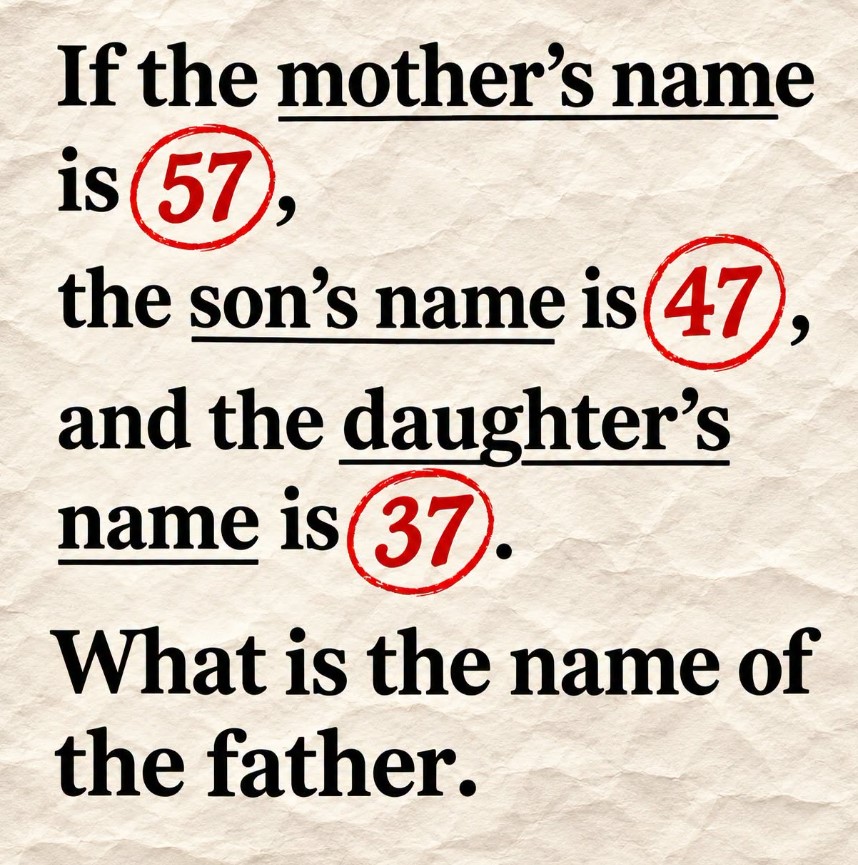
You are given the names of three family members, along with a series of numbers. Everything appears to follow a particular pattern, and your task is to figure out the name of the father.
At first, you might start looking for a mathematical connection between the numbers. You may try to discover a hidden sequence or calculate what number should come next.
But before you spend too much time searching for a complicated solution, take a closer look at how the final question is written.
The answer may be much simpler than you expect.
Are you ready to test your observation skills and see whether you can solve this tricky family riddle?
The Challenge: Can You Figure Out the Father’s Name?
Here is the puzzle:
A family has a mother, a son, a daughter, and a father.
The clues tell you:
- The mother’s name is 57.
- The son’s name is 47.
- The daughter’s name is 37.
Now comes the important question:
What is the name of the father?
Take a moment to think about your answer before continuing.
You might immediately notice that the numbers follow a descending pattern. The mother’s name is 57, the son’s name is 47, and the daughter’s name is 37.
Each number decreases by 10.
Naturally, this may encourage you to continue the sequence and assume that the father’s name must be represented by another number.
But is that really what the riddle is asking?
Look carefully at the final sentence. Sometimes, the most important clue isn’t hidden in the numbers but in the actual wording of the question.
Why Is This Riddle So Tricky?
The main reason people struggle with this puzzle is that the numbers attract their attention.
When we see 57, 47, and 37 arranged together, our brains immediately begin searching for a mathematical pattern. We expect another number to complete the sequence.
This is a natural reaction because recognizing patterns is an important part of solving puzzles.
However, this riddle uses that instinct as a distraction.
Instead of concentrating entirely on the numbers, you need to understand the question itself. The wording contains a small detail that changes the entire meaning of the challenge.
Many people read the final sentence quickly and assume they need to calculate another number. They overlook the possibility that the answer is already included in the question.
This is what makes the puzzle interesting. It tests your ability to read carefully rather than your ability to perform difficult calculations.
The Common Mistake Most People Make
One of the most common mistakes is assuming that the father’s name must follow the numerical pattern.
Since the three numbers decrease by 10, people may immediately think about the next number in the sequence.
Some might suggest 27, while others may try to find another mathematical explanation.
But this approach misses the real trick.
The puzzle is not asking you to continue the numerical sequence. It asks you to identify the father’s name.
There is a difference between solving a number pattern and understanding a question that uses numbers as distractions.
Before attempting complicated calculations, always examine the exact wording. A small word can sometimes reveal more than an entire list of numbers.
The Answer: What Is the Father’s Name?
Have you figured it out?
The correct answer according to the original riddle is:
WHAT.
Yes, the father’s name is “What.”
It may sound unusual, but the answer comes directly from the wording of the final question:
“What is the name of the father?”
The trick is to interpret the word “What” as the father’s name rather than simply as the opening word of a question.
The numbers are there to distract you from this simple detail.
Step-by-Step Explanation
Let’s break down the logic behind the answer.
Step 1: Look at the three names.
The riddle gives you the following information:
- Mother: 57
- Son: 47
- Daughter: 37
These numbers create an obvious descending pattern. Each one is 10 less than the previous number.
Step 2: Avoid getting distracted by the numbers.
Although the numerical pattern is noticeable, it does not provide the answer to the father’s name.
The puzzle is testing your interpretation of the question, not your ability to calculate the next number.
Step 3: Read the final sentence carefully.
The question asks:
“What is the name of the father?”
The trick is that the word “What” is presented as the answer.
Step 4: Give your answer.
The father’s name is What.
Once you notice this interpretation, the puzzle becomes much easier to understand.
What Makes Wordplay Riddles Different From Regular Math Puzzles?
Not every brain teaser is designed to test mathematical ability. Some are built around language, sentence structure, and the different ways a question can be interpreted.
Wordplay riddles are especially interesting because they encourage people to think beyond the obvious meaning of a sentence.
A regular math problem usually gives you numbers and operations that need to be evaluated according to mathematical rules. A wordplay riddle, on the other hand, may use familiar words in an unexpected way.
This is why reading carefully is so important.
You might know how to solve complicated equations, but that does not automatically mean you will recognize every trick hidden in a simple sentence.
The best approach is to remain flexible. Instead of assuming that every puzzle requires calculations, consider whether the wording itself contains the solution.
Simple Tips to Improve Your Riddle-Solving Skills
If you enjoy solving tricky IQ questions, a few simple habits can help you become more confident.
1. Read Every Word Carefully
Don’t rush through the question. Sometimes, a single word contains the most important clue. Read the entire sentence and pay attention to how it is structured.
2. Don’t Always Look for Mathematical Patterns
Numbers can be useful clues, but they can also serve as distractions. Before calculating anything, make sure the puzzle actually requires a mathematical solution.
3. Consider Different Interpretations
Some riddles are designed to have more than one possible interpretation. Try reading the question from another perspective instead of immediately accepting your first understanding.
4. Avoid Overthinking
A complicated-looking question does not always require a complicated answer. Sometimes, the simplest interpretation is the one the puzzle creator wants you to discover.
5. Practice Different Types of Brain Teasers
Try word riddles, number puzzles, visual challenges, and logical questions. Each type encourages you to approach problems differently and pay attention to details.
Final Thoughts
This clever family riddle is a reminder that solving a puzzle is not always about finding the right number or following a mathematical sequence. Sometimes, the real challenge is understanding the question itself.
The three numbers, 57, 47, and 37, make the puzzle look like a numerical challenge. They naturally encourage you to search for a pattern and predict what comes next.
However, the actual trick is hidden in the final sentence. According to the intended wordplay, the father’s name is “What,” a word that appears right at the beginning of the question.
If you recognized the trick immediately, congratulations! You managed to look beyond the numbers and focus on the wording.
If you guessed another number, don’t feel bad. That is exactly the kind of reaction this riddle is designed to encourage. It is easy to become distracted by an obvious pattern and overlook a much simpler clue.
The next time someone gives you a tricky brain teaser, remember to read the question carefully before searching for complicated answers.
Now share this riddle with your friends and family without revealing the solution. Ask them to figure out the father’s name and see whether they notice the wordplay or get distracted by the numbers.
You may be surprised by how many people confidently give the wrong answer before discovering the trick!