Some brain teasers look incredibly simple, yet they can make people stop and think much longer than expected. They don’t require advanced mathematics, complicated formulas, or special knowledge. Instead, they test how carefully you read a question and whether you can avoid making unnecessary assumptions.
Today’s challenge is a perfect example.
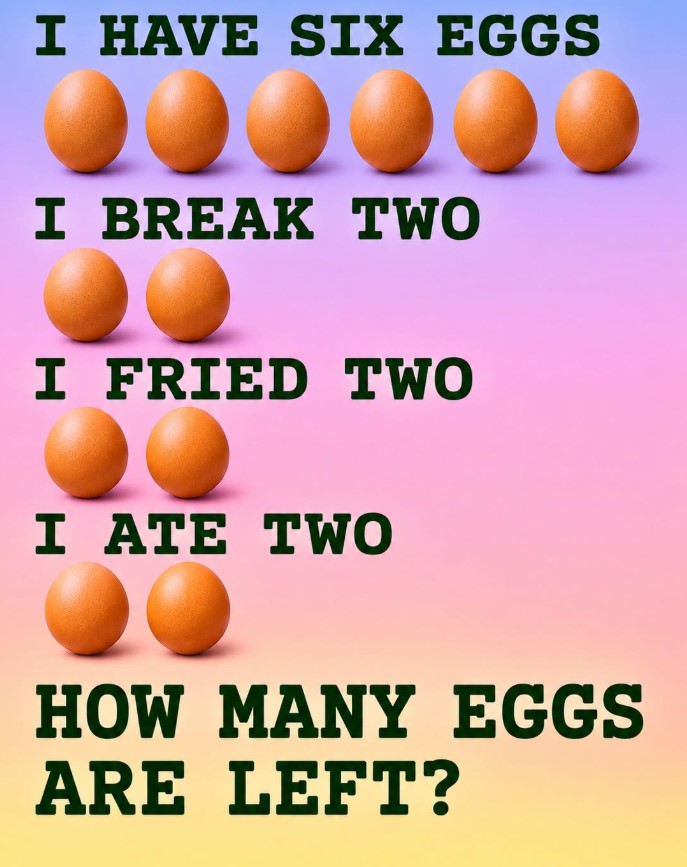
Imagine you have six eggs. You break two of them, cook two, and then eat two. How many eggs are left?
At first, you might think the answer is two because six minus two minus two minus two equals zero, or perhaps you may try another calculation depending on how you interpret the actions.
But there is an important detail hidden in the wording.
The question never says that you broke one pair of eggs, cooked another pair, and ate a completely different pair. The same two eggs could have been used for all three actions.
That small detail makes all the difference.
Before looking at the solution, take a moment to solve the riddle yourself. Can you find the correct answer without falling into the common trap?
The Challenge: How Many Eggs Are Left?
Here is the complete riddle:
I have six eggs.
I broke two.
I cooked two.
I ate two.
How many eggs do I have left?
Think carefully before answering.
The challenge seems straightforward because it gives you a starting number and three actions. Naturally, your brain may begin treating each action as something that removes two eggs from the original six.
However, that interpretation might not be correct.
Read the statements again.
The riddle says that two eggs were broken, two were cooked, and two were eaten. But it does not say that these were three separate pairs of eggs.
Could the same two eggs have gone through all three stages?
That’s the question you need to consider before deciding on your answer.
Why Is This Egg Riddle So Tricky?
The difficulty comes from the way the information is presented.
When people hear that six eggs are available and that three different actions involve two eggs each, they often assume that six separate eggs were used.
This is a natural reaction because we tend to interpret each sentence as describing a new action involving different objects.
But the wording does not actually require that interpretation.
Think about preparing breakfast. You take two eggs from a carton, crack their shells, cook their contents, and eat the finished meal.
Those are three different actions, but they all involve the same two eggs.
The puzzle uses this everyday situation to create confusion. By separating the actions into short sentences, it encourages you to count them independently.
Once you understand that the actions can involve the same eggs, the answer becomes much easier to find.
The Common Mistake Most People Make
The most common mistake is subtracting two eggs three separate times.
A person might calculate:
- Start with 6 eggs.
- Break 2, leaving 4.
- Cook 2, leaving 2.
- Eat 2, leaving 0.
This calculation assumes that every action involves a different pair of eggs.
However, breaking an egg does not mean that the egg disappears. It simply means that its shell has been cracked.
Likewise, cooking an egg does not remove it from the total. It changes its condition and prepares it for eating.
The same two eggs can therefore be broken, cooked, and eaten without using any additional eggs.
The important lesson is to understand what each action actually means rather than automatically subtracting the same quantity every time.
The Answer: How Many Eggs Do You Have Left?
Have you figured it out?
The correct answer is:
4 EGGS.
Yes, you still have four eggs left!
The explanation is simple: you started with six eggs and used only two of them.
Those same two eggs were broken, cooked, and eaten. Since the other four eggs were never touched, they remain available.
Step-by-Step Explanation
Let’s break down the solution so there is no confusion.
Step 1: Start With Six Eggs.
You begin with a total of six whole eggs.
At this point, none of them has been used.
Step 2: Break Two Eggs.
You take two eggs and crack their shells.
You now have two broken eggs and four untouched eggs.
Breaking the eggs does not mean they have disappeared. Their contents are still available for cooking.
Step 3: Cook the Same Two Eggs.
Next, you cook the two eggs you already broke.
You do not need to take another pair from the original six. The same two eggs are simply being prepared.
You still have four untouched eggs.
Step 4: Eat the Same Two Eggs.
Finally, you eat the two eggs you cooked.
Those two eggs are now consumed, but the other four have not been used.
Step 5: Count What Remains.
You started with six eggs and used two.
The calculation is:
6 − 2 = 4
The final answer is 4 eggs.
Why Reading Carefully Matters in Brain Teasers
This riddle demonstrates an important principle: understanding a question is sometimes more important than performing calculations.
When we encounter a problem involving numbers, we often assume that the solution must involve arithmetic. We immediately begin adding or subtracting quantities without first checking whether the information supports that calculation.
But not every math-style puzzle is really about mathematics.
Some challenges are designed around language, interpretation, and logical reasoning. They encourage you to question your first reaction and examine the information more carefully.
In this particular riddle, the difference between using two eggs and using six eggs completely changes the answer.
The wording does not introduce three separate pairs. It simply describes three actions performed on two eggs.
This is why taking a few seconds to understand the situation can prevent an unnecessary mistake.
Simple Tips to Improve Your Logical Thinking
If you enjoy solving riddles like this one, a few simple habits can help you approach similar challenges more effectively.
1. Read the Entire Question Before Calculating
Don’t start subtracting numbers as soon as you see them. Read every sentence first and make sure you understand exactly what is happening.
2. Don’t Assume Every Action Involves New Objects
When a puzzle mentions the same number several times, consider whether those actions could involve the same objects rather than separate groups.
3. Think About Everyday Situations
Sometimes, imagining the situation in real life makes the answer much clearer. In this case, thinking about how eggs are prepared for breakfast helps you understand why the same two eggs can be broken, cooked, and eaten.
4. Question Your First Answer
Your first reaction might be correct, but don’t accept it automatically. Take another look at the wording and see whether there is a simpler explanation.
5. Keep the Solution Simple
Not every brain teaser requires complicated calculations. Sometimes, the correct answer comes from understanding one small detail that everyone else overlooks.
Final Thoughts
This tricky egg riddle is a great example of how a simple question can challenge the way we think. At first, it seems like a basic subtraction problem involving six eggs and three separate actions.
But the real challenge is understanding that the same two eggs can be broken, cooked, and eaten.
Once you recognize that detail, there is no reason to subtract two eggs three different times. You only used two eggs in total, which means four remain untouched.
If you answered four, congratulations! You paid attention to the wording and avoided the most common mistake.
If you answered zero or another number, don’t worry. That’s exactly why puzzles like this are entertaining. They encourage us to slow down, reconsider our assumptions, and look at familiar situations from a different perspective.
The next time you encounter a tricky question, remember that the answer may depend less on complicated calculations and more on understanding what the question actually says.
Now share this egg riddle with your friends and family. Ask them how many eggs are left, but don’t give them any hints.
Will they find the answer immediately, or will they fall into the same counting trap?
Sometimes, the simplest questions are the ones that reveal how carefully we really think.