
Brain teasers are a fun way to test your reasoning, challenge your attention, and see how carefully you interpret a question. Some riddles look so easy that people answer immediately, only to realize they have overlooked an important detail.
This age puzzle is a perfect example. It uses just a few numbers, but the wording can make you rush into the wrong answer if you do not follow the timeline carefully.
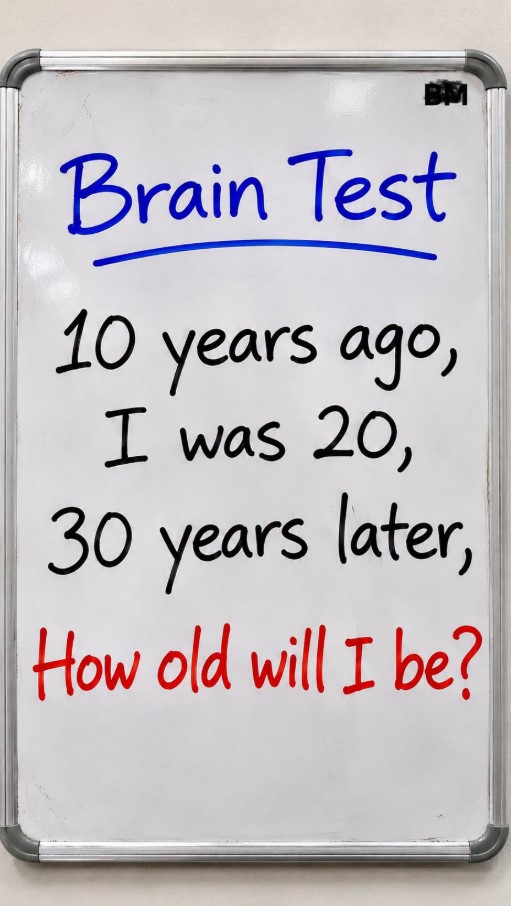
Here is the riddle:
“10 years ago, I was 20.
30 years later, how old will I be?”
Take a moment to think before reading the solution. The trick is to work out the person’s age today before calculating their age in the future.
Breaking Down the Puzzle Step by Step
The easiest way to solve this riddle is to divide it into two simple steps.
Step 1: Find the person’s current age.
The person says they were 20 years old 10 years ago.
That means we need to add those 10 years to their previous age:
20 + 10 = 30
So, the person is currently 30 years old.
Step 2: Calculate their age 30 years from now.
Now that we know their present age, the second part becomes much easier.
The question asks how old they will be 30 years later. We simply add 30 to their current age:
30 + 30 = 60
The correct answer is 60 years old!
Why Do People Get This Riddle Wrong?
The main reason people struggle with this question is that they sometimes combine the numbers too quickly without paying attention to the timeline.
For example, someone might see 20 and 30 and immediately add them together, arriving at 50. However, that calculation skips an important detail: the person was 20 years old 10 years ago, not today.
Others may become confused by the phrase “30 years later” and forget that the first step is to establish the person’s current age.
The best way to avoid this mistake is to read the question slowly and identify when each event takes place.
A Simple Timeline Makes Everything Clear
Think about the person’s age in three different moments:
- 10 years ago: The person was 20 years old.
- Today: The person is 30 years old.
- 30 years from today: The person will be 60 years old.
Once you organize the information this way, there is no need for complicated calculations. The answer becomes clear.
Why Brain Teasers Are Good for Your Mind
Simple riddles like this one can be entertaining while encouraging you to think more carefully. They remind us that solving a problem is not always about doing difficult calculations. Sometimes, the most important skill is understanding exactly what a question is asking.
Regularly trying brain teasers can help you practice several useful skills:
- Logical thinking: Following information in the correct order.
- Attention to detail: Noticing small but important words.
- Problem-solving: Breaking a question into manageable steps.
- Mental focus: Taking time to understand a problem before answering.
- Careful reasoning: Avoiding quick assumptions that lead to mistakes.
These puzzles are also enjoyable to share with friends and family because everyone can try to solve them before the answer is revealed.
Challenge Your Friends With This Age Riddle
Now that you know the solution, why not test someone else?
Share the question without giving away the answer. Ask your friends or family members to solve it mentally and see whether they arrive at the correct age.
You may be surprised by how many people confidently answer 50 without noticing that the person is already 30 today.
Conclusion
This simple age riddle proves that even an easy-looking question can catch people off guard when they do not pay close attention to the wording. The secret is not to rush or combine numbers without thinking. Instead, follow the timeline one step at a time.
The person was 20 years old 10 years ago, which means they are 30 today. After another 30 years, they will be 60 years old.
So, the correct answer is 60, not 50.
Did you solve the riddle correctly on your first attempt, or did the wording trick you? Share this brain teaser with someone and see if they can find the answer without help!