
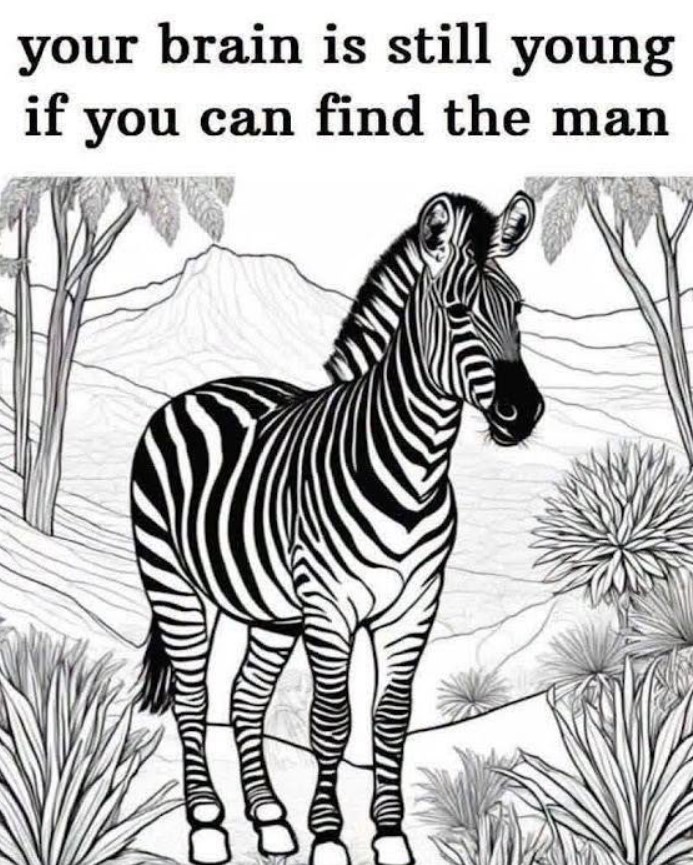
At first glance, this vintage zebra illustration looks like an ordinary black-and-white drawing of an animal. Its familiar stripes twist and overlap, creating the kind of pattern you would expect to see in a traditional zebra picture. But if you look a little more carefully, you may discover that there is something else hiding within the illustration.
A man is cleverly concealed somewhere in the image, and finding him is not as easy as it sounds. The zebra’s distinctive appearance naturally attracts your attention, making it easy to overlook the second figure hiding in plain sight.
This is the kind of visual puzzle that can leave you staring at the same picture for several minutes, wondering how you could possibly have missed something so obvious. The challenge is to stop seeing only a zebra and start noticing the shapes, lines, and spaces that create another image.
Before you look for hints, take a moment to examine the illustration carefully. Can you find the hidden man without anyone telling you where to look?
Can You Spot Him?
Take another look at the vintage zebra illustration and give yourself a few moments to search for the hidden figure.
At first, your eyes will probably go straight to the zebra. Its black-and-white stripes are the most noticeable feature, and the brain quickly recognizes the animal without needing to examine every detail.
However, the hidden man is not meant to be noticed immediately. His outline is cleverly incorporated into the surrounding visual pattern, which makes it difficult to distinguish him from the rest of the illustration.
Instead of concentrating only on individual zebra stripes, try looking at the picture as a whole. Pay attention to the spaces between the lines, unusual shapes, and areas where the pattern seems to create something different.
Sometimes, the hidden figure becomes easier to recognize when you stop searching for a complete person and begin looking for smaller clues that could form a human silhouette.
Why Is the Hidden Man So Difficult to See?
The difficulty of this puzzle comes from the way our brains naturally recognize familiar images.
When we look at a zebra, we immediately identify its body, stripes, and overall shape. Our brain organizes the information quickly, allowing us to understand what we are seeing without consciously studying every line.
That automatic recognition can make hidden images surprisingly difficult to find.
The man in this illustration is not drawn as a separate figure placed on top of the zebra. Instead, his shape is incorporated into the same visual information that makes up the animal and its pattern.
Your brain initially interprets the image as a zebra, so it may ignore shapes that do not fit that first impression. Finding the hidden man requires you to change your perspective and consider that the same lines could represent something entirely different.
Once you begin looking for a human outline instead of an animal, the puzzle becomes a different experience.
Look Beyond the Stripes
One of the biggest mistakes people make with hidden-picture puzzles is focusing too closely on the most obvious object.
In this case, the zebra’s stripes can easily keep your attention occupied. You may follow individual lines, examine the animal’s body, or repeatedly scan the same area without noticing the concealed figure.
Try shifting your attention away from the stripes themselves.
Look at the spaces between them. Sometimes the empty areas of an illustration can be just as important as the dark lines. A shape that appears meaningless when viewed as part of the zebra may look different when you examine the surrounding space.
Pay attention to:
- The spaces between the zebra’s stripes.
- Unusual breaks or changes in the pattern.
- Shapes that may resemble a head or shoulders.
- Lines that appear to form part of a human outline.
- Areas where several different shapes seem to connect.
Don’t rush through the image. Slowly moving your eyes across the illustration may help you notice details that you missed during your first few attempts.
A Classic Example of Figure-Ground Illusion
This illustration is a good example of a visual effect known as figure-ground perception.
When we look at an image, our brains naturally separate what appears to be the main object from the surrounding background. We decide which shapes are important and which ones are simply supporting details.
In this puzzle, the zebra immediately becomes the main figure. Its recognizable body and distinctive pattern make it easy to identify, while the hidden man becomes much harder to notice because his shape blends into the same visual arrangement.
The interesting part is that the image can be interpreted in more than one way.
At first, you see a zebra. After discovering the hidden figure, you may begin to notice shapes that previously seemed like nothing more than ordinary parts of the illustration.
That sudden change in perception is one of the most enjoyable features of optical illusions. The image itself hasn’t changed, but your understanding of it has.
Don’t Feel Bad If You Can’t Find Him Immediately
These puzzles are designed to make the hidden image difficult to notice. If you have looked at the illustration several times without finding the man, that doesn’t mean you are missing something obvious or that your observation skills are poor.
Sometimes, all it takes is a small change in the way you view the picture.
Step Away From the Image
Move a little farther away from your screen or hold your phone at a comfortable distance.
When you are too close, your eyes may become focused on individual lines and tiny details. Stepping back can help you see the larger shapes and overall arrangement more clearly.
Squint Slightly
Try softening your focus by squinting a little.
This can reduce the visual importance of smaller details and make larger silhouettes easier to recognize. You don’t need to strain your eyes; just look at the image with a slightly softer focus.
Turn the Image Into a Smaller View
If the illustration appears large on your screen, try reducing its size.
Sometimes, a hidden silhouette becomes easier to recognize when individual stripes blend together. The smaller image may allow you to notice the overall shape rather than becoming distracted by every separate line.
Look at the Negative Space
Instead of following the black stripes, concentrate on the white areas around them.
The spaces between different parts of the illustration may create shapes that are easier to recognize when viewed as a whole. This is often a useful technique for solving visual puzzles because the brain tends to focus on objects rather than the empty spaces surrounding them.
The Answer
If you’ve given the puzzle a good try and still haven’t found the hidden man, don’t worry. The figure is cleverly incorporated into the arrangement of the zebra’s stripes and surrounding shapes.
Rather than appearing as a clearly outlined person with a separate drawing, his shape is camouflaged within the illustration. The trick is to stop interpreting every line as part of the zebra and begin looking for a pattern that resembles a human figure.
Once your eyes recognize the general shape of a person’s head and body, the illusion becomes much easier to understand.
That is what makes this illustration clever: the man isn’t simply hidden behind the zebra. He is hidden within the way the zebra has been drawn.
Why Vintage Optical Illusions Remain So Popular
Old visual puzzles continue to attract attention because they offer a simple challenge that anyone can enjoy. You don’t need special equipment, complicated instructions, or a long explanation. All you need is an image and a little patience.
They also make people curious because the experience is different for everyone. Some viewers spot the hidden object almost immediately, while others spend several minutes looking at the same picture without noticing it.
The moment someone finally discovers the hidden figure can be surprisingly satisfying. Suddenly, the picture seems completely different, and it becomes difficult to understand how the shape went unnoticed in the first place.
Vintage illustrations are particularly interesting because they often contain intricate lines, patterns, and shapes that can be interpreted in different ways. Their traditional drawing styles can make it easier for artists to disguise objects within the overall composition.
These puzzles are also fun to share. Showing the same illustration to friends or family members can lead to completely different reactions, especially when one person finds the hidden figure while everyone else is still searching.
The Fun Is in Finding It Yourself
The next time you come across an old illustration that looks strangely ordinary, take a second look. There may be more going on than you realize.
This vintage zebra image is a reminder that seeing isn’t always the same as noticing. Our brains can recognize an obvious subject so quickly that they completely overlook another shape sitting right in front of us.
So before scrolling away, give the zebra one more careful look. Ignore the familiar stripes for a moment, examine the spaces between them, and see whether you can discover the hidden figure on your own.
Have you found the man yet, or is he still hiding in plain sight? Take your time, trust your eyes, and enjoy the challenge. Sometimes the most interesting part of a picture is the detail you never noticed until someone challenged you to look again.