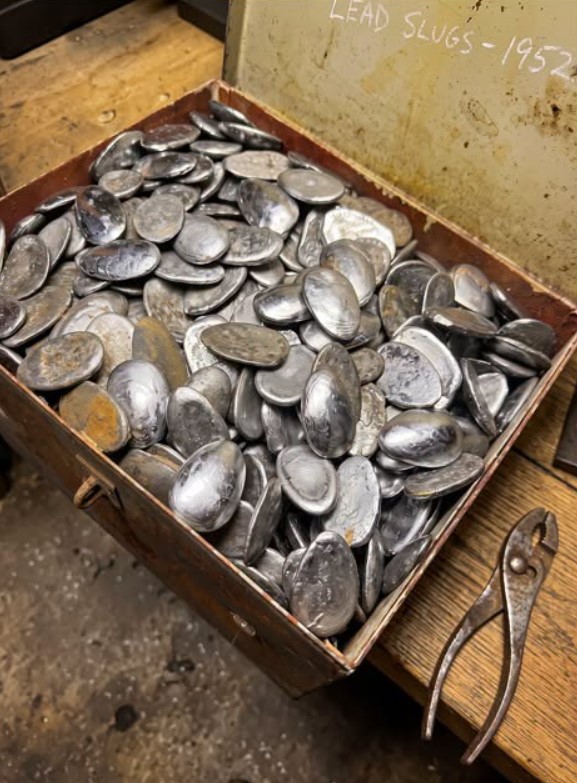
Have you ever come across an old, heavy metal tool and had absolutely no idea what it was designed to do?
Some antique objects look surprisingly familiar. They may resemble kitchen utensils, gardening tools, or ordinary workshop equipment. But appearances can be misleading. A tool that seems simple to modern eyes may have once played an important role in everyday life.
One particularly interesting example is an old cast-iron spoon or ladle. At first glance, it can look like an oversized cooking utensil. Its thick construction and long handle might make you think it was designed for stirring something over a fireplace.
Its real purpose, however, was much more unusual.
This type of cast-iron spoon was used for melting metal, particularly lead, before pouring it into molds. In some historical settings, the tool was used to help make bullets, fishing sinkers, and other small metal objects at home.
The object is a fascinating reminder of how differently people once approached everyday problems. Before modern stores made manufactured goods easily available, families often depended on practical skills, creativity, and whatever materials they had nearby.
It Looks Like a Giant Kitchen Spoon
The first thing that makes this old tool so interesting is its appearance.
A cast-iron melting spoon can look surprisingly similar to a traditional kitchen utensil. It has a rounded bowl and, depending on the design, a relatively long handle. The difference is in the construction.
Unlike an ordinary kitchen spoon, these tools were made from heavy metal and were designed to tolerate intense heat. Some examples also have a small pouring lip or notch along the edge of the bowl, making it easier to direct liquid metal into a mold.
That distinctive construction is an important clue to its original purpose.
A normal kitchen spoon would never be intended for this kind of work. The heavy cast-iron body of the old tool was designed for a completely different environment: the workshop, fireplace, or outdoor work area.
For someone unfamiliar with historical tools, though, it is easy to understand why the object might initially be mistaken for something used to prepare food.
So What Was It Actually Used For?
The answer is metal casting.
Historically, tools of this general type were used to heat metal until it became molten. The liquid metal could then be poured into a prepared mold and allowed to cool and harden into a specific shape.
One important use was producing lead projectiles for firearms. Another was making fishing sinkers. Small metal pieces and other useful objects could also be produced depending on the available molds and the needs of the household.
This meant that the tool was not simply a spoon at all.
It was essentially a small, simple piece of metalworking equipment.
The idea may seem unusual today because most people obtain finished products from stores. But for families living in rural areas many generations ago, making or repairing things at home could be an important part of daily life.
Life Before Everything Was Available at the Store
To understand why someone would own such a tool, it helps to think about everyday life during earlier periods.
Today, if someone needs a particular tool, replacement part, fishing accessory, or other manufactured item, they can often purchase it within minutes.
That convenience did not exist for previous generations.
People living in rural or isolated communities could be far from large towns. Manufactured products could be expensive, difficult to obtain, or simply unavailable when they were needed.
As a result, people learned to make use of what they already had.
Broken equipment was repaired instead of immediately replaced. Materials were reused whenever possible. Families developed practical skills that allowed them to solve problems without depending completely on outside suppliers.
The cast-iron melting spoon fits perfectly into that world of self-reliance.
How the Old Metalworking Process Worked
The basic concept behind the tool was relatively simple.
Metal was placed inside the deep bowl of the cast-iron spoon. The spoon could then be heated over a suitable heat source until the metal became liquid.
Once molten, the material could be transferred into a mold.
After cooling, the newly formed object could be removed.
Historical accounts describing these tools associate them with the production of items such as ammunition and fishing sinkers.
The process required patience and careful handling because molten metal is extremely hot and dangerous.
The finished object, however, could be something useful that the household might otherwise have needed to purchase.
That simple principle—turning available raw material into something useful—was an important part of traditional craftsmanship.
Why Making Bullets at Home Could Matter
One reason this particular tool is historically interesting is its connection to hunting.
For many rural families, hunting was not simply a recreational activity. Wild game could contribute to the household’s food supply.
Having the ability to produce ammunition therefore had practical importance in some communities.
Rather than relying entirely on a distant supplier, a skilled person could use available materials and traditional casting equipment to produce certain types of ammunition.
This was another example of the broader self-sufficient lifestyle common in many historical rural communities.
The same general idea applied to fishing.
Fishing sinkers could also be cast from metal, giving people another useful item without requiring them to purchase a finished product.
The tool therefore represented more than simple metalworking. It was connected to food gathering, household preparation, repair, and resourcefulness.
More Than a Tool: A Lesson in Self-Reliance
Perhaps the most fascinating part of this old object isn’t the spoon itself.
It is what the spoon tells us about the people who used it.
Previous generations often had to solve problems with limited resources. Instead of asking where they could buy something, they frequently had to ask a different question:
How can we make it ourselves?
That mindset encouraged people to develop a wide range of practical abilities.
They learned how to repair tools, work with wood, preserve food, sew clothing, maintain buildings, and work with metal.
Children could learn many of these skills simply by watching adults.
A young person might observe a parent or grandparent performing a task repeatedly, eventually learning how to do it independently.
This kind of hands-on education taught patience, precision, responsibility, and problem-solving.
Why These Old Tools Can Be Difficult to Identify
One reason antique tools create so much confusion is that their designs were often extremely simple.
Modern tools frequently have specialized shapes that immediately reveal their purpose. An old tool, by comparison, might consist of little more than a handle and a piece of forged or cast metal.
That simplicity can make identification difficult.
A person discovering one of these cast-iron spoons today might reasonably assume it was a cooking utensil.
However, several clues can help distinguish a metalworking spoon from an ordinary kitchen spoon.
Look for characteristics such as:
- A heavy cast-iron body
- A deep, rounded bowl
- A sturdy handle
- A noticeable pouring lip or notch
- A rough, sand-cast appearance
- Considerably more weight than an ordinary spoon
These features can provide useful clues about the object’s original function.
Of course, identifying an antique object with certainty can require comparing it with historical references or having it examined by someone familiar with old tools.
A Glimpse Into Traditional Craftsmanship
Old tools like these give us an unusual window into the past.
We often think of history through photographs, buildings, documents, and famous events. But ordinary objects can sometimes tell an equally interesting story.
A simple metal spoon can reveal information about:
- How people worked
- What materials they had available
- How families repaired and produced things
- How rural households became more self-sufficient
- How practical knowledge was passed from one generation to another
The worn surface of an old tool may show years of use, but its real value is the story behind that use.
It reminds us that everyday life once required a level of hands-on knowledge that many people rarely need today.
The Risks Were Very Real
Although the historical use of these tools is fascinating, it is important not to romanticize the process.
Working with molten metal is dangerous.
Lead presents an additional concern because modern science has established that lead exposure can be harmful. Heating lead can create hazardous exposure conditions, and historical workers did not have the modern understanding of lead toxicity or the safety controls available today.
Modern safety practices therefore differ significantly from historical methods.
Anyone researching traditional metal casting should use appropriate professional guidance, ventilation, protective equipment, and safer materials rather than attempting to reproduce historical lead-working methods casually.
The fact that people once performed these tasks at home does not mean that the practice is safe by modern standards.
Why People Still Find These Tools Fascinating
Even though modern manufacturing has made most home metal casting unnecessary for ordinary household needs, old tools continue to attract collectors and history enthusiasts.
Antique shops, estate sales, flea markets, museums, and private collections sometimes contain objects whose purposes are no longer obvious.
Traditional crafts have also attracted renewed interest.
Historical reenactors may study old techniques to better understand the past. Craftspeople may explore traditional metalworking methods. Others simply enjoy learning how previous generations solved practical problems.
The appeal often comes from discovering how much could be accomplished with relatively simple equipment.
The Forgotten Skill Behind the Object
Imagine finding one of these tools in an old shed.
It might be covered in dust. The handle could be worn from years of use. The surface might be darkened from repeated exposure to heat.
Without knowing its history, you might simply throw it into a box of old household items.
But that seemingly ordinary object could tell the story of a time when making things at home was not a hobby—it was sometimes a necessity.
The person who used it may have relied on it to create something needed for hunting, fishing, repairs, or other practical purposes.
That is what makes historical tools so fascinating.
Their value isn’t always in the material itself. Sometimes their greatest value lies in the knowledge they represent.
What This Old Spoon Says About the Past
The cast-iron melting spoon represents an era when people often had to depend on their own abilities.
There were fewer conveniences, fewer instant purchasing options, and fewer ways to obtain specialized products immediately.
People repaired what they owned.
They reused materials.
They learned from older generations.
And when something wasn’t available, they sometimes found a way to make it themselves.
The humble cast-iron spoon was one small part of that larger culture of practical problem-solving.
Today, we have access to technologies and manufacturing systems that previous generations could never have imagined. Yet the basic value behind this old tool remains familiar: knowing how something works can give you the ability to solve problems instead of simply replacing things.
Final Thoughts
The mystery behind this strange old cast-iron “spoon” is a fascinating reminder that everyday objects can have completely different stories from what we first imagine.
What looks like a large kitchen utensil may actually have been a metalworking tool used to melt lead and other materials before they were poured into molds. Historically, tools of this type were associated with producing items such as bullets, fishing sinkers, and other small metal objects.
More importantly, the tool represents a way of life built around resourcefulness.
People in earlier generations often had to work with whatever materials were available. They repaired, reused, adapted, and created. Skills that might seem unusual today were once practical knowledge passed from parents to children.
That is why an old tool can be much more than a piece of rusty metal.
It can be a small piece of history.
The next time you see an unusual object at an antique store, in an old workshop, or tucked away in a family collection, don’t assume you already know what it was for. Its shape may tell only part of the story.
Sometimes, the strangest-looking tools have the most interesting histories.