Have you ever looked at a simple picture and felt your brain suddenly stop working? That’s exactly what happens when people try to solve this viral green pea counting puzzle. At first glance, it seems like an easy challenge. You only need to count a group of small green peas scattered across a plain background. How difficult could that possibly be?
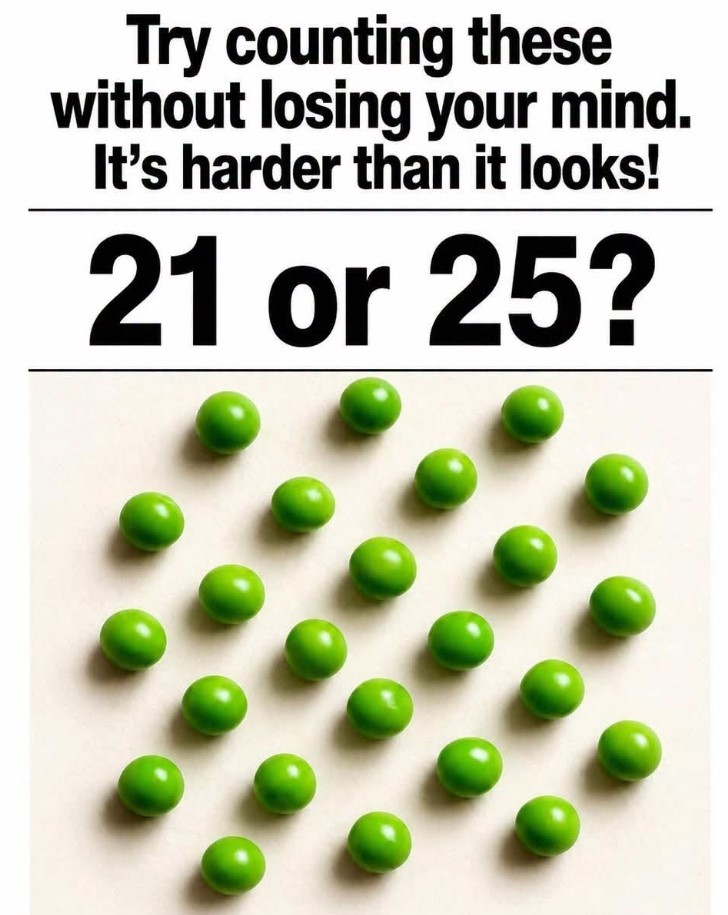
But there’s a little twist. The picture asks a seemingly simple question: Are there 21 or 25 peas?
You might feel confident choosing one of those numbers, but don’t rush. The peas are arranged in a pattern that makes it surprisingly easy to lose your place. Your eyes may skip one, count another twice, or become confused by the way the rows are positioned.
The challenge is to slow down, look carefully, and count every single pea without allowing the suggested answers to influence your decision.
Before reading the solution, try it yourself. Can you find the correct number without going crazy?
Why Is This Green Pea Puzzle So Confusing?
The difficulty isn’t really the mathematics. Counting small objects should be straightforward, but the arrangement of the peas makes the task more challenging than expected.
Instead of being placed in a perfectly straight grid, the green peas follow an alternating pattern. Some rows contain three peas, while others contain four. Each row is slightly shifted compared with the one above or below it.
This arrangement makes it harder for your eyes to follow a consistent direction.
Another reason people struggle is that all the peas look almost identical. They have similar shapes, colors, and shiny surfaces, so there are no obvious differences to help you keep track of which ones you have already counted.
The question itself also adds another challenge. By suggesting only two possible answers, 21 and 25, the puzzle encourages people to choose between those numbers instead of considering that neither option might be correct.
That’s what makes this little visual challenge so entertaining!
How to Count the Green Peas Correctly
The easiest way to solve the puzzle is to stop counting randomly and divide the arrangement into horizontal rows.
Rather than trying to count every pea at once, begin at the top and work your way down. This method helps you avoid counting the same pea twice or accidentally skipping one.
Let’s break it down.
The Top Half of the Pattern
Row 1: The top row
Start at the very top of the cluster. The first horizontal row contains 3 green peas.
Row 2: The second row
Move slightly downward. The next row contains 4 peas, positioned a little farther toward the outer sides.
Row 3: The third row
Continue counting downward. This row narrows again and contains 3 peas.
Row 4: The middle row
Now you reach the center of the arrangement. This wider row contains 4 peas.
The Bottom Half of the Pattern
Row 5: Below the center
The next row contains 3 peas, following the same alternating arrangement.
Row 6: The sixth row
Continue downward to another wider row containing 4 peas.
Row 7: The bottom row
Finally, the last row at the bottom contains 3 peas.
Now that we have counted every row separately, we can add the numbers together.
The Final Calculation
Here is the complete breakdown:
| Row | Number of peas |
|---|---|
| Row 1 | 3 |
| Row 2 | 4 |
| Row 3 | 3 |
| Row 4 | 4 |
| Row 5 | 3 |
| Row 6 | 4 |
| Row 7 | 3 |
| Total | 24 |
The calculation is:
3 + 4 + 3 + 4 + 3 + 4 + 3 = 24
The correct answer is 24 green peas!
That’s right! Neither 21 nor 25 is correct. The picture gives you two possible answers, but careful counting reveals a completely different number.
Why So Many People Get the Answer Wrong
One of the most interesting parts of this puzzle is that the suggested answers can influence how people approach the challenge.
When someone sees the choices 21 and 25, they naturally assume that one of them must be correct. If their own count produces 24, they may think they have missed a pea somewhere.
They start counting again, sometimes several times, hoping to reach one of the suggested numbers.
The arrangement also makes it easy to lose track. Because the rows alternate between three and four peas, counting without a clear system can quickly become confusing.
That’s why counting row by row is much more reliable than scanning the entire picture randomly.
The lesson is simple: don’t let the choices in a question convince you that there are no other possible answers.
A Simple Trick for Solving Similar Counting Puzzles
If you enjoy visual puzzles, there are a few useful habits that can make these challenges easier.
- Count in organized groups: Divide objects into rows, columns, or smaller sections.
- Move in one direction: Always follow the same path, from top to bottom or left to right.
- Keep track of each group: Write down the number in every row before adding everything together.
- Avoid rushing: A few extra seconds can prevent mistakes.
- Question the suggested answers: Sometimes the correct answer isn’t included among the options.
These simple techniques work for many other visual counting challenges, including puzzles involving circles, dots, flowers, and other repeated shapes.
Conclusion
So, did you manage to count all the green peas correctly? If your answer was 24, congratulations! You spotted the trick and didn’t let the two suggested choices lead you in the wrong direction.
The secret was to stop looking at the picture as one large group and divide it into seven manageable rows. Once we counted each row separately, the answer became much easier to find: three peas, four peas, three peas, four peas, three peas, four peas, and three peas. Together, they make a total of 24.
What makes this puzzle particularly clever is that it tests more than simple counting. It also challenges our ability to stay focused, follow a method, and question information that might seem obvious at first.
Sometimes, the biggest mistake isn’t miscounting the objects. It’s assuming that the answer must be one of the choices presented to us.
Now share this challenge with your friends and family. Ask them whether they see 21, 25, or the surprising answer of 24. You might be amazed at how many times everyone wants to count the peas all over again!