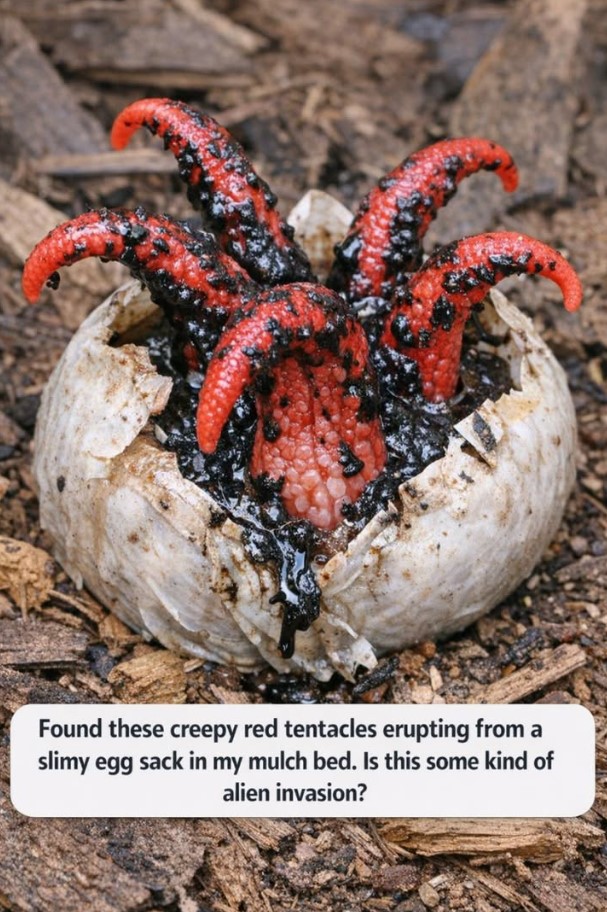
Walking into your garden and spotting bright red tentacle-like growths bursting out of a slimy white “egg” can feel like something straight out of a science fiction movie. Many people describe it as looking like an alien invasion, especially when it suddenly appears in mulch beds, flower gardens, or near decaying wood.
The good news is that it’s almost certainly not anything dangerous or supernatural—it’s usually a strange but natural fungus called Devil’s Fingers, also known as the octopus stinkhorn (Clathrus archeri). It belongs to the stinkhorn family, famous for bizarre shapes and strong odors. DIY Everywhere identifies this exact red-tentacle growth as Devil’s Fingers, which begins inside a white egg-like sac before splitting open.
It may look terrifying, but it plays a normal role in nature.
What This Strange Thing Actually Is
Devil’s Fingers fungus starts as a small white or pale gelatinous “egg” hidden in mulch or leaf litter.
As it matures:
- The egg splits open
- Bright red arms or “fingers” push outward
- The tentacles spread like a starfish or octopus
- A sticky dark slime forms on the arms
The Wildlife Trust explains that the fungus “hatches” from a slimy gelatinous egg, and the tentacle-like arms begin to protrude as it grows.
This dramatic growth is why it surprises so many gardeners.
Why It Smells So Bad
This fungus is part of the stinkhorn family, which means the smell is part of its survival strategy.
People often compare the odor to:
- Rotting meat
- Decaying flesh
- Something spoiled or dead nearby
That terrible smell is intentional. It attracts flies and insects, which land on the sticky spore-covered slime and help spread the fungus to new areas. Wildlife Trust notes that the odor is similar to rotting flesh and helps insects carry spores away.
A Reddit user describing a similar fungus simply said: “the substance on the end is stinky goo and is meant to attract flies to spread spores.”
Is It Dangerous?
Usually, no.
Devil’s Fingers is generally considered harmless to:
- People
- Pets
- Garden plants
It feeds on decaying organic matter like mulch, compost, and leaf litter rather than attacking healthy plants. DIY Everywhere notes that it is not considered toxic, though the smell alone usually keeps people away.
Curious pets might sniff it, but it’s mainly unpleasant rather than dangerous.
Why It Appears in Mulch Beds
This fungus loves:
- Damp conditions
- Decaying wood
- Rich organic mulch
- Compost-like environments
- Warm weather after rain
Mulch beds create the perfect environment because they hold moisture and contain lots of decomposing organic material.
That’s why it often seems to appear “overnight.”
Can You Remove It?
Yes, if the smell bothers you.
You can:
- Wear gloves
- Gently remove the fungus
- Seal it in a bag before disposal
- Reduce excess moisture in the area
- Turn mulch regularly to disturb future growth
However, it often disappears on its own after finishing its short reproductive cycle.
Other Look-Alikes
Some similar strange fungi include:
- Basket stinkhorn
- Octopus stinkhorn
- Cage stinkhorn
- Other stinkhorn mushrooms
Many of them look unusual and smell terrible, but they all serve a similar role in breaking down organic matter.
Conclusion :
Those creepy red tentacles erupting from a slimy egg in your mulch bed are almost certainly not signs of aliens—they’re most likely Devil’s Fingers fungus, one of nature’s strangest-looking mushrooms.
Its shocking appearance, bright red arms, and terrible smell make it unforgettable, but it’s simply part of the natural decomposition process happening in your garden. It feeds on old organic material and uses insects to spread its spores.
While it may look dramatic, it’s usually harmless and temporary.
In the end, it’s less of an invasion and more of a reminder that nature can sometimes be far stranger—and much weirder—than fiction.