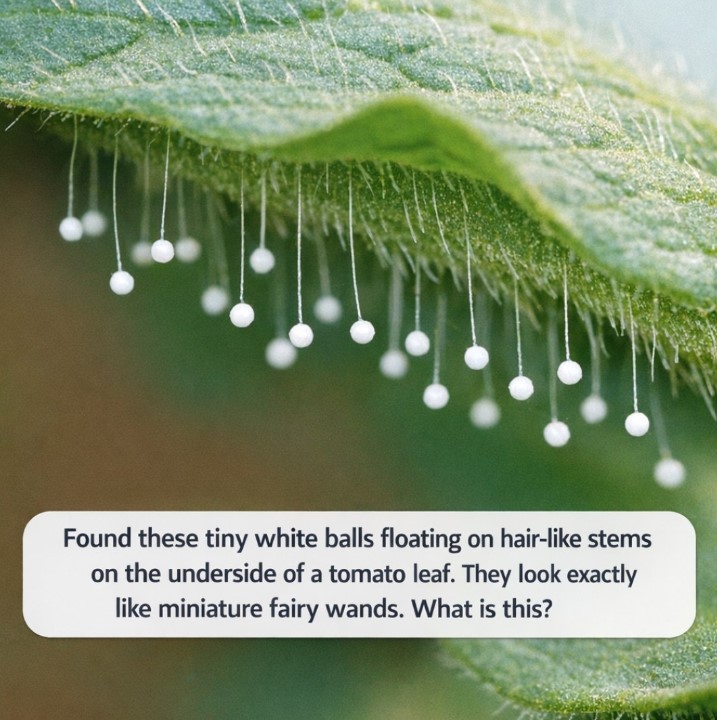
If you’ve ever inspected the underside of a tomato leaf and discovered a collection of tiny white balls seemingly floating above the surface, you might immediately wonder whether your plant has developed a strange disease.
The little structures can look almost magical. Each tiny white dot appears to sit on the end of an incredibly thin stem, giving the whole cluster the appearance of miniature fairy wands or tiny white pearls suspended above the leaf.
But despite their unusual appearance, these aren’t signs of a fungal infection, plant disease, or strange growth.
They’re most likely lacewing eggs.
And that’s actually very good news for your garden.
Green lacewings are beneficial insects, and their larvae are voracious predators of several common garden pests. Finding their eggs on your tomato plant means that nature may already be providing some free pest control.
Instead of removing these strange-looking structures, gardeners will usually want to protect them and allow the tiny predators inside to complete their development.
What Are the Tiny White Balls?
The small white balls are eggs laid by green lacewings, delicate insects belonging to the Chrysopidae family.
The eggs are extremely small, often around a millimeter long, and are typically pale white or cream-colored when newly laid.
What makes them so unusual isn’t just their appearance—it’s the way they’re attached to the plant.
Each egg sits at the end of its own thin, upright stalk.
When you first see them, they can resemble tiny lollipops, miniature balloons, or little pearls suspended from threads.
That strange arrangement is completely intentional.
The lacewing has evolved a clever way of protecting its offspring before they hatch.
Why Are the Eggs Sitting on Tiny Stems?
The hair-like stems aren’t part of the tomato plant.
The female lacewing creates each stalk while laying an egg. She deposits a small amount of material onto the leaf and draws it into a fine filament before placing the egg at the end.
The result is an egg elevated above the leaf surface.
This unusual design serves an important purpose.
Lacewing larvae are extremely hungry predators. Once they hatch, they immediately begin searching for food. Unfortunately for their siblings, young lacewing larvae aren’t particularly concerned about whether their prey is another insect or another lacewing larva.
By placing the eggs separately on individual stalks, the female reduces the chance that one newly hatched larva will immediately encounter and eat another egg.
Nature can be surprisingly clever—and occasionally ruthless.
Where Are You Most Likely to Find Lacewing Eggs?
Lacewing eggs are frequently found on the undersides of leaves.
This location provides some protection from direct sunlight, rain, and physical disturbance.
In a vegetable garden, you may discover them on:
- Tomatoes
- Peppers
- Beans
- Cucumbers
- Roses
- Flowering plants
- Other plants hosting soft-bodied insects
If your tomato plant has aphids, whiteflies, thrips, or similar pests, lacewings may be especially interested in laying eggs nearby.
The female is essentially placing her future offspring where there is likely to be an abundant food supply.
Why Would Lacewings Choose a Tomato Plant?
Tomato plants can provide excellent hunting grounds for lacewing larvae.
Although tomatoes themselves aren’t what the larvae are interested in eating, the plants often attract numerous small insects.
Aphids may gather around tender stems and new growth. Whiteflies can hide beneath leaves, while thrips may feed on flowers and foliage.
For a lacewing, an area with plenty of these soft-bodied insects can be an ideal nursery.
The female lays her eggs nearby so that once the larvae hatch, they won’t have to travel far to find their first meal.
What Happens When the Eggs Hatch?
The white eggs don’t remain on the plant forever.
Under warm conditions, lacewing eggs can hatch within several days, although development time varies according to temperature and species.
When they emerge, the larvae look dramatically different from the elegant adult lacewings.
Instead of delicate wings and a pale green body, the larvae look more like tiny alligators.
They are elongated, somewhat flattened, and equipped with curved jaws that allow them to capture and consume small prey.
This is the stage that makes lacewings particularly valuable to gardeners.
The Larvae Are Sometimes Called Aphid Lions
Lacewing larvae are sometimes nicknamed aphid lions, and the name is well deserved.
These tiny predators actively hunt aphids and other small insects.
A single larva can consume numerous aphids during its development, with the exact amount depending on the species, temperature, availability of prey, and length of the larval stage.
They can also attack other soft-bodied pests, including certain whiteflies, thrips, mites, and insect eggs.
So the tiny white dots you discovered today could eventually become a whole group of miniature predators patrolling your tomato plants.
Are Lacewing Eggs Good for Tomato Plants?
Yes.
Lacewing eggs themselves don’t damage tomato leaves, stems, roots, or fruit.
Their presence can actually indicate that your garden has attracted beneficial insects.
Once the larvae hatch, they can help reduce populations of pests that would otherwise feed on your tomato plants.
This is one of the best examples of natural pest management.
Instead of a gardener having to eliminate every insect manually or spray an insecticide, beneficial predators can help keep pest populations under control.
Should You Remove the Eggs?
Generally, no.
If you discover lacewing eggs on a healthy tomato leaf, the best thing to do is usually leave them exactly where they are.
Avoid scraping them away or rubbing the underside of the leaf.
The delicate stalks can break easily, and the eggs can be damaged in the process.
If the leaf is healthy and remains attached to the plant, simply leave the eggs alone and let nature take its course.
What If the Leaf Needs to Be Removed?
Sometimes a tomato leaf may be badly damaged, diseased, or ready to be pruned.
If you absolutely need to remove a leaf containing lacewing eggs, don’t automatically throw it away.
If practical, you can carefully move the leaf or place the section containing the eggs near another suitable plant.
The important thing is to avoid crushing or scraping the eggs.
Their tiny stalks are fragile, so handling them gently gives the developing larvae a better chance of surviving.
How Can You Tell Lacewing Eggs From Pest Eggs?
This is an important question because gardeners often discover unusual structures under leaves and immediately assume they’re harmful insect eggs.
The easiest clue is the stalk.
Lacewing eggs are individually elevated on tiny hair-like stems.
Other common garden insect eggs tend to sit directly against the leaf.
For example, some stink bugs lay groups of barrel-shaped eggs directly on the surface of leaves. Hornworm eggs are generally smooth and don’t sit on individual stalks.
Whitefly eggs are also extremely small and typically remain directly attached to the leaf.
If each tiny white egg is sitting at the top of its own delicate filament, lacewings are a strong possibility.
What Do Adult Lacewings Look Like?
Eventually, those strange little eggs produce beautiful adult insects.
Green lacewings are delicate insects with pale green bodies, long antennae, and transparent wings covered with a network of fine veins.
Their wings give them a fragile, almost fairy-like appearance—which makes the nickname associated with their unusual eggs seem surprisingly appropriate.
Some species also have distinctive golden or copper-colored eyes.
Adults are often more active around dusk and at night, and they may sometimes be attracted to outdoor lights.
Do Adult Lacewings Eat Garden Pests?
The answer depends on the species and life stage.
The larvae are the major predators that gardeners appreciate.
Many adult lacewings primarily feed on nectar, pollen, and honeydew, although adults of some species can also consume small insects.
This means that having flowering plants around your vegetable garden can help support adult lacewings and other beneficial insects.
A garden with flowers can provide food for adult beneficial insects while the vegetable plants provide habitat and prey for their offspring.
How to Encourage More Lacewings
If you want more beneficial insects in your garden, focus on creating an environment that supports them throughout their life cycle.
Planting small-flowered plants can be particularly helpful.
Consider adding plants such as:
- Sweet alyssum
- Dill
- Fennel
- Cilantro
- Yarrow
- Cosmos
- Coreopsis
These plants can provide nectar and pollen for adult beneficial insects.
A diverse garden is often more attractive to beneficial insects than a garden consisting of only one or two crop species.
Be Careful With Pesticides
One of the biggest threats to beneficial insects is unnecessary pesticide use.
Broad-spectrum insecticides don’t always distinguish between pests and helpful predators.
If you spray an area where lacewing eggs or larvae are present, you may accidentally eliminate the very insects that could have helped control your pest problem.
That doesn’t mean every pesticide is always inappropriate.
If a severe pest infestation requires treatment, follow the product label carefully and consider targeted approaches that minimize harm to beneficial insects.
But before spraying, inspect your plants.
You may discover that nature has already sent reinforcements.
What If Your Tomato Plant Has Aphids?
If you discover lacewing eggs on a tomato plant that also has aphids, don’t be surprised.
The two can be connected.
A female lacewing may have detected an area with abundant prey and deliberately chosen that location for her eggs.
Instead of immediately spraying the aphids, consider monitoring the situation for a few days.
Once the lacewing larvae hatch, they may begin feeding on the aphids naturally.
This doesn’t guarantee that they’ll eliminate the entire infestation, but they can contribute to keeping the population under control.
Don’t Expect Lacewings to Solve Every Pest Problem
Beneficial insects are helpful, but they’re not magical.
A large pest outbreak may still require additional management.
The goal of encouraging lacewings is not to guarantee a completely pest-free garden.
Instead, you’re creating a more balanced ecosystem in which natural predators help keep pest populations from becoming overwhelming.
This approach can reduce the need for repeated chemical treatments and make your garden more resilient over time.
Why You Should Inspect the Undersides of Leaves
Many gardeners primarily inspect the top surfaces of leaves.
That’s understandable because it’s where most of the visible damage appears.
But the underside can tell you much more about what’s happening in your garden.
It’s where you may find:
- Aphids
- Whiteflies
- Spider mites
- Insect eggs
- Lacewing eggs
- Pest larvae
- Signs of fungal problems
Make a habit of gently lifting a few leaves during your regular garden inspections.
You may discover an entire miniature ecosystem that would otherwise go unnoticed.
What Do Empty Lacewing Egg Stalks Mean?
After the larvae hatch, the tiny white eggs will disappear.
The delicate stalks may remain temporarily, leaving behind what looks like a collection of empty miniature stems.
If you return to the plant several days later and notice that the eggs are gone, the most likely explanation is that the larvae have emerged.
The young lacewings will then begin their hunting stage.
Don’t Bring the Eggs Indoors
It may be tempting to move unusual insect eggs inside so you can watch them hatch.
However, that’s generally unnecessary.
Lacewing larvae are predators that need suitable food after hatching. Keeping them indoors without an appropriate environment and food source can do more harm than good.
The best place for them is usually where they were naturally laid: outside on the plant.
A Small Discovery With a Big Benefit
The next time you find something strange under a tomato leaf, resist the urge to immediately remove it.
Gardeners often spend considerable time trying to eliminate insects, but some of the smallest creatures in the garden are actually doing valuable work.
Lacewing eggs are a perfect example.
They may look strange, but they’re a sign that beneficial insects are reproducing in your garden.
And once their larvae emerge, they can become some of the most effective natural predators working among your tomato plants.
Final Thoughts
Those tiny white balls floating above the underside of your tomato leaf may look mysterious, but they’re actually one of the better discoveries a gardener can make.
They’re most likely lacewing eggs, and the delicate stalks supporting them are part of a remarkable natural strategy for protecting the developing offspring.
Once the eggs hatch, the young lacewing larvae become active predators, hunting aphids, whiteflies, thrips, and other small garden pests. Rather than harming your tomato plants, they can help protect them.
So if you discover these strange little “fairy wands” beneath your tomato leaves, don’t reach for the insecticide or start scraping them away.
Leave them alone.
Watch closely, and within a few days you may see tiny predatory larvae emerge and begin searching the plant for pests.
What initially looks like something strange or alarming may actually be evidence that your garden is developing its own natural pest-control system.
Sometimes the best garden helpers are the ones you almost mistake for a problem.