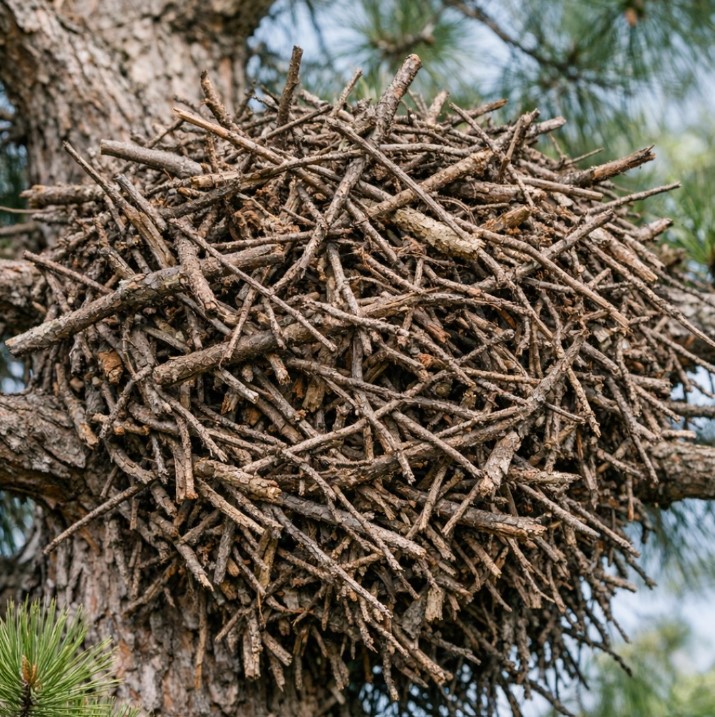
If you have ever looked up into a tall pine tree and noticed a strange, tightly packed ball of branches, you might have wondered whether a large bird had built an enormous nest. From a distance, these unusual formations can look like a tangled collection of sticks, almost as if someone had placed a giant bird’s nest high among the branches.
However, what you are seeing may have nothing to do with birds at all. In many cases, this strange formation is something known as a witches’ broom. It is an abnormal growth pattern that causes a tree to produce an unusually dense cluster of short branches and shoots in one particular area.
Although the name sounds mysterious, witches’ brooms are natural tree growth abnormalities. They can appear in pine trees, spruces, and several other types of trees. Some remain small for years, while others gradually become large enough to attract attention from anyone looking up into the canopy.
Understanding what causes these formations, whether they are dangerous, and what you should do about them can help you decide whether your unusual tree growth is something to worry about or simply an interesting feature of nature.
1. What Exactly Is a Witches’ Broom?
A witches’ broom is a dense cluster of abnormal branch growth that develops from one particular point or a small section of a tree. Instead of producing normal branches that grow outward with plenty of space between them, the tree develops numerous short shoots close together.
Over time, these shoots form a thick, tangled mass that can resemble a giant ball, a brush, or an oversized bird’s nest.
On pine trees and other conifers, the formation may remain green for several years. Its needles can appear shorter and more crowded than those found on the surrounding branches. Depending on the tree and the underlying cause, the shape may be round, flattened, irregular, or extremely dense.
Some witches’ brooms measure only a few inches across, while larger examples can grow several feet wide. This explains why a homeowner might suddenly notice what looks like a basketball-sized collection of branches high above the ground.
The important detail is that a witches’ broom is actually living tree growth. It is connected to the original branch rather than being a structure assembled from individual twigs.
2. Why Does It Look Like a Giant Bird’s Nest?
The resemblance is one of the main reasons people become curious about these formations.
From the ground, a witches’ broom can look almost identical to a large nest. Its rounded shape, tangled appearance, and position high in the tree make it easy to mistake for something built by a bird or squirrel.
However, there is an important difference between the two.
A real bird’s nest is made from materials collected and arranged by the animal. You may see separate sticks, leaves, grass, and other materials woven together to create a resting or nesting area. Depending on the species, it may have a recognizable bowl-shaped center.
A witches’ broom, on the other hand, is made of branches that grow directly from the tree. The entire formation is connected to the living branch system, and the dense shoots often fill the center rather than forming an open space.
Another clue is the presence of needles. If the mass appears green and has new growth emerging throughout it, that may indicate that it is part of the tree itself.
From a distance, these differences can be difficult to recognize, which is why binoculars or clear photographs can be helpful.
3. What Causes Witches’ Brooms to Form in Pine Trees?
There is not just one explanation for witches’ broom growth. Several biological factors can interfere with the normal development of a tree’s branches.
Some of the most common causes include:
Fungal infections: Certain fungi can interfere with normal branch development and trigger excessive growth. Some rust diseases are known to produce witches’ broom symptoms in susceptible trees.
Dwarf mistletoe: This parasitic plant is an important cause of witches’ broom formations in certain conifers. It takes nutrients and water from its host tree and can cause unusually dense clusters of branches to develop around the infected area.
Insects and mites: Some insects and mites can damage buds or affect developing shoots. Their activity may contribute to abnormal growth patterns in certain tree species.
Physical damage: Injury to a growing bud or branch can sometimes change how new shoots develop. Instead of producing one normal extension, several shoots may begin growing from the affected area.
Genetic changes: Occasionally, abnormal branching can result from a natural genetic mutation. In these situations, the unusual growth pattern may occur without an active infection.
The exact cause depends on the tree species, the location, and the symptoms surrounding the formation. Looking at the shape alone is not enough to determine which explanation applies.
4. How Can You Tell Whether It Is a Witches’ Broom or an Actual Nest?
If you have discovered a strange mass of branches in your pine tree, there are several clues that can help you distinguish abnormal tree growth from an animal nest.
Look at the density. Witches’ brooms are often extremely compact, with many short branches packed tightly together. A bird’s nest generally contains separate pieces of nesting material and may have a visible central space.
Check whether it is growing. A witches’ broom is living wood, so it may continue producing needles and new shoots. An abandoned nest does not produce new branches or needles of its own.
Look at how it is attached. A witches’ broom develops directly from a branch or an affected section of the tree. A nest is constructed on top of existing branches or supported between them.
Observe its appearance over time. If the formation remains green and develops additional shoots during the growing season, abnormal tree growth becomes a stronger possibility.
Watch for animal activity. Birds and squirrels may visit or even occupy dense branch formations. Their presence does not automatically mean the structure is a nest.
If you cannot clearly identify the object from the ground, avoid climbing the tree simply to get a closer look.
5. Does a Witches’ Broom Mean Your Pine Tree Is Dying?
Fortunately, discovering one witches’ broom does not automatically mean your pine tree is dying.
Some mature trees can carry a single abnormal growth for many years while the rest of the canopy remains relatively healthy. If the surrounding needles have normal color, the branches continue growing, and there are no obvious signs of widespread damage, the tree may not be in immediate danger.
However, the underlying cause is important.
If the formation is associated with dwarf mistletoe or another damaging disease, the tree may gradually lose vigor. This is particularly concerning when several witches’ brooms appear throughout the canopy.
A tree that is already struggling with drought, poor growing conditions, root damage, or other diseases may also be less able to tolerate additional stress.
Rather than focusing only on the strange-looking cluster, it is important to examine the overall condition of the tree.
6. Warning Signs That Your Tree May Have a Bigger Problem
Although some witches’ brooms are relatively harmless, certain symptoms deserve closer attention.
Here are some warning signs to watch for:
- Multiple witches’ brooms appearing in different parts of the tree.
- Needles turning yellow, brown, or falling earlier than expected.
- Branch tips becoming dry or dying back.
- Large sections of the upper canopy becoming thin or bare.
- New seasonal growth becoming weaker or less abundant.
- Cracks, unusual swelling, or damaged bark around the affected branch.
- The abnormal formation becoming noticeably larger over time.
One isolated witches’ broom may simply be an unusual feature of the tree. Several formations combined with declining branches, however, could indicate an underlying disease or parasite.
Pay particular attention to large formations growing on already weakened limbs. Their additional weight can become a concern during strong winds, heavy rain, or winter storms.
If you notice several of these symptoms together, consider arranging an inspection by a qualified arborist.
7. Why Do Witches’ Brooms Become So Thick and Tangled?
To understand why these formations look so unusual, it helps to know a little about how trees normally grow.
A healthy branch usually develops according to signals controlled by plant hormones. These chemical signals influence when buds remain dormant, when new shoots appear, and how branches extend.
When something interferes with those signals, the normal growth pattern can change.
Instead of one main shoot growing longer, numerous buds may begin developing at the same time. The resulting branches often remain short and crowded, producing a thick mass of growth.
This is why a witches’ broom can look more like a giant brush than an ordinary tree branch.
On pine trees, the needles make the formation appear even denser. From the ground, it may seem as though an enormous bundle of twigs has been squeezed into one small area of the canopy.
8. Can Birds and Squirrels Actually Use These Formations?
Yes! Although a witches’ broom is not originally an animal nest, it can still provide a useful hiding place for wildlife.
Its dense branches create shelter from wind, rain, and potential predators. Birds may use the thick growth as a resting place, while squirrels and other small animals may take advantage of the protection it provides.
This is one of the interesting things about these unusual tree formations. Something that develops because of an abnormal growth process can eventually become useful to other living creatures.
However, you should never assume that a witches’ broom is unoccupied. Birds may build nests inside or near the dense branches, especially during the breeding season.
Before considering any pruning, check for signs of wildlife activity. If you suspect an active bird nest, leave it undisturbed and follow the wildlife protection rules in your area.
9. Should You Remove the Witches’ Broom or Leave It Alone?
The decision depends on its size, location, underlying cause, and the overall health of the tree.
If the formation is small, isolated, and located high in an otherwise healthy pine, removing it may not be necessary. Many homeowners choose to leave these growths alone, particularly when they do not affect the tree’s structure or create a safety concern.
However, removal may be worth considering when:
- The affected branch is becoming weak or overloaded.
- The formation is associated with a disease that could affect other parts of the tree.
- The growth is damaging the tree’s natural shape.
- The branch hangs over a driveway, roof, patio, or frequently used outdoor area.
- Several abnormal formations are appearing throughout the canopy.
It is important to understand that removing the visible cluster does not necessarily eliminate the underlying cause. If a parasite or disease is responsible, simply cutting away the outer shoots may not solve the problem.
An arborist can determine whether the affected branch should be removed and whether further treatment or monitoring is needed.
10. How to Inspect the Formation Safely From the Ground
When something unusual appears high in a pine tree, it is natural to want a closer look. However, climbing a tall tree to investigate a witches’ broom can be dangerous.
Pine branches may be weaker than they appear, and the bark can make climbing difficult. Using a ladder against a tall tree also creates unnecessary risks.
Fortunately, you can collect useful information without leaving the ground.
Start by using binoculars to examine the formation. Look for green needles, short crowded shoots, and a connection to a particular branch.
You can also use your phone camera’s zoom feature to take photographs from a safe, stable position.
Try to capture the formation from several angles. It may help to photograph the surrounding branches as well, especially if you notice other unusual growths or areas of discoloration.
Pay attention to the approximate size and location of the cluster. Knowing whether it is a small formation or several feet wide can help an arborist understand the situation.
Most importantly, do not climb the tree or attempt to cut the formation down yourself if it is high above the ground.
11. When Is Pruning Appropriate?
Pruning can be useful when a witches’ broom is affecting a particular branch, but it should be done carefully.
If the affected area is small and accessible, a qualified person may be able to remove the entire affected branch back to an appropriate healthy lateral branch or its point of origin.
Simply trimming the outer tips of the broom may not be effective if the underlying problem remains inside the affected branch.
The timing of pruning depends on the tree species and the suspected cause. In some situations, dormant-season pruning may make it easier to see the branch structure and carry out the work properly.
Tools should be clean and sharp, especially when a disease is suspected. Proper pruning cuts are also important because unnecessary damage can create additional problems for the tree.
Large branches, high formations, and limbs close to buildings or electrical lines should always be handled by trained professionals.
12. When Should You Call a Certified Arborist?
Not every unusual branch formation requires professional attention, but there are situations where an arborist’s assessment is particularly valuable.
Consider contacting one if the witches’ broom is high in the canopy, attached to a large structural limb, or located close to utility lines.
Professional advice is also useful when several formations appear throughout the tree or when you notice widespread needle discoloration, dead branches, and thinning growth.
An arborist can examine the affected area and help determine whether the cause is a fungal disease, dwarf mistletoe, insect activity, physical injury, or another growth abnormality.
This distinction matters because different causes require different approaches. Removing one affected branch may be sufficient in one situation, while another may require ongoing monitoring of the entire tree.
A professional can also assess whether the affected limb presents a risk during storms or strong winds.
13. How Can a Witches’ Broom Affect a Tree Over Time?
The long-term effects depend on the size of the formation and what caused it.
A small witches’ broom may remain mostly unchanged for years without seriously affecting an established tree. However, larger formations can place additional weight on the branch that supports them.
This becomes more important during severe weather. Heavy snow, freezing rain, and strong winds can put extra pressure on an already weakened limb.
There is also the issue of the tree’s overall health. Producing an unusually large number of shoots in one area changes the normal pattern of growth. One small formation may not make a noticeable difference, but several large formations can contribute to stress, especially when the tree is already struggling.
If the underlying cause is a parasite or disease, the effects may become more noticeable over time.
For this reason, it is useful to monitor the formation and the condition of the surrounding canopy rather than assuming that it will remain harmless forever.
14. Other Things That Can Look Like Witches’ Brooms
Although witches’ broom is a likely explanation for a dense cluster of living branches, it is not the only possibility.
Several other natural structures can look similar from the ground.
Squirrel nests: Squirrels sometimes build large nests called dreys using twigs, leaves, and other plant materials. These structures may look like tangled balls of branches, especially when viewed from a distance.
Mistletoe growth: In certain regions, mistletoe can form dense clusters in trees. Some types of dwarf mistletoe also cause witches’ broom symptoms in conifers.
Storm damage: Strong winds can break branches and push them together, creating an unusual mass of tangled wood.
Abnormal regrowth: When a branch or the top of a tree is damaged, new shoots may develop in unusual patterns as the tree responds to the injury.
Large clusters of branches and cones: Certain natural growth patterns can create a dense appearance without necessarily being a witches’ broom.
The best way to distinguish these possibilities is to examine how the structure is attached and whether it consists of living shoots or collected materials. When identification is uncertain, photographs and an expert assessment are more reliable than guessing from its silhouette.
15. What Should You Do If You Find One in Your Pine Tree?
If you discover a large, dense cluster high in your pine tree, there is no need to panic.
Begin by taking a few photographs from the ground. Try to capture the entire formation and the branch where it appears to originate.
Next, examine the rest of the tree. Are the needles still green? Are the surrounding branches growing normally? Do you see other similar clusters or signs of dying branches?
If the formation is isolated and the tree appears healthy, you may simply monitor it. Keep an eye on whether it becomes larger or whether new symptoms develop elsewhere.
However, if the tree has several abnormal growths, visible damage, or large weakened branches, arrange an assessment by a qualified arborist.
Avoid climbing the tree, cutting high branches, or disturbing possible animal nests. A little patience and careful observation can help you understand what is happening without putting yourself or the tree at unnecessary risk.
16. The Simple Answer: What Is That Huge Knot of Twigs?
If the huge, tightly packed mass in your pine tree looks like a giant bird’s nest but consists of dense branches growing from one point, it is very likely a witches’ broom.
This unusual formation is an abnormal pattern of tree growth that can be associated with fungal infections, dwarf mistletoe, insects, physical damage, or natural genetic changes.
Although its appearance can be surprising, it does not automatically mean that your pine tree is dying. Some trees carry these formations for many years without showing serious problems, while others may need closer attention because of an underlying disease or weakened branches.
The most important thing is to look beyond the strange shape. Check the surrounding needles, observe the overall condition of the tree, and pay attention to any signs of spreading damage.
If the formation is large, high up, or attached to a potentially dangerous branch, professional advice is the safest option. And if you discover birds or other wildlife using the dense branches, make sure they are not disturbed before any pruning is considered.
Conclusion :
Finding what looks like an enormous bird’s nest hidden high in a pine tree can certainly be surprising. When the branches are tightly packed together and the formation seems to appear out of nowhere, it is easy to imagine that some unusually large bird or animal has been building a home in the canopy. But nature often has explanations that are even more interesting than our first guesses.
In many cases, this strange structure is a witches’ broom, an abnormal cluster of branches and shoots that develops when something interferes with the tree’s normal growth. It may be connected to a fungal infection, dwarf mistletoe, insect activity, physical damage, or even a natural genetic change. Instead of forming ordinary branches that grow outward in an organized way, the affected area produces numerous short shoots that become crowded together into a thick, tangled mass.
The good news is that seeing one witches’ broom does not necessarily mean your pine tree is in serious trouble. Some trees can carry these unusual formations for many years while continuing to grow normally. Others may need attention, particularly when the formation is associated with disease, when several clusters appear throughout the canopy, or when heavy growth places extra pressure on an already weakened branch.
That is why observing the entire tree is more important than judging the unusual formation by its appearance alone. Healthy green needles, normal growth, and the absence of widespread dead branches are encouraging signs. On the other hand, thinning foliage, dying branch tips, damaged bark, and multiple abnormal clusters are reasons to seek professional advice.
It is also worth remembering that even though a witches’ broom is not originally a bird’s nest, it can still become a valuable shelter for wildlife. Birds and small animals may use its dense branches to hide from predators or escape harsh weather. Before considering removal, always check whether animals are using the area and avoid disturbing active nests.
So, the next time you notice a giant knot of twigs high in a pine tree, take a closer look from a safe distance before deciding what it is. What appears to be a mysterious nest may actually be a fascinating example of how trees respond to changes in their environment. And sometimes, understanding these unusual natural formations is all it takes to turn an alarming discovery into an interesting lesson about the world growing right outside your home.