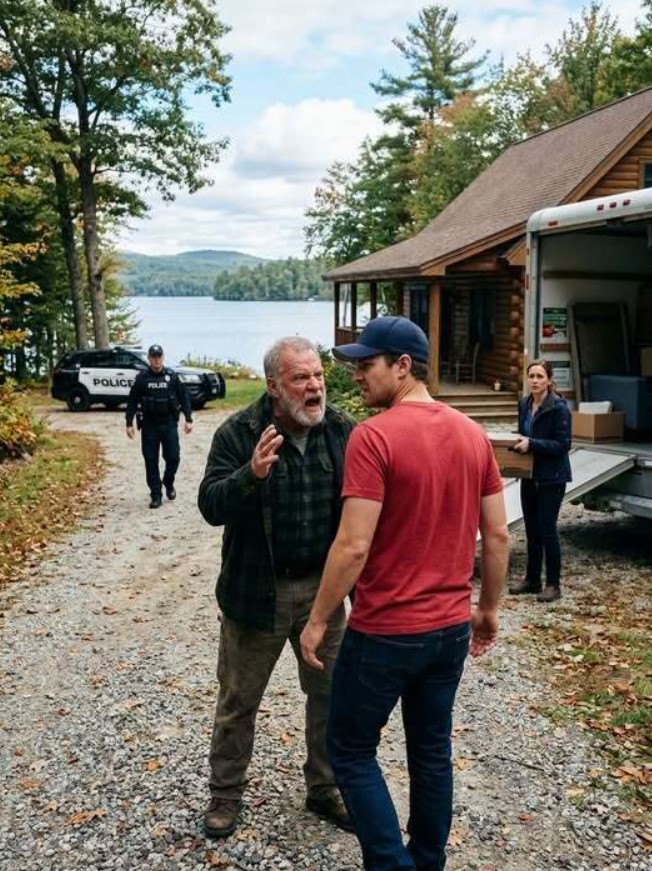
The truth was far bigger than an unauthorized move-in.
The document in Deputy Miller’s hand was not simply a questionable deed. It was evidence that someone had tried to manufacture an entirely new history for the cabin.
And the person who had created it had made one enormous mistake.
They had forgotten that Susan was dead.
That single fact was enough to tear the entire scheme apart.
Evelyn arrived at the cabin shortly afterward. She examined the document carefully before looking at me.
“Walter, this deed was filed recently.”
“I know.”
“But there is something else you need to understand.”
She turned the document toward me.
“Someone has been trying to use this cabin as collateral.”
My stomach tightened.
“For what?”
“A loan.”
“How much?”
Evelyn hesitated.
“Three hundred and twenty thousand dollars.”
I looked toward Greg and Brenda.
Neither of them was speaking anymore.
The smug confidence Greg had shown when I first arrived was gone.
Evelyn explained that a lender had received paperwork claiming that Shawn and Hannah were authorized to use the cabin as security for a large loan.
The application had been submitted shortly before Greg and Brenda arrived with the U-Haul.
That meant the move had not been spontaneous.
It had been part of the plan.
Someone wanted the cabin to look as though it had already been transferred to the Lawson family.
And then they wanted to borrow money against it.
I looked at Greg.
“Did Shawn tell you about the loan?”
Greg swallowed.
“He told us the property was going to be transferred.”
“That wasn’t my question.”
He looked down.
“I knew there was some financing involved.”
Brenda immediately turned toward him.
“Greg, you said Shawn told us everything was legal.”
“I thought it was!”
Evelyn stepped between them.
“Everyone needs to stop talking about what they thought. We need facts.”
She turned to me.
“Where is Shawn?”
I didn’t know.
Then a red pickup appeared at the end of the driveway.
Shawn had arrived.
Hannah was sitting beside him.
The moment my daughter stepped out of the truck, she looked at me with tears in her eyes.
“Dad, please.”
I held up the forged deed.
“Did you sign this?”
She froze.
Shawn immediately answered for her.
“She knew exactly what she was signing.”
I looked at Hannah.
“Is that true?”
She shook her head.
“No.”
Shawn stared at her.
“Hannah.”
“I didn’t know.”
She walked toward me.
“Shawn told me it was part of the estate paperwork. He said that because Mom wanted me to have the cabin someday, we were just organizing everything in advance.”
My heart sank.
“Did you see this deed?”
“No.”
“Did you sign documents Shawn gave you?”
She nodded.
“How many?”
“I don’t know.”
Evelyn closed her eyes for a moment.
“That is exactly how people get trapped.”
Shawn became defensive.
“You’re making this sound like some criminal conspiracy.”
Evelyn looked directly at him.
“Then explain how Susan Miller signed a deed six months ago.”
The color disappeared from his face.
Hannah looked at him.
“What does she mean?”
Shawn said nothing.
My wife’s name hung in the air.
Susan had been dead for three years.
There was no explanation that could make that signature legitimate.
Then Evelyn found another document.
It claimed that I had resigned as trustee because I was supposedly no longer capable of managing my own affairs.
Attached to it was a medical statement claiming that a doctor had evaluated me and found me mentally incompetent.
I knew the doctor’s name.
Dr. Robert Hayes.
He had treated Susan for years.
He had also been dead for more than a year.
I stared at the document.
“They forged a medical report too?”
Evelyn nodded.
“This was planned.”
That was the moment everything became clear.
The cabin was not being taken because Shawn suddenly believed it belonged to Hannah.
Someone had created a chain of false documents designed to make the transfer appear legitimate.
First, they created a deed.
Then they created evidence that I was supposedly incapable of controlling the trust.
Then they tried to use the cabin as collateral.
And finally, they moved people into the property.
It was a carefully constructed attempt to make a stolen property look legitimately inherited.
Then Brenda suddenly spoke.
“There was a developer.”
Everyone turned toward her.
Shawn stared at his mother.
“Mom.”
She continued.
“You told us the cabin was going to be sold.”
I looked at her.
“Sold to whom?”
She pulled a brochure from her purse.
The cover showed a luxury development overlooking Cooper Lake.
Private homes.
A marina.
Walking trails.
Expensive vacation properties.
At the bottom of the page was the name of a development company.
Evelyn took the brochure.
“Where did you get this?”
“Shawn gave it to us.”
She turned toward Shawn.
“How much were they planning to pay?”
Brenda answered before he could.
“Nearly two million dollars.”
I felt something inside me go completely still.
This wasn’t about a cabin.
It was about the land.
The lakefront property was worth far more than Shawn’s parents had ever imagined.
And Shawn had apparently decided that he could take control of it before I even realized what was happening.
Evelyn asked Deputy Miller to collect all the documents.
Shawn’s story began falling apart.
Messages on his phone showed that he had been discussing the property with a developer for months.
He had referred to the cabin as “the lake parcel.”
He had discussed removing the existing structures and constructing luxury homes.
He had even written that once the title was “clean,” the sale could move forward.
But the title was never clean.
It belonged to the Miller Family Trust.
And I was still the trustee.
The sheriff’s office opened an investigation.
The forged deed was sent for examination.
The supposed medical report was also investigated.
Within days, investigators discovered that the doctor’s signature had been digitally copied.
The deed contained another problem as well.
The notary listed on the document had never witnessed Susan signing anything.
Susan couldn’t have signed it.
She had been buried three years earlier.
Eventually, the notary admitted that Shawn had approached him with documents already bearing signatures.
He had been paid to notarize them.
That admission changed everything.
The authorities had enough evidence to move forward.
The lender froze the loan application.
The attempted transfer was blocked.
The developer was notified that Shawn had no authority to sell the property.
And Greg and Brenda were ordered to remove their belongings from the cabin.
For the first time since I had arrived that morning, the house was quiet.
I walked inside alone.
Susan’s green raincoat was still hanging by the mudroom.
Her coffee mug was still beside the sink.
Nothing had changed.
Yet somehow everything had changed.
I touched the edge of the kitchen counter.
This was the same place where Susan had once stood laughing because I had tried to fix a leaking faucet and accidentally flooded the kitchen.
The same place where Hannah had done her homework.
The same place where Susan and I had spent countless quiet mornings.
And someone had looked at all of that and seen nothing but a dollar amount.
That hurt more than the attempted theft itself.
Hannah came inside.
She looked exhausted.
“Dad.”
I turned toward her.
“I didn’t know.”
“I know.”
“I should have asked questions.”
“Yes.”
She began crying.
“I trusted him.”
“That was his advantage.”
She wiped her face.
“Do you hate me?”
“No.”
“Even after I signed those papers?”
“I am angry that you signed documents without understanding them. But I don’t hate you.”
She nodded.
“I don’t know how to fix this.”
“You don’t have to fix everything today.”
She looked toward the kitchen.
“Can I stay here tonight?”
I nodded.
That night, Hannah slept in her mother’s old bedroom.
I stayed awake in the living room.
Around midnight, I walked outside.
The lake was almost completely still.
For three years, I had avoided coming here because everything reminded me of Susan.
Now I understood something.
Avoiding the cabin had not protected me from losing Susan.
It had only left the door open for someone else to try to take what she had left behind.
The next morning, Evelyn arrived with new trust documents.
“We’re changing the structure,” she told me.
“How?”
“The cabin will remain protected within the family trust. No single beneficiary will be able to sell or mortgage it without independent legal review.”
I nodded.
“Good.”
She looked at me.
“Walter, I also want you to consider something.”
“What?”
“Your daughter needs to understand why this happened.”
“I know.”
“She trusted the wrong person because she assumed family meant safety.”
I looked toward the window.
“Then maybe this is the lesson.”
Months passed.
The legal case continued.
Shawn eventually admitted that he had fabricated several of the documents.
He had hoped to obtain financing against the property and then sell the lakefront parcel to a developer.
He had convinced Hannah that the paperwork was simply part of estate planning.
He had convinced his parents that they would eventually live at the cabin.
And he had convinced himself that I would never discover the truth until it was too late.
He was wrong.
The court invalidated the forged documents.
The loan disappeared.
The attempted sale collapsed.
Hannah eventually filed for divorce.
The family changed after that.
Not immediately.
There were arguments.
There were painful conversations.
There were moments when Hannah blamed herself.
But slowly, we began rebuilding our relationship.
One year later, Hannah brought me a small wooden box.
“What is this?”
She smiled.
“Mom’s things.”
Inside was an old photograph.
Susan was sitting on the cabin porch.
She was younger, smiling, and holding a cup of coffee.
On the back, she had written four words:
Our place. Always ours.
I couldn’t speak.
Hannah sat beside me.
“I found it in the attic.”
I turned the photograph over again.
“Your mother knew what this place meant.”
“I know.”
We sat together in silence.
That summer, Hannah began visiting the cabin regularly.
She helped repair the garden.
She painted the porch.
She even planted the same flowers Susan used to grow beside the front steps.
One afternoon, my granddaughter was born.
Hannah named her Susan.
When I first held that little girl at the cabin, I looked across the lake and thought about everything that had happened.
The forged deed.
The U-Haul.
The fake medical report.
The attempted loan.
The planned sale.
The betrayal.
And somehow, after all of it, the cabin was still standing.
The porch was repaired.
The rain no longer came through the roof.
Susan’s coffee mug was still in the kitchen.
And her memory was still everywhere.
People sometimes think an inheritance is about property.
They see land, houses, money, and accounts.
But an inheritance can be much bigger than that.
Sometimes what someone leaves behind is a place where a family remembers who they were.
For me, the cabin was never just a piece of real estate.
It was the last physical place where Susan’s presence still felt close.
And when someone tried to steal it, they didn’t just try to take land.
They tried to take part of our family’s history.
That is why I fought.
Not because the cabin was worth millions.
Not because a developer wanted it.
Not because someone had placed my name on a forged document.
I fought because Susan had left it to our family with love.
And some things are worth protecting simply because they cannot be replaced.
Years later, whenever I drive toward Cooper Lake, I still slow down before reaching the cabin.
I look at the porch.
I see the green raincoat hanging inside.
I hear Hannah laughing somewhere in the yard.
And I remember the morning I arrived to find a U-Haul parked outside my late wife’s home.
That morning, I thought I was dealing with a family dispute.
I was wrong.
I was standing at the beginning of a much bigger fight.
And the person who thought he could take the cabin from me learned one lesson the hard way:
A family inheritance may be passed down through paperwork, but its true value cannot be forged.