I Found My Daughter-in-Law’s Family Living in My Second Home—So I Took Back the Money, the Bills, and the Locks
When I drove up to my mountain house that Tuesday morning, I expected to spend a few quiet hours getting the property ready for a realtor.
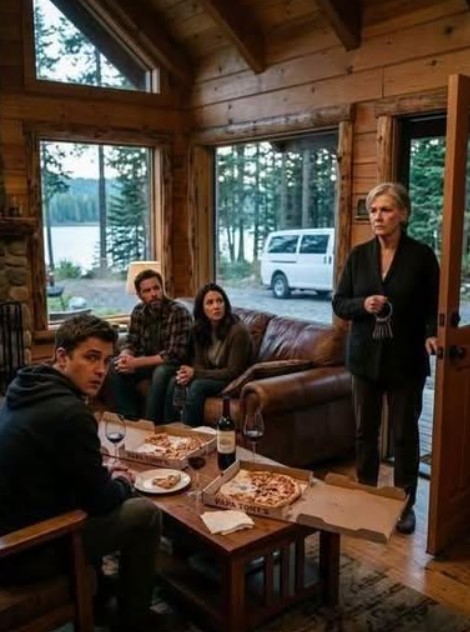
Instead, I found five people inside.
They were sitting comfortably in my living room as if they had every right to be there.
There were empty pizza boxes on my antique coffee table, dirty dishes stacked beside the sink, and one of my best bottles of wine sitting open on the kitchen counter.
For several seconds, I simply stood in the doorway.
Then Brenda, my daughter-in-law Sarah’s mother, looked up at me.
She didn’t look embarrassed.
She didn’t even look surprised.
Instead, she smiled.
“Sarah said we could stay here,” she told me.
I stared at her.
“This is my house.”
Brenda shrugged.
“Well, yes. Technically. But Sarah said it will belong to her and Jason eventually anyway.”
That sentence changed everything.
Until that moment, I had been angry because strangers were using my property without permission.
After she said those words, I realized the problem was much bigger.
They weren’t simply treating my house like a free vacation rental.
They had already decided that what belonged to me would eventually belong to them.
And apparently, they had started behaving as though that future had already arrived.
My name is Diane Hayes. I was sixty-eight years old at the time.
The mountain house had belonged to me and my late husband, Robert.
We bought it twenty years earlier, back when we still dreamed about retiring there together.
Robert died five years ago.
After that, the house became difficult for me to visit alone. Every room reminded me of him. Every chair, every photograph, every corner seemed to hold a piece of the life we had planned.
But I never abandoned the property.
I continued paying the taxes, maintaining the utilities, keeping the place clean and making sure everything was in working order.
Eventually, I realized the house could provide something important for me.
Income.
A long-term rental could bring in roughly twenty-five hundred dollars a month, possibly more.
That money was part of my retirement plan.
I had worked as an elementary school teacher for thirty-five years. I had saved carefully because I never wanted to depend completely on my son, Jason, when I became older.
The mountain house was part of that independence.
It wasn’t a family hotel.
It wasn’t a future inheritance that everyone could use whenever they wanted.
It was mine.
And that morning, I made that very clear.
“I need all of you to leave,” I said.
Brenda frowned.
“But Sarah told us—”
“Sarah doesn’t own this house.”
Larry, her husband, appeared from the hallway carrying a beer.
He tried to calm things down.
“Diane, let’s not make this bigger than it needs to be.”
I picked up my phone.
“I have a realtor coming here at ten. If you don’t leave now, I’m calling the police.”
That changed the atmosphere immediately.
Brenda grabbed her purse.
Larry stopped arguing.
The others gathered their belongings.
As they walked toward the door, Brenda turned back.
“You’re going to regret this,” she said. “Sarah is going to be furious.”
I looked directly at her.
“Then I’ll talk to Sarah.”
They left.
I stood in the driveway and watched their cars disappear down the mountain road.
Then I went back inside.
There was work to do.
The house needed cleaning before the realtor arrived.
Fortunately, the realtor showed up exactly on time with a couple named David and Michelle.
They were looking for a long-term rental in the mountains.
They walked through the house quietly, examining everything.
When they reached the back porch, they stood there for several minutes looking at the view.
Finally, David turned to me.
“We’d like to rent it.”
I smiled.
“How soon could you move in?”
“Two weeks.”
That was all I needed to hear.
After they left, I sat alone on the porch.
Robert and I had spent countless mornings there drinking coffee and watching the sunrise.
I looked at the mountains and thought about what had happened.
Then I checked my phone.
Five missed calls from Jason.
I didn’t answer.
I knew exactly what had happened.
Brenda had called Sarah.
Sarah had called Jason.
And now Jason was calling me.
I also knew what he was probably going to say.
He would tell me that everyone had misunderstood the situation.
He would say they had only intended to stay for the weekend.
He would probably remind me that they were family.
And I already knew what I needed to do.
When I returned to Charlotte, I opened my laptop.
For years, I had kept a savings account for Jason and his children.
There was sixty thousand dollars in it.
That money was supposed to help Jason and Sarah with the down payment on a house.
They knew the money was there.
They had already started thinking about what they would do with it.
I transferred the entire amount back into my private account.
Then I sat quietly at my desk.
I asked myself whether I was punishing them.
The answer was no.
I wasn’t taking something away that belonged to them.
I was simply withdrawing a gift I had never been obligated to give.
There is a difference.
A gift is a choice.
And if someone treats the person making that choice as though she owes them, the person has every right to reconsider.
The next morning, Sarah appeared at my front door.
She didn’t knock.
She walked in with the confidence of someone who believed she had come to correct me.
“My mother is devastated,” she said.
I continued watering my flowers.
“She thought you would be happy that the family was using the house.”
“I wasn’t.”
“We’re family.”
“I know.”
“Jason agreed they could stay.”
“Jason doesn’t own the house.”
She stared at me.
Then she said something that told me exactly how deeply this belief had taken root.
“That house is going to be ours someday anyway.”
I slowly put down the watering can.
“Someday isn’t today.”
She looked confused.
“What does that mean?”
“It means I am still alive. I still own the house. And I still decide what happens to it.”
Her face changed.
I continued.
“And I’m reconsidering my estate plan.”
Sarah went pale.
That was when I understood something else.
The house wasn’t the only thing she had been thinking about.
The money mattered too.
She brought up the sixty thousand dollars almost immediately.
“We’re supposed to close on our house next week,” she said.
“Then you’ll have to find another source for the down payment.”
“But we were counting on that money.”
“And I was counting on being respected.”
She had no answer for that.
She tried several different arguments.
She said I was overreacting.
She said it had only been one weekend.
She said I was making the consequences bigger than the mistake.
But I kept returning to the same point.
It wasn’t about one weekend.
The weekend had simply exposed something that had apparently been there for much longer.
They had started thinking about my property as theirs before I had even given it to them.
Eventually, Sarah stormed out.
That evening, Jason finally called again.
This time, I answered.
He was quieter than Sarah.
He told me he was sorry about what had happened, but he still seemed to believe I had reacted too strongly.
“It was just one weekend, Mom.”
“No,” I said. “It was one weekend that showed me what everyone thought was acceptable.”
He became silent.
I told him about Brenda’s comment.
I told him exactly what she had said about the house eventually belonging to him and Sarah.
Then I asked him a question.
“Did you actually give her permission to use my property?”
Jason hesitated.
“I told Sarah that if you weren’t using it, maybe they could stay.”
“That isn’t permission.”
“I understand that now.”
I explained that I needed the rental income for my retirement.
I explained that I had spent decades building a life that would allow me to take care of myself.
And I told him something else.
“I love you, Jason. But I’m not a resource for everyone to manage.”
He didn’t argue.
Instead, he said quietly, “You’re right.”
That conversation was the beginning of a change.
David and Michelle moved into the mountain house two weeks later.
They were excellent tenants.
They paid on time.
They took care of the property.
They didn’t treat the furniture as disposable.
They didn’t invite relatives without asking.
They understood something very simple.
They were living in a house that belonged to someone else.
Three months later, Jason invited me to dinner.
Just the two of us.
We sat at a quiet restaurant downtown.
He looked different somehow.
Not physically.
More like someone who had finally stopped defending himself long enough to understand what had actually happened.
“I owe you an apology,” he said.
I waited.
“I should have defended you immediately. I should never have told Sarah that her parents could use the cabin without asking you.”
I nodded.
He told me he and Sarah had started counseling.
The cabin incident had forced them to confront problems they had ignored.
Boundaries.
Money.
Entitlement.
Respect.
“She wants to apologize to you,” Jason said.
“Then I’ll listen.”
Six months after the original incident, Sarah came to my house.
This time, she knocked.
She waited until I opened the door.
That small detail mattered more than she probably realized.
We sat at my kitchen table.
She apologized.
Not the kind of apology where someone says, “I’m sorry you felt that way.”
A real apology.
She admitted she had been wrong.
She admitted that she had started thinking about the mountain house as though it already belonged to her.
And then she said something I appreciated.
“I was thinking about the future as though it had already happened.”
I looked at her.
“That was the problem.”
She nodded.
“I know.”
She also apologized for what her mother had said.
Then she looked down at her hands.
“I never actually told Mom the house was hers.”
“No,” I said. “But you thought it.”
She didn’t deny it.
“Yeah,” she whispered. “I did.”
That honesty mattered.
I told her I forgave her.
But forgiveness didn’t mean returning everything to the way it had been.
Trust had to be rebuilt.
If she ever wanted to stay at the mountain house, she would ask me.
Not Jason.
Not her mother.
Not anyone else.
Me.
She agreed.
And for the first time, I believed that she understood.
A year after the incident, I finally did something I had been putting off for decades.
I went to Italy.
Robert and I had talked about going there for years.
We always said, “Someday.”
There was always another bill.
Another responsibility.
Another reason to wait.
After Robert died, I kept thinking I would go eventually.
But eventually never seemed to arrive.
So I bought the ticket.
I went alone.
I spent three weeks walking through old streets, sitting outside cafés, looking at buildings that had stood for centuries and realizing how quickly one human life passes.
One evening, I sat outside a small restaurant and thought about the mountain house.
About Robert.
About Jason.
About Sarah.
About the word someday.
I realized that someday can become dangerous when people use it to justify taking what belongs to someone else.
But it can also become an excuse we use against ourselves.
We wait to travel.
We wait to live.
We wait to say what we want.
We wait for the perfect moment.
And then one day, we realize the moment was never coming unless we created it.
I returned home with a different perspective.
The mountain house was still rented.
David and Michelle renewed their lease.
They loved the place.
They respected it.
And I loved knowing it was being cared for.
About a year after everything happened, I ran into Brenda at the grocery store.
She looked uncomfortable.
Then she apologized.
I accepted.
There was no reason to carry anger forever.
But she eventually asked about the mountain house.
Was it still available?
I smiled.
“No.”
She nodded.
Then she asked what I would do if it became available again.
“You would have to ask me directly,” I said. “And you’d have to pay the same rent as everyone else.”
Her face turned red.
I didn’t say anything else.
I simply picked up my groceries and walked away.
For the first time, I felt completely free of the situation.
Not because everyone had suddenly become perfect.
Not because the past had disappeared.
But because I no longer felt responsible for making other people comfortable with my boundaries.
The mountain house remained part of my retirement plan.
I still hadn’t decided exactly what would happen to it after I was gone.
Maybe I would leave it to Jason.
Maybe I would sell it.
Maybe I would keep renting it.
Maybe I would eventually use the money to fund something Robert and I had dreamed about but never done.
I didn’t know.
And for once, I wasn’t in a hurry to decide.
Because the decision was mine.
That was the lesson I had learned.
People don’t always take something from you because they are cruel.
Sometimes they take it because you allowed access for so long that they forgot access was a privilege.
Sometimes love makes us generous.
Sometimes generosity becomes expected.
And sometimes expectations quietly turn into entitlement.
I had spent years believing that protecting my family meant giving them whatever I could.
The mountain house changed that.
I realized that protecting my family also meant teaching them that other people’s boundaries mattered.
Even mine.
Especially mine.
Today, I’m sixty-nine.
My retirement is secure.
My mountain house is occupied by people who treat it with respect.
Jason and I have dinner together once a month.
Our relationship is better now because we finally learned how to talk honestly.
Sarah and I aren’t as close as sisters, but there is respect between us.
And that is enough.
Sometimes people expect forgiveness to mean that everything returns to exactly how it was.
It doesn’t.
Forgiveness can simply mean that you stop carrying the anger.
You can forgive someone and still lock your doors.
You can forgive someone and still protect your finances.
You can forgive someone and still say no.
You can love your children without handing them control over your life.
I learned that at sixty-eight.
The mountain house was never just a building.
It represented twenty years of marriage.
It represented plans Robert and I made together.
It represented decades of work, saving, sacrifice and responsibility.
It represented the life we had built.
And when Robert died, keeping that house was one of the ways I kept a piece of that dream alive.
I wasn’t going to let someone else’s assumptions erase it.
Sometimes I still drive up there.
When David and Michelle are away, I sit on the back porch with a cup of coffee.
I watch the mountains.
I listen to the wind move through the trees.
And I remember Robert sitting beside me all those years ago.
We had looked at that same view and talked about retiring there.
We never got the chance to do it together.
But I finally understood something.
Taking care of what we built wasn’t selfish.
Living the life I still had wasn’t selfish.
Protecting my future wasn’t selfish.
And saying, “This is mine,” wasn’t cruel.
It was simply true.
The house is mine.
The decisions are mine.
My future is mine.
And after spending so many years making sure everyone else had what they needed, I finally learned that I was allowed to take care of myself too.
Not out of spite.
Not to punish anyone.
But because self-respect sometimes begins with one very simple sentence:
No one gets to decide what happens to my life except me.
And that, I discovered, was more valuable than the sixty thousand dollars, more valuable than the rental income, and even more valuable than the mountain house itself.
It was the freedom to know that I could love my family without surrendering myself to them.
And I wouldn’t trade that freedom for anything.