“How confused?” Mom asked.
I almost smiled.
“Confused enough that Abigail believes she is still in control.”
Mom nodded slowly.
“Then I can do that.”
The next morning, she came downstairs wearing a pale robe and an expression so vacant that even I almost believed the performance.
Abigail was already in the kitchen.
Mom stared at the toaster for several seconds.
Then she pointed at it.
“Is that where the bus comes from?”
Abigail’s face immediately softened into the concerned expression she had been showing the neighbors.
“Oh, Adela,” she said loudly. “You see what I have to deal with every day?”
She made sure her voice carried across the kitchen.
I kept my eyes on my coffee.
Mom reached for the sugar bowl.
Her hand trembled deliberately.
Then she knocked it onto the floor.
The ceramic bowl shattered.
Abigail moved faster than I expected.
She grabbed Mom by the wrist.
Hard.
Mom’s skin turned white beneath Abigail’s fingers.
“Stop embarrassing me in front of Samuel,” Abigail whispered through clenched teeth.
I felt anger surge through me.
But I forced myself to stay calm.
“Abigail,” I said quietly, “please be patient with her.”
She released Mom.
Then she smiled.
“I’m glad you’re finally beginning to understand what I’ve been dealing with.”
She had no idea that the recorder beneath the table had captured every word.
After Mom went upstairs, Abigail placed a thick folder beside my plate.
“The appointment is at nine tomorrow morning,” she said.
“Tomorrow?”
“The psychiatrist will determine whether your mother is competent.”
She opened the folder.
Inside were medical notes, supposed reports from doctors, and papers concerning legal authority over Mom’s affairs.
“If she is declared incompetent,” Abigail continued, “you can sign the guardianship papers.”
I turned one page.
“What happens to Mom’s house?”
Abigail didn’t hesitate.
“We can sell it.”
“Why would we sell her house?”
“To pay for a proper facility.”
I looked at her.
“Mom owns the house outright.”
“I know.”
That answer told me everything.
This wasn’t about protecting my mother.
It was about taking her property.
I spent the rest of the day building a case.
First, I contacted the county clerk.
Mom’s property records had already been flagged with a fraud alert. That prevented anyone from quietly transferring ownership or placing a fraudulent lien against the house.
Then I contacted someone I trusted at the state attorney general’s office.
The eighty-thousand-dollar transfer request had been submitted with a scanned signature.
The signature was supposed to belong to Mom.
It was fake.
I hired a locksmith to examine the bedroom door.
His report confirmed what I already suspected.
The lock had been altered so it could only be opened from the hallway.
Mom couldn’t unlock it from inside.
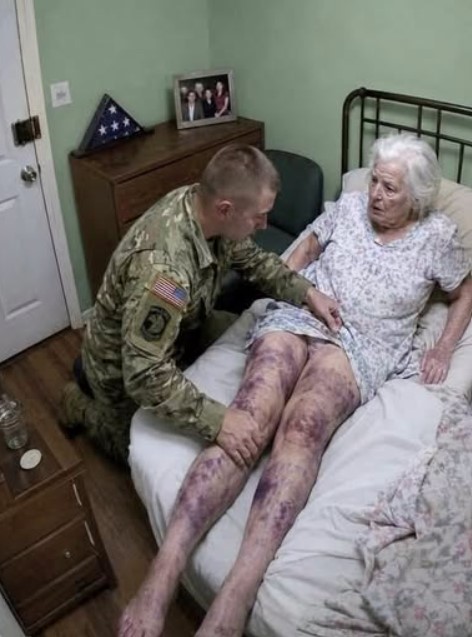
A military physician also examined the bruises around her wrists.
His conclusion was devastating.
The injuries were consistent with forceful restraint, not accidental falls.
But I still needed one thing.
Something that showed what Abigail had actually done.
Mom provided it.
That evening, she looked at me and said quietly, “Your father’s old desk.”
I frowned.
“The bottom drawer.”
I searched it after Abigail went upstairs.
At the very back, underneath old receipts and envelopes, I found a small camera disguised as a smoke detector.
My father had installed it years earlier after several burglaries in the neighborhood.
Abigail had disabled the newer security cameras.
She had forgotten about this one.
I removed the memory card.
My hands were already shaking before I even opened the first file.
The footage showed Mom being dragged through the hallway.
It showed Abigail taking her phone.
It showed her locking Mom inside the bedroom.
It showed Abigail practicing the story she told the neighbors.
Then I found something even worse.
Three nights earlier, Abigail had met a man in the driveway.
His name was Raymond.
He was a local property developer.
The recording captured their conversation.
Raymond talked about buying Mom’s house once she was declared incompetent.
He explained that the property could be acquired for far less than its actual value.
Then Abigail leaned toward him and kissed him.
They had been working together.
My mother’s illness was a lie.
Her imprisonment was part of the plan.
And the house was the prize.
At that moment, I stopped thinking like a betrayed husband.
I started thinking like an investigator.
I copied every piece of evidence into multiple files.
One went to Dr. Angela Ross, the psychiatrist Abigail had chosen.
Another went to Detective Cooper in the elder-abuse unit.
The third was scheduled to be delivered automatically to Abigail’s attorney when the psychiatric evaluation began.
I wanted there to be no way for Abigail to destroy everything at once.
She had no idea.
She continued believing that I was the obedient husband she could manipulate.
That evening, she drank more wine than usual.
We sat across from each other at the dinner table.
“Your mother always hated me,” Abigail said.
I said nothing.
“Now look at her. She’s completely helpless.”
“She might recover,” I replied.
Abigail laughed.
“Recover from dementia?”
I looked directly at her.
“I meant her wrists.”
Her smile disappeared.
For several seconds, neither of us spoke.
Then she leaned closer.
“Nobody is going to believe that old woman over me.”
The recorder beneath the table captured every word.
“I’ve already told everyone she’s confused,” Abigail continued. “I’ve told the neighbors she falls, screams, forgets things, and doesn’t know what she’s doing.”
She smiled.
“Tomorrow, the doctor will put it in writing.”
I lifted my glass.
“To tomorrow.”
She clinked hers against mine.
She had no idea what she had just given me.
Later, I went upstairs.
Mom was waiting beside the door.
I handed her a clean dress.
Then I gave her an old photograph of my father.
She looked at it for a long moment.
“Are you certain you can do this?” I asked.
Mom straightened.
“Your wife wanted me examined by a psychiatrist.”
She handed the photograph back to me.
“So let’s make sure the psychiatrist examines the right person.”
The next morning, Abigail dressed carefully.
She wore expensive pearls and the kind of polished expression people use when they want to appear trustworthy.
Mom sat quietly in the back seat as I drove.
Abigail spent the entire journey coaching her.
“Don’t argue with the doctor,” she warned.
Mom said nothing.
“Answer slowly.”
Still nothing.
“And if you become confused, don’t get angry.”
Mom looked out the window.
“I’ll remember that.”
Abigail smiled, satisfied.
She thought Mom was broken.
She thought I was fooled.
Neither was true.
At the clinic, Abigail walked straight to the receptionist and handed over her carefully prepared folder.
I waited until Dr. Ross appeared.
Then I approached her privately.
“I have another file,” I said.
She looked at me.
“What’s in it?”
“Everything you need to know before you evaluate my mother.”
I handed her the folder.
Inside were photographs of Mom’s injuries, the forged bank transfer, security access logs, the locksmith’s report, the physician’s notes, the camera footage, and the audio recording.
Dr. Ross read the first few pages.
Her expression changed.
Then she looked at the photographs.
She immediately instructed her nurse to secure the office.
The evaluation began.
Abigail sat beside Mom, prepared to answer questions for her.
But Dr. Ross stopped her.
“Your mother-in-law will answer for herself.”
Mom looked at the doctor.
Dr. Ross began with simple questions.
“What is today’s date?”
Mom answered immediately.
“What is your address?”
She gave it.
“What medications do you take?”
Mom listed them.
“What are your financial accounts?”
She described them accurately.
Then came memory tests.
Mom completed them without difficulty.
She remembered birthdays.
Names.
Dates.
Family relationships.
She even explained the security system in the house and described precisely how the older camera had been hidden.
Then she told Dr. Ross what had happened.
She described being confined to the bedroom.
She described losing access to her phone.
She described Abigail grabbing her wrists.
She described the threats and the repeated instructions to appear confused.
Abigail suddenly stood.
“She practiced this!”
Dr. Ross looked at her.
“What do you mean?”
“She knew you were coming. Samuel told her what to say.”
I stayed silent.
Dr. Ross turned back to Abigail.
“Why was an apparently competent adult being locked inside a bedroom?”
“For her safety.”
“Why could the door only be opened from the outside?”
Abigail’s eyes moved toward me.
“Samuel.”
I said nothing.
“Tell her.”
She was desperate now.
“Tell her the truth.”
I placed my phone on the doctor’s desk.
Then I pressed play.
Abigail’s own voice filled the room.
“No one is going to believe that old woman.”
Her face changed instantly.
The confidence disappeared.
Dr. Ross listened to the entire recording.
Then she listened to the portion where Abigail admitted that she had convinced the neighbors that Mom was confused.
Afterward, she looked at Abigail.
“You have been presenting a false narrative about this woman.”
Abigail shook her head.
“No.”
Dr. Ross didn’t raise her voice.
She didn’t need to.
“I have also received documentation showing financial activity involving your mother-in-law’s property.”
Abigail looked at me.
“You did this?”
I finally answered.
“No.”
I pointed toward Mom.
“She survived what you did. I simply made sure the truth couldn’t be erased.”
Within an hour, Detective Cooper arrived.
The evidence was handed over.
The recordings.
The photographs.
The forged documents.
The financial records.
The camera footage.
Everything.
Abigail was taken aside for questioning.
Raymond was located later that afternoon.
His connection to the property scheme was established through financial records and messages between him and Abigail.
The plan had been simple.
Convince everyone that Mom had dementia.
Get control of her finances.
Have her declared incompetent.
Sell the house.
Move the money.
And make it appear as though everything had been done for her protection.
They had almost succeeded.
But they had made one mistake.
They underestimated how much evidence a frightened person could leave behind.
Mom’s injuries were evidence.
The altered lock was evidence.
The bank transfer was evidence.
The forged signature was evidence.
The old camera was evidence.
And Abigail’s own voice was evidence.
The investigation continued for months.
Mom’s accounts were secured.
The fraudulent property documents were cancelled.
Raymond was charged in connection with the financial scheme.
Abigail faced charges related to elder abuse, unlawful confinement, fraud, and financial exploitation.
As for me, I filed for divorce.
There was no dramatic conversation.
No final argument.
No tears.
There was simply a stack of papers and a signature.
The marriage had ended long before I walked into that locked bedroom.
I just hadn’t known it yet.
Mom eventually moved into a safer home.
Not a facility.
Not somewhere Abigail had chosen.
A small, comfortable place near my sister’s family where Mom could have visitors whenever she wanted.
One afternoon, I found her sitting by the window with a cup of tea.
“You saved me,” she said.
I shook my head.
“You saved yourself.”
She smiled.
“No. You listened.”
That sentence stayed with me.
Because that was what Abigail had counted on.
She believed that if she repeated a lie often enough, people would stop listening to the person being harmed.
She believed a polished appearance could hide cruelty.
She believed medical paperwork could replace the truth.
And most of all, she believed I would trust her simply because she was my wife.
She was wrong.
A few weeks later, I returned to the house one final time.
The bedroom door was still there.
The same lock.
The same room.
I stood in the hallway remembering the night Mom had whispered, Not yet. She watches everything.
I thought about how difficult it had been to close that door again.
I had hated myself for participating in the charade.
But Mom had squeezed my hand.
She knew what I was doing.
She understood that sometimes you have to appear powerless while you gather the evidence that will finally make the truth impossible to ignore.
Before leaving, I removed the lock.
I carried it outside and dropped it into the trash.
Mom never needed that door locked again.
And neither did I.
My deployment had taught me to stay calm when everything around me looked dangerous.
My years as an investigator had taught me to follow evidence instead of assumptions.
But Mom taught me something neither experience could have taught me.
Sometimes protecting someone doesn’t mean fighting immediately.
Sometimes it means listening.
Sometimes it means pretending.
Sometimes it means waiting until the person hurting them becomes so confident that they finally reveal themselves.
Abigail thought she had arranged a psychiatric evaluation that would take my mother’s freedom away.
Instead, she gave us the opportunity to prove exactly what she had been doing.
And the woman she tried to silence became the person whose voice finally exposed everything.
Mom had never been confused.
She had never been helpless.
She had simply been trapped.
And once the door opened, the truth came out with her.