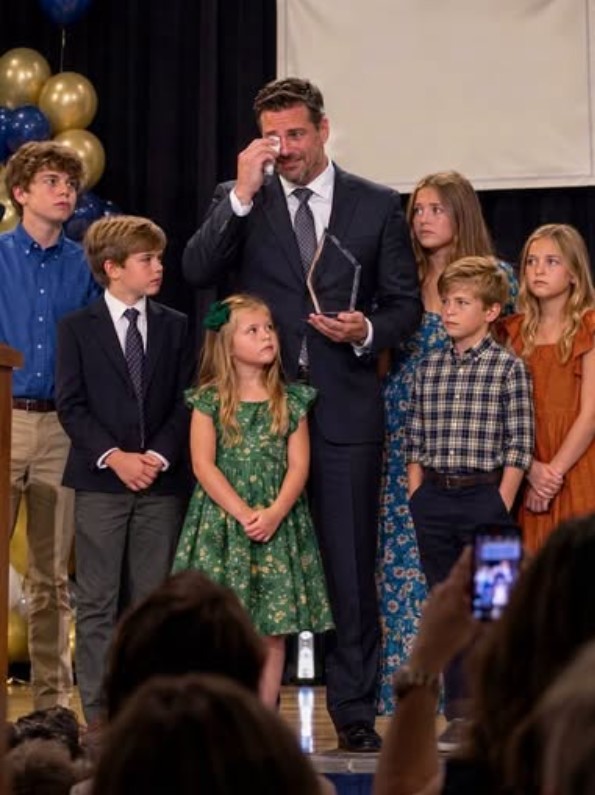
The auditorium remained completely silent.
Lily was still standing beside Richard, both hands wrapped around the microphone.
My husband had stopped smiling.
Only a few seconds earlier, he had been the proud father everyone admired. Now he looked like a man who had suddenly realized that the one person he had never thought to control was a seven-year-old child who didn’t understand the meaning of a carefully constructed public image.
Richard bent toward her.
“What bike, sweetheart?”
Lily looked confused.
“The pink one.”
A few people exchanged glances.
Richard forced a laugh.
“Oh, honey. That was just something we talked about at home.”
Lily shook her head.
“No. You said I could have it if I told Mrs. Carter that you always help us.”
The silence became heavier.
I felt my heart pounding.
Richard slowly stood.
“Lily, you must have misunderstood me.”
Then our ten-year-old son, Sam, spoke from behind Grace.
“You said I’d get the game too.”
Richard turned toward him.
“Sam.”
His voice wasn’t loud.
It didn’t need to be.
The warning was obvious.
Sam immediately looked down.
But our oldest daughter, Claire, didn’t.
She stared directly at her father.
Then she looked at me.
And in that instant, I understood.
There was much more to this than a promised bicycle.
I stood from my seat.
“Kids,” I said quietly, “come with me.”
Richard took one step toward us.
“Megan, don’t make a scene.”
I looked at him.
“You already made the scene.”
Then I walked out of the auditorium with all six children behind me.
We entered an empty classroom down the hallway.
I closed the door.
For several seconds, nobody spoke.
I could hear the muffled voices from the auditorium outside.
Then I turned around.
“Okay,” I said softly. “Nobody is in trouble.”
Lily immediately looked at me.
“I’m sorry, Mommy.”
My heart broke.
I crouched down in front of her.
“You don’t have anything to apologize for.”
“But Daddy told me—”
“I know.”
I looked at all six children.
“I just need you to tell me the truth. What has your father been saying to you?”
The children looked at one another.
Claire finally spoke.
“Dad knew he was being considered for the award.”
My stomach tightened.
“When did he find out?”
“Several weeks ago.”
Claire swallowed.
“He started asking us questions.”
“What kind of questions?”
She hesitated.
“Things like what Dad does for us. Things he buys. Places he takes us.”
Sam nodded.
“He kept reminding us about the lake trip.”
Grace added, “And the concert.”
Lily raised her hand as if she were in class.
“He said I could get the pink bicycle.”
I closed my eyes for a second.
“Why?”
Lily answered honestly.
“Because I was supposed to tell Mrs. Carter that Daddy always helps us.”
Claire’s face became red.
“He did it to all of us.”
I stared at her.
“What do you mean?”
“He didn’t tell us exactly what to say,” she explained. “But he kept saying things like, ‘Remember who paid for that,’ or ‘Don’t forget who takes care of you.’”
Sam nodded.
“He said people might ask what kind of father he was.”
Grace looked down.
“He told me the school should know how much he sacrifices.”
I sat down in the nearest chair.
For years, I had watched Richard use money to create the appearance of involvement.
Now I realized he had started using the children themselves to build that image.
And the worst part was that they had been carrying the burden of his secret.
Claire’s voice became quieter.
“I didn’t tell you because I thought you’d be embarrassed.”
I looked at her.
“Embarrassed?”
She nodded.
“I thought people would think our family was weird.”
I reached for her hand.
“Listen to me carefully.”
All six children looked at me.
“None of you did anything wrong.”
Lily wiped her eyes.
“But Daddy said—”
“Your father is the adult. You are the children. It was never your job to make him look good.”
Claire finally started crying.
I pulled her into my arms.
And for the first time in years, I felt something inside me change.
I had spent so long protecting my children’s relationship with their father that I had forgotten to protect them from the pressure he was putting on them.
The next morning, I contacted the school.
Mrs. Carter agreed to meet with me.
Claire asked if she could come.
I said yes.
We sat in the principal’s office, and Claire told the story herself.
Mrs. Carter listened without interrupting.
When Claire finished, the principal looked deeply uncomfortable.
“I need to be honest with you,” she said.
I waited.
“During the nomination process, we spoke with several students about their parents.”
I nodded.
“We also received a written statement from Richard describing his involvement with the children’s education, school activities, fundraisers, and family responsibilities.”
I looked at Claire.
She looked angry.
Mrs. Carter continued.
“Some of the things he described were difficult for us to verify.”
“Because he wasn’t actually there?” I asked.
She lowered her eyes.
“He attended some major events. He was visible. People know him. He’s respected in the community.”
“That doesn’t answer my question.”
“No,” she admitted.
“It doesn’t.”
She promised the school would review the nomination.
I didn’t ask them to give the award to me.
I didn’t want his award.
I wanted the truth.
Two days later, Mrs. Carter called.
The school had compared Richard’s statements with attendance records, volunteer records, school communications, and information from teachers.
Several of the things Richard had presented as regular involvement could not be verified.
Then Mrs. Carter said the sentence I knew Richard would hate.
“We are withdrawing the award.”
I sat quietly.
“Are you sure?”
“Yes.”
“What about the people who nominated him?”
“We’ve spoken with them.”
She paused.
“The school also needs to review how the award was selected.”
That evening, Richard came home furious.
He didn’t even take off his jacket.
“You ruined my reputation.”
I was sitting at the kitchen table.
“No,” I said.
“You did that yourself.”
His face hardened.
“You have no idea what that award meant to me.”
“I think I do.”
He stared at me.
“It meant people finally believed the story you’ve been telling about yourself.”
He looked away.
For several seconds, neither of us spoke.
Then something unexpected happened.
Richard sat down.
His shoulders dropped.
“My father barely noticed me when I was growing up.”
I didn’t respond.
“I promised myself I’d be different.”
He rubbed his hands together.
“I wanted the kids to think I was a good father.”
“You wanted everyone to think you were a good father.”
He looked at me.
I continued.
“Those aren’t the same thing.”
Richard lowered his head.
“I know.”
“No,” I said. “I don’t think you do.”
I stood.
“You bought them things. You showed up when there were cameras. You smiled at school events. But you missed ordinary life.”
He didn’t argue.
“You don’t know what Lily’s favorite book is.”
Silence.
“You didn’t know Sam changed instruments.”
His expression changed.
“You don’t know which child hates tomatoes, which one is afraid of thunderstorms, which one still needs a night-light, or which one has been struggling with multiplication.”
Richard looked toward the hallway.
For once, there was no audience.
No applause.
No one taking pictures.
Just a father being confronted with the difference between providing money and providing presence.
Finally he asked:
“What do I do?”
I answered honestly.
“Start showing up.”
He nodded.
“But understand something.”
He looked at me.
“You don’t get me back simply because you start doing the things you should have been doing all along.”
He remained silent.
“Our marriage may not survive this.”
He swallowed.
“I understand.”
I wasn’t sure he did.
So I stopped explaining.
Instead, I watched.
Over the next several weeks, Richard began taking responsibility for parts of the children’s lives.
Tuesday and Thursday school runs became his responsibility.
He took Sam to music practice.
He helped Lily with reading.
He cooked dinner twice a week.
He started attending appointments.
At first, everything was awkward.
Very awkward.
During his first grocery trip, he bought three jars of pasta sauce but forgot the pasta.
He bought cereal nobody liked.
He bought yogurt containing an ingredient one of the children was allergic to.
He came home frustrated.
I didn’t laugh.
I simply explained what he had forgotten.
Another afternoon, he picked Sam up for piano practice.
Except Sam hadn’t played piano for months.
He had switched to trumpet.
Richard stood in the doorway when they returned.
“I didn’t know.”
I looked at him.
“You were never asking.”
That sentence stayed with him.
Slowly, things changed.
Not dramatically.
Not overnight.
There were still mistakes.
There were still arguments.
But something was different.
Richard was finally learning things about his children that could not be photographed.
One evening, I walked past Lily’s room and heard her reading.
She stumbled over a word.
Richard immediately said, “Focus.”
Lily became quiet.
I stopped in the hallway.
Then Richard took a breath.
“I’m sorry.”
There was a pause.
“Let’s try it again.”
Lily started reading.
Richard stayed beside her.
Nobody knew he was doing it.
There was no camera.
No award.
No principal.
No audience.
And somehow, that mattered more than anything else.
Around that same time, I began rebuilding my own life.
I had spent years believing that leaving my career had been the price of being a good mother.
But I was still the same woman who had built that career before I became a full-time mother.
So I started again.
Slowly.
I updated my résumé.
I researched certification requirements.
I began taking classes at night after the children went to bed.
The first time I received confirmation that I had completed a required certification, I stared at my name on the screen for several minutes.
I smiled.
Not because Richard had changed.
Not because the school had withdrawn his award.
Because I had finally remembered that I was more than the person standing behind everyone else.
I was still me.
Months passed.
The Parent of the Year award became something people rarely mentioned.
Richard never displayed the plaque.
I never asked where it went.
What mattered was what happened on ordinary days.
One Tuesday evening, Richard came through the front door carrying groceries.
Lily ran behind him.
“Mommy!”
She was practically bouncing.
“Daddy knows!”
I smiled.
“Knows what?”
She pointed at Richard.
“Ask him.”
Richard laughed.
“Go ahead.”
I looked at him.
“What is Lily’s favorite color?”
“Pink.”
She smiled.
“What is my best friend’s name?”
“Evie.”
“What’s the book we’re reading?”
He answered.
Lily nodded seriously.
Then she hugged him.
I stood in the kitchen watching them.
There was no stage.
No microphone.
No applause.
No reporter.
No award.
Just a father who was finally learning the details of his children’s lives.
And that was when I understood something.
The truth had never been about who deserved an award.
It had never been about who looked like the better parent.
The truth was much simpler.
Children don’t measure love by trophies.
They measure it by who remembers.
Who listens.
Who shows up when they’re sick.
Who knows their fears.
Who notices when something is wrong.
Who sits beside them when nobody is watching.
Richard had spent years trying to convince an entire town that he was a great father.
But six children had always known the truth.
And Lily had been brave enough to say it.
That night, after the children went to bed, I stood alone in the kitchen.
Richard walked in.
For a moment, neither of us spoke.
Then he said quietly:
“I finally understand why you were always so tired.”
I looked at him.
He continued.
“I thought I was providing for everyone. I never realized how much of parenting happens in the parts nobody sees.”
I didn’t tell him everything was forgiven.
It wasn’t.
I didn’t tell him our marriage was saved.
I didn’t know yet.
Instead, I said:
“Then don’t tell me.”
He looked confused.
“Show me.”
He nodded.
And for the first time in years, I believed he understood what I meant.
Not because he promised.
Not because he apologized.
Not because anyone was watching.
But because the next morning, before I even woke up, I heard six lunchboxes being packed in the kitchen.
And when I walked downstairs, Richard was standing there reading the labels on each one carefully.
He looked up.
“I almost put tomatoes in Lily’s.”
I smiled faintly.
“You remembered.”
He nodded.
“I’m learning.”
Maybe that was all any of us could do.
Learn.
Repair what could be repaired.
Accept what could not.
And most importantly, stop confusing being admired with being loved.
Because when the lights go out, the audience goes home, and the microphone is finally turned off, the only people who truly know who you are are the people who live with you.
And my six children had known the truth all along.