
Sophie placed the old phone on the kitchen table between us.
Neither of us touched it for several seconds.
The screen was cracked, and the battery had barely enough power to stay on. But somehow, after six years of silence, Daniel’s old phone had found its way back into our lives.
“I started the video,” Sophie whispered. “But I stopped when I saw Dad.”
My hands were trembling.
“Play it.”
She pressed the screen.
A timestamp appeared.
11:47 p.m.
It was the night before Daniel took our three boys fishing.
Then my husband’s face appeared.
He was sitting inside his truck.
The interior light was on, and behind him I could see the dark outline of our garage.
Daniel looked exhausted.
Not frightened.
Not confused.
Just tired in a way I had never seen before.
He stared at the camera for several seconds before speaking.
“Alison, if you’re watching this, something has gone wrong.”
I stopped breathing.
Sophie grabbed my hand.
Daniel continued.
“I don’t know whether you’ll ever see this. Maybe I’m being paranoid. I hope I am.”
He rubbed his face.
“But if something happens tomorrow, I need you to know that I didn’t keep quiet because I didn’t trust you.”
My eyes filled with tears.
“It’s because I don’t know who I can trust anymore.”
The video became silent for a moment.
Then Daniel looked directly into the camera.
“It’s Dean.”
I stared at the screen.
Dean was Daniel’s younger brother.
My brother-in-law.
The man who had spent six years sitting beside me at memorial gatherings.
The man who had brought food to our house after the disappearance.
The man who had repeatedly told me that I needed to accept that my husband and sons were gone.
Dean.
Daniel continued.
“I found out about the insurance policy.”
My stomach tightened.
“Dean has been asking questions about it. Too many questions. He knows how much I’m worth. He knows what the boys would inherit if something happened to me.”
Daniel leaned closer to the camera.
“I don’t have proof yet. That’s why I haven’t told Alison.”
I covered my mouth.
For six years, I had believed the lake had taken my family.
But my husband had been afraid of someone before he ever left for that fishing trip.
Someone close to us.
Someone I had trusted.
The recording continued.
“If I’m wrong, I’ll delete this tomorrow and pretend I was being ridiculous.”
Daniel gave a tired smile.
“But if I’m not wrong, I need someone to know where to look.”
The video ended.
Sophie and I sat in silence.
Then she whispered,
“Mom…”
I couldn’t answer.
I was thinking about every conversation I’d ever had with Dean after Daniel disappeared.
Every hug.
Every comforting word.
Every time he had told me, “You have to move forward.”
My entire body felt cold.
Sophie opened another file.
“There’s more.”
She showed me photographs of documents stored on the phone.
An insurance policy.
Bank information.
Messages.
And then one document made my heart stop.
A life insurance application connected to Daniel.
The beneficiary information was wrong.
Dean’s name appeared where it should never have been.
“That can’t be real,” I whispered.
Sophie zoomed in.
“Look at the signature.”
It looked like Daniel’s.
But something about it felt wrong.
Daniel’s handwriting had always been slightly uneven.
This signature was too careful.
Too deliberate.
We called the police.
This time, they didn’t dismiss the evidence as another grieving family’s attempt to find meaning in an old mystery.
A detective named Chen came to the house.
She watched the video twice.
Then she examined the documents.
“Where did you find this phone?”
Sophie explained everything.
Detective Chen looked at me.
“Did Daniel ever tell you that he was afraid of his brother?”
“No.”
“Did Dean have access to your financial information?”
I thought about it.
“Yes.”
My voice became smaller.
“He helped us with paperwork after Daniel disappeared.”
Detective Chen exchanged a look with her partner.
“Then we’re going to need to ask some questions.”
The phone was taken for forensic examination.
For the first time in six years, our family’s case was no longer being treated as a closed tragedy.
It was being treated as a possible crime.
A few days later, Detective Chen returned.
The video was authentic.
The timestamp matched the phone’s internal records.
There was no evidence that it had been edited.
Daniel had really recorded it the night before the fishing trip.
And there was more.
The investigators had recovered deleted messages.
One conversation was between Daniel and Dean.
Daniel had confronted him about the insurance policy.
Dean denied knowing anything about it.
Then, hours later, another message appeared.
It was short.
You don’t understand what you’re risking.
My hands went numb.
Detective Chen continued.
“There are financial records we’re examining as well.”
“What kind of records?”
“Loans. Transfers. Insurance paperwork.”
She hesitated.
“We’re also looking into whether the boat accident could have been caused deliberately.”
I stared at her.
“The boat?”
“Yes.”
She explained that investigators had originally focused on the storm and the damaged boat.
But the old phone gave them a reason to examine everything again.
The boat had suffered damage that hadn’t completely matched the original theory.
There were also questions about the fuel system and the boat’s emergency equipment.
The possibility that someone had interfered with the vessel could no longer be ignored.
For six years, I had blamed the lake.
Now I wondered whether the lake had simply been where someone had hidden what they had done.
Then the police found something else.
A phone call.
Dean had contacted someone shortly before the fishing trip.
The conversation was recorded because the other person had been involved in an unrelated investigation.
Dean had spoken about Daniel.
He had said Daniel was becoming suspicious.
He had complained that his brother was asking too many questions.
And then he had said something that made the detective pause the recording.
“He’s taking the boys tomorrow.”
That sentence alone wasn’t proof.
But combined with everything else, it became another piece of the puzzle.
The police searched Dean’s property.
They found financial records.
Copies of insurance documents.
And an old jacket containing a receipt from a marine supply store.
The same store Daniel’s phone had recorded him visiting.
But Daniel hadn’t bought the equipment for himself.
He had purchased additional emergency gear.
Three orange whistles.
And another flotation vest.
At first, I didn’t understand why.
Then Detective Chen explained.
“Your husband may have suspected something was going to happen.”
The extra equipment might have been his attempt to prepare for an emergency.
That was Daniel.
Even when he was afraid, he was still thinking about the boys.
Always the boys.
The investigation continued for weeks.
Then came the news that changed everything.
The police believed Dean had tampered with the boat.
The theory was devastating.
He had allegedly wanted Daniel dead because of the insurance money and financial problems.
But when Daniel changed his plans and took all three boys with him, Dean’s actions put the children in danger too.
I couldn’t understand how anyone could do that.
Especially someone who had watched those boys grow up.
Someone who had held them as babies.
Someone who had sat at our table.
Someone who had cried beside me when they disappeared.
Dean was arrested.
When I saw him in the courthouse hallway, he looked smaller than I remembered.
For six years, I had imagined the person responsible as a stranger.
Someone evil enough to destroy a family.
Instead, it was the man who had hugged me while I was falling apart.
He looked at me.
I expected an apology.
There wasn’t one.
Instead, he said,
“I didn’t think it would happen that way.”
Those words nearly broke me.
“What did you think would happen?”
He looked away.
“I thought Daniel would understand.”
“Understand what?”
He didn’t answer.
I stepped closer.
“You took my husband.”
His eyes filled.
“And my sons.”
“I never meant for the boys—”
“Don’t.”
My voice shook.
“Don’t say you never meant for them.”
Because intention didn’t change what happened.
My boys were still gone.
Daniel was still gone.
Our family still had three empty bedrooms.
A photograph on the wall still showed four people who would never walk through our front door again.
The investigation eventually revealed that Dean had been struggling financially.
He had taken out loans.
He had debts.
He had become obsessed with Daniel’s life insurance.
He believed that if Daniel died, the money would solve his problems.
When Daniel discovered what Dean was doing, he became suspicious.
That’s why he recorded the video.
That’s why he hid the phone.
And that’s why he had begun quietly documenting everything.
Daniel had known something was wrong.
He just hadn’t known how far his brother was willing to go.
The trial came months later.
I sat through every day of it.
I heard evidence I wish I could forget.
Financial records.
Phone calls.
Forensic reports.
Details about the boat.
Details about the insurance policy.
The prosecutor explained how the evidence connected Dean to the sabotage.
There was no single piece that brought my family back.
There was only one piece after another.
Together, they finally told the story Daniel had been trying to warn me about.
When the verdict was read, I didn’t feel victorious.
How could I?
No courtroom decision could return my husband.
No prison sentence could give me back three sons.
Justice was not the same thing as restoration.
After the trial, I went home and opened the boys’ bedroom doors.
For six years, I had been afraid to change anything.
Their clothes were still there.
Their old books were still stacked on the shelves.
Fishing magazines were piled beside the bed.
One son’s baseball glove sat exactly where he had left it.
I had always believed that changing the rooms meant admitting they were never coming back.
But that day, I understood something.
Keeping everything untouched wasn’t keeping them alive.
It was keeping me trapped in the moment they disappeared.
So I called Sophie.
Then my other daughters came home.
We opened the windows.
We packed boxes.
We kept the things that mattered.
We donated things that could help other children.
We laughed when we found an old photograph.
We cried when we found a shirt that still smelled faintly like the laundry soap I used years ago.
We stopped when it became too painful.
Then we continued.
Not because we were forgetting.
Because we weren’t.
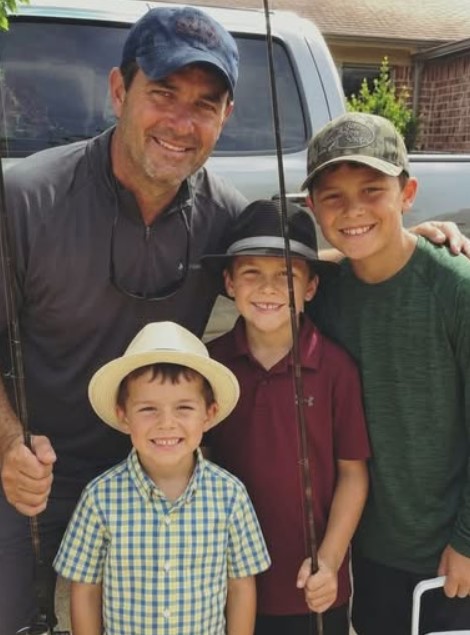
Six years earlier, I had taken a photograph of Daniel and our three boys before they left for the lake.
I had kept that picture on my phone for years.
Now I printed it.
I placed it in a frame.
Beside it, I placed Daniel’s old phone.
Not because the phone represented the tragedy.
Because it represented the truth.
For six years, I believed the lake had taken my family.
I was wrong.
The lake had only been where the evidence disappeared.
The real danger had been much closer.
It had been someone sitting at our table.
Someone we trusted.
Someone who knew exactly what my family meant to me.
And yet, even after everything that happened, I refused to let Dean’s actions become the final definition of my husband or my sons.
They weren’t just victims.
They were people.
Daniel was the man who checked the boat straps four times.
The father who insisted his boys wear life jackets.
The husband who worried about his family even when he was frightened himself.
My sons were loud.
Messy.
Funny.
Stubborn.
They fought over the television remote and argued about who got the last pancake.
They were so much more than the way they died.
I wanted to remember them that way.
Not as four names on a case file.
Not as four empty chairs.
Not as four photographs behind glass.
As my husband.
My sons.
My family.
Six years after they disappeared, I finally had an answer.
It wasn’t the answer I wanted.
But it was the truth.
And sometimes the truth doesn’t heal the wound.
Sometimes it simply stops you from wondering whether you imagined the pain.
I still visit the lake.
I still think about that last photograph.
But now, when I look at it, I don’t only see the last time I saw them.
I see the life they had before that moment.
The laughter.
The teasing.
The love.
The ordinary morning I didn’t know was precious.
And I have learned not to take ordinary moments for granted.
Because sometimes the moments that seem completely unimportant become the memories we spend the rest of our lives protecting.
Daniel’s old phone gave us the truth.
But my children gave me something more important.
A reason to keep living after it.
And six years later, I finally understood that moving forward did not mean leaving them behind.
It meant carrying them with me.