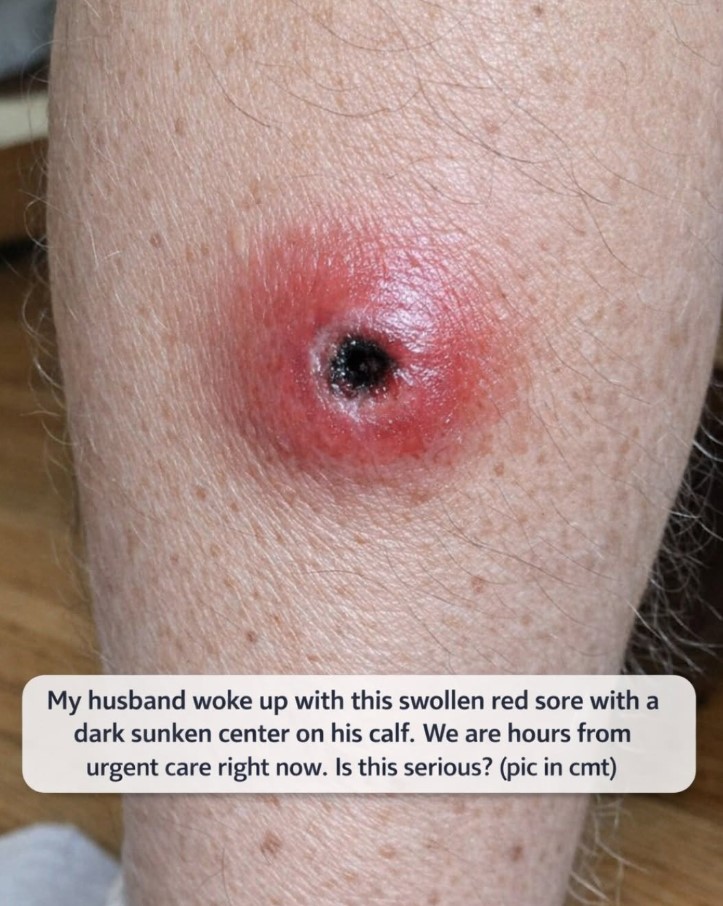
Waking up to discover a new, swollen, red sore with a dark or sunken center on the calf can be frightening, especially when there is no obvious explanation for how it appeared. A lesion like this can understandably make someone wonder whether they were bitten by a spider during the night or whether something more serious is happening beneath the skin.
One possibility that often receives attention is a brown recluse spider bite, because some bites can eventually develop a pale or bluish center surrounded by redness and swelling, with tissue damage producing a darker, depressed area. However, it is extremely important not to assume that every mysterious skin lesion is a spider bite. Other conditions—including bacterial skin infections and abscesses—can look remarkably similar. A definitive diagnosis of a spider bite generally requires either a characteristic clinical presentation or identification of the spider itself.
A rapidly changing, painful, swollen, or darkening wound deserves medical attention rather than an experiment with home remedies. Some serious skin infections can progress quickly, while certain venomous bites can cause tissue damage or, less commonly, symptoms affecting the whole body.
The safest approach is to understand the possible causes, recognize warning signs, and know when professional medical evaluation is necessary.
What Could Cause a Red, Swollen Sore With a Dark Center?
A lesion with this appearance can have several possible explanations.
One possibility is an arthropod bite, including a bite from a spider. Another is a bacterial infection that began as a small bump and progressed into an abscess or area of cellulitis. Other inflammatory skin conditions, trauma, or circulation-related problems can also create unusual discoloration.
Because these conditions can overlap in appearance, looking at a photograph—or even examining the wound in person—may not always be enough to determine its cause without a proper medical assessment.
That’s particularly important when the lesion is getting larger, becoming more painful, developing blisters, producing drainage, or changing color.
Could It Be a Brown Recluse Spider Bite?
Brown recluse spiders belong to the Loxosceles genus. Their bites can cause a range of reactions, from relatively mild localized skin problems to more significant tissue injury.
According to medical references, a more severe reaction can begin with redness and increasing pain. Over the following days, the area may develop a pale central region surrounded by redness, followed by blistering and blue or violet discoloration. In some cases, the center can become dark, hard, and sunken as tissue becomes damaged.
However, there is an important warning here:
A dark center does not prove that a spider caused the wound.
Many skin infections and other medical conditions can resemble presumed spider bites. In fact, people frequently describe unexplained skin lesions as “spider bites” even when no spider was seen.
That is why a healthcare professional should evaluate a suspicious lesion rather than relying solely on its appearance.
Why the Dark, Sunken Center Matters
A darkened or depressed center can indicate that the tissue in the middle of the lesion is being damaged.
With some severe brown recluse reactions, venom can contribute to tissue death, known medically as necrosis. The affected area may eventually form an ulcer or dark scab and can take weeks to heal.
But necrosis is not exclusive to spider bites.
Severe infections can also damage tissue. That’s why a wound that is becoming darker, deeper, larger, or increasingly painful should not simply be watched at home without medical advice.
The “Red, White, and Blue” Appearance
A concerning pattern sometimes associated with brown recluse bites is described as a red, white, and blue appearance.
The center can become pale because of reduced blood flow, while the surrounding tissue becomes red and inflamed. Later, blue or violet discoloration may develop as tissue injury progresses.
This pattern can be useful to clinicians, but it is not enough by itself to establish the diagnosis.
A person should not look at a circular red mark and conclude that they have been bitten by a brown recluse.
Not Every Spider Bite Causes Tissue Damage
It’s also important not to assume that a spider bite automatically leads to a severe wound.
Many spider bites do not produce serious complications. Brown recluse bites, in particular, can vary significantly in severity. Some remain localized and heal without major intervention, while a smaller proportion develop more substantial tissue damage or systemic illness.
This is one reason medical evaluation is useful: it helps distinguish a mild localized reaction from a lesion that requires closer monitoring or treatment.
It Could Be a Bacterial Skin Infection
One of the most important alternatives to consider is a bacterial skin infection.
An infection can begin as a small red bump and gradually become swollen, warm, painful, and increasingly inflamed. An abscess may develop underneath the skin, sometimes creating a central area that looks darker or damaged.
Certain bacterial infections can closely resemble what people commonly call a “spider bite.” This is why assuming an unexplained lesion is venom-related can sometimes delay appropriate treatment.
Warning signs of infection can include:
- Increasing redness
- Spreading swelling
- Warmth around the wound
- Increasing pain
- Pus or cloudy drainage
- Red streaks extending away from the lesion
- Fever or chills
- Swollen lymph nodes
- Feeling generally unwell
If these symptoms appear, medical assessment should not be delayed.
What If the Redness Is Spreading?
Rapidly expanding redness is an important warning sign.
A small area of irritation that remains stable is different from a lesion whose red border continues to expand over hours or days.
If the redness spreads outward, the swelling increases significantly, or the area becomes increasingly hot and painful, a healthcare professional should evaluate it promptly.
These changes can indicate infection or progressive tissue inflammation.
What About an Abscess?
An abscess is a collection of pus beneath the skin that can appear as a painful, swollen lump.
The area may feel warm and tender, and the center can sometimes develop a softer or discolored appearance. As the abscess progresses, it may eventually drain.
An abscess should not automatically be squeezed or punctured at home. Depending on its size and location, medical treatment may be necessary, and some abscesses require professional drainage.
Trying to cut into the lesion yourself can introduce additional bacteria and potentially worsen the infection.
What Should You Do Immediately?
If someone wakes up with an unexplained swollen, red, painful, or darkening lesion, the first priority should be protecting the area and arranging appropriate medical evaluation.
Several simple measures can be useful while waiting for medical advice.
Keep the Area Clean
Gently wash the affected skin with soap and water.
Avoid aggressive scrubbing, especially if the skin is blistered or open.
Don’t Pick at the Wound
Avoid scratching, peeling, squeezing, or removing tissue from the lesion.
Manipulating the area can introduce bacteria and cause additional injury.
Don’t Cut or Drain It Yourself
If there is a dark center, blister, or apparent pocket beneath the skin, resist the temptation to open it.
Professional evaluation is preferable to attempting a procedure at home.
Keep the Area Protected
If the skin is open, a clean dressing can help protect it from friction and contamination while you seek medical advice.
Photograph the Lesion
Taking a clear photograph can be useful for documenting how the wound changes over time.
If the border of redness expands, the center becomes darker, or the lesion changes significantly, having earlier photographs can help a clinician understand its progression.
What About Ice?
For a suspected brown recluse bite, cooling the affected area can help with swelling and pain, and medical references describe using an ice pack as part of initial care.
If using cold, don’t place ice directly against bare skin. Wrap a cold pack in a cloth and use it briefly.
However, cooling should not be viewed as a substitute for medical assessment when the lesion is worsening or has signs of tissue damage.
Should You Put Antibiotic Cream on It?
Treatment depends on what is actually causing the lesion.
Antibiotics are not automatically required for a venomous bite, and using medication without knowing the cause may not solve the underlying problem.
If a healthcare professional determines that a bacterial infection is present, antibiotics may be appropriate. For brown recluse bites, treatment is generally focused on wound care, symptom control, and monitoring for complications; antibiotics are used when there is an associated bacterial infection rather than simply because a spider bite occurred.
This is another reason to avoid guessing at the diagnosis.
Don’t Try Dangerous Home Remedies
An unexplained wound with a dark center can tempt people to search for dramatic home treatments.
Avoid cutting the skin, burning the area, applying harsh chemicals, attempting to suck out venom, or using irritating substances.
These methods can cause additional tissue damage and make the wound harder to evaluate and treat.
Medical references specifically caution against relying on unproven treatments such as dapsone for presumed brown recluse bites because evidence is limited and the medication can cause serious complications in some people.
When Should You Seek Urgent Medical Care?
A suspicious lesion should receive prompt medical attention if it is:
- Rapidly enlarging
- Becoming increasingly painful
- Developing a dark or black center
- Forming a deep ulcer
- Producing pus or significant drainage
- Surrounded by rapidly spreading redness
- Associated with significant swelling
- Accompanied by fever or chills
- Associated with weakness, nausea, vomiting, or severe body aches
A dark, sunken center is particularly worth taking seriously because it can indicate tissue damage, although it does not identify the cause by itself.
When Is It an Emergency?
Some symptoms require emergency medical attention rather than waiting for a routine appointment.
Seek emergency help if the person develops:
- Difficulty breathing
- Swelling of the face, lips, tongue, or throat
- Fainting or severe dizziness
- Confusion
- Severe weakness
- Rapidly worsening illness
- Severe generalized muscle pain or cramping
- Signs of a serious systemic reaction
These symptoms can indicate a severe allergic reaction, significant envenomation, or another serious medical condition.
What Happens at the Doctor’s Office?
A clinician will usually begin by examining the lesion carefully and asking questions about when it appeared, how quickly it changed, whether it is painful or itchy, and whether there was any possible exposure to insects or spiders.
They may also ask whether the person has experienced fever, chills, nausea, vomiting, body aches, or other symptoms.
If the wound looks infected or the patient has systemic symptoms, additional testing may be appropriate.
For a suspected brown recluse bite, diagnosis is primarily clinical. A definite spider identification is helpful, but most people never see the spider responsible for a bite.
Why Identifying the Spider Can Be Difficult
Brown recluse spiders are reclusive by nature, and bites often occur when a person unknowingly disturbs a spider.
A person may be asleep, wearing clothing that conceals the skin, or unaware of the bite entirely.
Consequently, most suspected bites don’t come with a captured spider.
If a spider is safely available for identification, it may be useful to have it examined by an appropriate professional. But nobody should risk another bite trying to catch a spider.
How the Lesion May Change Over Time
One of the reasons these wounds can be difficult to interpret is that their appearance may change over several days.
A severe brown recluse reaction can begin relatively quietly and then become more painful. A pale area may appear, followed by blistering and blue or violet discoloration. In some cases, tissue can eventually die and form a dark, sunken ulcer.
This progression is another reason to monitor a suspicious wound rather than assuming that its first appearance tells the whole story.
How Long Can Healing Take?
Healing time depends heavily on the severity of the injury.
Mild localized reactions can improve relatively quickly, while wounds involving tissue necrosis can take considerably longer.
Medical literature notes that some necrotic brown recluse lesions can take weeks to heal, and more extensive ulcers may require prolonged wound care.
If tissue has died, healing may need to occur gradually as healthy tissue develops.
Can a Brown Recluse Bite Cause Whole-Body Symptoms?
Yes, although serious systemic reactions are uncommon.
Possible systemic symptoms described in medical references include fever, weakness, nausea, headache, muscle aches, and, in severe cases, blood-related or organ complications.
Children and certain vulnerable individuals may be at greater risk of severe reactions.
Any unexplained systemic symptoms occurring alongside a rapidly worsening skin lesion deserve prompt medical evaluation.
What About Tetanus?
A wound or bite can be an opportunity to review whether a person’s tetanus vaccination is up to date.
Healthcare professionals may recommend a tetanus booster depending on the type of wound and the person’s vaccination history.
This is another reason a medical visit can be useful even when the lesion initially appears limited to the skin.
Prevention: Reducing the Chance of Bites
If you live or spend time in an area where medically significant spiders occur, several practical precautions can reduce exposure.
Shake out clothing and shoes that have been left undisturbed, particularly in storage areas.
Be cautious when reaching into dark boxes, closets, sheds, garages, or other places where spiders may hide.
Keep storage areas organized and reduce clutter where possible.
If you suspect a significant spider infestation, professional pest-control advice may be appropriate.
Don’t Let the Appearance Create False Confidence
One of the biggest lessons from mysterious skin lesions is that appearance alone can be misleading.
A red circle doesn’t automatically mean spider bite.
A blister doesn’t automatically mean spider bite.
A dark center doesn’t automatically mean spider bite.
And even a lesion that looks like a classic spider bite may ultimately have another explanation.
Medical evaluation becomes especially important when the lesion is painful, spreading, ulcerating, or associated with systemic symptoms.
A Practical Checklist
If you suddenly discover a suspicious lesion on the calf, ask yourself:
- When did it first appear?
- Is it getting larger?
- Is the redness spreading?
- Is the area becoming hotter or more painful?
- Is there a blister?
- Is the center becoming dark or sunken?
- Is there pus or drainage?
- Does the person have fever or chills?
- Are there red streaks traveling away from the lesion?
- Is the person experiencing weakness, nausea, vomiting, severe muscle pain, or breathing problems?
The more warning signs that are present, the more important it is to seek medical care promptly.
Final Thoughts
Discovering a swollen red sore with a dark, sunken center on the calf can understandably be alarming. A severe brown recluse reaction is one possible explanation because these bites can, in some cases, progress from redness and pain to blistering, discoloration, and tissue necrosis.
But the most important takeaway is that you should not diagnose a mysterious wound as a spider bite based only on appearance. Bacterial infections, abscesses, and other skin conditions can look remarkably similar, and delaying appropriate treatment can sometimes allow a serious infection to progress.
If the wound is rapidly changing, increasingly painful, spreading, developing a dark or dead-looking center, or accompanied by fever or other whole-body symptoms, professional medical evaluation is the safest course.
Until the cause is known, keep the area clean, avoid squeezing or cutting it, don’t attempt to remove tissue yourself, and avoid unproven or potentially harmful home remedies. If a spider is actually found, don’t put yourself at risk trying to capture it.
Most importantly, a strange-looking wound is not something to dismiss simply because the person feels well at first. Some reactions evolve over time, and early medical assessment can help determine whether the problem is a minor bite, an infection, or something requiring more specialized treatment.